Personal Finance for Beginners: India + US Guide 2026

By Tapabrata Biswas · Published July 29, 2026 · 25 min read
Written and fact-checked by Tapabrata Biswas. How I write
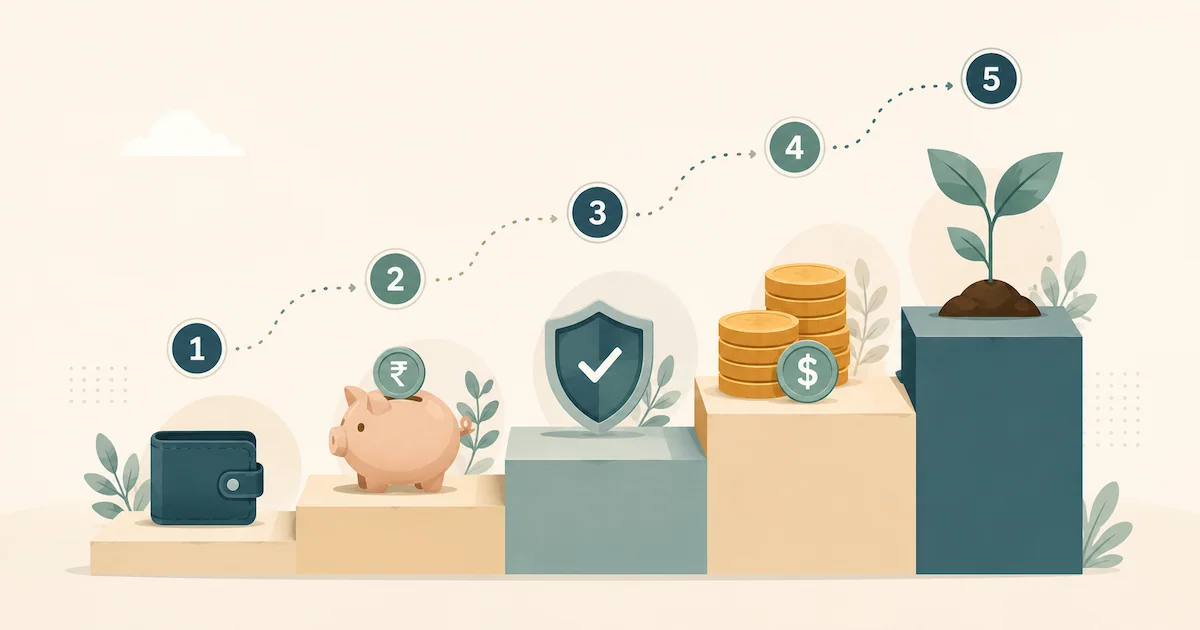
Ask ten personal finance guides where to start and you get ten piles of the same "basics": make a budget, build an emergency fund, pay off debt, invest early. All true. None of it answers the only question a beginner actually has, which is what to do first, and then what after that. The order is the whole game, and almost nobody teaches it.
This guide is built as an order of operations. Each step comes where it does for a reason, and each one makes the next step safe. It covers both India and the US in one place, because the sequence is the same in both even when the accounts and the tax rules differ. And it links out to the deep guide for every step, so this page stays the map and never re-teaches the territory. If you want the underlying concepts defined first, start with our personal finance basics primer, then come back here for the order.
One thing worth saying up front. This is educational, not personal advice, and the numbers are examples. Where a step touches tax or investing, the honest move is to confirm your own case with a CA, a CPA, or a SEBI-registered adviser.
Where do you actually start with personal finance?
Personal finance for beginners is a sequence, not a syllabus: a short list of actions done in the right order, where each step makes the next one safe. You do not need to understand every concept before you begin. You need to know what comes first.
The sequence below is the order most financial educators converge on, adapted for India and the US together. Read the table as the whole plan at a glance, then take the steps one at a time.
| Step | What you do | Why it sits here | India note | US note | Learn it in depth |
|---|---|---|---|---|---|
| 1 | Track spending, pick a budget | You can't manage what you never measure | Budget on in-hand pay | Budget on take-home pay | budgeting methods |
| 2 | Work out your net worth | The baseline you measure progress against | Assets minus loans | Assets minus liabilities | what is net worth |
| 3 | Open the right accounts | Money needs the right home before it grows | Salary + spends split, UPI | Checking + high-yield savings | banking basics |
| 4 | Build a starter emergency fund | Stops a surprise from starting a debt spiral | Rs 25,000 to Rs 50,000 | About $1,000 | emergency fund |
| 5 | Match, then kill high-interest debt | Free money first, then guaranteed returns | EPF is automatic | Grab the 401(k) match | debt and credit |
| 6 | Finish the fund, automate it | Resilience, then it runs without willpower | 3 to 6 months of essentials | 3 to 6 months of essentials | saving money |
| 7 | Get your taxes right | Stop overpaying and file correctly | New default regime | Set withholding right | tax concepts |
| 8 | Lay a safe instrument base | A foundation before you take risk | EPF, PPF, NPS | High-yield savings, bonds | government schemes |
| 9 | Start investing (when ready) | Growth comes after the safety net | Equity via SIP, later | Index investing, later | financial literacy |
The rest of this guide walks each step, with worked rupee and dollar examples the usual guides skip.
Some people absorb a sequence like this better when someone else sets the pace. For that route, we compared ten courses across India and the US on what they charge and what the certificate is actually worth, and three of them cost nothing end to end.
Step 1: Do you know where your money goes?
The first step is tracking where your money actually goes for one month, because a budget built on guesses fails within weeks. Most people underestimate two or three categories badly, and the only way to catch it is to record every rupee or dollar for 30 days, then group the spending into needs, wants and savings.
Once you have real numbers, a budgeting method gives them structure. The most quoted is the 50-30-20 rule: 50% of take-home to needs, 30% to wants, 20% to savings. Treat it as a target, not a law. It breaks for a lot of beginners, and the clearest case is rent. Take a Mumbai renter bringing home Rs 60,000 a month. Split by the rule, that is Rs 30,000 for needs, Rs 18,000 for wants, Rs 12,000 to save. But a one-bedroom flat plus utilities and transport can run Rs 40,000 on its own, which is 67% of in-hand, and the rule has already snapped. The honest response is to hold the savings share as fixed as you can and squeeze wants, not to give up on budgeting. A $4,500-a-month earner in a US city hits the same wall the same way.
One India-specific point the US guides miss: budget on your in-hand pay, the figure after EPF and tax are deducted, because your EPF contribution is already a forced saving you never see. Our how to track spending guide covers the recording part, and budgeting methods explained compares 50-30-20 against zero-based, envelope and pay-yourself-first for tighter incomes. The 50-30-20 deep dive has the full worked version.
Step 2: What are you actually worth right now?
Net worth is everything you own minus everything you owe, and it is the single number that tells you whether you are moving forward. A budget shows the month. Net worth shows the trajectory. Calculate it once now, then again every few months.
The math is simple. Add up your assets: bank balances, EPF or 401(k), any FDs or investments, the resale value of a vehicle, property. Then subtract your liabilities: home loan, car loan, personal loan, credit card balances, student debt. A fresh graduate might have Rs 40,000 in the bank, Rs 20,000 in EPF, and a Rs 3,00,000 education loan, for a net worth of minus Rs 2,40,000. That negative number is normal and not a failure. The point is that next quarter it should be less negative, and eventually it crosses zero. A beginner in the US with $2,000 saved and $25,000 in student loans starts at minus $23,000 and watches the same line climb.
What matters is the direction, tracked honestly. Our net worth explainer walks the full calculation and the traps, like counting a depreciating car at its purchase price.
Step 3: Where should your money actually live?
The right account structure separates the money you spend from the money you are protecting, so the two never mix by accident. Most beginners run their whole financial life out of one account, which is exactly how an emergency fund quietly gets spent.
A workable structure is two or three accounts. In India: your salary account where pay lands, a separate spending account you actually transact from over UPI, and a savings account or sweep-in FD for the emergency fund. UPI makes moving money between them instant and free, which is the point, since friction is what makes people leave everything in one pot. India ran about 18.4 billion UPI transactions worth Rs 24.77 lakh crore in a single month in early 2025, per NPCI, so this is the default rail for moving money. In the US the parallel is a checking account for spending and a high-yield savings account for the fund, linked so transfers are quick.
The savings side is where beginners leave money on the table. A regular savings account in India pays around 2.5 to 4%, while a US high-yield savings account pays around 4 to 4.5%, several times the near-zero of a big-bank checking account. Our banking basics hub covers the account types, and the checking and savings account explainers cover the mechanics, including high-yield savings.
Step 4: What is your first safety net?
A starter emergency fund is a small, fast cushion, roughly one month of essentials or Rs 25,000 to Rs 50,000 in India and about $1,000 in the US, that stops a surprise expense from becoming a debt. It comes before debt payoff and long before investing, because without it the first flat tyre or medical bill goes straight onto a credit card and undoes everything.
This is not the full fund yet. It is the firebreak. The logic is behavioral as much as financial: once even a small buffer exists, a Rs 8,000 phone repair is an annoyance you handle in an afternoon, and it stops being a trigger for a 40% card balance. Keep it liquid and separate, in the savings account from Step 3, and refill it the moment you use it.
Size the eventual full fund off essential expenses, not total spending. If your rent, EMI, groceries, utilities, transport and insurance come to Rs 30,000 a month, a six-month fund is Rs 1,80,000, and you get there in stages. Our how to build an emergency fund guide has the staged plan, and the emergency fund calculator sizes the target from your own numbers.
Step 5: Should you save more or kill debt first?
Once the starter fund exists, the least-costly order is free money first, then high-interest debt, then more saving, and the reason is which move gives the biggest guaranteed return. This is the step every beginner agonises over, and the answer is a sequence you work through in order.
Work it in this order:
First, capture any employer retirement match. In the US, a 401(k) match is an instant 50 to 100% return on what you put in, which nothing else on this list beats, so skipping it is choosing a pay cut. In India the equivalent is automatic: your employer's EPF contribution is already going in, so this box is ticked for you.
Second, attack debt above roughly 8 to 10%. Clearing a credit card charging 20%, or an Indian card running 36 to 42% a year, is a guaranteed return equal to that rate, and no safe investment reliably pays it. On what order to clear multiple debts, our debt snowball vs avalanche guide covers the two methods and the debt payoff calculator runs both against your actual balances.
Third, once the expensive debt is gone, move to Step 6 and finish the emergency fund. Very low-interest debt, like a home loan at 8.5% or a subsidised student loan, does not need to be rushed and can run alongside saving. The debt and credit hub covers the full India and US picture, including how credit scores work in each.
Step 6: How do you finish the safety net and automate everything?
With expensive debt cleared, you grow the emergency fund to a full three to six months and put the whole system on autopilot, because a plan that depends on willpower every month eventually loses. The full fund is the resilience layer; automation is what makes it happen without you thinking about it.
The right fund size moves with income stability, which most guides state as a flat "three to six months" and never explain. A salaried person with one steady job sits near three months. A freelancer, a commission earner, or the only earner in a single-income household sits nearer six to twelve, because their income can stop with less warning. Size it to your risk, not a slogan.
Automation is the behavioral trick that carries the whole plan. Pay yourself first: set a standing instruction so savings leave your account on payday, before you can spend them, the same way EPF already does. This defeats the two forces that quietly wreck beginner finances, lifestyle inflation and the intention-action gap. Every raise tempts a bigger flat and a newer phone; automating a fixed savings share before the money lands is what stops the raise from vanishing. Our saving money hub covers the automation-first system, and the savings goal calculator works out the monthly amount for a target.
How does insurance protect the whole plan?
Insurance is the layer that stops a single bad event from erasing years of saving, which is why it sits beside the emergency fund and before serious investing. A funded emergency fund absorbs a Rs 30,000 shock. It cannot absorb a Rs 15 lakh hospital bill or the loss of the household's earner, and covering those risks is what insurance does.
Two policies do most of the work for a beginner. Term life insurance replaces lost income and matters only where someone depends on that income, so a single person with no dependents often has no need for it yet. The common India reference point is cover of about 10 to 15 times annual income, and a Rs 1 crore term policy runs roughly Rs 8,000 to Rs 12,000 a year for a healthy 30-year-old. Health insurance is the one that applies to almost everyone, dependents or not, because a serious illness is the quickest path from solvent to indebted in both India and the US. A Rs 5 lakh to Rs 10 lakh family floater is a typical India base, and the US equivalent is an employer or marketplace health plan and understanding its deductible.
One structural point most independent educators make: the bundled "investment-cum-insurance" products, ULIPs and endowment plans, try to be protection and investment at once and tend to do neither job well, which is why term cover and investing are usually treated as separate decisions. A dedicated insurance guide is on our roadmap; until then, a licensed insurance adviser can size cover to your situation.
Step 7: How do taxes fit in, for India and the US?
Getting tax right means paying what you owe and not a rupee or dollar more, and for Indian beginners in 2026 that starts with one fact almost every guide gets wrong: the new regime is now the default, and it changes the old advice completely. This is the single most out-of-date corner of beginner personal finance content in India.
Under the new default regime for FY 2025-26, salary up to Rs 12.75 lakh can be effectively tax-free, because the Section 87A rebate cancels the tax up to Rs 12 lakh of taxable income and the Rs 75,000 standard deduction lifts the salary threshold to Rs 12.75 lakh. The catch that reshapes beginner advice: the deductions everyone is told to chase, Section 80C (the Rs 1.5 lakh one), 80D for health premiums, and HRA, apply only under the old regime. So the reflex to "invest Rs 1.5 lakh in ELSS or PPF to save tax" gives most salaried beginners on the default regime no tax benefit at all. PPF and EPF are still fine as safe savings on their own merits. They are just not a tax move under the new regime. That distinction is missing from almost the entire field.
This does not mean the old regime is dead. Someone paying high rent or a large home-loan interest bill can still come out ahead on the old regime, which is a genuine calculation and not a default. Our income tax guide for salaried employees runs the regime comparison with worked numbers and a break-even table, and the tax concepts hub covers the vocabulary for both India and the US. In the US, the beginner equivalent is setting your W-4 withholding so you neither owe a large sum nor hand the IRS an interest-free loan all year. Because tax rules turn on your exact situation, a CA or CPA is the right person for a real return.
Step 8: Which safe instruments lock in the foundation?
Before you take any market risk, a safe foundation of guaranteed or low-risk instruments does the boring work of protecting and slowly growing money you cannot afford to lose. In India this layer is unusually strong because of government small-savings schemes; in the US it is thinner and centres on cash-like accounts.
India's core instruments carry current, dated rates worth comparing honestly, which the field almost never does. The table below is the comparison the field almost never draws.
| Instrument | Lock-in / liquidity | Rate (2026) | Taxation | Who it suits |
|---|---|---|---|---|
| EPF | Till retirement / job change | 8.25% (FY, EPFO) | EEE, exempt on maturity | Every salaried employee (automatic) |
| PPF | 15 years, partial withdrawals from year 7 | 7.1% (Oct-Dec 2026) | EEE, fully tax-free | Long-term safe savings |
| Sukanya Samriddhi | Till girl child turns 21 | 8.2% | EEE | A daughter's education or marriage |
| NPS | Till age 60, then partial annuity | Market-linked | Partly taxable at exit | Retirement, with 80CCD(2) surviving the new regime |
| Bank FD | Your chosen tenure | 6.5% to 7.5% | Interest fully taxable | Parking money for a fixed date |
The point of the table is not to pick one for you. It is that these differ on lock-in, liquidity and tax in ways a rate alone hides, and a beginner should match the instrument to the goal's timeline. A US beginner's version of this layer is simpler: a high-yield savings account for near-term money, and government bonds or CDs for slightly longer horizons. Our government schemes hub covers each Indian scheme in depth, starting with the PPF explainer. Rates change with each government review, so check the current figure before you act.
Step 9: When are you actually ready to invest?
You are ready to invest for growth once four things are true at the same time, and not before, because investing on a shaky base forces you to sell at the worst moment. This guide stops at the readiness check on purpose and does not tell you what to buy.
The four signals:
Your emergency fund is funded to at least three months. Your high-interest debt is cleared. Your term and health insurance are in place, so one accident does not wipe out the plan. And you have a goal with a timeline, because money you need in two years and money you need in twenty belong in very different places.
When those hold, market investing (equity mutual funds through SIPs in India, low-cost index funds in the US) is the growth engine that beats inflation over long horizons. The mechanics of how it compounds, and why starting early matters so much, sit in our financial literacy hub. What this guide will not do is recommend a specific fund or allocation, because that turns on your risk tolerance, your timeline and your full picture. That is a conversation for a SEBI-registered investment adviser or a CFP, and a dedicated investing guide is on our roadmap.
What does the whole sequence look like over one year?
Walked end to end, the plan is nine steps a beginner can start this month and largely finish inside a year, and it plays out like this for a real income in each market. Numbers are illustrative.
Take Priya, bringing home Rs 60,000 a month in Bengaluru. Month one, she tracks spending and finds she is saving nothing. She sets a starter budget, opens a separate savings account, and parks a Rs 40,000 starter fund over two months. Her EPF match is automatic, so she clears a Rs 45,000 credit card balance at 40% over months three and four, which alone saves her about Rs 18,000 a year in interest. Months five to nine she builds the fund to Rs 1,80,000 and automates a Rs 10,000 monthly transfer. She confirms she is better off on the new tax regime, so she stops force-buying ELSS purely for 80C. By month twelve she has a full safety net, no expensive debt, term and health cover, and she is ready to start a SIP.
The US version, Marcus on $4,500 a month, runs identically: $1,000 starter fund, capture the 401(k) match, kill the 22% card, build to a three-month fund, set withholding right, then open a high-yield savings base before investing. Same order, different accounts. That is the whole point of teaching the sequence rather than the syllabus.
What are the most common beginner mistakes?
The mistakes that set beginners back are less about picking the wrong fund and more about skipping steps or doing them out of order. A handful account for most of the damage, and every one is avoidable once the sequence above is clear.
The first is investing before the safety net exists, which forces a sale at the worst possible time when an emergency lands. The second is treating equity as an emergency fund, then discovering the market is down 20% exactly when the money is needed. The third, specific to India in 2026, is chasing 80C deductions under the new default regime where they save no tax, mistaking a savings decision for a tax one. The fourth is letting every raise become a bigger flat and a newer phone, so income climbs for years while savings never do. And the fifth is skipping health insurance to save a premium, which works right up until the one hospital stay that costs more than a decade of premiums.
None of these come from a lack of knowledge. They come from doing the right things in the wrong order, or trading the boring protection steps for the exciting growth ones. The order of operations exists to prevent exactly this.
Does the order change with your age or income?
The order of operations holds at any age and income; what changes is the size of each step and how fast you move through it. A 22-year-old and a 40-year-old both begin by tracking spending and building a safety net. The sequence is identical. The stakes differ.
A beginner in their 20s holds the one asset that cannot be bought back later, which is time, so reaching the investing step early puts decades of compounding on offer. A beginner starting in their 40s runs the same steps with more urgency on retirement instruments and usually larger amounts, since fewer years remain for growth to work. Higher income does not reorder anything either; it means the emergency fund and the debt clear faster, freeing you to reach the investing step sooner. The trap at every age is assuming a later start justifies skipping steps. It doesn't. It just means moving through them quicker.
What this guide deliberately does not cover
This is an educational roadmap, not personal financial, tax, legal or investment advice, and every figure is an example. It gives you the order and the logic; it does not tell you which fund to buy, which regime to elect, or how much of your own money to move, because those depend on details no article can see.
It stays a map on purpose and hands the depth to the specialist guides. The concepts get defined in personal finance basics; budgeting methods in the budgeting hub; the saving system in the saving hub; debt and credit in their hub; accounts in banking basics; Indian schemes in the schemes hub; tax vocabulary in the tax hub and the salaried ITR guide. Two things sit outside this guide entirely: a full investing how-to (the readiness check is here, the fund selection is not) and detailed insurance product comparison. For anything specific to your return, your policy or your portfolio, a CA, CPA, licensed insurance adviser or SEBI-registered adviser is the right call.
Frequently asked questions
What is the right order to manage money as a beginner? The order most financial educators converge on is: first track your spending and set a budget, then work out your net worth as a baseline, open the right accounts, build a one-month starter emergency fund, capture any free employer retirement match and clear high-interest debt, grow the fund to three-to-six months and automate it, get your taxes right, secure a safe foundation of instruments, and only then start investing. The value is the sequence: each step makes the next one safe. Where exactly you start depends on your situation, which is where a qualified adviser helps.
Under India's new tax regime, is investing in 80C instruments still worth it? For most salaried beginners on the default new regime, 80C no longer saves tax, because Section 80C, 80D, HRA and home-loan-interest deductions apply only under the old regime. Under the new regime for FY 2025-26 salary up to Rs 12.75 lakh is already effectively tax-free through the Section 87A rebate and the Rs 75,000 standard deduction, so locking Rs 1.5 lakh into ELSS or PPF purely to save tax gives most beginners no tax benefit at all. PPF and EPF can still make sense as safe savings on their own merits, just not as a tax play under the new regime. A CA can confirm which regime fits your numbers.
How big should a beginner's emergency fund be? Three to six months of essential expenses is the common range, and the right number moves with how stable your income is. A salaried person with one stable job sits near the three-month end; a freelancer, a commission earner, or the sole earner in a single-income household sits nearer six to twelve months, because their income can stop with less warning. Size it off essential expenses (rent or EMI, groceries, utilities, transport, insurance), leaving out discretionary spending. Start with a one-month starter amount and build from there.
Should I save or pay off debt first? Do a small amount of both, in a specific order. Build a one-month starter emergency fund first so a surprise expense does not push you deeper into debt, then capture any employer retirement match because that is a guaranteed 50 to 100% return you cannot recreate later, then attack debt above roughly 8 to 10% because paying off a 20% card is a guaranteed 20% return no safe investment beats, and only then grow the emergency fund to its full size. Very low-interest debt can run alongside saving, with no need to rush it.
How much term and health insurance does a beginner need? A common starting point in India is term life cover of about 10 to 15 times annual income for anyone with dependents, plus a health insurance floater. A Rs 1 crore term policy costs roughly Rs 8,000 to Rs 12,000 a year for a healthy 30-year-old, and a family health floater of Rs 5 lakh to Rs 10 lakh is a typical base. Someone with no dependents may not need life cover yet but still needs health cover. Insurance protects the plan, so it belongs before serious investing. A licensed insurance adviser can size it to your situation.
When am I actually ready to start investing? You are ready to invest once four things are true: your emergency fund is funded to at least three months, your high-interest debt is cleared, your term and health insurance are in place, and you have a goal with a timeline. Investing before these is fragile, because one emergency can force you to sell at a bad time. This guide deliberately stops at the readiness checklist and does not tell you what to buy; that is a decision for you and a SEBI-registered investment adviser or a CFP.
Is the 50-30-20 rule enough for a beginner? The 50-30-20 rule is a useful starting frame with real limits, and it breaks for many beginners, especially renters in expensive metros. It splits take-home pay into 50% needs, 30% wants and 20% savings, but in cities like Mumbai or the Bay Area, rent alone can push needs well past 50%, sometimes to 65 or 70%. When that happens, the honest fix is to hold the savings percentage as fixed as you can and squeeze wants, keeping the plan alive. Treat 50-30-20 as a target to move toward, and check our budgeting guide for methods that fit a tighter income.
Where should a beginner keep an emergency fund? An emergency fund belongs somewhere liquid and safe, not in the stock market. In India that means a high-interest savings account or a sweep-in fixed deposit that stays accessible; in the US, a high-yield savings account paying around 4% is the standard home. The point of the fund is that the exact rupee or dollar amount is there on the day you need it, so a small amount of interest matters far less than instant access and no risk of a fall in value. Keep it separate from your spending account so you are not tempted to dip into it.
Sources
- Income Tax Department of India, Salaried Individuals for AY 2026-27 (new-regime slabs, Section 87A rebate, Rs 75,000 standard deduction). incometax.gov.in
- Employees' Provident Fund Organisation, EPF interest rate (8.25% for the financial year). epfindia.gov.in
- Ministry of Finance, Small savings interest rates (PPF 7.1%, SSY 8.2% for Oct-Dec 2026). nsiindia.gov.in
- National Payments Corporation of India, UPI product statistics (monthly transaction volume and value). npci.org.in
- Pension Fund Regulatory and Development Authority, National Pension System. pfrda.org.in
- US Internal Revenue Service, Tax withholding estimator (setting W-4 withholding). irs.gov
- Consumer Financial Protection Bureau, An essential guide to building an emergency fund. consumerfinance.gov



You might also like

Personal finance basics explained in plain English: income, saving, debt, credit, and investing, the small set of concepts every adult tends to encounter.
10 min read

The 2026 index puts US financial literacy at 47%. India's last national survey said 27% and is seven years old. What the numbers mean, and where to begin.
12 min read
Which Act governs the return you file this July, the FY 2025-26 slabs and Rs 60,000 rebate, and the 30-day e-verification rule that quietly makes returns late.
27 min read