Pillar 11

Tax Concepts

Taxes are confusing because the language is technical and the rules change yearly. This section explains the underlying concepts — what tax slabs are, what deductions and credits do, what capital gains tax is, what HRA exemption means in India, what FICA tax funds in the US. These are definitional explainers, not filing advice. For your specific tax situation, consult a qualified Chartered Accountant in India or a Certified Public Accountant in the US.

11 articles

A unified GST flag replacing seventeen separate older tax labels representing the central and state levies subsumed by the Goods and Services Tax in July 2017
TaxWhat Is GST India Explained — The 2017 Indirect Tax That Replaced 17 Earlier Levies

What is GST in India? The Goods and Services Tax — a comprehensive destination-based indirect tax introduced on 1 July 2017 that subsumed 17 earlier central and state-level taxes. Covers the 5-slab rate structure (0%, 5%, 12%, 18%, 28% + cess), the CGST/SGST/IGST split between centre and state, Input Tax Credit, the GST Council, registration thresholds (₹40L for goods, ₹20L for services in most states), and the composition scheme for small businesses. For your specific business or filing situation, consult a Chartered Accountant or GST practitioner.

9 min read

A US pay stub showing the FICA line item split into Social Security and Medicare components alongside federal income tax, with the wage base threshold highlighted
TaxWhat Is FICA Tax Explained — How US Payroll Funds Social Security and Medicare

What is FICA tax in the US? The Federal Insurance Contributions Act payroll tax funding Social Security (6.2% on wages up to the wage base) and Medicare (1.45% on all wages, plus 0.9% Additional Medicare above income thresholds). Covers the 2025 wage base of $176,100, employer match doubling the total burden to 15.3% up to the wage base, self-employed treatment under SECA (Schedule SE), and brief comparison to India's EPF + ESIC payroll-based social security.

9 min read

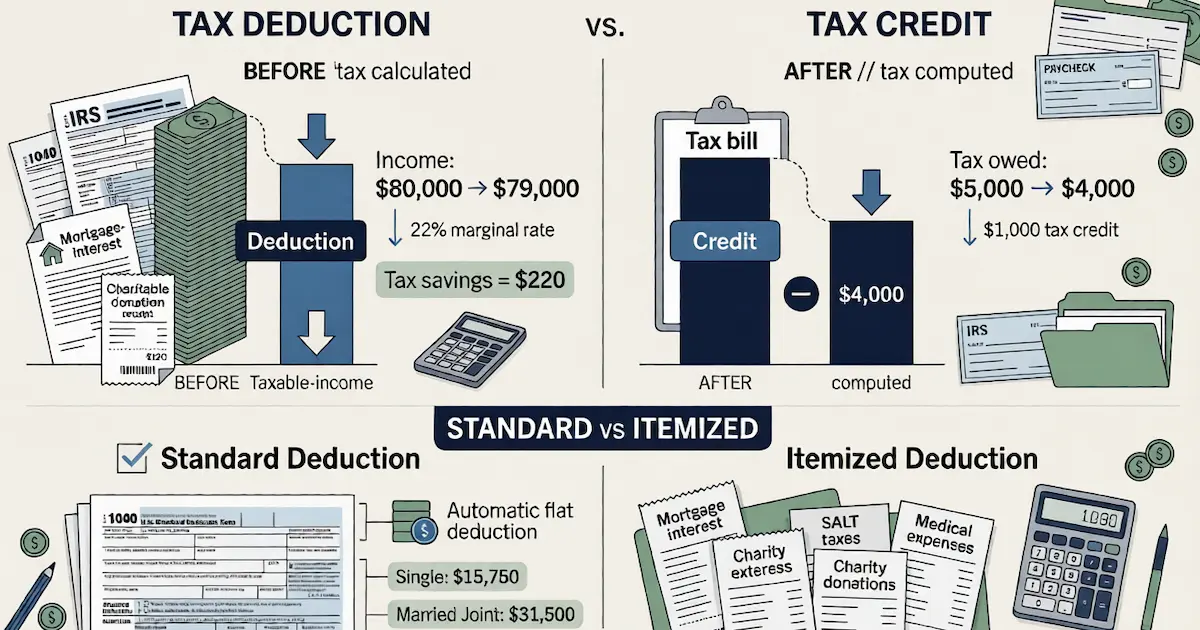
Side-by-side illustration showing how a tax deduction reduces taxable income before the rate is applied while a tax credit reduces the tax owed after the rate is applied, with example numbers
TaxTax Deductions vs Credits + Standard vs Itemized Deduction — How US Tax Structure Reduces Liability

What is the difference between a tax deduction and a tax credit, and between standard and itemized deduction? Tax deductions reduce taxable income (worth your marginal rate × deduction amount); tax credits reduce tax owed dollar-for-dollar. Standard deduction is the flat IRS-fixed amount ($15,750 single / $31,500 married joint for TY 2025); itemized deduction sums specific expenses (SALT cap $10K, mortgage interest, charitable contributions, medical above 7.5% AGI). Covers the math, the structural distinction, and when each makes sense — for educational understanding, not filing advice.

10 min read

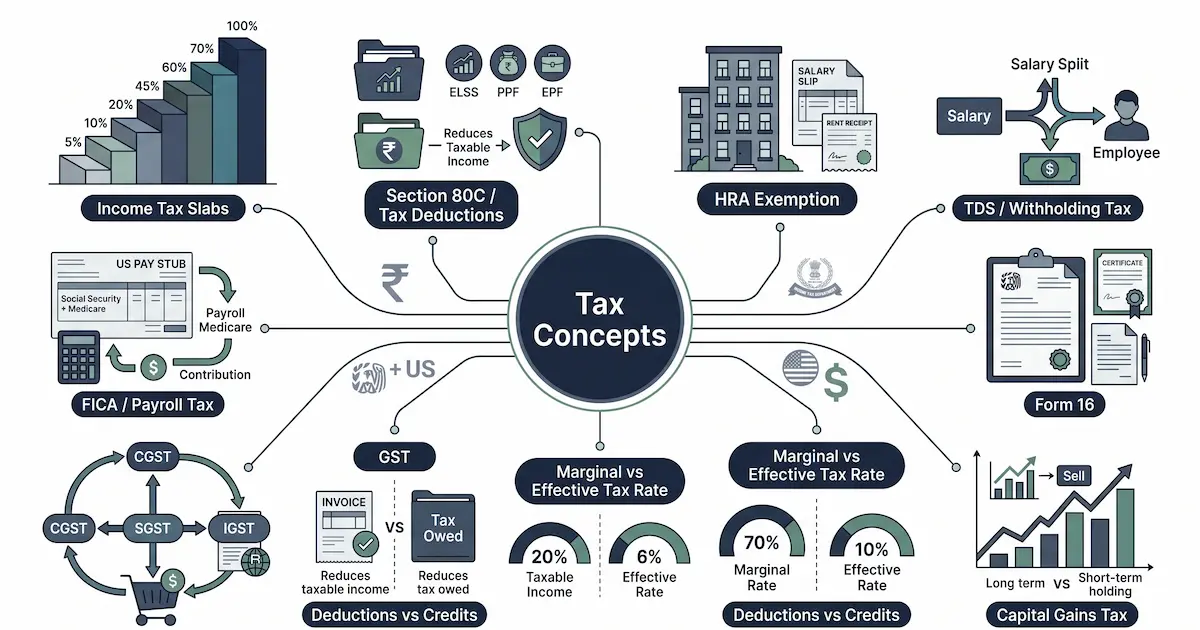
An interconnected diagram of ten tax concept nodes — slabs, deductions, credits, capital gains, TDS, FICA, GST — illustrating how the foundational vocabulary of Indian and US taxation fits together
TaxTax Concepts Explained — Definitions and Mechanics for India and US Taxpayers

What are the foundational tax concepts every Indian and US taxpayer should understand? This pillar page synthesizes 10 definitional explainers covering income tax slabs (India new + old regime), Section 80C, HRA exemption, TDS, Form 16, capital gains, marginal vs effective tax rates, deductions vs credits, standard vs itemized deduction, GST, and FICA. Research-led definitions — not tax planning advice. For your specific situation, consult a Chartered Accountant (India) or Certified Public Accountant (US).

12 min read

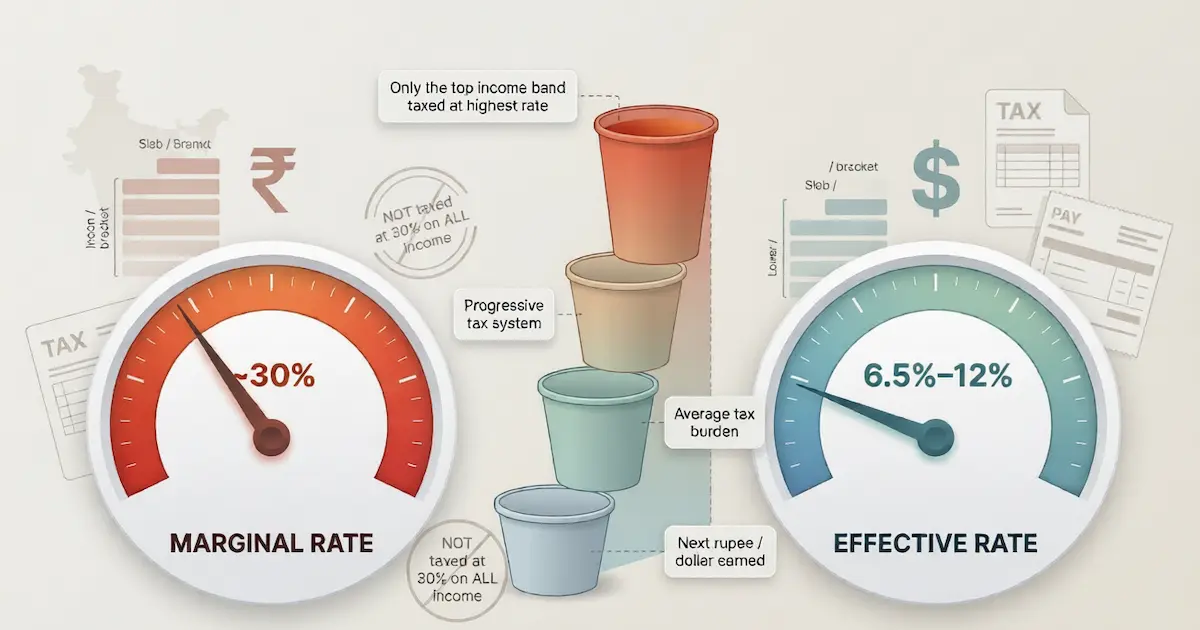
Two rate gauges side by side — one labelled MARGINAL showing 30% and the other labelled EFFECTIVE showing a much lower 12%, illustrating the structural gap between the two concepts in progressive tax systems
TaxMarginal vs Effective Tax Rate Explained — Why You're Not Actually 'In the 30% Bracket' on Every Rupee

What is the marginal tax rate vs the effective tax rate? Two related but distinct concepts in progressive tax systems. Marginal rate is the percentage applied to your next rupee or dollar of income; effective rate is total tax divided by total income. Covers worked examples for India (new regime ₹15L salary at 15% marginal / 6.5% effective) and the US (federal marginal 22% / effective ~12-14% typical), the most common bracket misconception, and why each rate matters for different decisions.

9 min read

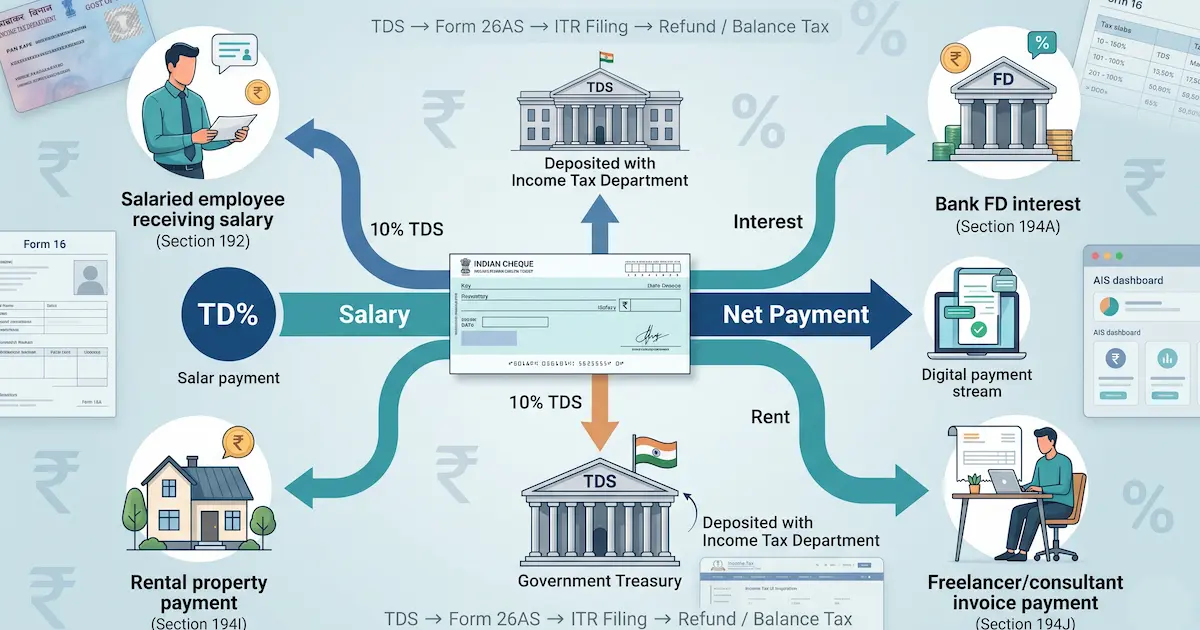
A salary cheque being split at the source with the tax portion routed to the Income Tax Department, illustrating how TDS deducts tax before the payment reaches the recipient
TaxWhat Is TDS — How Tax Deducted at Source Works in India Across Salary, Interest, Rent, and Professional Fees

What is TDS? Tax Deducted at Source — the mechanism where the payer of certain income deducts tax before paying the recipient and deposits it with the government. Covers Section 192 (salary), 194A (interest), 194I (rent), 194J (professional fees), 194C (contractor payments), 194 (dividends), the PAN requirement under Section 206AA, current FY 2025-26 thresholds, and how TDS reconciles against ITR liability via Form 26AS.

9 min read

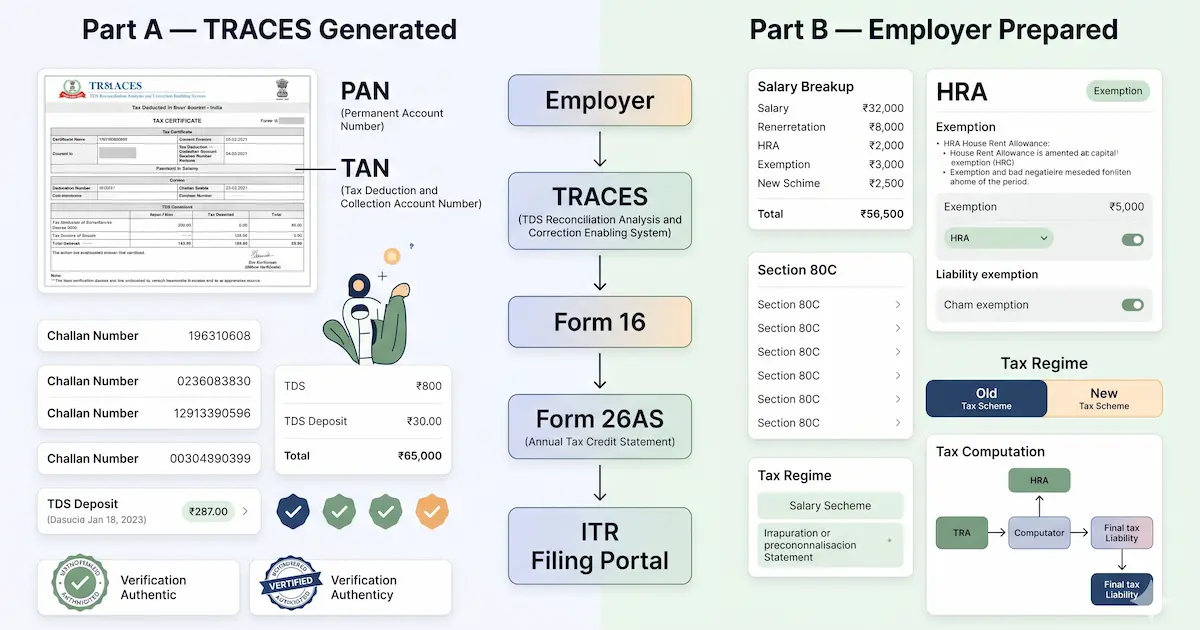
A two-part document showing Part A and Part B of Form 16 with salary breakup, deductions claimed, and TDS deducted across the financial year
TaxWhat Is Form 16 in India — The TDS Certificate Your Employer Issues for ITR Filing

What is Form 16? The TDS certificate Indian employers issue to salaried employees under Section 203 of the Income Tax Act, documenting tax deducted from salary across the financial year. Covers Part A (TRACES-generated, TDS quarter-by-quarter) vs Part B (employer-prepared, salary and deduction breakup), the June 15 issuance deadline, Form 16A for non-salary TDS, how to reconcile Form 16 against Form 26AS, and what to do about mismatches.

9 min read

A clock and a calendar showing the holding-period threshold that separates short-term from long-term capital gains, alongside currency symbols for INR and USD
TaxWhat Is Capital Gains Tax — How Short-term and Long-term Gains Are Taxed in India and the US

What is capital gains tax? The tax on profit from selling a capital asset, with rates depending on how long you held it. Covers India's post-Budget-2024 rates (12.5% LTCG on equity above ₹1.25L, 20% STCG on equity, 12.5% LTCG on all other assets without indexation, 12-month / 24-month holding periods) and the US structure (0/15/20% long-term rates by income, ordinary slab rates on short-term). Includes worked examples in both countries.

10 min read

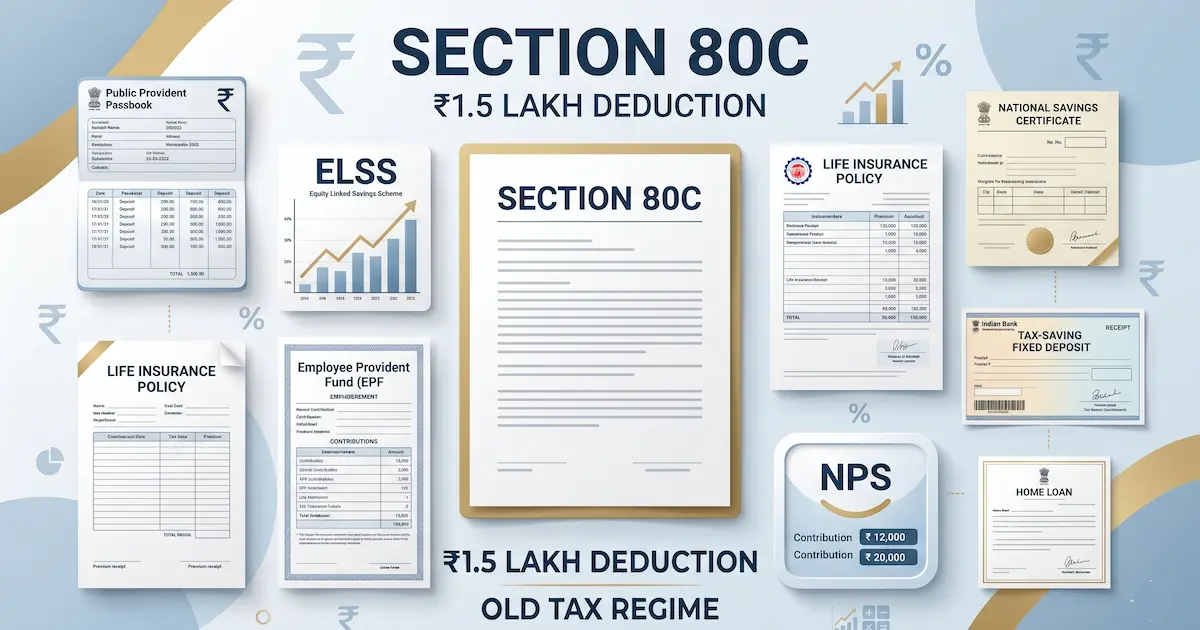
A document labelled Section 80C of the Income Tax Act surrounded by icons representing PPF, ELSS, life insurance, and other eligible investment instruments under the ₹1.5 lakh deduction
TaxWhat Is Section 80C Deduction — The ₹1.5 Lakh Tax Deduction India's Old Regime Allows

What is Section 80C of the Income Tax Act? A deduction of up to ₹1.5 lakh per financial year from taxable income, available only under India's old tax regime. Covers the eligible instruments (PPF, EPF, ELSS, NSC, life insurance, home loan principal, tuition fees, NPS Tier 1 under Section 80CCD), the lock-in periods, the new regime's exclusion of 80C, and how a Chartered Accountant assesses whether the old regime's 80C plus other deductions outweighs the new regime's lower rates.

10 min read

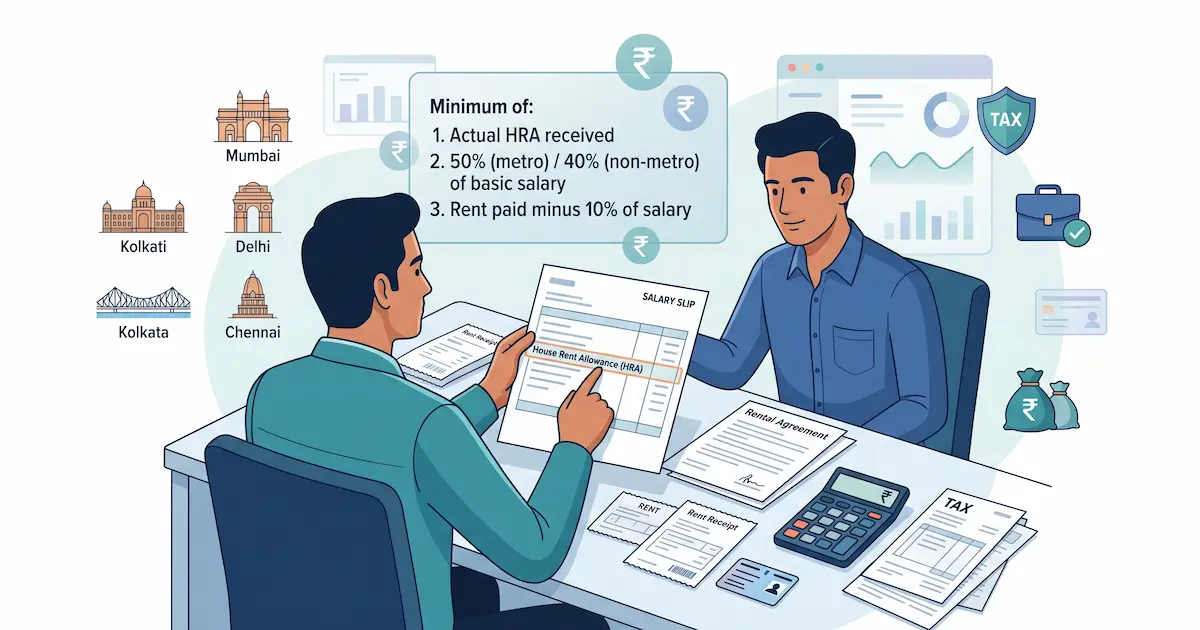
A salary slip with House Rent Allowance line item highlighted alongside rent receipts and a calculator showing the three-condition HRA exemption formula
TaxWhat Is HRA Exemption Explained — How the House Rent Allowance Deduction Actually Works in India

What is HRA exemption in India? A tax exemption under Section 10(13A) of the Income Tax Act that allows salaried taxpayers to exempt part of their House Rent Allowance from taxable income. Covers the three-condition formula that determines exempt HRA, the 50%/40% metro vs non-metro split, the rent receipt and landlord PAN requirements, the new regime's exclusion of HRA, and a worked example for a Mumbai-based employee.

10 min read

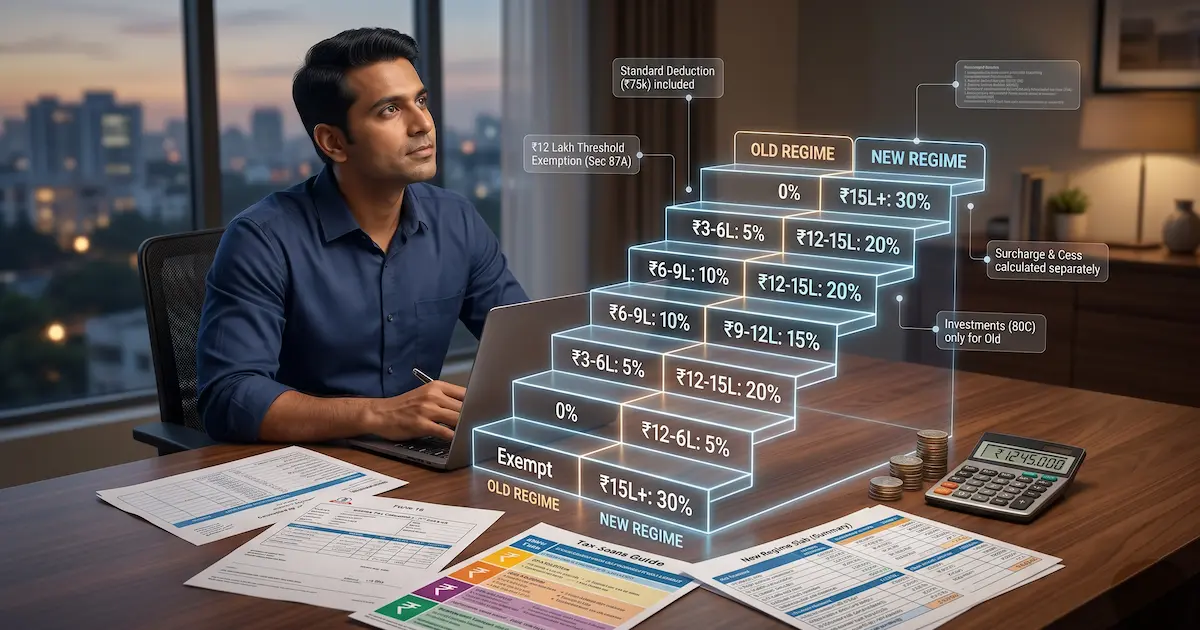
A staircase of progressively taller blocks representing India's progressive income tax slab structure, with the Indian rupee symbol and percentage labels marking each band
TaxIncome Tax Slab India Explained — How the Old and New Regime Slabs Actually Work

What is an income tax slab in India? The progressive-rate structure where different bands of income are taxed at increasing percentages. Covers the new regime slabs and old regime slabs as notified by the Income Tax Department for the current financial year, the Section 87A rebate that produces effective zero tax up to ₹12 lakh under the new regime, the standard deduction of ₹75,000, Health and Education Cess of 4%, and a fully worked example. For your specific situation, consult a Chartered Accountant.

10 min read