Income Tax Slabs in India FY 2025-26: New vs Old Regime

By Tapabrata Biswas · Updated September 11, 2026 · 18 min read
Written and fact-checked by Tapabrata Biswas. How I write
Reviewed by Subir Kumar Debsharma, Tax, GST and ROC professional with 20+ years of experience.
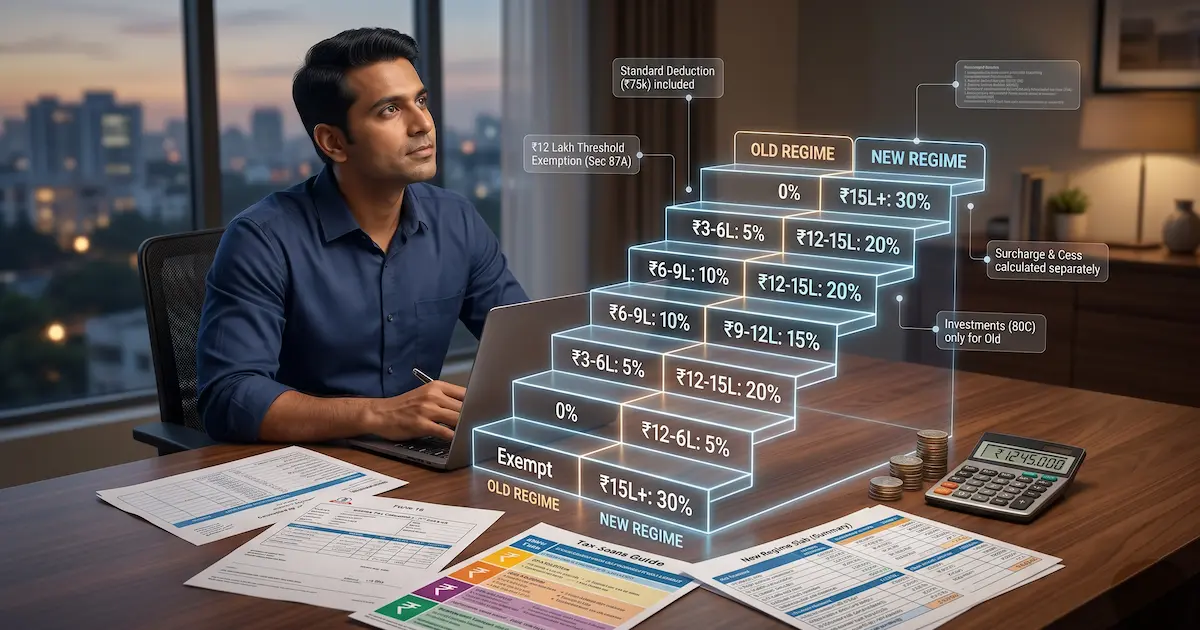
Budget 2025 rewrote the number every salaried Indian now quotes: income up to ₹12 lakh pays zero tax under the new regime, or ₹12.75 lakh once you count the standard deduction. Budget 2026 then changed nothing, so that figure holds for the year you are filing an ITR for now and the year currently running. Yet a surprising number of pages still show the old ₹3 lakh exemption and a ₹7 lakh rebate as if they were current. They are not.
This is a research-led explainer of India's income tax slab structure as notified by the Income Tax Department. It is not tax advice. Tax law changes with each Union Budget, individual circumstances vary, and applying slabs and exemptions to your specific salary, deductions, and other income depends on details only a qualified Chartered Accountant who knows your situation can assess. Consult a CA before filing your ITR or making any tax-relevant decision. What this post gives you is the structure: what a slab is, both regimes for FY 2025-26, the ₹12 lakh rebate and its marginal-relief cliff, surcharge and cess, and a fully worked example.
What is an income tax slab?
An income tax slab is a band of annual income that is taxed at a specific percentage rate, and India applies these bands progressively, so each higher band is taxed at a higher rate than the one below it. The word people miss is progressive. It changes the whole calculation.
Take someone earning ₹8 lakh. They do not pay 10% on the entire ₹8 lakh. The first ₹4 lakh is taxed at 0%, the next ₹4 lakh at 5%, and only income that climbs into a higher band is taxed at that band's rate. The rate on your last rupee is your marginal rate. Your total tax divided by your total income is your effective rate, and it is always lower. This is not an Indian quirk. The US, the UK, Canada, and India all tax income in progressive bands; only the thresholds and percentages differ. One myth worth killing: women do not get a separate or lower slab in India. That distinction was removed years ago, and the same slabs apply regardless of gender.
India's slabs are set by the Ministry of Finance in the Union Budget each February and confirmed by the Finance Act that follows. Two slab systems now run side by side: the new regime, which is the default, and the old regime, which you elect. The rest of this post walks through both.
What are the new tax regime slabs for FY 2025-26?
The new regime for FY 2025-26 (AY 2026-27) taxes income at nil up to ₹4 lakh, then 5%, 10%, 15%, 20%, and 25% across successive ₹4 lakh bands, and 30% above ₹24 lakh. It has been the default since FY 2023-24, so anyone who does not actively choose the old regime is taxed here. The provision is section 115BAC for FY 2025-26, and section 202 of the Income-tax Act 2025 from FY 2026-27 onward.
| Total income | Tax rate |
|---|---|
| Up to ₹4,00,000 | Nil |
| ₹4,00,001 to ₹8,00,000 | 5% |
| ₹8,00,001 to ₹12,00,000 | 10% |
| ₹12,00,001 to ₹16,00,000 | 15% |
| ₹16,00,001 to ₹20,00,000 | 20% |
| ₹20,00,001 to ₹24,00,000 | 25% |
| Above ₹24,00,000 | 30% |
The Income Tax Department publishes the same table in a rupee-amount form that most consumer pages drop, and it is worth keeping because you can compute your own tax from it. The ₹8 lakh to ₹12 lakh row reads "₹20,000 plus 10% above ₹8 lakh," the ₹12 lakh to ₹16 lakh row reads "₹60,000 plus 15% above ₹12 lakh," and so on. A salaried person or pensioner also gets a standard deduction of ₹75,000, raised from ₹50,000 in Budget 2024 specifically for this regime. Add the Section 87A rebate of up to ₹60,000, and taxable income up to ₹12 lakh pays zero tax, which for a salaried filer means salary up to ₹12.75 lakh after the standard deduction. Budget 2026 left every one of these figures untouched, so the table applies to FY 2026-27 as well.
What are the old tax regime slabs, including for senior citizens?
The old regime taxes income at nil up to ₹2.5 lakh, 5% up to ₹5 lakh, 20% up to ₹10 lakh, and 30% above ₹10 lakh, and unlike the new regime it raises the exemption for older taxpayers. You stay in it by choosing "old regime" on Form 10-IEA each year.
| Total income | Tax rate (below 60) |
|---|---|
| Up to ₹2,50,000 | Nil |
| ₹2,50,001 to ₹5,00,000 | 5% |
| ₹5,00,001 to ₹10,00,000 | 20% |
| Above ₹10,00,000 | 30% |
The old regime is the only one that recognises age. The higher exemption reflects that a retiree living on savings has less taxable headroom.
| Age group | Basic exemption (old regime) |
|---|---|
| Below 60 | ₹2,50,000 |
| Senior citizen, 60 to 80 | ₹3,00,000 |
| Super senior citizen, 80 and above | ₹5,00,000 |
One detail catches people out: the new regime is age-neutral. A 75-year-old and a 25-year-old both get the same ₹4 lakh nil band, with no senior top-up. So the age benefit exists only if a senior citizen chooses the old regime. The old regime also keeps a ₹50,000 standard deduction and an 87A rebate of up to ₹12,500, which zeroes tax on income up to ₹5 lakh, and it preserves the full set of exemptions the new regime drops, including HRA and Section 80C.
New regime vs old regime: how do they differ?
The new regime trades away exemptions for wider slabs and a much bigger rebate, while the old regime keeps every exemption but taxes at 30% from just ₹10 lakh. The two are best read side by side.
| Feature | New regime | Old regime |
|---|---|---|
| Basic exemption | ₹4,00,000 | ₹2,50,000 (₹3L senior, ₹5L super senior) |
| Top rate starts at | Above ₹24,00,000 | Above ₹10,00,000 |
| Section 87A rebate | Up to ₹60,000 | Up to ₹12,500 |
| Zero-tax income | ₹12,00,000 (₹12.75L salaried) | ₹5,00,000 |
| Standard deduction | ₹75,000 | ₹50,000 |
| HRA, 80C, home loan interest | Not allowed | Allowed |
The old regime produces a lower bill only when a taxpayer's deductions (a big home loan, metro HRA, the full ₹1.5 lakh under 80C, and so on) add up to more than the new regime's wider slabs and larger rebate give away. Below about ₹12 lakh of income the new regime almost always wins, because zero tax is hard to beat. At higher incomes the answer depends entirely on how large the deduction stack is, which is a per-person calculation. Working out which regime costs you less, and switching correctly, is a filing decision covered in our Indian income tax guide for salaried employees, and one a CA can compute both ways for your exact numbers. Our income tax calculator runs both regimes side by side on your figures, with the full line-item breakdown including the marginal relief most tools skip.
How does the ₹12 lakh zero-tax rebate work?
Section 87A is a rebate that wipes out the slab-calculated tax entirely when taxable income stays at or below ₹12 lakh under the new regime, up to a maximum of ₹60,000. The slab math still runs, then the rebate cancels it. For FY 2026-27 onward the same rebate sits at section 156 of the Income-tax Act 2025, unchanged in substance.
At exactly ₹12 lakh of taxable income, the new-regime slabs produce ₹60,000 of tax (₹20,000 in the 5% band plus ₹40,000 in the 10% band). The 87A rebate of ₹60,000 knocks it to zero. For a salaried person the salary figure is ₹12.75 lakh, because the ₹75,000 standard deduction lands taxable income back at ₹12 lakh, a point the government itself made in the Budget 2025 press release.
Two limits matter, and both trip people up. First, the rebate does not touch special-rate income. Capital gains, crypto, and lottery or gaming winnings are taxed at their own fixed rates, so a person with ₹11 lakh of salary and ₹2 lakh of equity capital gains does not get a free pass on the gains. Second, a marginal relief provision softens the cliff just above ₹12 lakh. Consider income of ₹12,10,000. The rebate is gone, so the raw slab tax is about ₹61,500, yet the income above ₹12 lakh is only ₹10,000. Marginal relief caps the tax at that ₹10,000 of excess, so the person pays roughly ₹10,000 plus 4% cess, not ₹61,500. The relief tapers off by around ₹12.75 lakh of total income, above which the normal slab tax applies in full. That single provision is what stops a ₹10,000 raise from costing ₹60,000 in tax.
How do surcharge and cess add to the tax?
Surcharge and the health and education cess are two extra layers charged on the tax itself, not on your income, and they only bite once your income or your tax crosses set thresholds. For most salaried taxpayers below ₹50 lakh, neither applies.
Surcharge is an additional percentage on the tax, triggered by total income:
| Total income | Surcharge on tax |
|---|---|
| Up to ₹50 lakh | Nil |
| ₹50 lakh to ₹1 crore | 10% |
| ₹1 crore to ₹2 crore | 15% |
| ₹2 crore to ₹5 crore | 25% |
| Above ₹5 crore | 25% new regime, 37% old regime |
The new regime caps surcharge at 25%, so the 37% top tier applies only under the old regime. A separate 15% cap on surcharge applies to capital gains taxed under sections 111A, 112, and 112A regardless of income. On top of the tax plus any surcharge sits the health and education cess, a flat 4% that funds central health and education programmes and applies to every taxpayer in both regimes. So if your slab tax is ₹1 lakh and no surcharge applies, the 4% cess adds ₹4,000, for ₹1,04,000 total.
How much income tax on a ₹15 lakh salary?
A salaried person earning ₹15 lakh under the new regime for FY 2025-26 pays ₹97,500 in total tax, an effective rate of 6.5%. Working it through shows exactly how the slabs, the standard deduction, and the cess combine.
Start with ₹15,00,000 of gross salary, subtract the ₹75,000 standard deduction, and taxable income is ₹14,25,000. Apply the new-regime slabs band by band.
| Band | Income in band | Rate | Tax |
|---|---|---|---|
| Up to ₹4 lakh | ₹4,00,000 | 0% | ₹0 |
| ₹4 lakh to ₹8 lakh | ₹4,00,000 | 5% | ₹20,000 |
| ₹8 lakh to ₹12 lakh | ₹4,00,000 | 10% | ₹40,000 |
| ₹12 lakh to ₹14.25 lakh | ₹2,25,000 | 15% | ₹33,750 |
| Total slab tax | ₹93,750 |
Income is above ₹12 lakh, so no 87A rebate. Add the 4% cess on ₹93,750, which is ₹3,750, and total tax is ₹97,500. The marginal rate, on the last rupee earned, is 15%, while the effective rate is just 6.5%, because most of the income sat in the lower bands. That gap between marginal and effective is the whole point of a progressive system, explained in marginal vs effective tax rate. For contrast, the same ₹15 lakh under the old regime with only the standard deduction runs about ₹2,57,400, which is why the old regime rarely wins without a heavy deduction stack. A person at ₹12 lakh, by comparison, pays nothing at all.
Did Budget 2026 change the income tax slabs?
Budget 2026 made no change to the income tax slabs; the new-regime rates, the Section 87A rebate, the standard deduction, surcharge, and cess for FY 2026-27 (AY 2027-28) are identical to FY 2025-26. The headline reform was Budget 2025, which set the current ₹4 lakh exemption and the ₹12 lakh zero-tax threshold.
That parity is useful. It means the table on this page serves two audiences at once: anyone filing an ITR now for FY 2025-26, and anyone planning TDS or advance tax for the running FY 2026-27. Tax-content trackers such as ClearTax confirm the no-change position for FY 2026-27, though a Budget can always be amended, so the Income Tax Department's own notification is the final word before you file.
Which Act applies, and why the section numbers changed
The rates did not change, but the Act did. The Income-tax Act 1961 was repealed and replaced by the Income-tax Act 2025, which came into force on 1 April 2026. Almost nothing written about slabs mentions this, and it matters for the second of the two audiences above.
Which one governs you depends on the year, not on the date you file.
| Financial year | Assessment year | Governed by |
|---|---|---|
| FY 2025-26, the return being filed now | AY 2026-27 | Income-tax Act 1961 |
| FY 2026-27, the year currently running | AY 2027-28 | Income-tax Act 2025 |
The Income Tax Department states the first of those directly, that the return for income earned during FY 2025-26 is filed for AY 2026-27 under the provisions of the Income Tax Act, 1961. So this season's filing is unaffected by any of it.
On whether you now owe more, CBDT answers in its own transition FAQ, and the answer is no. Its words are that the Income Tax Act, 2025 does not impose any new tax. The government's press release puts it as no major tax policy changes, to ensure continuity and certainty, and no modifications of tax rates. Every slab, the rebate, the standard deduction, the surcharge and the cess on this page carry over unchanged.
What did change is where the law sits. The new Act runs to 536 sections and 16 schedules against the old Act's 819 sections and 14 schedules, so most of the numbers people quote have moved.
| What you know it as | 1961 | 2025 |
|---|---|---|
| The new tax regime | Section 115BAC | Section 202 |
| The rebate that makes ₹12 lakh tax-free | Section 87A | Section 156 |
One substantive point sits inside that renumbering rather than beside it. Under section 202 the new regime is the default. Tax is computed at the section 202(1) table rates unless a person actively exercises the option under section 202(4) to be taxed otherwise. The old regime did not disappear, but it is now the thing you have to ask for.
A caution on form numbers while you are here. They are not in the Act at all. A search of the gazetted text for Form 16 or Form 26AS returns nothing, because every form number comes from the Income-tax Rules 2026 instead, notified on 20 March 2026.
What this post does not cover
This explainer defines the slab structure and works the arithmetic. It deliberately stops short of the following, each of which lives elsewhere. Which regime is cheaper for you is a planning decision that depends on your full deduction profile, covered in the salaried income tax guide and best confirmed with a CA. The filing process, ITR forms, Form 16, and deadlines sit in that same guide and in what is Form 16. The specific deductions that swing the regime choice, such as Section 80C and HRA, have their own posts. Capital gains follow a separate rate structure covered in capital gains tax, short vs long term. Figures here reflect notifications current to September 2026 and can change with any Budget or amendment, so a qualified Chartered Accountant remains the right source for a decision tied to your money.
Frequently asked questions
What is an income tax slab in India in simple terms? An income tax slab is a band of annual income that is taxed at a specific percentage rate. India uses a progressive structure, so the first band is taxed at a low rate or zero and each higher band is taxed at a higher rate. A person earning ₹15 lakh does not pay one flat rate on the whole amount. They pay 0% on the first band, 5% on the next, and so on until the last rupee falls into whatever top band their income reaches. That is why the effective rate, meaning total tax divided by total income, is always lower than the top slab rate. Two parallel slab systems run in India: the new regime, which is the default, and the old regime, which a taxpayer can opt into.
What are the income tax slabs for FY 2025-26 under the new regime? For FY 2025-26 (AY 2026-27) the new regime slabs are: nil up to ₹4 lakh, 5% from ₹4 lakh to ₹8 lakh, 10% from ₹8 lakh to ₹12 lakh, 15% from ₹12 lakh to ₹16 lakh, 20% from ₹16 lakh to ₹20 lakh, 25% from ₹20 lakh to ₹24 lakh, and 30% above ₹24 lakh. A ₹75,000 standard deduction applies for salaried people and pensioners, and a Section 87A rebate of up to ₹60,000 makes taxable income up to ₹12 lakh tax-free. Budget 2026 kept these slabs unchanged for FY 2026-27 (AY 2027-28), so the same table applies to both years.
Is income up to ₹12 lakh really tax-free in India? Yes, under the new regime for FY 2025-26, taxable income up to ₹12 lakh attracts zero income tax, because the Section 87A rebate of up to ₹60,000 exactly cancels the slab-calculated tax at that level. For a salaried person the figure is ₹12.75 lakh of salary, since the ₹75,000 standard deduction first reduces the salary to ₹12 lakh of taxable income. Two conditions matter. The rebate does not cover special-rate income such as capital gains, crypto, and lottery winnings, which are taxed separately. And just above ₹12 lakh a marginal relief provision limits the tax so a small increase in income does not trigger a large tax jump, up to roughly ₹12.75 lakh of total income.
What is the difference between the old and new tax regime? The new regime has wider slabs, a ₹75,000 standard deduction, and a Section 87A rebate that makes income up to ₹12 lakh tax-free, but it disallows most exemptions and deductions such as HRA, Section 80C, and home loan interest. The old regime has a lower ₹2.5 lakh basic exemption, a 30% rate starting at just ₹10 lakh, a ₹50,000 standard deduction, and an 87A rebate only up to ₹5 lakh, but it keeps the full menu of exemptions and deductions. The old regime produces a lower bill only when a taxpayer's allowable deductions are large enough to outweigh the new regime's wider slabs and bigger rebate. Which one is lower for a given person is an individual calculation best done with a Chartered Accountant.
Do senior citizens have different income tax slabs? Under the old regime, yes. A senior citizen aged 60 to 80 gets a higher basic exemption of ₹3 lakh, and a super senior citizen aged 80 and above gets ₹5 lakh, compared with ₹2.5 lakh for those below 60. Under the new regime there is no age-based benefit at all: the ₹4 lakh nil band applies to everyone regardless of age. So an older taxpayer with modest income and few deductions may find the old regime's higher exemption useful, while the new regime treats all ages identically. The rest of the old-regime slabs (5%, 20%, 30%) apply above each age group's exemption.
Did Budget 2026 change the income tax slabs? No. Budget 2026 left the new-regime slabs, the Section 87A rebate of ₹60,000, the ₹75,000 standard deduction, the surcharge rates, and the 4% cess unchanged for FY 2026-27 (AY 2027-28), so they are identical to FY 2025-26. The large change happened in Budget 2025, which introduced the current ₹4 lakh basic exemption and the ₹12 lakh zero-tax threshold. This means the slab table on this page applies to both the year most people are filing an ITR for now (FY 2025-26) and the currently running year (FY 2026-27). Always confirm against the latest Income Tax Department notification before filing.
Does the new Income-tax Act 2025 change the tax slabs? No. The Income-tax Act 1961 was repealed and replaced by the Income-tax Act 2025 with effect from 1 April 2026, but CBDT states in its own transition FAQ that the 2025 Act does not impose any new tax, and the government's press release describes it as no modifications of tax rates. Every slab, the rebate, the standard deduction, the surcharge and the cess carry over unchanged. What moved is the numbering. The new tax regime was Section 115BAC and is now Section 202, and the rebate that makes ₹12 lakh tax-free was Section 87A and is now Section 156. Which Act applies depends on the year, not the filing date: the return for FY 2025-26 is filed for AY 2026-27 under the 1961 Act, while FY 2026-27 onward runs under the 2025 Act.
Sources
- Central Board of Direct Taxes, Income-tax Act 2025 transition FAQ, for the statement that the 2025 Act does not impose any new tax, and Press Information Bureau on no modifications of tax rates. Our full verified section-by-section mapping, checked against the gazetted Act, is recorded in the site's research notes.
- Income Tax Department of India, Tax slabs for salaried individuals, AY 2026-27 (incometax.gov.in)
- Income Tax Department of India, Slabs for senior and super senior citizens, AY 2026-27 (incometax.gov.in)
- Press Information Bureau, Union Budget 2025-26: no income tax up to ₹12 lakh (₹12.75 lakh for salaried) (pib.gov.in)
- Ministry of Finance, Union Budget documents and Finance Acts (indiabudget.gov.in)
- ClearTax, Income tax slabs FY 2025-26 and FY 2026-27 (cleartax.in)
- ClearTax, Section 87A rebate and marginal relief (cleartax.in)



You might also like
Which Act governs the return you file this July, the FY 2025-26 slabs and Rs 60,000 rebate, and the 30-day e-verification rule that quietly makes returns late.
27 min read
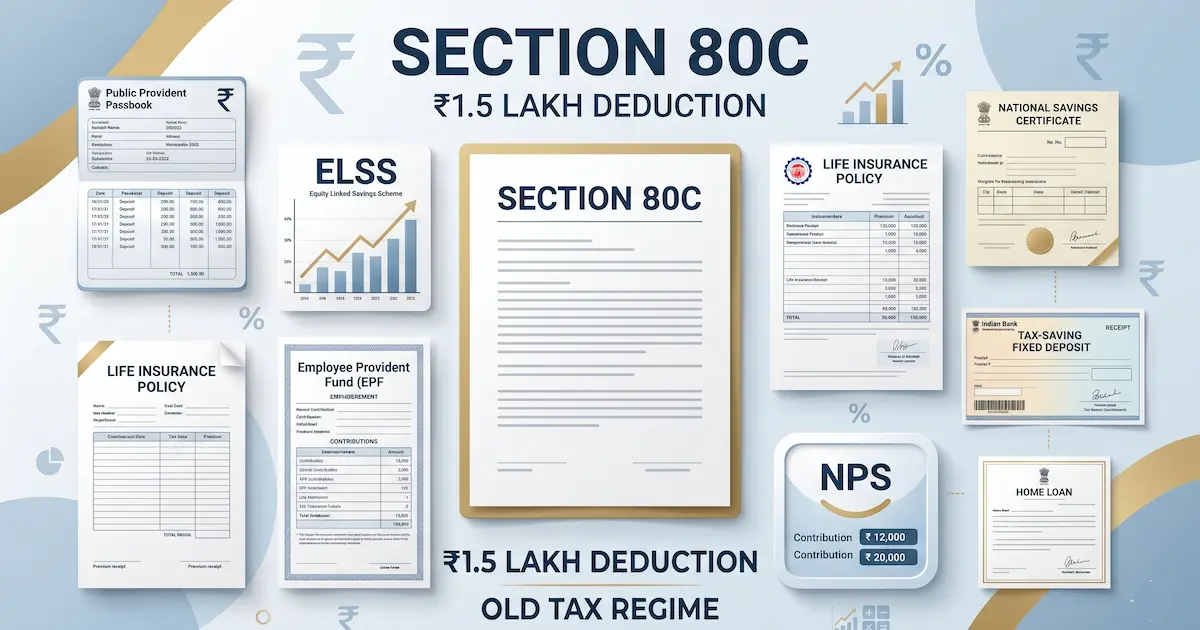
Section 80C cuts up to Rs 1.5 lakh off taxable income under the old regime only. The list, the limit, and where it lands as Section 123.
16 min read
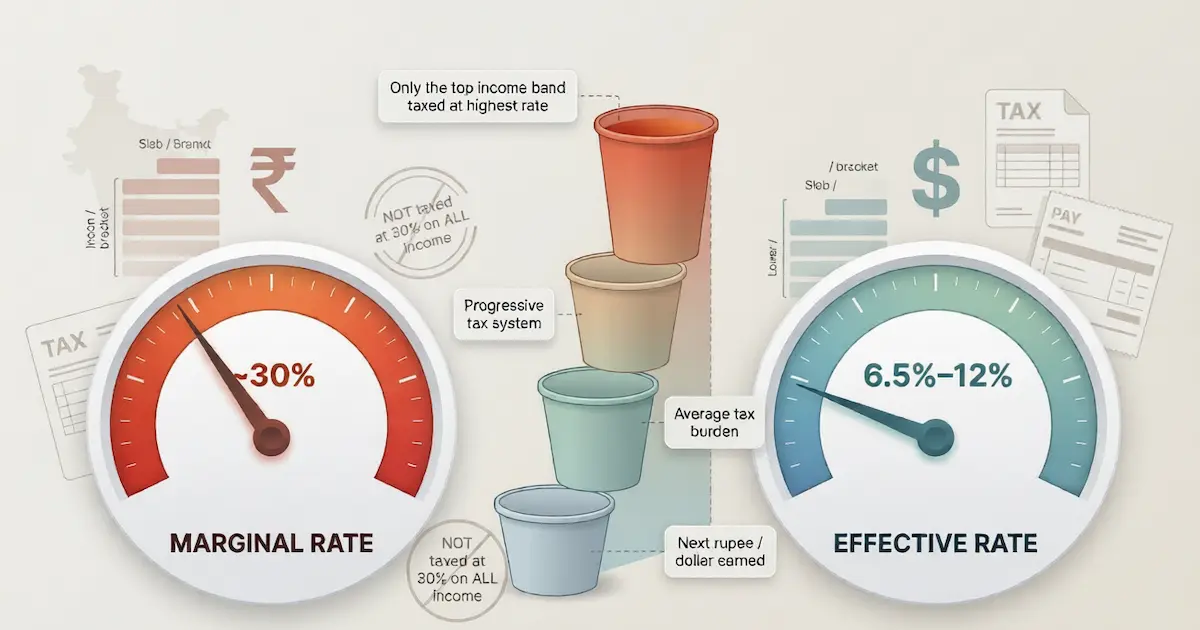
Marginal vs effective tax rate explained: the tax on your next rupee versus total tax over total income, with worked India and US examples and the bracket myth.
15 min read