Marginal vs Effective Tax Rate: What's the Difference?

By Tapabrata Biswas · Updated September 11, 2026 · 15 min read
Researched with AI assistance, reviewed and edited by Tapabrata Biswas.
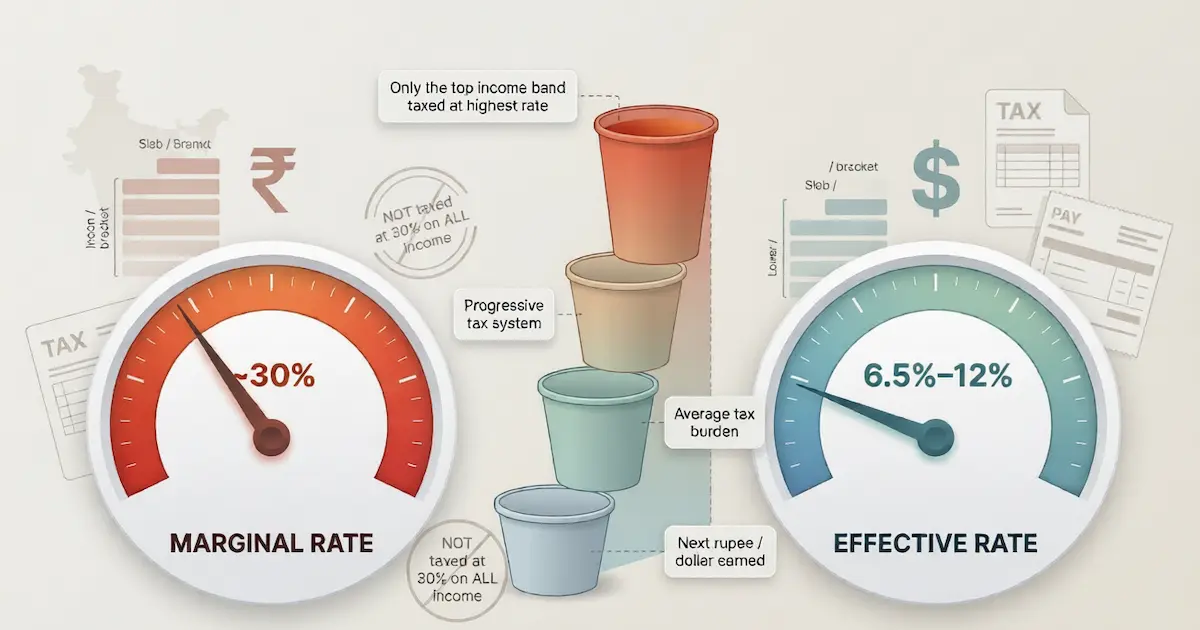
A single number sends people to turn down raises: their tax bracket. "I'm in the 30% slab," the thinking goes, "so a bigger salary just feeds the taxman." It's one of the most expensive misunderstandings in personal finance, and it rests on confusing two different rates. Your bracket is your marginal rate, the rate on your next rupee. What you actually hand over is your effective rate, the average across everything you earn. The two are never equal, and a household earning ₹16 lakh in India can sit in the 15% slab while paying just 7.8%.
This is a research-led explainer of marginal and effective tax rates, which apply to any progressive tax system. It is not tax planning advice. The rates that apply to you depend on your income, your regime choice in India, your deductions, your filing status in the US, and details only a qualified Chartered Accountant or CPA who knows your situation can assess. Consult the right professional for a decision that turns on your exact rate. What follows is the concept: what each rate is, why the effective rate is always lower, the bracket myth worked with a real raise, and which rate to use for which decision.
What is a marginal tax rate?
The marginal tax rate is the percentage applied to your next rupee or dollar of income, which is the rate of the highest slab or bracket your income reaches. It governs money added at the top: a raise, a bonus, side income, or the saving from a deduction.
Progressive systems split income into bands, called slabs in India and brackets in the US, and each band carries its own rate. Your marginal rate is simply the rate of the band your last rupee lands in. A salaried Indian with ₹14.25 lakh of taxable income under the new regime for FY 2025-26 reaches the ₹12 lakh to ₹16 lakh slab, taxed at 15%, so their marginal rate is 15%. The next ₹1 they earn is taxed at 15%, plus the 4% cess. A US single filer with $74,250 of taxable income for tax year 2025 lands in the 22% bracket, so their marginal rate is 22%. This is the number that answers "if I earn a bit more, how much of it do I keep." A ₹1.5 lakh Section 80C deduction for someone at a 15% marginal rate saves 15% of ₹1.5 lakh, or ₹22,500, well short of the headline slab figure. The slab tables these rates come from sit in our income tax slabs guide.
What is an effective tax rate?
The effective tax rate is your total tax divided by your total income, the average rate you actually pay across every band of income combined. It is a smaller, calmer number than the marginal rate, and it is the one that describes your real burden.
Take the same ₹15 lakh salaried case. After the ₹75,000 standard deduction, taxable income is ₹14.25 lakh, the tax works out to ₹97,500 including cess (the full slab-by-slab computation is in the slabs guide), and ₹97,500 divided by ₹15 lakh is an effective rate of 6.5%. Marginal 15%, effective 6.5%. One more piece of vocabulary matters here. Economists and bodies like the Tax Policy Center call this the average tax rate, while tax-preparation sites call it the effective tax rate. They are the same number. The only term that means something different is "your tax bracket," which points to your marginal rate, the rate on your next rupee. Getting those three labels straight, bracket equals marginal, average equals effective, clears up most of the confusion in one line.
Why is your effective rate lower than your tax bracket?
Your effective rate is lower than your bracket because only the top slice of your income is taxed at the bracket rate, while every band below keeps its own lower rate. The gap is structural, built into how the bands work, and it grows wider the more your income spans the lower bands.
Picture your income filling buckets from the bottom up. The first bucket fills at 0%, the next at a low rate, and only the last, partly full bucket sits at your marginal rate. Averaging across all of them lands you well below the top. The clearest way to see it is a ladder of incomes under India's new regime, each with its top slab rate beside its effective rate.
| Taxable income | Top slab rate | Total tax (with 4% cess) | Effective rate |
|---|---|---|---|
| ₹8 lakh | 5% | ₹0 (87A rebate) | 0% |
| ₹12 lakh | 10% | ₹0 (87A rebate) | 0% |
| ₹16 lakh | 15% | ₹1,24,800 | 7.8% |
| ₹24 lakh | 25% | ₹3,12,000 | 13.0% |
| ₹50 lakh | 30% | ₹11,23,200 | 22.5% |
Two rows deserve a second look. At ₹12 lakh, the slab math produces ₹60,000 of tax, but the Section 87A rebate of up to ₹60,000 cancels it, so the effective rate is 0% even though the income runs through slabs taxed up to 10%. Section 87A is the number for FY 2025-26, which is filed under the Income-tax Act 1961. The same rebate is Section 156 of the Income-tax Act 2025, which governs FY 2026-27 onward, and the arithmetic below is unaffected because the rates did not change. That is the sharpest example of the gap anywhere in the system: a positive marginal slab rate sitting on a zero effective rate. And even at ₹50 lakh, where the last rupee is taxed at 30%, the effective rate is 22.5%, because the first ₹24 lakh climbed gently through the lower slabs. The marginal rate is always the ceiling, never the average.
Does moving into a higher tax bracket lower your take-home pay?
No. Moving into a higher slab or bracket never reduces your take-home pay, because only the income above the threshold is taxed at the higher rate. A raise always leaves more in your pocket, and refusing one to "stay in a lower bracket" costs you money.
Work it through in rupees. Someone with ₹15 lakh of taxable income sits in the 15% slab, and takes a ₹2 lakh raise to ₹17 lakh, which crosses into the 20% slab. Only the part above ₹16 lakh moves up: the first ₹1 lakh of the raise is taxed at 15% (₹15,000), the next ₹1 lakh at 20% (₹20,000), for ₹35,000 plus ₹1,400 cess, about ₹36,400 in total tax on the raise. They keep roughly ₹1.64 lakh of the ₹2 lakh. Their pre-raise income is untouched. The US works identically. A single filer with $48,000 taxable, near the top of the 12% bracket, takes a $5,000 raise that crosses into 22%: only about $475 stays at 12% and the remaining $4,525 is taxed at 22%, roughly $1,050 of tax on the $5,000, leaving about $3,950 extra. In both countries the marginal rate on the new money jumped, yet take-home still rose. That is the whole answer to the bracket myth: a higher bracket taxes your next rupees harder, never your existing ones.
Can your real marginal rate be higher than your bracket?
Yes, in narrow zones your true marginal rate on the next rupee can exceed your slab or bracket rate, because crossing a threshold can strip away a rebate or a benefit. These spikes are rare but real, and they're the one case where the "just look at your bracket" shortcut breaks.
India's clearest example sits just above ₹12 lakh. At exactly ₹12 lakh taxable income the 87A rebate makes the tax zero, but a rupee more would, in raw slab terms, lose the entire ₹60,000 rebate and add 15% band tax, an absurd jump. To prevent that cliff, a marginal relief provision caps the tax so it can't exceed the income earned above ₹12 lakh, which means the true marginal rate in the ₹12 lakh to roughly ₹12.75 lakh zone is effectively 100% of the excess for a short stretch before it settles. The US has its own version through phase-outs: as income rises, credits like the Earned Income Tax Credit taper off, so a low-income family can face a true marginal rate well above their 10% or 12% bracket once the lost credit is counted. The lesson is the same in both places. Your statutory bracket is usually your marginal rate, but near a rebate or phase-out threshold, the real rate on the next rupee can be higher.
When does marginal matter, and when does effective?
The marginal rate answers questions about extra income and the effective rate answers questions about total burden, and using the wrong one is a common, costly mistake. Each is correct for its own job.
| Question | Use which rate | Why |
|---|---|---|
| Is this raise, bonus, or overtime worth it? | Marginal | The new income sits at the top of your existing income |
| What is my total tax burden? | Effective | It averages across all slabs |
| How much will a ₹1.5 lakh 80C deduction save? | Marginal | A deduction subtracts from your top band |
| What is my real take-home as a share of gross? | Effective | Total tax over total income |
| Is freelance side income worth taking on? | Marginal | Side income stacks on top |
| What savings rate can my budget support? | Effective | Budgeting works off total income |
| Comparing tax burden across years or households | Effective | It gives an apples-to-apples figure |
The confusion shows up in two predictable places. In salary talk, people estimate the take-home from a raise using their effective rate, which flatters the number, when the raise is taxed at the marginal rate. In budgeting, people estimate their total tax from their marginal rate, which overstates it, when the effective rate is what governs the household. Both rates are right; the error is picking the wrong one for the question. How these rates flow into your actual take-home pay sits in our gross vs net income explainer.
What is your all-in marginal rate?
Your all-in marginal rate is the true percentage taken from your next rupee or dollar once every layer beyond the base slab or bracket is added. It is usually higher than the headline rate, and it's the number that actually governs an earning or investing decision.
In India, the base slab rate is lifted by the 4% health and education cess, which is levied on the tax amount, so a 30% slab becomes about 31.2% on the next rupee. High earners add a surcharge on top: 10% of the tax above ₹50 lakh of income, 15% above ₹1 crore, and 25% above ₹2 crore, capped at 25% under the new regime. In the US, the layers stack higher. A worker's next dollar of wages can carry the federal marginal bracket, a state marginal rate, 7.65% in Social Security and Medicare payroll tax up to the wage base, an extra 0.9% Medicare surtax above $200,000, and a 3.8% Net Investment Income Tax on investment income above the same kind of threshold. A California earner in the 24% federal bracket can face an all-in marginal rate closer to 40% once state tax and payroll are counted. The US payroll layer is broken down in our FICA tax explainer. The exact all-in figure for your situation depends on variables that warrant a CA or CPA computation.
What this post does not cover
This explainer defines the two rates and shows the arithmetic. It stops short of planning. How to lower your marginal rate through income smoothing, deferred compensation, or a regime choice is a tax-planning decision specific to your circumstances, and belongs with a CA or CPA. Which deductions give the biggest benefit depends on your eligible options and full income picture. Whether to manage income around a threshold is a personal decision that turns on the tools available to you. The slab tables and the tax computation themselves live in the income tax slabs post, the across-salary picture for a full return in the salaried income tax guide, and the separate rates on investment profit in the capital gains post. Figures here reflect FY 2025-26 in India and tax year 2025 in the US, current to July 2026, and can change with any Budget or law, so a qualified professional remains the right source for a decision tied to your money.
Frequently asked questions
What is the difference between marginal and effective tax rate? The marginal tax rate is the rate applied to your next rupee or dollar of income, which is the rate of the highest slab or bracket your income reaches. The effective tax rate is your total tax divided by your total income, the average rate across all your income. In a progressive system like India's or the US's, the effective rate is always lower than the marginal rate, because the lower bands of income are taxed at lower rates and only the top slice reaches the marginal rate. For example, an Indian at ₹16 lakh taxable income under the new regime has a 15% marginal rate but only a 7.8% effective rate. The marginal rate answers questions about extra income; the effective rate answers what fraction of your total income went to tax.
Does moving into a higher tax bracket reduce my take-home pay? No. Moving into a higher tax slab or bracket never reduces your take-home pay, because only the income above the threshold is taxed at the higher rate, and everything below keeps its lower rates. If an Indian with ₹15 lakh taxable income takes a ₹2 lakh raise that crosses from the 15% slab into the 20% slab, only the part above ₹16 lakh is taxed at 20%; the raise still leaves about ₹1.64 lakh extra in hand. The same holds in the US: a raise that pushes you from the 12% into the 22% bracket taxes only the dollars above the line at 22%, so your net pay rises. Refusing a raise to stay in a lower bracket always leaves you worse off.
Why is my effective tax rate lower than my tax bracket? Your effective rate is lower than your bracket because a progressive tax system taxes income in bands, and only the top band reaches your bracket rate. Think of your income filling buckets from the bottom up: the first bucket is taxed at 0% or the lowest rate, the next slightly higher, and only the last, partly filled bucket sits at your top rate. When you average the tax across every band, the result lands well below the top rate. In India's new regime, someone reaching the 15% slab still pays 0% on their first ₹4 lakh, 5% on the next ₹4 lakh, and 10% on the ₹4 lakh after that, so their overall effective rate is a fraction of 15%.
Is the effective tax rate the same as the average tax rate? Yes. The effective tax rate and the average tax rate are the same number: total tax divided by total income, expressed as a percentage. The two names come from different sources. Consumer and tax-preparation sites tend to say effective tax rate, while economists and policy bodies like the Tax Policy Center say average tax rate. Both mean the same thing and both are always lower than the marginal rate in a progressive system. The one term that means something different is your tax bracket, which names your marginal rate, the rate on your next rupee or dollar, not the average you actually pay.
Should I use the marginal or effective rate to evaluate a raise? Use the marginal rate to evaluate a raise, bonus, freelance income, or the tax saving from a deduction, because that new money sits at the top of your income and is taxed at your marginal rate. If you are at a 15% marginal slab in India, a ₹1 lakh bonus is taxed at roughly 15% plus cess, so you keep about ₹84,000 of it. Use the effective rate for your total tax burden, your real take-home as a share of gross, and budgeting or savings-rate planning, because it averages across all your income. Using the effective rate to judge a raise understates the tax on it, and using the marginal rate to judge your total burden overstates it.
Can income up to ₹12 lakh really have a 0% effective tax rate? Yes, under India's new regime for FY 2025-26, taxable income up to ₹12 lakh has a 0% effective tax rate, because the Section 87A rebate of up to ₹60,000 exactly cancels the slab-calculated tax at that level. The income still passes through slabs taxed at 5% and 10%, so the marginal slab rate is positive, but the rebate wipes out the bill, leaving an effective rate of zero. Just above ₹12 lakh, a marginal relief provision stops a small rise in income from triggering a large tax jump, so the effective rate inches up gradually. The full mechanics sit in our income tax slabs guide.
Sources
- Income Tax Department of India, Tax slabs for individuals, AY 2026-27 (incometax.gov.in)
- ClearTax, Income tax slabs FY 2025-26 (cleartax.in)
- US Internal Revenue Service, Federal income tax rates and brackets (irs.gov)
- Tax Foundation, 2026 federal income tax brackets (taxfoundation.org)
- Tax Policy Center, Difference between marginal and average tax rates (taxpolicycenter.org)




You might also like

Income tax slabs in India for FY 2025-26 (AY 2026-27): new and old regime rates, the ₹12.75 lakh salaried zero-tax point, the 87A rebate, surcharge, and cess.
18 min read

Which Act governs the return you file this July, the FY 2025-26 slabs and Rs 60,000 rebate, and the 30-day e-verification rule that quietly makes returns late.
27 min read

Short versus long-term rates in India and the US: the 12.5% LTCG and Rs 1.25 lakh exemption, the US 0/15/20% brackets, and the new sections.
20 min read