Capital Gains Tax: Short-Term vs Long-Term, India and US

By Tapabrata Biswas · Updated August 29, 2026 · 20 min read
Researched with AI assistance, reviewed and edited by Tapabrata Biswas.
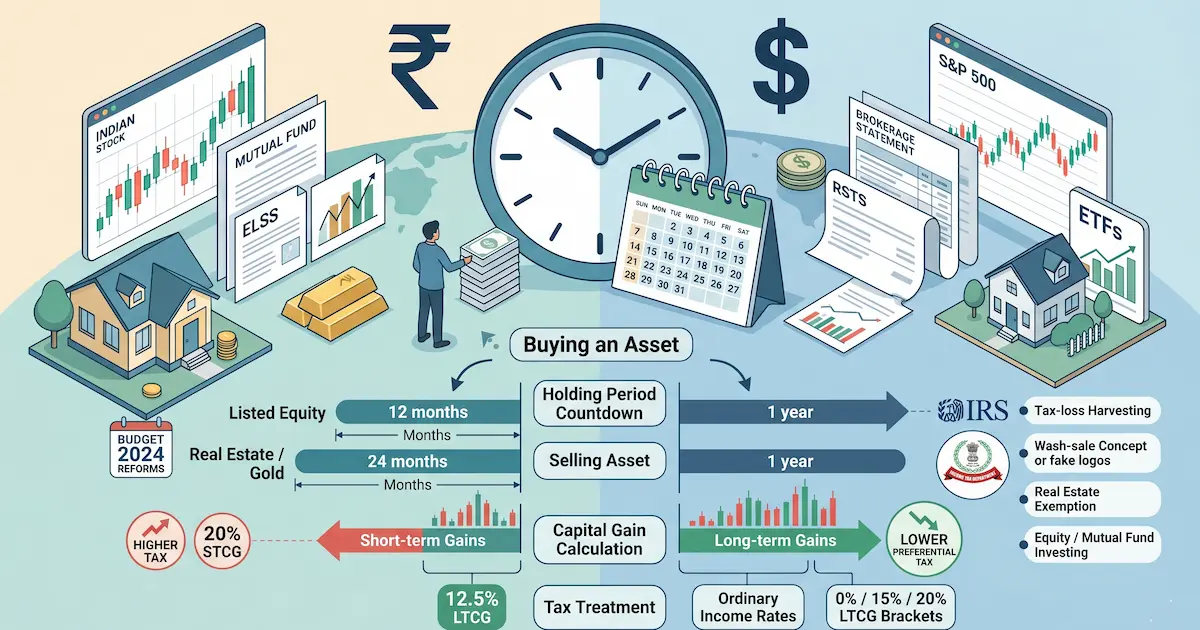
Sell equity mutual funds on 22 July 2024 and the long-term tax was 10%. Sell the same units on 23 July 2024 and it became 12.5%. One day rewrote the rate on nearly every asset an Indian household owns, and the change is now the settled law for the returns being filed this season. The US, by contrast, has held its 0%, 15%, and 20% long-term rates steady for years. Two systems, one shared idea: hold longer, pay less.
This is a research-led explainer of capital gains tax in India (under the Income Tax Act, 1961, as amended by the Finance No. 2 Act, 2024) and the United States (under the Internal Revenue Code). It is not tax or investment advice. The right rate for your sale depends on the asset, the holding period, an indexation choice, exemptions under Sections 54, 54EC, and 54F in India or Sections 121 and 1031 in the US, and details only a qualified Chartered Accountant or CPA who knows your situation can assess. Consult the right professional before acting. What follows is the structure: the short-versus-long split, India's post-Budget-2024 rates by asset, the indexation story, the US brackets, a side-by-side, and worked examples in both currencies.
What is capital gains tax?
Capital gains tax is the tax on the profit from selling a capital asset, calculated as the sale price minus the purchase cost minus allowable expenses, with the rate set by how long the asset was held. Three pieces make up that definition, and each one matters.
A capital asset is broadly anything held as an investment: shares, mutual fund units, land, buildings, gold, bonds. India defines it in Section 2(14) of the Income Tax Act, with specific carve-outs. The capital gain is the profit, not the sale value, so if you buy at ₹3 lakh and sell at ₹5 lakh, the ₹2 lakh difference is what gets taxed, less brokerage, stamp duty, and similar costs. The rate then turns on the holding period, splitting every gain into short-term or long-term. Governments tax long-term gains more gently on purpose, to reward patient capital and to lean against rapid speculative churn. Whether that incentive actually works is debated, but the rate gap is real money, and it is the single most important number to know before you sell.
Short-term vs long-term: what's the difference?
The difference between short-term and long-term capital gains is the holding period, and crossing it usually cuts the tax rate sharply. Where the line sits depends on the country and the asset.
In India, listed equity shares and equity mutual funds turn long-term after just 12 months. Property, gold, unlisted shares, and most other assets need 24 months. The old 36-month category is gone, simplified in Budget 2024. In the US, the rule is one clean threshold: hold more than one year and the gain is long-term, hold a year or less and it's short-term. The reward for waiting is large. Indian equity held 11 months is taxed at 20%; held 13 months, it drops to 12.5%. A US asset sold at month 11 is taxed as ordinary income, up to 37%; sold at month 13, it can be taxed at 0%. That cliff, sitting on a single calendar date, is why the sale date matters as much as the sale price.
What are India's capital gains tax rates for FY 2025-26?
For FY 2025-26, Indian listed equity is taxed at 20% short-term and 12.5% long-term above a ₹1.25 lakh yearly exemption, while most other assets held over 24 months are taxed at 12.5% long-term without indexation. The rates come from Budget 2024 and vary by asset class.
| Asset | Long-term after | STCG | LTCG |
|---|---|---|---|
| Listed equity, equity mutual funds (STT paid) | 12 months | 20% (Sec 111A) | 12.5% above ₹1.25 lakh/yr (Sec 112A) |
| Property (land or building) | 24 months | slab rate | 12.5% without indexation, or the 20%-with-indexation option |
| Gold, jewellery | 24 months | slab rate | 12.5% without indexation |
| Unlisted shares | 24 months | slab rate | 12.5% without indexation |
| Debt mutual funds bought on or after 1 Apr 2023 | never long-term | slab rate always | not applicable |
| Bonds, debentures | 24 months | slab rate | 12.5% |
Two nuances hide behind the headline rates. First, the ₹1.25 lakh equity exemption is annual and applies only to Section 112A gains, so ₹1.25 lakh of listed-equity LTCG each year is free before the 12.5% starts. Second, the 12.5% is not always the final number. A surcharge applies to high incomes, capped at 15% for equity gains under Sections 111A and 112A, and a 4% health and education cess sits on top of the tax for everyone. So an equity LTCG "at 12.5%" can carry a little more once cess is added.
Our capital gains tax calculator applies all of this to a sale of your own, surcharge cap and 4% cess included, and it settles which Act governs the sale before it computes anything. The surcharge and cess mechanics themselves live in our income tax slabs guide.
What did Budget 2024 change, and did Budget 2025 or 2026 touch it?
Budget 2024, effective 23 July 2024, overhauled India's capital gains tax, and neither Budget 2025 nor Budget 2026 changed it since. The July 2024 date is the hinge the whole system now turns on.
Four things changed at once. Equity STCG rose from 15% to 20%. Equity LTCG rose from 10% to 12.5%, with the annual exemption lifted from ₹1 lakh to ₹1.25 lakh. LTCG on non-equity assets was unified at 12.5% with indexation stripped out for most cases. And holding periods were collapsed to two: 12 months for listed securities, 24 months for everything else. The one wrinkle that trips people up is the mid-year split. A sale before 23 July 2024 used the old rates, a sale on or after used the new ones, so two transactions in the same financial year can carry different rates purely by date. For FY 2025-26, that ambiguity is gone: the whole year sits under the new regime. Watch for pages that still show 10% LTCG, a ₹1 lakh exemption, or 15% STCG, and for older guides listing property as long-term only after 36 months. Those are stale.
What the Income-tax Act 2025 changes for capital gains
Capital gains are the one part of this cluster where the changeover has already happened. Everywhere else, the rule is that FY 2025-26 is still filed under the 1961 Act. Capital gains follow the date of transfer, and the Income-tax Act 2025 commenced on 1 April 2026. So the figures above are right for a sale made on or before 31 March 2026, and a sale made today sits under the new Act.
| 1961 Act | 2025 Act | Heading in the new Act |
|---|---|---|
| 111A | 196 | Tax on short-term capital gains in certain cases |
| 112 | 197 | Tax on long-term capital gains |
| 112A | 198 | Tax on long-term capital gains in certain cases |
The rates did not move. 12.5% above ₹1.25 lakh on listed equity long-term gains sits at Section 198(2), the 20% short-term rate at Section 196(1)(i), the 12.5% residual long-term rate at Section 197(1)(b), and the 12 and 24 month holding periods at Section 2(101). The surcharge cap of 15% and the 4% cess carry over through the Finance Act 2026.
One thing genuinely did change, and it tidies up a mess. Under the 1961 Act, the land-and-building indexation option was written by comparing against "the provisions of this Act as they stood immediately before their amendment by the Finance (No. 2) Act, 2024", which after 1 April 2026 points at a repealed statute. Section 197(3) replaces that with an explicit formula, E = A minus B, where B is the tax at 20% on indexed cost. Same outcome, but stated rather than cross-referenced. Indexation now exists for that one purpose, feeding item B, under Section 72(2).
The 23 July 2024 split also stops doing any work. The option turns on when the property was bought, before 23 July 2024, and since the new Act only reaches transfers from 1 April 2026 onward, the old condition about selling on or after 23 July 2024 is satisfied by every transfer it can apply to. Pages still printing both halves of that test are carrying forward wording that no longer separates anything.
A caution for anyone checking the Act text themselves. Extracting text from the consolidated PDF floats a footnote reading "Substituted for '60%' by the Finance Act, 2026" into the middle of Section 196, immediately above the 20% rate. That footnote belongs to Section 195(1)(i), where the Finance Act 2026 cut the rate on unexplained income from 60% to 30%. Section 196's 20% carries no amendment footnote at all. A hurried read of that PDF misreports the short-term rate.
And the Cost Inflation Index moved statute. The index of 384 for Tax Year 2026-27 was notified under Section 72(8)(a) of the 2025 Act, by Notification 85/2026, S.O. 3889(E), dated 15 July 2026. Every earlier value sits under Section 48 of the 1961 Act, so 384 is the first index notified under the new statute and attributing it to Section 48 is wrong. The full old-to-new map is in our Income-tax Act 2025 section mapping.
How does indexation work now, and what is grandfathered?
Indexation, which adjusts an asset's purchase price upward for inflation to shrink the taxable gain, was removed for almost all assets from 23 July 2024, and now survives only as an option on older property. Understanding what's left is where real money is decided.
The surviving case is narrow but valuable. A resident individual or HUF selling land or a building acquired before 23 July 2024 can choose the lower of two computations: 20% with indexation, or 12.5% without. NRIs, companies, and firms don't get the choice, and it never applies to gold, shares, or debt funds. Take a flat bought in FY 2010-11 for ₹30 lakh and sold in FY 2025-26 for ₹90 lakh. Without indexation, the gain is ₹60 lakh and the tax at 12.5% is ₹7,50,000. With indexation, using the Cost Inflation Index of 376 for FY 2025-26 against 167 for FY 2010-11, the indexed cost rises to about ₹67.5 lakh, the gain shrinks to roughly ₹22.5 lakh, and the tax at 20% is about ₹4,49,000. Here indexation wins by around ₹3 lakh. The pattern: long holds with modest appreciation favour 20% with indexation, while short holds or steep price jumps favour the flat 12.5%. No single page in the field works this crossover, yet it decides thousands of rupees on a single sale.
Two more grandfathering rules matter. For listed equity, gains up to 31 January 2018 are protected: the cost of acquisition is the higher of the actual cost or the lower of the 31 January 2018 fair market value and the sale price, so only post-2018 appreciation is taxed. And for debt mutual funds, the date to watch is 1 April 2023, not July 2024. Units bought on or after 1 April 2023 are "specified mutual funds" under Section 50AA, taxed at slab rates as short-term no matter how long you hold them. Units bought before that date and held over 24 months still get 12.5% LTCG. Confusing the two dates is the most common debt-fund mistake on the entire SERP.
How are capital gains taxed in the US?
In the US, gains on assets held one year or less are short-term and taxed as ordinary income, while gains on assets held longer than a year are long-term and taxed at 0%, 15%, or 20% by income. The long-term rates are the gentlest in the developed world for many households.
| Filing status (tax year 2025) | 0% up to | 15% up to | 20% above |
|---|---|---|---|
| Single | $48,350 | $533,400 | $533,400 |
| Married filing jointly | $96,700 | $600,050 | $600,050 |
| Head of household | $64,750 | $566,700 | $566,700 |
For tax year 2026, inflation lifts the single-filer 0% ceiling to $49,450 and the 15%-to-20% breakpoint to $545,500, with married-jointly at $98,900 and $613,700. Short-term gains get no such break: they stack on top of wages and are taxed at the ordinary brackets, up to 37% federally plus state tax. Three further layers shape the real bill. A 3.8% Net Investment Income Tax applies above $200,000 of income for singles and $250,000 for married-jointly, lifting the top long-term rate to 23.8%. Collectibles like art and coins are capped at 28%, and the depreciation portion of a real-estate gain (unrecaptured Section 1250 gain) is capped at 25%. Capital losses offset gains fully and up to $3,000 of ordinary income a year, with the rest carried forward. And the wash-sale rule disallows a loss if you rebuy a substantially identical security within 30 days, a trap India has no equivalent to.
India vs US capital gains, side by side
India and the US both split gains by holding period, but they diverge on the exemption, on indexation, and on how they treat repurchased losses. Seeing them together is the fastest way to grasp either.
| Feature | India | US |
|---|---|---|
| Long-term holding period | 12 months equity, 24 months most others | Over 12 months, all assets |
| Short-term rate | 20% equity, slab for other assets | Ordinary income, up to 37% |
| Long-term rate | 12.5% (equity above ₹1.25 lakh; most assets) | 0%, 15%, or 20% by income |
| Annual exemption | ₹1.25 lakh on equity LTCG | None, every dollar taxed |
| Inflation indexation | Removed, except an option on old property | Never existed |
| Loss on quick repurchase | Allowed, no wash-sale rule | Disallowed within 30 days |
| High-earner add-on | 15% surcharge cap on equity gains, plus 4% cess | 3.8% NIIT above $200k or $250k |
The sharpest contrast is the exemption. An Indian investor can book ₹1.25 lakh of equity long-term gains every year and pay nothing on it, while a US investor pays on the first dollar, just at a preferential rate. The US trades that away for its 0% bracket, which lets a low-income year absorb sizeable long-term gains tax-free. Neither is simply better. They reward different behaviour.
Worked examples in ₹ and $
A real number shows how the exemption and the rate combine, and how much the short-versus-long line actually costs. Start with Indian equity.
An investor sells equity mutual fund units for ₹8 lakh in FY 2025-26, having bought them three years earlier for ₹5 lakh. The gain is ₹3 lakh, long-term. Subtract the ₹1.25 lakh annual exemption and ₹1.75 lakh is taxable at 12.5%, which is ₹21,875, plus 4% cess of ₹875, for ₹22,750 in total. The effective rate on the full ₹3 lakh gain is about 7.6%, held down by the exemption. Had the same ₹3 lakh gain been short-term, sold inside 12 months, it would face 20% under Section 111A, roughly ₹60,000 plus cess, nearly triple the tax on the identical profit.
Now the US. An investor in the 15% long-term bracket sells stock for $50,000 that cost $30,000, held 18 months. The $20,000 long-term gain is taxed at 15%, or $3,000 federally, before any state tax (California would add about 9.3% as ordinary income, Texas and Florida nothing). Sold at month 11 instead, that $20,000 would be short-term, taxed at the investor's ordinary rate, say 22%, for $4,400 federally, before state tax. The one-year mark is worth $1,400 here on a single sale.
Exemptions and capital losses
Both countries let you defer or reduce capital gains tax through specific statutory routes, each with strict conditions best confirmed with a professional. These are the main individual-level provisions, not a how-to.
In India, Section 54 exempts LTCG from a residential property if reinvested in another residential property within set time limits, capped at ₹10 crore. Section 54EC allows up to ₹50 lakh of LTCG to be parked in specified NHAI or REC bonds within six months, with a five-year lock-in. Section 54F covers LTCG from any asset other than a house, reinvested into a residential property. In the US, Section 121 excludes up to $250,000 of gain on a primary residence, or $500,000 for a married couple, if it was the main home for two of the last five years, and Section 1031 defers gain on investment real estate swapped for like-kind property. Both countries let capital losses offset capital gains: India allows short-term losses against any gain and long-term losses against long-term gains, carried forward eight years, while the US caps the ordinary-income offset at $3,000 a year. How any of these applies to a specific sale, and how capital gains slot into a salaried return that may need ITR-2, is covered in our salaried income tax guide and best settled with a CA.
What this post does not cover
This explainer defines capital gains tax and works the arithmetic. It stops short of decisions and procedure. Whether to sell now or hold for long-term treatment is investment-plus-tax planning that needs a SEBI-registered adviser or a fiduciary planner, not a general article. How to actually claim a Section 54 exemption, including the Capital Gains Account Scheme and its deadlines, needs a CA's case-specific guidance. Whether tax-loss harvesting is worth it depends on your whole portfolio and the wash-sale and dividend-stripping rules. How capital gains interact with your slab or regime choice sits in the income tax slabs post and the tax concepts hub, and note that in India capital gains are taxed at their own statutory rates regardless of old or new regime. The Section 87A rebate does not cover these special-rate gains. Figures here reflect law current to July 2026 and can change with any Budget or amendment, so a qualified Chartered Accountant or CPA remains the right source for a decision tied to your money.
Frequently asked questions
Which sections cover capital gains under the Income-tax Act 2025? Sections 196, 197 and 198, and they took over from 1 April 2026. Section 111A becomes Section 196, tax on short-term capital gains in certain cases. Section 112 becomes Section 197, tax on long-term capital gains. Section 112A becomes Section 198, tax on long-term capital gains in certain cases. The rates carried over intact: 12.5% above ₹1.25 lakh on listed equity long-term gains under Section 198(2), 20% short-term under Section 196(1)(i), 12.5% on residual long-term gains under Section 197(1)(b), and the 12 and 24 month holding periods under Section 2(101). Capital gains differ from the rest of the tax cluster in one important way. They follow the date of transfer, so a sale made today already falls under the new Act and its numbering, even though the return being filed for FY 2025-26 is still governed by the 1961 Act.
What is capital gains tax in simple terms? Capital gains tax is the tax you pay on the profit from selling a capital asset such as shares, mutual fund units, property, or gold. It applies only to the gain, meaning the sale price minus the purchase cost minus allowable expenses, not to the whole sale amount. The rate depends on how long you held the asset. A shorter holding period is taxed as a short-term capital gain (STCG), usually at a higher rate, and a longer holding period is taxed as a long-term capital gain (LTCG), usually lower. The exact holding periods and rates differ by asset class and country. India and the US both use this short-versus-long split, with very different numbers.
What is the difference between short-term and long-term capital gains? The difference is the holding period, the length of time you owned the asset before selling, and it changes both the classification and the rate. In India, listed equity and equity mutual funds become long-term after 12 months, while property, gold, unlisted shares, and most other assets become long-term after 24 months. In the US, any asset held more than one year is long-term. Long-term gains are taxed more gently: in India equity LTCG is 12.5% above a ₹1.25 lakh exemption, and in the US long-term rates are 0%, 15%, or 20%. Short-term gains are taxed harder: 20% on Indian equity, slab rates on other Indian assets, and ordinary income rates up to 37% in the US.
What are the capital gains tax rates in India for FY 2025-26? For FY 2025-26, listed equity and equity mutual funds are taxed at 20% short-term (Section 111A) and 12.5% long-term above a ₹1.25 lakh annual exemption (Section 112A), with a 12-month long-term holding period. Property, gold, and unlisted shares held over 24 months are taxed at 12.5% long-term without indexation, and at slab rates if short-term. Debt mutual funds bought on or after 1 April 2023 are taxed at slab rates regardless of holding period. These rates come from Budget 2024, effective 23 July 2024, and Budget 2025 and Budget 2026 left them unchanged. A surcharge (capped at 15% on equity gains) and a 4% cess apply on top, so the headline rate is not always the final rate.
Is indexation still available on capital gains in India? Mostly no. Budget 2024 removed the indexation benefit (adjusting the purchase price for inflation using the Cost Inflation Index) for almost all assets from 23 July 2024, replacing it with a flat 12.5% long-term rate. One exception remains: a resident individual or HUF selling land or a building that was acquired before 23 July 2024 can choose to pay the lower of 20% with indexation or 12.5% without indexation. That option does not apply to NRIs, companies, or firms, and it does not apply to gold, shares, or debt funds. For everything else, indexation is gone and the 12.5% rate applies to the full nominal gain.
How are capital gains taxed in the US? In the US, capital gains are split by a one-year holding period. Assets held one year or less are short-term and taxed as ordinary income at the taxpayer's marginal rate, up to 37% federally. Assets held more than one year are long-term and taxed at preferential rates of 0%, 15%, or 20%, depending on taxable income: for a single filer in tax year 2025, 0% up to $48,350, 15% up to $533,400, and 20% above that. High earners also pay a 3.8% Net Investment Income Tax above $200,000 (single) or $250,000 (married filing jointly), pushing the top rate to 23.8%. Unlike India, the US has no annual exemption, so every dollar of gain is taxable, and it has a wash-sale rule that disallows a loss if you rebuy within 30 days.
Did Budget 2025 or Budget 2026 change capital gains tax? No. The big change was Budget 2024, effective 23 July 2024, which raised equity STCG from 15% to 20%, raised equity LTCG from 10% to 12.5%, lifted the equity exemption from ₹1 lakh to ₹1.25 lakh, removed indexation for most assets, and simplified holding periods to 12 and 24 months. Budget 2025 (February 2025) and Budget 2026 (February 2026) made no change to these headline capital gains rates, thresholds, or holding periods, so the Budget 2024 structure is the one that applies to FY 2025-26 returns being filed now. As always, confirm against the latest Income Tax Department notification before filing.
Sources
- Income Tax Department of India, Capital gains, Sections 45 to 55A (incometax.gov.in)
- Ministry of Finance, Finance (No. 2) Act 2024, capital gains rationalisation (indiabudget.gov.in)
- ClearTax, Capital gains tax on shares and mutual funds, FY 2025-26 (cleartax.in)
- US Internal Revenue Service, Topic 409, capital gains and losses (irs.gov)
- US Internal Revenue Service, Net Investment Income Tax (irs.gov)
- Central Board of Direct Taxes, Cost Inflation Index, Notification 70/2025 (incometaxindia.gov.in)




You might also like
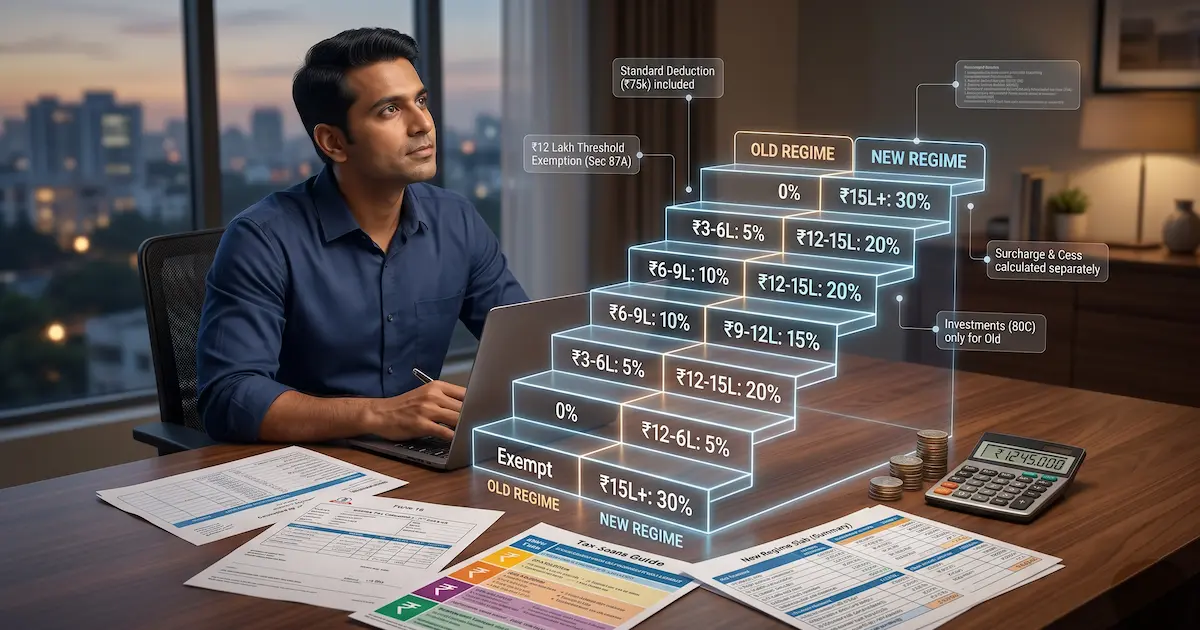
Income tax slabs in India for FY 2025-26 (AY 2026-27): new and old regime rates, the ₹12.75 lakh salaried zero-tax point, the 87A rebate, surcharge, and cess.
18 min read

Which Act governs the return you file this July, the FY 2025-26 slabs and Rs 60,000 rebate, and the 30-day e-verification rule that quietly makes returns late.
27 min read
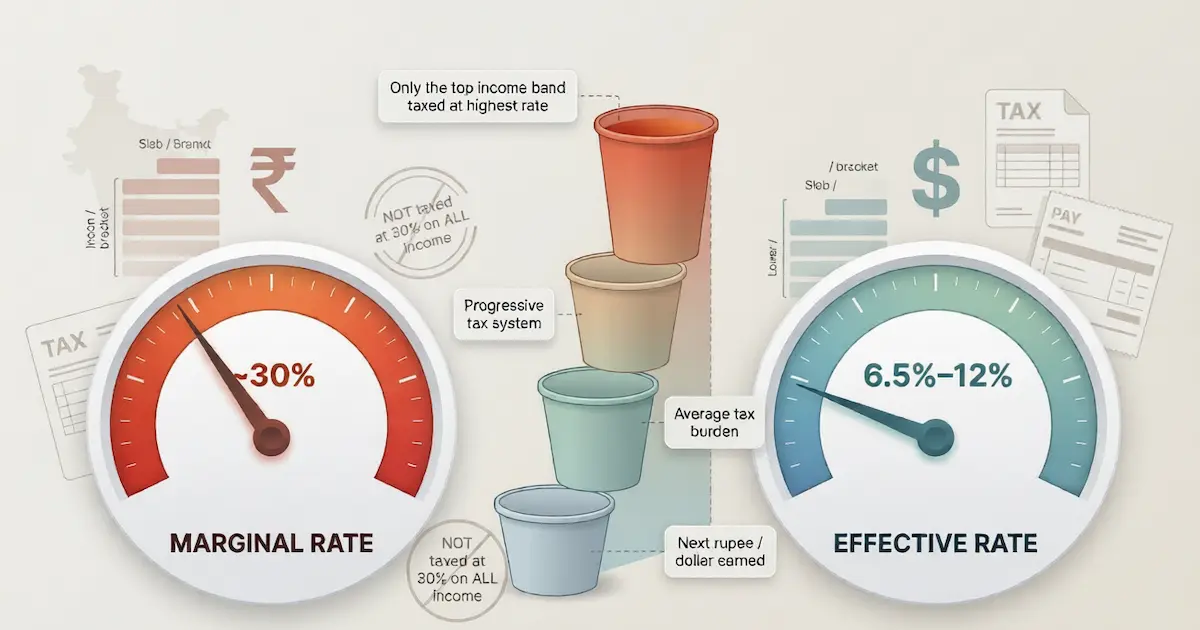
Marginal vs effective tax rate explained: the tax on your next rupee versus total tax over total income, with worked India and US examples and the bracket myth.
15 min read