What Is TDS? Full Form, Rates, and Sections (2025-26)

By Tapabrata Biswas · Updated September 11, 2026 · 15 min read
Written and fact-checked by Tapabrata Biswas. How I write
Reviewed by Subir Kumar Debsharma, Tax, GST and ROC professional with 20+ years of experience.
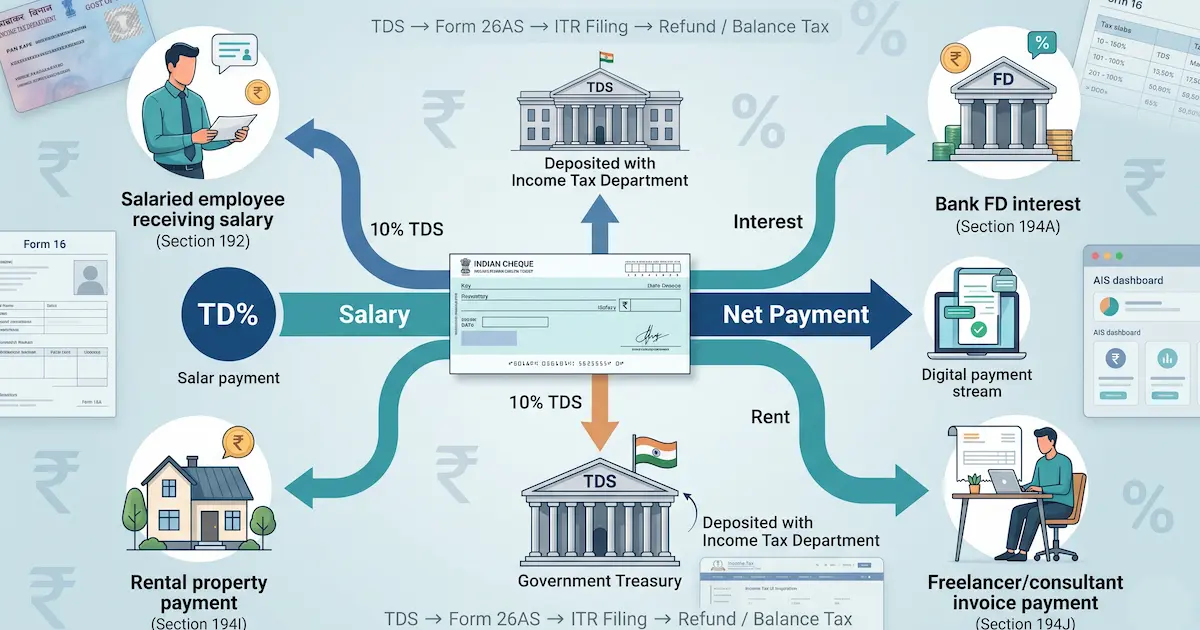
The word TDS confuses people twice over. Type it into a search box and you'll get water purifiers (Total Dissolved Solids) sitting next to income tax, so let's settle it: this is the tax kind. And even among taxpayers, the salaried worker staring at a smaller-than-expected payslip rarely gets a straight answer about the deduction. This guide gives one, for FY 2025-26, from the payee's side.
Nothing here is tax advice. TDS rates and thresholds turn on the exact nature of a payment, and applying them to your situation is a job for a Chartered Accountant, so consult one for anything specific. What follows is definitional: what TDS is, the current section rates, and how it lands back in your return.
What is TDS (tax deducted at source)?
TDS (Tax Deducted at Source) is income tax that the payer withholds from certain payments, such as salary, interest, rent, and professional fees, and deposits with the government against the recipient's PAN. So if a payment is covered, you receive it already net of tax, and the deductor sends that slice to the government for you.
Two roles run the whole system. The deductor is whoever makes the payment, your employer, your bank, your tenant, and is legally responsible for cutting the tax and depositing it. The deductee is you, the one whose income it is. The tax comes out at the time of payment or when it's credited in the books, whichever is earlier, and the deductor pays it to the government by the 7th of the next month.
The point of it is collection at the source, per the Income Tax Department, so tax arrives steadily as income is earned, well before the year-end reckoning, which also makes evasion harder. The part that trips people up: TDS is not a separate or extra tax. It's an advance instalment of the income tax you'd owe anyway, and it gets credited back to you at filing, which the reconciliation section below covers.
What are the main TDS sections and rates for FY 2025-26?
Each type of payment has its own TDS section, threshold, and rate, and for FY 2025-26 the interest, rent, and professional-fee limits all went up from 1 April 2025. The table below covers the sections a regular taxpayer actually runs into.
| Section | Payment | Who it usually hits | Threshold (FY 2025-26) | Rate |
|---|---|---|---|---|
| 192 | Salary | Salaried employees | Basic exemption / slab | Slab rate |
| 194A | Interest (bank, post office) | FD and deposit holders | ₹50,000 (₹1,00,000 for seniors) | 10% |
| 194 | Dividends | Shareholders | ₹10,000 | 10% |
| 194C | Contractor payments | Contractors, businesses | ₹30,000 single or ₹1,00,000 a year | 1% individual, 2% others |
| 194H | Commission, brokerage | Agents, brokers | ₹20,000 | 2% |
| 194I | Rent | Landlords, business tenants | ₹50,000 a month | 10% land/building, 2% plant |
| 194J | Professional or technical fees | Freelancers, consultants | ₹50,000 | 10% professional, 2% technical |
| 194Q | Purchase of goods | Large buyers | ₹50 lakh | 0.1% |
| 194IA | Sale of property | Property sellers | ₹50 lakh | 1% |
| 194N | Cash withdrawal | Heavy cash withdrawers | ₹1 crore (₹20 lakh for non-filers) | 2% (5% above ₹1 crore for non-filers) |
| 194T | Payments by a firm to a partner | Partners in firms and LLPs | ₹20,000 | 10% |
A couple of the numbers deserve a flag because they're new for this year. Salary TDS under Section 192 has no fixed threshold; your employer estimates your annual tax under whichever regime you pick and spreads it across your monthly pay. And Section 194T is genuinely new, effective 1 April 2025: for the first time, a partnership firm or LLP must deduct 10% on remuneration, interest, or bonus paid to a partner once the yearly total crosses ₹20,000, and the tax then applies to the whole amount, not just the excess.
Our TDS calculator applies these thresholds to a payment of your own using the Budget 2025 numbers, and it works out which Act governs the deduction first.
What did Budget 2025 change?
Budget 2025 raised several TDS thresholds and scrapped the higher-rate penalty for non-filers, all effective 1 April 2025. If you're reading an older TDS chart, these are the lines most likely to be wrong.
| Section | Old threshold (FY 2024-25) | New threshold (FY 2025-26) |
|---|---|---|
| 194A interest (general) | ₹40,000 | ₹50,000 |
| 194A interest (senior citizens) | ₹50,000 | ₹1,00,000 |
| 194I rent | ₹2,40,000 a year | ₹50,000 a month |
| 194J professional/technical fees | ₹30,000 | ₹50,000 |
| 194H commission, brokerage | ₹15,000 | ₹20,000 |
| 194 dividends | ₹5,000 | ₹10,000 |
Beyond the thresholds, the headline change is a deletion. Section 206AB, which forced deductors to charge a higher TDS rate to anyone who hadn't filed their income tax returns, was removed from 1 April 2025 along with its TCS twin, Section 206CCA. Your filing history no longer changes your TDS rate. One more shift worth knowing: commission and brokerage under Section 194H moved to a flat 2% (down from 5%) back in October 2024, so that rate is now settled at 2%.
What happens if you do not give your PAN?
Without a valid PAN, TDS is deducted at the higher of the section rate or 20%, under Section 206AA. This is the one penalty that survived Budget 2025, and it's a steep one, because 20% often dwarfs the normal rate.
There's a modern twist: an inoperative PAN, meaning one not linked to Aadhaar, is now treated exactly like no PAN, so it triggers the same 20%. Two payment types cap the hit at 5% (e-commerce under 194-O and purchase of goods under 194Q), but for everything else, no valid PAN means 20%. Since Section 206AB is gone, the old worry about a still-higher rate for non-filers no longer applies; only the no-PAN rule remains.
Where does your TDS show up?
Every rupee of TDS deducted from you is credited against your PAN and appears in three documents you use to file: Form 16, Form 26AS, and the AIS. This is how the advance tax finds its way back to you.
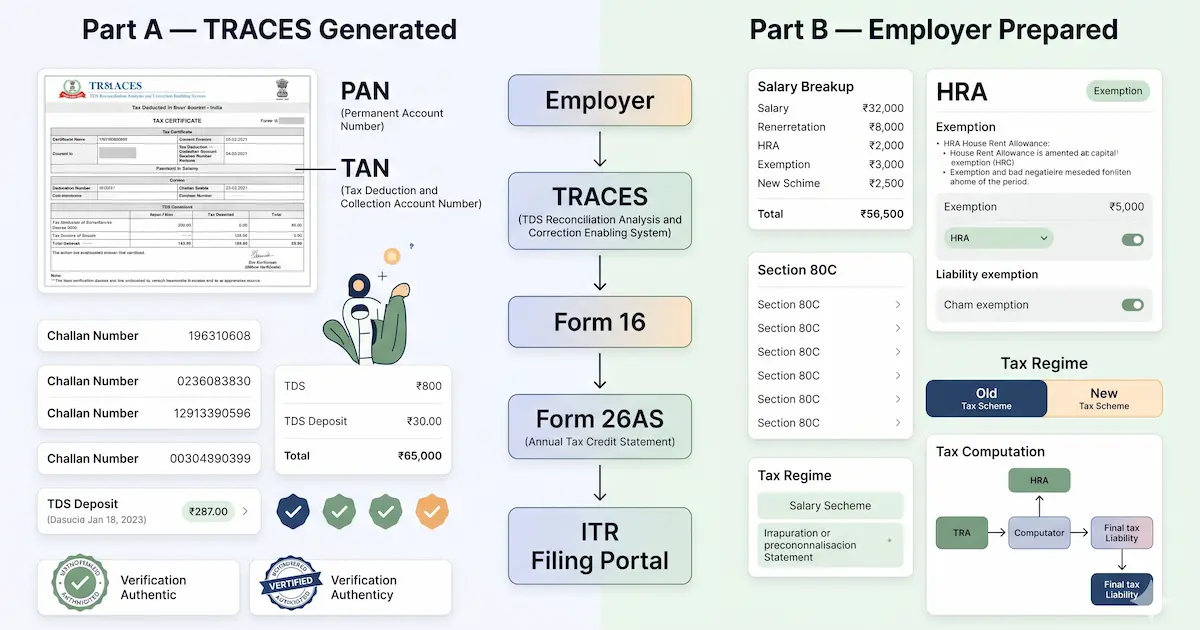
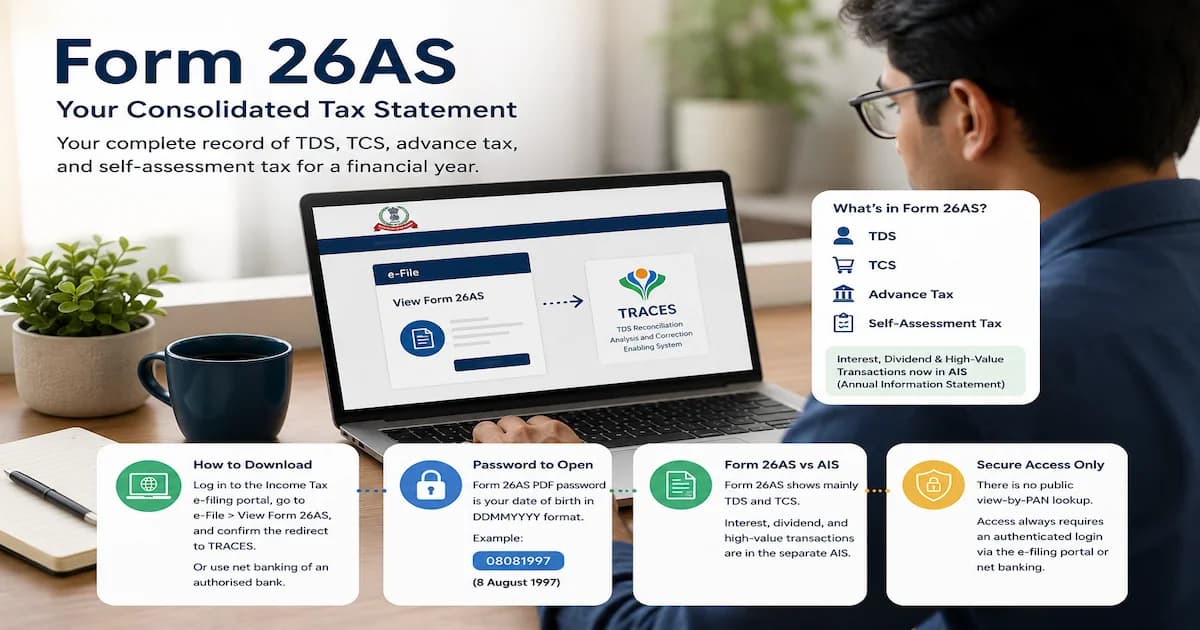
Your employer's salary TDS is certified on Form 16, the salary TDS certificate. Across all payers, the total shows up in Form 26AS, the consolidated tax-credit statement, and the wider AIS (Annual Information Statement). At filing, you total your income, compute the tax due, and subtract the TDS already sitting in those statements. If the TDS came to more than your final liability, the difference is refunded; if less, you pay the balance. The one habit that saves grief is checking that the TDS you claim actually matches Form 26AS, because a mismatch is what holds up a refund.
TDS vs TCS: what's the difference?
TDS is deducted by the payer on what they pay you, while TCS is collected by the seller on top of what you buy. They pull in opposite directions but both end up as advance tax on your account.
| TDS | TCS | |
|---|---|---|
| Full name | Tax Deducted at Source | Tax Collected at Source |
| Who acts | The payer (employer, bank, tenant) | The seller |
| Triggered by | Specified payments (salary, rent, interest) | Sale of specified goods |
| Governing law | Sections 192 to 194T | Section 206C |
TCS shows up in places most people meet only occasionally: buying a car priced above ₹10 lakh, sending money abroad under the Liberalised Remittance Scheme, booking an overseas tour package, or dealing in scrap, timber, and liquor. Both TDS and TCS are credited to your PAN and reconciled the same way at filing.
A worked example: salary plus fixed-deposit interest
Take a salaried person with a fixed deposit, and you can see two TDS sections work at once. Say you hold an ₹8,00,000 fixed deposit earning 7%, which is ₹56,000 of interest in the year.
Because ₹56,000 crosses the ₹50,000 interest threshold, your bank deducts 10% under Section 194A, which is ₹5,600, and pays you ₹50,400. Had you been a senior citizen, the threshold would be ₹1,00,000, so nothing would have been deducted. Meanwhile your salary carries its own TDS under Section 192, deducted monthly by your employer at your slab rate. Both amounts land in your Form 26AS. When you file, you add the full ₹56,000 interest and your salary to your income, work out the tax, and set off the ₹5,600 plus the salary TDS against it. For the slab rates that decide the salary side, see income tax slabs explained, and for how the concepts fit together, the tax concepts hub.
The TDS sections under the Income-tax Act 2025
The Income-tax Act 2025 has been in force since 1 April 2026, and it renumbered every TDS section without changing what you pay. The rates and thresholds in this post carry over. CBDT says in its own transition FAQ that the 2025 Act does not impose any new tax.
Which Act applies depends on the year, not on when you file. The return for FY 2025-26, filed for AY 2026-27, runs on the 1961 Act, so the 194-series numbers above are the right ones for this season. FY 2026-27 onward runs on the 2025 Act.
This is where the numbers went.
| What you know it as | 1961 | 2025 |
|---|---|---|
| TDS on salary | Section 192 | Section 392(1) |
| The entire 194-series, interest, rent, professional fees, contractors | 194A, 194I, 194J, 194C and the rest | Section 393, consolidated into one table |
| TCS | Section 206C | Section 394 |
| Lower or nil deduction certificates, and the duty to issue a TDS certificate | Sections 197 and 203 | Section 395 |
One warning, because this is the error currently sitting on ranking pages. Several sources state that Section 393 is TDS on salary. It is not. Salary TDS is Section 392, Section 393 is everything that is not salary, and the duty to hand you a certificate is Section 395. If a page tells you otherwise, it has not read the Act.
The forms moved too, and their numbers come from the Income-tax Rules 2026 rather than from the Act itself. Form 16 becomes Form 130, Form 16A becomes Form 131, the 15G and 15H declarations become a single Form 121 under Section 393(6), and Form 24Q becomes Form 138. Worth saying plainly that Form 16 has not been abolished, whatever you may have read. The number 16 was simply reused for an unrelated donation certificate.
The one change here that costs you something is easy to miss. Section 397(1)(f) cuts the window for correcting a TDS or TCS statement from six years to two. That is a genuine narrowing of a compliance right. If a deductor has your PAN wrong or has reported the wrong amount, the time available to get it fixed is now a third of what it was, so checking your annual statement early matters more than it used to.
What this post deliberately does not cover
To keep the scope honest on a tax topic:
- Filing and depositing TDS (challans, quarterly returns like 24Q and 26Q, due dates) is a compliance task for a deductor or an accountant.
- Claiming a TDS refund and the step-by-step return flow are in the salaried income tax guide.
- Deep dives on the documents where TDS appears are in Form 16, Form 26AS, and the AIS.
- NRI and property-specific TDS (Sections 195, 194-IB) carry their own rules and rates.
- This is general education, not filing advice. For your specific deduction, rate, or a mismatch, consult a Chartered Accountant.
Frequently asked questions
What is TDS in simple terms? TDS (Tax Deducted at Source) is income tax that the person paying you, called the deductor, subtracts from certain payments before handing over the rest, then deposits with the government against your PAN. It applies to salary, bank interest, rent, professional fees, commission, and similar payments. The idea is to collect tax as income is earned, spread across the year. The TDS deducted is not an extra tax: it is credited to you in Form 26AS, and you set it off against your total tax when you file your return, getting a refund if too much was deducted. Note this is the income-tax meaning, not the Total Dissolved Solids reading on a water purifier.
What are the main TDS sections and their FY 2025-26 thresholds? The most common sections for individuals in FY 2025-26 are: Section 192 (salary, at your slab rate); Section 194A (bank and post-office interest, 10% above ₹50,000, or ₹1,00,000 for senior citizens); Section 194 (dividends, 10% above ₹10,000); Section 194C (contractor payments, 1% or 2% above ₹30,000 single or ₹1,00,000 a year); Section 194H (commission or brokerage, 2% above ₹20,000); Section 194I (rent, 10% on land and buildings above ₹50,000 a month); and Section 194J (professional or technical fees, 10% or 2% above ₹50,000). The rent, professional-fee, and interest thresholds were raised by Budget 2025 from 1 April 2025.
Is TDS the same as my total income tax? No. TDS is only an advance slice of your income tax, collected during the year by whoever pays you. Your actual tax is calculated on your total income for the year across all sources, using the slab rates. At filing, the TDS already deducted, which appears in your Form 26AS and AIS, is subtracted from that final tax. If your TDS exceeds your liability, you claim the difference as a refund; if it falls short, you pay the balance as self-assessment tax. So TDS is a payment mechanism, not a separate or extra tax.
What is the difference between TDS and TCS? TDS (Tax Deducted at Source) is deducted by the payer from specified payments such as salary, rent, or interest, and paid to the government on your behalf. TCS (Tax Collected at Source) works the other way: the seller collects an extra amount from the buyer on certain sales, under Section 206C, and deposits it. TCS applies to items like scrap, liquor, timber, motor vehicles priced above ₹10 lakh, and money sent abroad under the Liberalised Remittance Scheme or overseas tour packages. Both are advance tax that you reconcile against your final liability when you file.
What are the TDS sections under the new Income-tax Act 2025? The Income-tax Act 2025 has been in force since 1 April 2026 and renumbered the TDS provisions without changing the rates. Salary TDS moved from Section 192 to Section 392(1). The whole 194-series, meaning interest, rent, professional fees and contractor payments, consolidated into a single table at Section 393. TCS moved from Section 206C to Section 394, and both the lower-deduction certificate and the duty to issue you a TDS certificate now sit at Section 395. Be careful here, because several ranking pages state that Section 393 is salary TDS, and that is wrong. The forms changed too: Form 16 is now Form 130, Form 16A is Form 131, the 15G and 15H declarations merge into Form 121, and Form 24Q is Form 138. Your FY 2025-26 return is still filed under the 1961 Act, so the 194-series numbers remain correct for this season.
What happens if I do not give my PAN for TDS? Under Section 206AA, if you do not provide a valid PAN to the deductor, TDS is deducted at the higher of the applicable section rate or 20%. An inoperative PAN, one not linked to Aadhaar, is now treated the same as no PAN, so it also triggers the 20% rate. Two payment types cap this at 5% (e-commerce under 194-O and purchase of goods under 194Q). Separately, Section 206AB, which charged a still-higher rate to people who had not filed their income tax returns, was removed from 1 April 2025, so filing status no longer affects your TDS rate.
In summary
TDS is the government collecting your income tax in slices, at the source, as your salary, interest, and rent are paid to you. For FY 2025-26 the thresholds are higher (interest at ₹50,000, rent at ₹50,000 a month, fees at ₹50,000), a new Section 194T reaches partners in firms, and the old higher-rate penalty for non-filers is gone. What has not changed is the no-PAN rule: skip a valid PAN and you lose 20%.
The thing to carry away is that TDS is never money lost. It sits in your Form 26AS with your name on it, waiting to be set off against your final tax, and refunded if it ran ahead. Check that statement before you file, make sure the numbers match, and the deduction on your payslip stops being a mystery.
Sources
- Income Tax Department of India, TDS overview and the deductor-deductee mechanism: incometax.gov.in
- Income Tax Department of India, TDS on cash withdrawal under Section 194N (FAQ): incometax.gov.in
- Central Board of Direct Taxes, TDS rates and sections: incometaxindia.gov.in
- Ministry of Finance, Government of India, Finance Act 2025 (Budget 2025 TDS changes): indiabudget.gov.in
- Tax Information Network (TIN), TDS deposit and Form 26AS infrastructure: tin-nsdl.com



You might also like
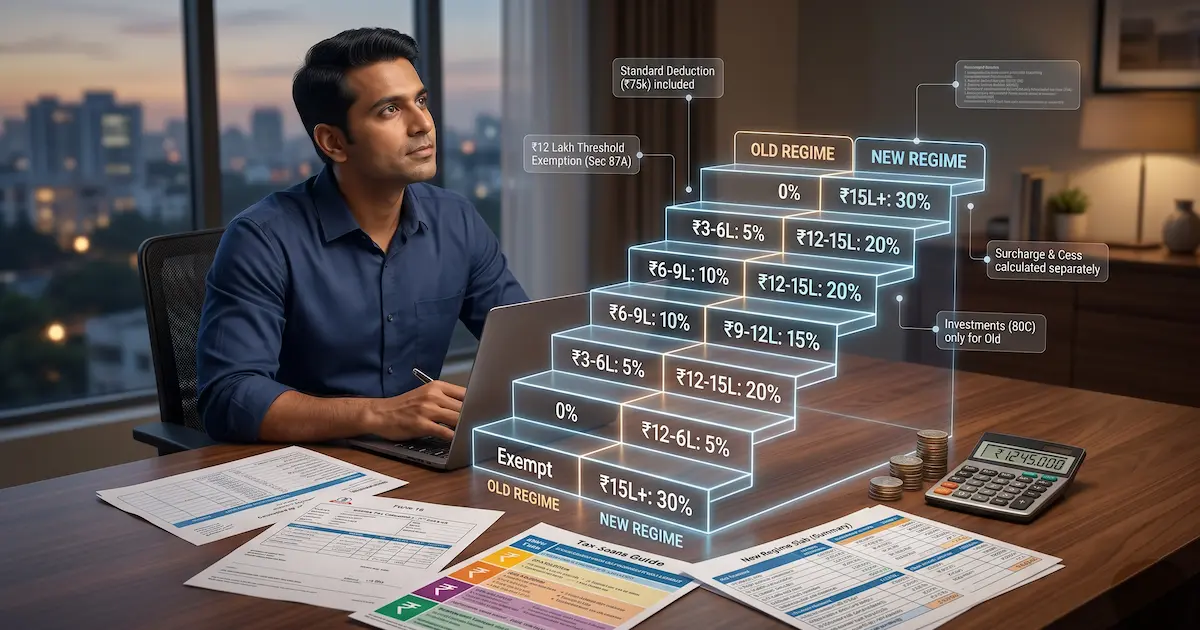
Income tax slabs in India for FY 2025-26 (AY 2026-27): new and old regime rates, the ₹12.75 lakh salaried zero-tax point, the 87A rebate, surcharge, and cess.
18 min read
Form 16 becomes Form 130 from Tax Year 2026-27, and a different Form 16 now certifies research donations. Plus the password and filing without it.
20 min read
The Form 26AS password is your date of birth as DDMMYYYY, the same for PDF, text and Excel. PAN plus date of birth is a different form entirely.
18 min read