What Is Form 16? Password, Parts A and B, Form 130

By Tapabrata Biswas · Updated August 29, 2026 · 20 min read
Researched with AI assistance, reviewed and edited by Tapabrata Biswas.
Reviewed by Subir Kumar Debsharma, Tax, GST and ROC professional with 20+ years of experience.
Two things trip up almost everyone who opens a Form 16 for the first time. The PDF asks for a password nobody told them, and half the internet tells them to "download it from TRACES," which as an employee you simply cannot do. Both have clean answers, and this guide leads with them before working through what the document actually is, the difference between its two parts, when it's due, and how to file your return even if it never arrives.
Form 16 is the paper that anchors the salaried Indian's tax year, and it's roughly India's version of the US W-2: the employer's record of what you were paid and what tax was taken out. This is a definitional explainer, not tax-filing advice. Reconciling figures, choosing the right ITR form, and handling a discrepancy all depend on your specific situation, so consult a Chartered Accountant before you file.
What is Form 16?
Form 16 is the TDS certificate an Indian employer issues to a salaried employee under Section 203 of the Income Tax Act, showing the salary paid and the tax deducted from it across the financial year. The employer deducts tax at source on your salary under Section 192, deposits it with the government, and then certifies the whole thing to you on Form 16.
The certificate records three things: the gross salary paid, the exemptions and deductions the employer allowed while computing tax (HRA exemption, the standard deduction, the Section 80C investments you declared), and the total tax deducted and deposited on your behalf. It comes in two parts from two different sources, which is the single most misunderstood thing about it.
One clarification worth making up front: Form 16 is not your income tax return. It's the employer's certificate that feeds into your return. You still file the ITR yourself with the Income Tax Department, using Form 16 as the main input. The full filing walkthrough lives in our Indian income tax guide for salaried employees; this post is about the document itself.
Has Form 16 been replaced by Form 130?
From Tax Year 2026-27 the salary TDS certificate is Form No. 130, but the certificate for the return you are filing right now is still Form 16. Both statements are true at once, which is why this is confusing.
The Income-tax Act 2025 commenced on 1 April 2026 and repealed the 1961 Act. Your return for FY 2025-26, filed for AY 2026-27, is still made under the old Act, so the certificate your employer hands you this June is still Form 16. Form 130 covers salary paid in Tax Year 2026-27.
The Central Board of Direct Taxes publishes the mapping itself. Its FAQ document is headed Form No. 130 (Earlier Form No. 16) and opens with a table:
| Old | New | |
|---|---|---|
| Form name | 16 (I.T. Rules, 1962) | 130 (I.T. Rules, 2026) |
| Section | 203 (I.T. Act, 1961) | 395(4)(b) (I.T. Act, 2025) |
| Rule | 31 (I.T. Rules, 1962) | 215(1) Table Sl. No. 1 (I.T. Rules, 2026) |
The document also grew. Form 16 has two parts; Form 130 has three. Part A carries the employer or specified bank details and the employee details. Part B is a summary reconciliation of the amount paid or credited against the tax deducted. Part C holds two annexures: Annexure I where tax is deducted from salary under Section 392, with the gross salary breakup, exemptions, deductions, total taxable income, tax payable, relief under Section 157 and net tax payable; and Annexure II for specified senior citizens whose tax is deducted under Section 393(1), carrying pension income and the interest paid by the specified bank.
One practical change sits underneath all that. A deductor cannot issue Form 130 without having filed the quarterly TDS statement first, because the certificate is generated by processing those statements in Form No. 138. If your employer is late with its quarterly return, your certificate cannot exist yet.
Form No. 16 still exists, and it is not your salary certificate
From 1 April 2026 two live documents are called Form 16, and only one of them has anything to do with your salary. The salary one is now Form 130. The thing actually named Form No. 16 in the 2026 Rules is a certificate a research institution gives to a donor.
CBDT published a separate FAQ for it, headed FORM 16, Annual Certificate to Donors for Scientific Research, under Section 45(4)(a) read with Section 45(3) of the Income-tax Act 2025. In CBDT's own description it is an annual certificate, issued once for a tax year and not as a receipt for each donation, due on or before 31 May following the end of that tax year, generated from the institution's Form 15 statement to the department. It applies only to donations for scientific research. Donations to charitable institutions run on a separate certificate framework.
So the claim doing the rounds that Form 16 has been abolished is wrong in both directions. The salary certificate was not abolished, it was renumbered to 130. And the number 16 was not retired, it was handed to something else entirely. If someone tells you in 2027 that they are waiting for their Form 16, they mean Form 130. If a research institute sends you a Form 16, it is not a salary document and it will not help you file a salaried return.
What is the password to open Form 16?
The Form 16 PDF password is the first five characters of your PAN in capital letters, followed by your date of birth as DDMMYYYY, run together with no space. So a PAN of ABCDE1234F and a date of birth of 1 January 1990 give the password ABCDE01011990.
That's the format most employers use, per ClearTax and other tax platforms. Some payroll teams set a different rule, so if the standard version is rejected, try these common variants in order:
| Variant | Example (PAN ABCDE1234F, DOB 01-01-1990) |
|---|---|
| First 5 of PAN (caps) + DDMMYYYY | ABCDE01011990 |
| First 5 of PAN (lowercase) + DDMMYYYY | abcde01011990 |
| Full 10-character PAN + DDMMYYYY | ABCDE1234F01011990 |
| Last name + DOB, or name + PAN | (whatever the covering email specifies) |
The covering email from your payroll team usually states the exact rule. To keep an unprotected copy, open the file in Chrome, enter the password once, then print it back to a PDF, which saves it without the password.
What is the difference between Part A and Part B of Form 16?
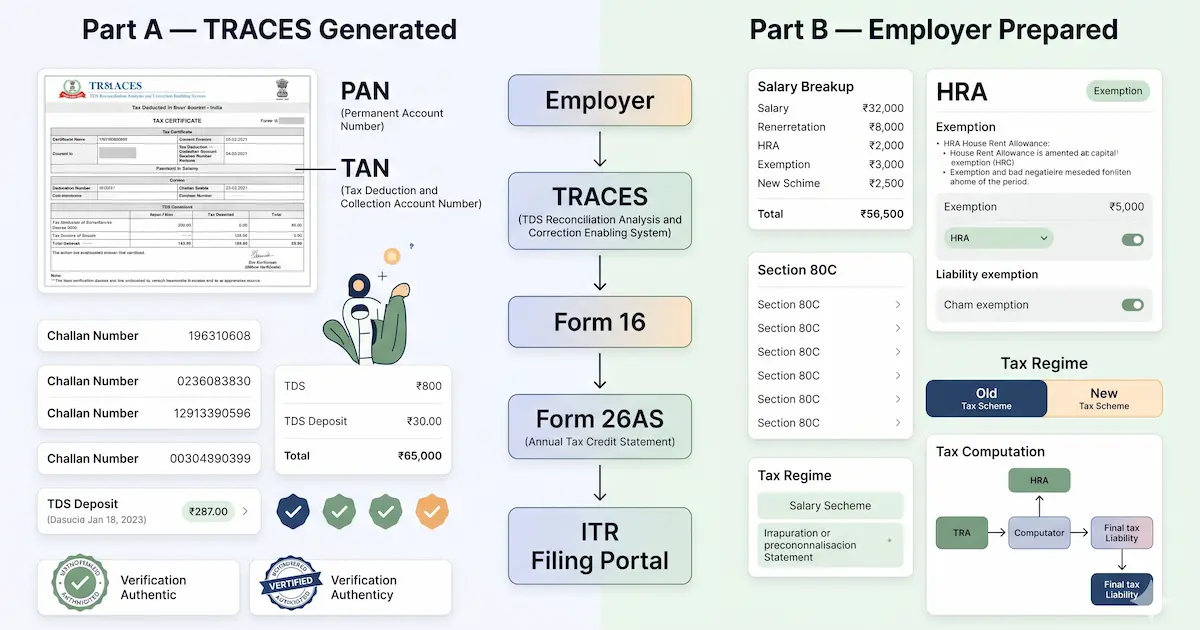
Part A is the system-generated proof that your tax was deposited with the government, and Part B is the employer's salary-and-tax calculation showing how that tax figure was reached. They come from different places and serve different jobs, and together they make one complete Form 16.
| Part A | Part B | |
|---|---|---|
| Generated by | The Income Tax Department's TRACES portal | The employer's payroll team |
| Contents | Employer TAN, employee PAN, period of employment, quarter-by-quarter TDS deducted and deposited | Gross salary breakup, Section 10 exemptions, Chapter VI-A deductions, taxable income, tax computed |
| Key markers | A unique 7-character certificate number, a TDS-CPC logo, and a national-emblem watermark | The regime declared, standard deduction, and any Section 89 relief |
| Editable? | No, tamper-resistant once generated | Yes, prepared by the employer |
Part A carries the security features most people never notice: a unique 7-character certificate number plus the TDS-CPC logo and the national emblem, which is how you tell a genuine TRACES-issued Part A from a fabricated one, a detail almost no explainer mentions (SAG Infotech). If the employer filed the TDS return with an error, Part A can only be corrected by filing a revised return, after which TRACES regenerates it.
Part B is the employer's worksheet. It shows your basic pay, HRA and other allowances, the exemptions claimed such as HRA exemption, the Section 80C deductions you declared, the taxable income, and the tax due. Your EPF contribution is usually the largest single 80C entry in Part B, and it appears automatically because it's a payroll deduction.
A common mix-up worth killing here: Part A and Part B are not "Form 16A" and "Form 16B." Several popular sites label them that way, and it's wrong. Form 16A and Form 16B are entirely separate certificates, covered below.
How do you download or get Form 16?
You cannot download Form 16 from TRACES yourself; only your employer can, because the law requires the employer to furnish it to you. This is the honest answer to the most-searched Form 16 question, and nearly every ranking page buries it deep in an FAQ, well below the fold.
As an employee, you get Form 16 in one of two ways: your employer emails it to you, or you download it from your company's payroll or HR self-service portal (Greytip, Zoho, Darwinbox, and similar). There's no employee login on TRACES that hands you your own Form 16, per Quicko and the official TRACES FAQ.
On the employer side, the deductor logs in to TRACES using their PAN, requests Form 16 for the financial year, and downloads Part A once the quarterly TDS returns are processed, then attaches the employer-prepared Part B. If a previous employer hasn't given you Form 16, the only lawful source is that employer, so request it in writing from their HR or payroll team. If they won't cooperate, you're not stuck, because you can still file without it, as the last section explains.
When is Form 16 issued, and what if it's late?
Employers must issue Form 16 by 15 June of the assessment year, so for FY 2025-26 salary the deadline is 15 June 2026, under Rule 31(3) of the Income-tax Rules. By the time most salaried Indians file their return in July, Form 16 should already be in hand.
The 15 June date follows a chain worth understanding. The employer's Q4 TDS return (Form 24Q) is due by 31 May, TRACES then processes it, and only after that can Part A be generated, which is why the certificate lands in mid-June and not earlier (Tax Update). For a late certificate, the penalty is Rs 100 per day, per certificate, capped at the TDS amount, under Section 272A(2)(g). Be careful here: several high-traffic guides state Rs 500 a day, but the statutory figure under 272A(2)(g) is Rs 100.
One practical timing point the field skips: don't rush to file in early June off the pre-filled data, because Form 26AS and the AIS may not yet reflect your employer's processed Q4 return. Wait until the numbers settle, generally around 10 June onward, before you match them.
Who is eligible for Form 16, and is it mandatory?
Form 16 is mandatory only where your employer actually deducted TDS on your salary; there is no fixed salary limit that triggers it. The obligation under Section 203 attaches to the act of deducting tax, not to a rupee figure of pay.
If your income was below the taxable threshold and no tax was deducted, your employer isn't required to issue Form 16, though many still hand over at least Part B as good practice (ClearTax). This is why "form 16 salary limit" has no clean answer: the trigger is TDS deduction, and salary alone doesn't decide it. And because the rebate under the new tax regime lifts the effective no-tax point, more employees now legitimately receive no Form 16 at all, which is perfectly normal.
Form 16 vs Form 16A vs Form 16B
Form 16 covers salary TDS, Form 16A covers non-salary TDS, and Form 16B covers TDS on the sale of property. They're three separate certificates for three separate situations, which is where a lot of confusion starts.
| Certificate | What it covers | Issued by | When |
|---|---|---|---|
| Form 16 | TDS on salary (Section 192) | Your employer | Annually, by 15 June |
| Form 16A | TDS on non-salary income (bank interest, rent, commission, professional fees) | The bank, tenant, client, or company that deducted it | Quarterly, within 15 days of the quarter-end |
| Form 16B | TDS on the sale of immovable property, at 1% of the sale value | The buyer of the property | Per transaction |
A salaried person with fixed-deposit interest above the TDS threshold typically holds one Form 16 from the employer and one or more Form 16As from the bank; all of it shows up against the same PAN. Unlike Form 16, Form 16A has no Part B, because the deductor is only withholding a flat statutory rate without computing your tax.
Form 16 vs Form 26AS vs AIS
Form 16 is what your employer reported, Form 26AS is what's actually deposited against your PAN, and the AIS is everything the Income Tax Department already knows about your finances. All three should tell a consistent story, and cross-checking them before you file is what keeps a return clean (Adwani & Co).
- Form 16 is the employer's TDS-on-salary certificate for the year.
- Form 26AS is the consolidated tax-credit statement showing all TDS, TCS, and taxes paid against your PAN. The TDS total in Form 16 Part A should match your employer's figure in 26AS. For the full breakdown, see what Form 26AS is.
- The AIS (Annual Information Statement) is the wider record of your reported financial transactions, including interest, dividends, securities, and property.
The reconciliation matters because income that shows up in the AIS but is missing from your return can trigger a Section 143 notice. If Part A and Form 26AS disagree, the usual causes are a TDS amount deducted but not correctly deposited, a wrong PAN in the employer's return, or a late or erroneous filing. The fix is to raise it with the employer's payroll team so they file a corrected Form 24Q, after which TRACES updates 26AS. For any meaningful gap, a Chartered Accountant can advise the safest filing approach, since the credit you claim has to line up with 26AS or the return is treated as defective.
Can you file ITR without Form 16?
Yes. Form 16 is supporting documentation. It is not a filing requirement, so you can reconstruct your salary and TDS from other records and file anyway. The employer's job is to deduct and certify tax; computing and filing your return is ultimately your responsibility (ClearTax).
The reconstruction runs roughly like this:
- Total your income from your monthly payslips (salary, plus any pension, house-property, or interest income).
- Pull your TDS from Form 26AS and cross-check it against the AIS.
- Gather proof for your deductions and exemptions: rent receipts for HRA, investment statements for 80C, premium receipts for 80D.
- Compute total income, apply your deductions, and run it through the income tax slabs for your regime.
- Compare the TDS already paid against the tax due, pay any balance as self-assessment tax, then file and e-verify.
One trap to avoid when doing 80C yourself: count only your own EPF contribution, not the employer's matching share, since the employer's part is not your deduction. The deeper TDS mechanics behind all of this are in what TDS is.
What if you have two Form 16s?
Change jobs during the year and you get one Form 16 per employer, and you must combine them, because each employer taxed you as if their salary was your only income. That combining step isn't just tidiness; skipping it usually means you owe more tax.
The trap is this. Each employer independently gives you the basic exemption and the standard deduction, and may each count your 80C, as though you worked nowhere else that year. So if you earned Rs 6 lakh at each of two jobs, both deducted TDS as if your income were Rs 6 lakh, not the real Rs 12 lakh, and applied the lower slabs and the exemptions twice. When you file on the combined Rs 12 lakh at the correct higher slabs, the total TDS falls short, and the shortfall comes with interest under Sections 234B and 234C (ClearTax). A double-claimed EPF or 80C deduction is disallowed outright.
The clean prevention is to tell your new employer about the old salary using Form 12B when you join, so the new employer deducts TDS on your full year's income and the gap never opens up. If you're already past that, recalculate your exemptions and deductions once across both Form 16s at filing time, and pay any balance before you submit.
What this post deliberately does not cover
To keep the scope honest on a tax topic:
- The full ITR-filing walkthrough, ITR-1 vs ITR-2 selection, and choosing a regime at filing are in the Indian income tax guide for salaried employees.
- How TDS works as a mechanism is in what is TDS.
- The slab structure and the old-vs-new regime economics are in income tax slabs explained.
- The 80C list and limit and the HRA formula, both of which appear inside Part B, are in Section 80C and HRA exemption.
- This is general education, not filing advice. For a mismatch, a missing form, or any unusual income, a Chartered Accountant is the right professional to consult before you file.
Frequently asked questions
Has Form 16 been replaced by Form 130? Yes, but not for the return you are filing now. From Tax Year 2026-27 the salary TDS certificate is Form No. 130, issued under Section 395(4)(b) of the Income-tax Act 2025. CBDT's own FAQ for it is headed Form No. 130 (Earlier Form No. 16) and carries a mapping table: form 16 under the Income-tax Rules 1962 becomes form 130 under the Rules 2026, Section 203 of the 1961 Act becomes Section 395(4)(b) of the 2025 Act, and Rule 31 becomes Rule 215(1) Table Sl. No. 1. For salary paid during FY 2025-26, which is the return filed for AY 2026-27, employers still issue Form 16 under the 1961 Act. So this year runs on the old numbering and the next one does not.
Is there still a Form No. 16 under the new rules? Yes, and it is a completely different document. The Income-tax Rules 2026 reuse the number for an annual certificate that a research institution issues to a donor, under Section 45(4)(a) read with Section 45(3) of the Income-tax Act 2025. CBDT's FAQ for it is headed FORM 16, Annual Certificate to Donors for Scientific Research. It is issued once a tax year and not per donation, is due on or before 31 May following the tax year, is generated from the institution's Form 15 statement, and applies only to scientific research donations and not to charitable ones. This is why saying Form 16 has been abolished is wrong twice over. The salary certificate was renumbered to 130, and the number 16 was handed to something else.
What is Form 16 in simple terms? Form 16 is the TDS certificate that an Indian employer issues to a salaried employee whose salary had tax deducted at source during the financial year, under Section 203 of the Income Tax Act. It records the salary paid, the exemptions and deductions the employer allowed while computing tax, and the total TDS deducted and deposited with the government. It comes in two parts: Part A, generated by the Income Tax Department's TRACES portal, and Part B, the salary and deduction breakup prepared by the employer. It is the main supporting document for filing your income tax return, but it is not the return itself.
What is the password to open Form 16? The Form 16 PDF password is the first five characters of your PAN in capital letters, followed by your date of birth in DDMMYYYY format, with no space. For example, if your PAN is ABCDE1234F and your date of birth is 1 January 1990, the password is ABCDE01011990. Some employers use a variant, such as the PAN in lowercase, the full 10-character PAN plus DOB, or your last name plus PAN, so if the standard format fails, check the covering email from your payroll team for the exact rule.
Can I download Form 16 from TRACES myself? No. Only the employer (the deductor) can log in to TRACES and download Form 16, because the law requires the employer to furnish it to you. As an employee you cannot download it from TRACES with your own login. You get Form 16 from your employer directly, or from your company's payroll or HR self-service portal. Note that Part A is generated by TRACES from the employer's quarterly TDS return, while Part B is prepared by the employer.
Is Form 16 mandatory, and is there a salary limit? Form 16 is mandatory only where your employer actually deducted TDS on your salary, under Section 203. There is no fixed salary limit that triggers it. If your income was below the taxable threshold and no TDS was deducted, the employer is not obliged to issue Form 16, though many issue at least Part B as good practice. Because the rebate under the new tax regime raises the effective no-tax threshold, more employees now legitimately receive no Form 16 at all.
Can I file ITR without Form 16? Yes. Form 16 is supporting documentation. It is not a filing requirement. If your employer has not issued it, you can reconstruct your salary from your monthly payslips, take your TDS from Form 26AS and cross-check it against the Annual Information Statement (AIS), and gather your own proof for deductions like rent receipts and investment statements. One caution: when you claim Section 80C on your own, include only your own EPF contribution, not the employer's share.
In summary
Form 16 is your employer's certificate of the salary it paid you and the tax it deducted, split into a TRACES-generated Part A that proves the tax was deposited and an employer-prepared Part B that shows how the figure was worked out. Open it with your PAN's first five characters and your date of birth, get it from your employer or payroll portal and never from TRACES, and expect it by 15 June.
The most useful thing to remember is what Form 16 is not. It isn't your tax return, it isn't mandatory when no tax was deducted, and it isn't the only way to file, because your payslips, Form 26AS, and the AIS can stand in for it. Cross-check those three before you file, combine every Form 16 if you changed jobs, and bring in a CA for anything that doesn't reconcile. For the return that Form 16 feeds into, start with the Indian income tax guide for salaried employees.
One date to carry forward. This June's certificate is still Form 16, and from the following year it arrives as Form 130 with a third part attached. Nothing about the tax changes, only the paperwork and the numbering. The full old-to-new map is in our Income-tax Act 2025 section mapping.
Sources
- Central Board of Direct Taxes, Form No. 130 (Earlier Form No. 16) Frequently Asked Questions, giving the 16-to-130, 203-to-395(4)(b) and Rule 31-to-215(1) mapping and the three-part structure: incometaxindia.gov.in
- Central Board of Direct Taxes, FORM 16, Annual Certificate to Donors for Scientific Research, Section 45(4)(a) with Section 45(3), for the reused form number and the 31 May due date: incometaxindia.gov.in
- Income Tax Department of India, Section 203, Certificate of Tax Deducted at Source, and Rule 31 issuance timelines: incometax.gov.in
- TRACES, Form 16 general FAQ (deductor-generated, employee cannot download): tdscpc.gov.in
- ClearTax, Form 16 password format and worked example: cleartax.in/s/form-16-password
- ClearTax, How to file ITR without Form 16: cleartax.in/s/efile-without-form-16
- Adwani & Co, AIS vs Form 26AS vs Form 16 reconciliation: adwaniandco.com
- Income Tax Department, New tax regime as default under Section 115BAC (FAQ): incometax.gov.in



You might also like
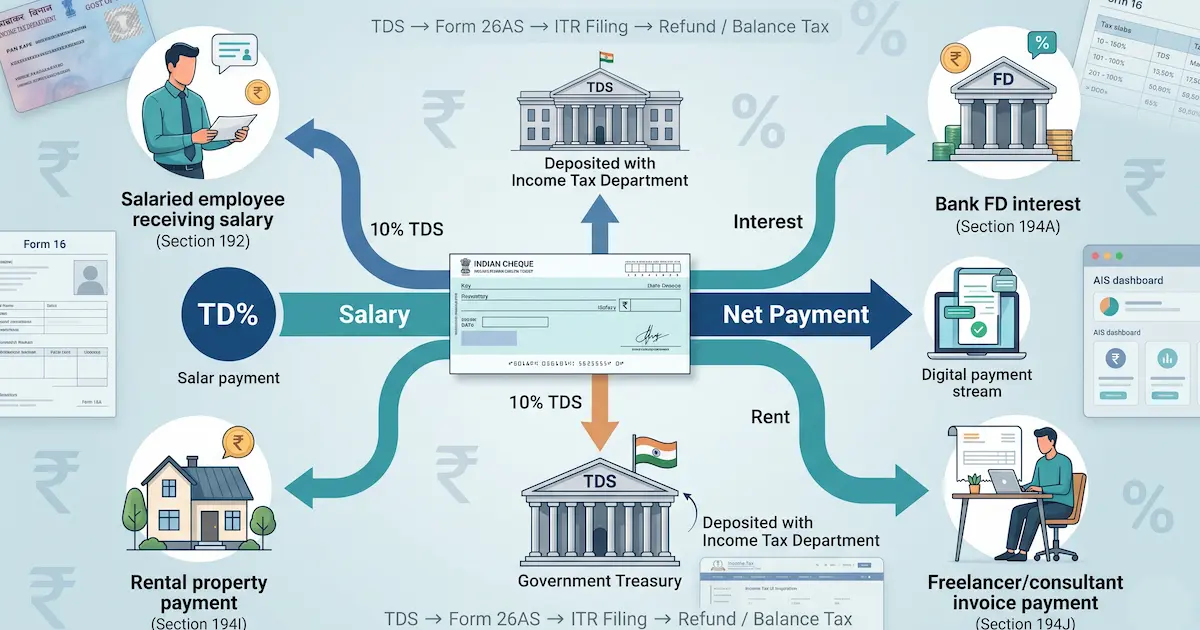
TDS is tax withheld from your salary, interest, and rent. The FY 2025-26 section rates and thresholds, what Budget 2025 changed, and how TDS differs from TCS.
15 min read
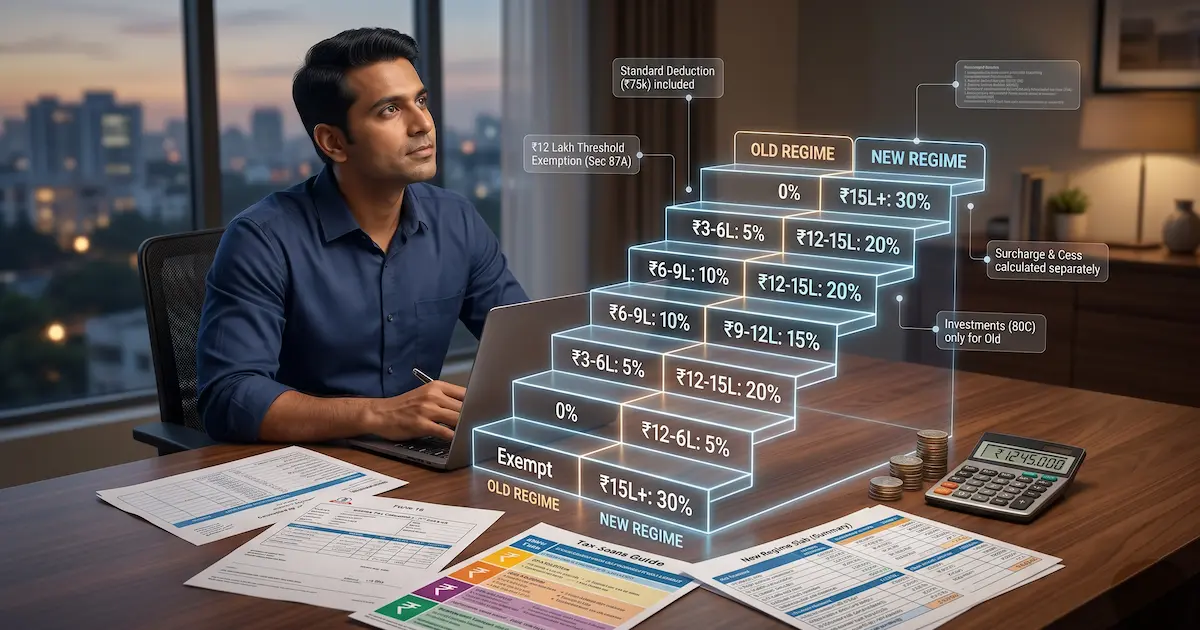
Income tax slabs in India for FY 2025-26 (AY 2026-27): new and old regime rates, the ₹12.75 lakh salaried zero-tax point, the 87A rebate, surcharge, and cess.
18 min read
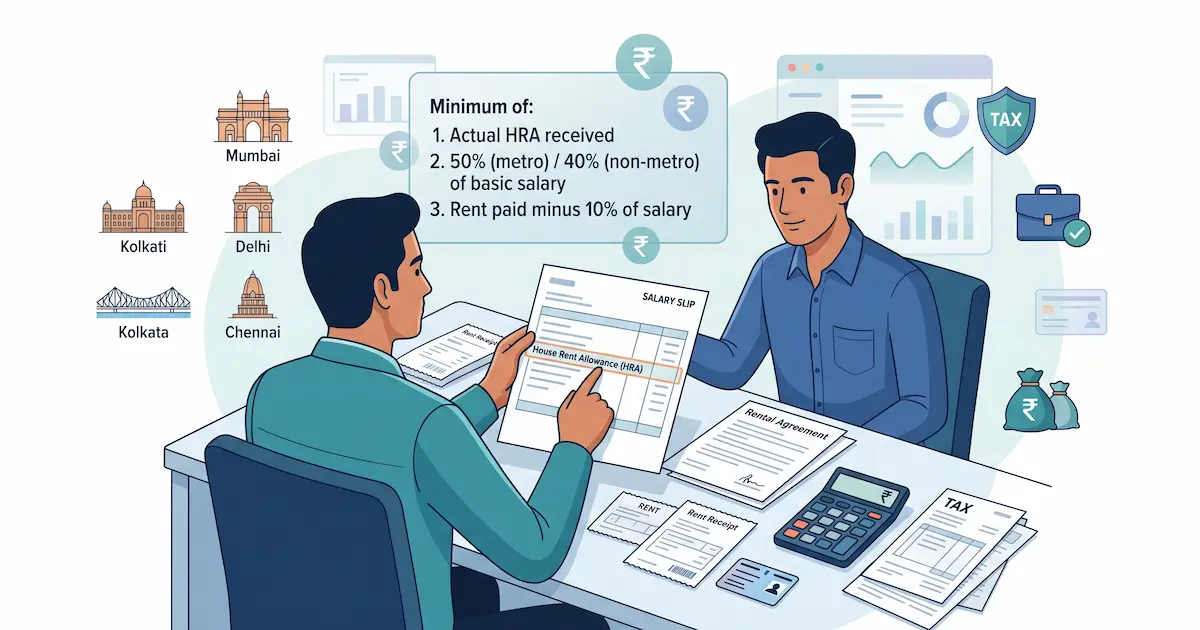
Eight cities now get the 50% HRA rate, but only from FY 2026-27. See which year uses which list, the three-part formula, and when 50% changes nothing.
16 min read