What Is EPF? Interest Rate, Contribution and Rules

By Tapabrata Biswas · Updated October 3, 2026 · 19 min read
Researched with AI assistance, reviewed and edited by Tapabrata Biswas.

Your EPF balance will look wrong for most of the year, and it isn't a glitch. Interest is worked out on your monthly running balance, roughly 0.688% a month at the current rate, but it only lands in your passbook once, after the government approves the rate around June or July. So the number sits flat for months, then jumps in one go. That single quirk confuses more first-time PF holders than any other part of the scheme. Our EPF calculator runs that month-by-month build-up to retirement, with the pension-slice split applied so the corpus it shows is the part that actually earns interest.
The rate itself is 8.25% for FY 2025-26, the third year in a row at that figure, and it's still the highest guaranteed return the Indian government offers a saver. This post covers what EPF is, where every rupee of your 12% and your employer's 12% actually goes, the withdrawal rules that changed on 29 June 2026, the tax treatment, and how to read your balance without waiting for the annual jump.
What is EPF?
The Employees' Provident Fund (EPF) is a mandatory retirement savings scheme for salaried employees in India, run by the Employees' Provident Fund Organisation (EPFO) under the Ministry of Labour and Employment. Every month a slice of your pay goes into an individual account in your name, your employer adds a matching amount, and the balance earns a government-declared rate of interest until you withdraw it.
It began under the Employees' Provident Funds and Miscellaneous Provisions Act of 1952, and from 29 June 2026 it operates under the new EPF Scheme 2026, part of the Code on Social Security. The "PF" line on your salary slip is this. Establishments with 20 or more workers must enrol their staff, and anyone earning a monthly basic plus dearness allowance up to Rs 15,000 is covered by default. Higher earners can stay in, and most do, because the employer match and the tax treatment are hard to beat.
If you know the US system, EPF sits somewhere between Social Security and a 401(k). Like the FICA payroll taxes, it's compulsory and payroll-deducted. Unlike FICA, it builds a personal balance you own and can withdraw, closer to a 401(k), but with a rate the government fixes each year, where a 401(k) return rides the market.
Three features set EPF apart from a voluntary scheme like PPF. It's mandatory for covered employees. It carries a genuine employer contribution on top of your own, which is real compensation many people never notice. And it bundles a pension (EPS) and a small life cover (EDLI) into the same monthly deduction.
What is the current EPF interest rate?
The EPF interest rate is 8.25% for FY 2025-26, declared by the EPFO Central Board of Trustees at its 239th meeting on 2 March 2026 and credited to members by around July 2026. The government ratified it through the Ministry of Labour and Employment, and it holds the rate at 8.25% for the third straight year, after FY 2023-24 and FY 2024-25 at the same figure.
Watch the financial year attached to any rate you read, because three consecutive years share the 8.25% number and a lot of pages quote it with a stale or missing year. The accurate recent history:
| Financial year | EPF interest rate |
|---|---|
| FY 2025-26 | 8.25% |
| FY 2024-25 | 8.25% |
| FY 2023-24 | 8.25% |
| FY 2022-23 | 8.15% |
| FY 2021-22 | 8.10% |
| FY 2020-21 | 8.50% |
| FY 2019-20 | 8.50% |
| FY 2018-19 | 8.65% |
The rate is recommended by the Central Board of Trustees and notified by the Ministry of Labour after the Ministry of Finance agrees. The mechanic behind your balance is worth understanding. Interest accrues on the closing balance of each month, so at 8.25% that's about 0.688% a month, and the year's total is credited in a single entry after the financial year ends and the government signs off, usually June or July. New contributions start earning from the month after they land. That delayed, once-a-year credit is why your passbook can look static for months.
How much do you contribute to EPF, and where does it go?
You contribute 12% of your basic salary plus dearness allowance every month, and your employer contributes an equal 12%, but the employer's half is split between the pension fund and EPF. The EPFO puts it plainly: 8.33% of the employer's share is diverted to the Employees' Pension Scheme (EPS) and the remaining 3.67% goes to EPF.
The EPS diversion is capped, because it's calculated only on the statutory wage ceiling, which is Rs 25,000 a month from 17 September 2026. So the most that can go to EPS is 8.33% of Rs 25,000, which is Rs 2,083 a month. Take a worked example at exactly the ceiling:
| Contribution | Rate | On Rs 25,000 |
|---|---|---|
| Employee to EPF | 12% | Rs 3,000 |
| Employer to EPS | 8.33% (capped) | Rs 2,083 |
| Employer to EPF | 3.67% | Rs 917 |
| Employer to EDLI (insurance) | 0.50% | Rs 125 |
| Employer admin charge | 0.50% | Rs 125 |
Above Rs 25,000 basic, the EPS piece stays frozen at Rs 2,083, and the employer's surplus contribution spills entirely into EPF. That's why higher earners see a larger share of the employer's money land in their EPF rather than their pension. That frozen Rs 2,083 a month still buys a lifelong pension from age 58, and our EPS pension calculator estimates how much, including the higher-pension option on actual salary. One caution on that calculator while the change beds in: a pension is worked out on the average of your last 60 months of pensionable salary, so somebody retiring soon will have spent almost all of those 60 months under the old Rs 15,000 cap, and the new ceiling lifts pensions gradually rather than at once. To see where this deduction sits between your gross and take-home pay, our explainers on gross vs net income and how to read a pay stub map it out.
One exception worth knowing: a reduced 10% rate (down from 12%) applies to establishments with fewer than 20 employees and to a handful of notified industries such as beedi, jute, brick, coir, and guar gum, under a 1997 government notification. For most salaried workers in larger firms, the rate is 12%.
The ceiling rose to Rs 25,000 on 17 September 2026, the first revision since September 2014. Proposals to raise it circulated for years without being notified, which is why so many explainers still carry the old figure. It was done by Gazette Notification S.O. 5109(E), and the Press Information Bureau states the consequence plainly, that with the pensionable wage ceiling at Rs 25,000 the maximum employer pension contribution at 8.33% rises from Rs 1,250 to Rs 2,083 a month. The government expects around 51 lakh more employees to fall within mandatory coverage as a result.
If your payslip still shows Rs 1,800 going to PF, that is 12% of the old Rs 15,000 ceiling. At the new one the capped figure is Rs 3,000.
What is VPF, and how is it different from EPF?
The Voluntary Provident Fund (VPF) is an optional top-up to EPF, where you contribute more than the mandatory 12% of basic plus DA into the same account, earning the same interest rate. There's no employer match on the extra amount, and no statutory upper limit; you can direct up to 100% of your basic plus DA into VPF on top of the compulsory 12%.
VPF earns the same 8.25% and gets the same tax treatment as EPF, with one catch covered in the tax section below: interest on your own EPF plus VPF contributions above Rs 2.5 lakh a year is taxable. For a salaried person, VPF is one of the few guaranteed fixed-income options that clears the rate on most bank fixed deposits, but whether it fits your goals is a call for you and, if the amounts are large, a financial adviser.
When can you withdraw EPF under the new rules?
Under the EPF Scheme 2026, in force from 29 June 2026, you can make a partial withdrawal after just 12 months of service, as long as at least 25% of your eligible balance stays in the account. This is a big change from the old scheme, which required 5 to 7 years of service for most grounds.
The new scheme groups withdrawals into three categories, replacing the old list of a dozen-plus specific reasons:
| Category | What it covers | How much |
|---|---|---|
| Essential Needs | Illness, education, marriage | Up to 100% of the eligible balance |
| Housing | Buying or building a house or flat, buying land, repairs, or repaying a home loan | As prescribed, subject to the 25% retention |
| Special Circumstances | Situations that no longer need any extra justification | As prescribed |
Two rules run across all of them. At least 25% of your eligible balance must remain untouched after any partial withdrawal. And full and final settlement is now allowed at retirement or after 12 months of continuous unemployment, up from the old two-month wait.
EPFO has explained what the 25% floor is for. Business Standard, reporting the organisation's own statements in July 2026, gave the reason plainly: about 48.7% of EPF members hold a balance of only ₹10,000 to ₹20,000 at the time of final settlement. Nearly half the formal-sector workforce finishes with that. The retention rule exists to move that number, and how it sits against the retirement targets Indians are told to hit is covered in retirement savings by age.
What changed from the 1952 scheme: the old 7-year condition for marriage and education and the 5-year condition for housing are gone, replaced by the flat 12-month rule; the 25% minimum-balance retention is new; and the settlement wait after leaving a job stretched from 2 months to 12. The 8.25% rate and the 12% plus 12% contribution structure did not change. Because this is a fresh notification and EPFO is still rolling out the digital claim process, confirm the exact limit for your specific ground with EPFO before you file.
When you change jobs, transferring the EPF balance to your new employer's account through the Universal Account Number keeps your service continuous, which matters for the 5-year tax rule below. Withdrawing instead resets that clock.
Is EPF taxable?
EPF carries EEE (Exempt-Exempt-Exempt) status, meaning the contribution, the interest, and the maturity can all be tax-free, but each leg has a condition. The contribution qualifies for a Section 80C deduction up to Rs 1.5 lakh a year, the interest is exempt, and withdrawal after 5 years of continuous service is fully tax-free.
The conditions are where people get caught. The Section 80C deduction on your EPF contribution is available only under the old tax regime; under the new default regime you still contribute, but you get no 80C benefit, though the interest and qualifying maturity stay exempt. Your EPF share often fills a large chunk of the Rs 1.5 lakh cap on its own, which then feeds into the income tax slab structure, and both contributions show up in Part B of your annual Form 16.
Withdrawal before 5 years is taxable. If the amount exceeds Rs 50,000, EPFO deducts TDS at 10% (or 20% if you haven't given a PAN) under Section 192A, which is renumbered as Section 392(7) from 1 April 2026 with the same rates. Filing Form 15G (or 15H for seniors) stops the TDS when your total income is below the taxable limit. There's an escape hatch: if your job ended through ill-health, your employer's business closing, or any cause beyond your control, the withdrawal is tax-free regardless of tenure.
A separate rule from Budget 2021 taxes the interest on large contributions. If your own EPF plus VPF contributions cross Rs 2.5 lakh in a year, the interest earned on the excess is taxable as income from other sources, computed through the separate taxable and non-taxable accounts under CBDT Notification 95/2021. Crossing Rs 2.5 lakh needs roughly Rs 20.9 lakh of annual basic salary at the 12% rate, or a smaller salary paired with heavy VPF. Where the employer makes no contribution at all, a government-provident-fund style case, the threshold is Rs 5 lakh instead. Only the interest on the excess is taxed, not the whole balance, and this is genuinely tax-specific, so a chartered accountant is the right person to run your exact numbers.
What are UAN, EPS, and EDLI?
These three acronyms sit around EPF and get mixed up constantly, so here's each one plainly.
The Universal Account Number (UAN) is a 12-digit number the EPFO issues you once, that links every EPF account you ever hold across employers. Each new job creates a new member ID, but they all sit under the same UAN, which is how your service history and pensionable years add up across jobs. Since 1 August 2025, EPFO activates the UAN through the UMANG app and face authentication, replacing the old OTP method.
The Employees' Pension Scheme (EPS) is the pension leg funded by the employer's 8.33% diversion. You qualify for a monthly pension at 58 with at least 10 years of service, calculated as pensionable salary times pensionable service divided by 70. The statutory minimum pension is Rs 1,000 a month, set in 2014 and unchanged since. You'll see Rs 7,500 quoted a lot, but that's a long-running demand, not law; the arithmetic of the demand comes from the Rs 15,000 ceiling (Rs 15,000 times 35 years divided by 70 is Rs 7,500), which is also the current maximum.
The Employees' Deposit-Linked Insurance (EDLI) scheme is a small life-cover benefit funded by the employer's 0.50% contribution, paying a lump sum to the family if a member dies in service. EPF, EPS, and EDLI together make one packaged social-security deduction.
How do you check your EPF balance?
You can check your EPF balance four ways, all needing your UAN activated and a KYC document seeded. No single method is better than the others; they return the same passbook data.
| Method | How | Prerequisite |
|---|---|---|
| Passbook portal | Log in at passbook.epfindia.gov.in with UAN and password | UAN activated |
| UMANG app | Services, then EPFO, then View Passbook, then UAN and OTP | UAN linked to mobile |
| Missed call | Ring 9966044425 from your registered mobile; it cuts after two rings, free | Mobile + KYC seeded |
| SMS | Send EPFOHO UAN to 7738299899 from your registered mobile | Mobile + KYC seeded |
One correction worth making, since almost every finance site gets it wrong: the official SMS format is just "EPFOHO UAN", with English as the default. You only add a code for a regional language, using the first three letters, such as EPFOHO UAN HIN for Hindi or EPFOHO UAN TAM for Tamil. The "ENG" suffix that most guides tell you to add is not required.
EPF vs PPF vs VPF vs NPS
Most salaried Indians hold EPF automatically and can add the others voluntarily. They run in parallel and answer different needs:
| Factor | EPF | VPF | PPF | NPS |
|---|---|---|---|---|
| Return | 8.25% (FY 2025-26) | 8.25% (same as EPF) | 7.1% (current quarter) | Market-linked |
| Who can hold it | Salaried in covered firms | EPF members | Any resident Indian | Any Indian 18-70 |
| Contribution | Mandatory 12% of basic + DA | Voluntary top-up | Rs 500 to Rs 1.5 lakh/year | Voluntary |
| Employer role | Matches 12% | None | None | Optional |
| Tax status | EEE (5+ years) | EEE (5+ years) | EEE | EET (partly taxed at exit) |
| Lock-in | Till retirement or 12 months jobless | Same as EPF | 15 years | Till 60 |
For a salaried worker, EPF is the base layer, and VPF is the lever to add more at the same guaranteed rate. PPF suits anyone wanting a parallel tax-free account, and it's the option for the self-employed who have no EPF. NPS is the market-linked add-on. The deeper comparison, including the extra Rs 50,000 deduction under Section 80CCD(1B), lives in our NPS explainer, and the full PPF mechanics are in the PPF guide.
What this post deliberately does not cover
To keep the scope honest on a money topic:
- The full NPS comparison and its annuity rules live in the NPS explainer; this post keeps NPS to a single comparison row.
- PPF mechanics, lock-in, and maturity math are in the PPF guide and the PPF calculator.
- The full Section 80C instrument list and shared-cap mechanics are in the 80C explainer.
- The step-by-step online claim process is on the EPFO portal, which is the authoritative source and updates faster than any blog.
- The EPF Scheme 2026 details are freshly notified and still rolling out, so verify the exact rule for your situation with EPFO.
- This is general education, not financial or tax advice. For your own numbers, a chartered accountant or a SEBI-registered adviser is the right call.
Frequently asked questions
What is the current EPF interest rate in 2026? The EPF interest rate is 8.25% for FY 2025-26. It was declared by the EPFO Central Board of Trustees at its 239th meeting on 2 March 2026, ratified by the government, and credited to members by around July 2026. This is the third consecutive year at 8.25% (FY 2023-24, 2024-25, and 2025-26). Interest is calculated on the monthly running balance, roughly 0.688% a month, but is credited to your passbook only once a year after the government approves the rate, which is why the balance appears to jump around mid-year.
How much do I contribute to EPF from my salary? An employee contributes 12% of basic salary plus dearness allowance (DA) to EPF each month, and the employer contributes an equal 12%. The employer's 12% splits: 8.33% goes to the Employees' Pension Scheme (EPS), capped at Rs 2,083 a month (8.33% of the Rs 25,000 wage ceiling in force since 17 September 2026), and the remaining 3.67% goes to EPF. On a Rs 25,000 basic that is Rs 3,000 employee EPF, Rs 2,083 employer EPS, and Rs 917 employer EPF. Above Rs 25,000 basic, the EPS part stays frozen at Rs 2,083 and the surplus flows into EPF.
When can I withdraw my EPF balance? Under the EPF Scheme 2026, effective 29 June 2026, you can make a partial withdrawal after just 12 months of service, provided at least 25% of your eligible balance stays untouched. Grounds are grouped into three categories: Essential Needs (illness, education, marriage, up to 100% of the eligible balance), Housing (buying, building or repairing a home, or repaying a home loan), and Special Circumstances (which need no further justification). Full and final settlement is allowed at retirement or after 12 months of continuous unemployment. Always verify the specific limit for your situation with EPFO before applying.
Is EPF withdrawal taxable? EPF has EEE (Exempt-Exempt-Exempt) status if you complete 5 years of continuous service, in which case withdrawal is fully tax-free. Withdrawal before 5 years is taxable, and if it exceeds Rs 50,000 the EPFO deducts TDS at 10% (20% without PAN) under Section 192A, which becomes Section 392(7) from 1 April 2026. Form 15G or 15H stops the TDS when your total income is below the taxable limit. Separately, interest on your own EPF plus VPF contributions above Rs 2.5 lakh in a year is taxable, and the Section 80C deduction on your contribution applies only under the old tax regime.
What is the full form of EPF? EPF stands for Employees' Provident Fund (sometimes written Employee Provident Fund). It is a mandatory retirement savings scheme run by the Employees' Provident Fund Organisation (EPFO) under the Ministry of Labour and Employment, Government of India. The 'PF' line you see deducted on your Indian salary slip refers to this scheme. It began under the Employees' Provident Funds and Miscellaneous Provisions Act of 1952 and is now governed by the EPF Scheme 2026 under the Code on Social Security.
How can I check my EPF balance? There are four ways. Log in to the EPFO passbook portal at passbook.epfindia.gov.in with your UAN and password. Use the UMANG app (Services, then EPFO, then View Passbook). Give a missed call to 9966044425 from your registered mobile. Or send an SMS reading 'EPFOHO UAN' to 7738299899 from your registered mobile (add a three-letter language code like HIN or TAM for a regional language; the official format is 'EPFOHO UAN', and English is the default). All four need your UAN activated and a KYC (Aadhaar, PAN or bank account) seeded.
In summary
EPF is the mandatory workplace retirement scheme for salaried Indians, paying 8.25% for FY 2025-26 on a 12% plus 12% employee-and-employer contribution, with the employer's half split between EPF (3.67%) and the pension scheme (8.33%, capped at Rs 1,250). The interest is real and guaranteed, but it lands once a year, which is why your balance looks frozen until the July credit.
The rules that changed this year matter most. The EPF Scheme 2026 lets you withdraw partially after 12 months instead of 5 to 7 years, keeps a quarter of your balance locked, and stretches the final-settlement wait to 12 months of unemployment. The tax picture holds its EEE shape, but the 80C deduction is an old-regime benefit, the 5-year rule still governs whether a withdrawal is taxed, and heavy contributors past Rs 2.5 lakh a year lose the tax-free status on the excess interest.
The one habit that quietly protects your tax position: when you change jobs, transferring the balance through your UAN keeps the service clock running, where withdrawing resets it. For the broader Pillar 8 picture across every government scheme, see the Indian government savings schemes overview.
Sources
- Press Information Bureau, EPFO Raises Wage Ceiling from Rs. 15,000 to Rs. 25,000; Over 51 Lakh Workers to Benefit, for the revised ceiling effective 17 September 2026 under Gazette Notification S.O. 5109(E), and for the employer pension contribution rising from Rs 1,250 to Rs 2,083 a month: pib.gov.in
- Press Information Bureau, Cabinet Approves Higher EPFO Wage Ceiling of Rs. 25,000, Expanding Mandatory Coverage: pib.gov.in
- Employees' Provident Fund Organisation (EPFO), Member FAQ and Scheme Documents: epfo.gov.in/faq-epfo
- EPFO, Present Rates of Contribution: epfo.gov.in EPF scheme
- Prasar Bharati / News Services Division, EPFO notifies 8.25% interest for FY 2025-26: newsonair.gov.in
- Deccan Chronicle, Centre notifies EPF Scheme 2026, effective 29 June: deccanchronicle.com
- ClearTax, EPF interest taxation on contributions exceeding Rs 2.5 lakh: cleartax.in/s/epf-interest-taxation-exceeding-2-5-lakh
- Income Tax Department of India, TDS and EPF taxation: incometax.gov.in



You might also like
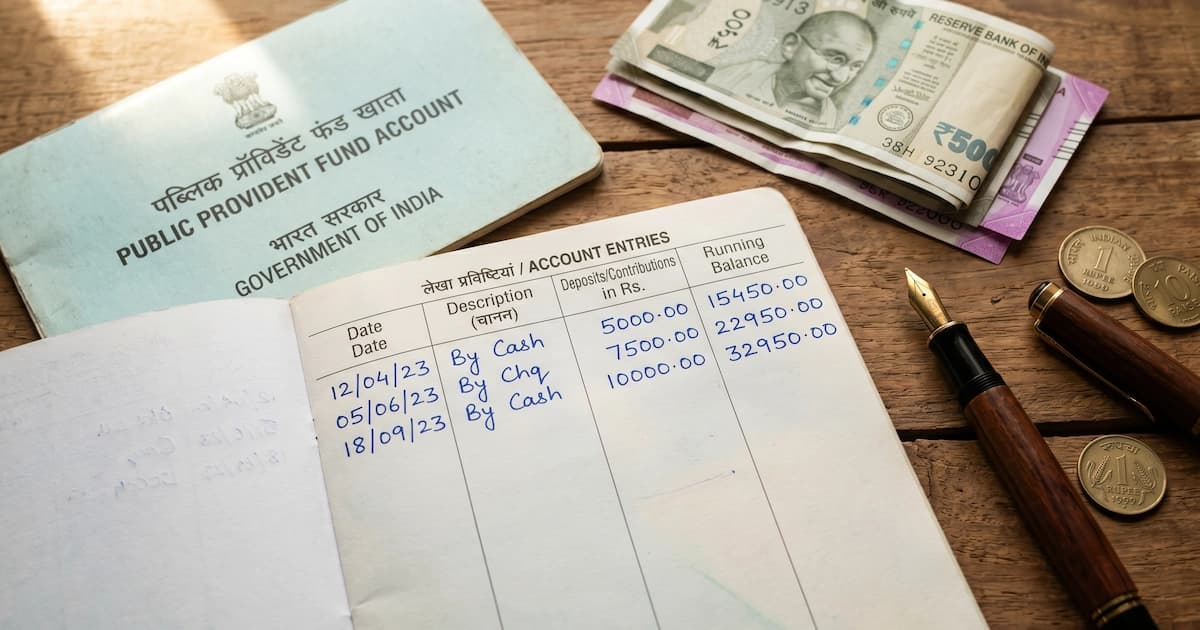
PPF pays 7.1% for Oct-Dec 2026, unchanged since 2020. See the Rs 500 to Rs 1.5 lakh limits, EEE tax, 15-year lock-in, withdrawal rules and a maturity example.
16 min read

NPS entry now runs to age 85, and non-government exits need only 20% annuity since December 2025. What the new tax regime allows, and what it takes away.
14 min read
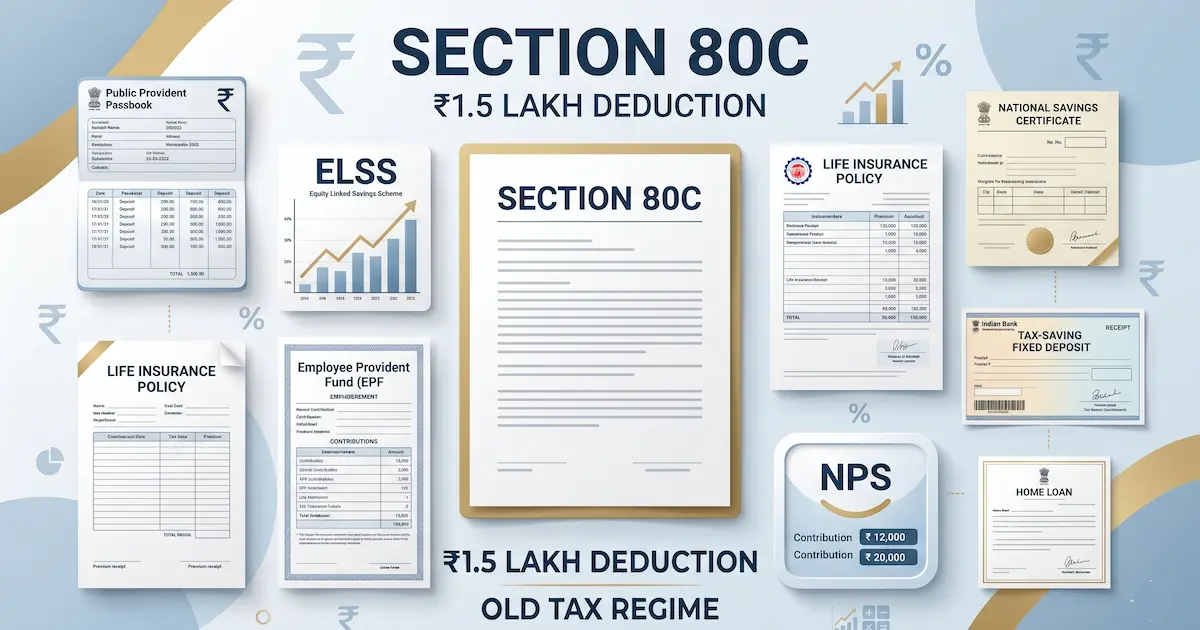
Section 80C cuts up to Rs 1.5 lakh off taxable income under the old regime only. The list, the limit, and where it lands as Section 123.
16 min read