What Is Sukanya Samriddhi Yojana (SSY)? Rate and Rules

By Tapabrata Biswas · Updated July 16, 2026 · 13 min read
Written and fact-checked by Tapabrata Biswas. How I write
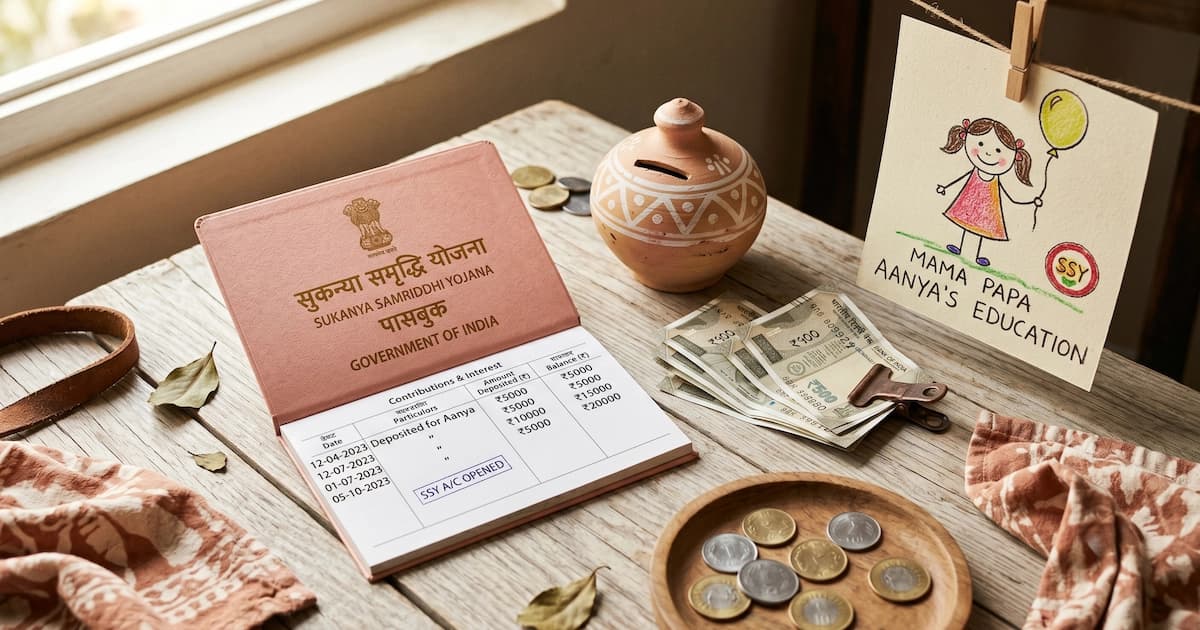
Sukanya Samriddhi Yojana pays 8.2% interest per year, 1.1 percentage points above PPF's 7.1% as of Oct-Dec 2026, and applies the same EEE tax treatment. The Indian government launched the scheme in January 2015 under the Beti Bachao Beti Padhao initiative as a dedicated savings vehicle for girl children below age 10. At maximum contributions of ₹1.5 lakh per year for the 15-year deposit period, the account compounds to roughly ₹71.82 lakh by the 21-year maturity, significantly higher than the equivalent PPF outcome, both because of the higher rate and the 6 extra years of compounding without fresh deposits.
This post covers what SSY actually is, the eligibility rules, how the 15-year-deposit + 21-year-maturity structure works, the partial withdrawal and premature closure rules, and a worked example showing how the higher rate compounds over the full holding period.
What SSY actually is
Sukanya Samriddhi Yojana (literally "Girl Child Prosperity Scheme") is a small savings scheme launched on 22 January 2015 by the Government of India under the Beti Bachao Beti Padhao Abhiyan. It is administered by the Ministry of Finance's Department of Economic Affairs and operated through India Post and designated banks.
The scheme has three structural features that differentiate it from PPF and other small-savings instruments:
Girl-child eligibility only. SSY is specifically for the financial benefit of a girl child below 10 years of age at account opening. A boy child has no eligible parallel scheme, though general small-savings vehicles like PPF or NSC remain available for any child via a guardian-operated account.
Asymmetric deposit-to-maturity timeline. Deposits are required only during the first 15 years of the account. The maturity is at 21 years from account opening, meaning the account compounds at the SSY rate for 6 additional years without any further contributions.
Highest small-savings interest rate. SSY has paid the highest rate among the government's small-savings basket since launch. As of Oct-Dec 2026 it is 8.2%, vs PPF's 7.1%, NSC's 7.7%, and SCSS's 8.2%. The relative premium over PPF has ranged from 0.5 to 1.5 percentage points over the scheme's history.
Eligibility rules
| Parameter | Rule |
|---|---|
| Girl child age | Below 10 years at account opening |
| Parent / guardian | Natural parent or legal guardian opens and operates the account |
| Maximum accounts per family | Two (one per girl child); exception for twins / triplets |
| Residency | Girl child must be Indian resident; NRIs cannot open accounts |
| Account ownership transfer | Operated by guardian until girl reaches 18; girl operates the account after 18 |
The two-account-per-family limit is strict but has a documented exception. Families with twin or triplet daughters can open a third (or fourth) SSY account by submitting an affidavit and medical certificate confirming multiple birth.
Only one SSY account is permitted per girl child across all banks and post offices. Opening a duplicate is treated as an irregularity by the administering bank/post office and excess deposits are returned without interest.
How the contribution and interest mechanics work
The deposit rules are similar to PPF but with a tighter minimum:
| Parameter | SSY rule |
|---|---|
| Minimum deposit per financial year | ₹250 |
| Maximum deposit per financial year | ₹1,50,000 across all accounts under the family's two-account limit |
| Number of deposits per year | Up to 12 installments OR lump sum |
| Deposit period | First 15 financial years from account opening |
| Interest accrual after year 15 | Continues at prevailing SSY rate until 21-year maturity |
Interest is calculated monthly on the minimum balance between the 5th and last day of each calendar month, the same rule as PPF. Depositing before the 5th of the month earns interest for that full month; depositing on or after the 6th earns interest only from the following month.
Interest is compounded annually and credited to the account at the end of each financial year. The compounding mechanic, covered in detail in our piece on what is compound interest, produces meaningful growth over the long horizon.
A missed-deposit penalty applies. A financial year with no deposit (or less than the ₹250 minimum) requires a ₹50 penalty plus payment of the missed minimum to regularize the account. Accounts without these regularization payments become "discontinued" and can only be reactivated within 15 years of opening.
A worked example, ₹1.5 lakh/year for 15 years, compounded until year 21
The maximum contribution scenario at the current 8.2% rate:
| Year | Annual contribution | Year-end balance |
|---|---|---|
| 1 | ₹1,50,000 | ₹1,62,300 |
| 5 | ₹1,50,000 | ₹9,55,955 |
| 10 | ₹1,50,000 | ₹23,73,620 |
| 15 (last deposit) | ₹1,50,000 | ₹44,75,994 |
| 16 (no deposit) | nil | ₹48,43,026 |
| 21 (maturity) | nil | ₹71,82,127 |
Total contributed across 15 years: ₹22.5 lakh. Maturity value: roughly ₹71.82 lakh, fully tax-free.
The interest-earned portion is ₹49.32 lakh, more than 2x the total contributions. The two compounding levers driving this: a 1.1 percentage-point higher rate than PPF, AND 6 additional years of interest accrual after the deposit period ends.
A smaller-contribution comparison. ₹50,000 per year for 15 years at 8.2%: maturity value about ₹23.94 lakh on ₹7.5 lakh of contributions. Even at one-third the contribution, the absolute maturity is significantly higher than the PPF equivalent because of the extended compounding period.
To try your own deposit amount and rate and see the full year-by-year balance, including the 6 years after deposits stop, use our Sukanya Samriddhi Yojana calculator.
Partial withdrawal at age 18 or Class 10 completion
The first opportunity to access SSY funds before maturity is at one of these two milestones, whichever comes first:
- The girl child turns 18 years of age
- The girl child completes the Class 10 (Secondary School Certificate) examination
At that point, a single partial withdrawal of up to 50% of the account balance at the end of the preceding financial year is permitted. The withdrawal is specifically intended for higher-education expenses and requires submission of confirmed admission documents (admission letter, fee structure from the educational institution).
The withdrawal can be taken as a lump sum or as up to 5 annual installments spread across the higher-education years. Multiple withdrawals within the same financial year are not permitted, the cap is one withdrawal per financial year.
Premature closure on marriage
If the account holder (the girl child) marries after age 18 but before the 21-year maturity date, the account can be closed and the full balance withdrawn. The application must be submitted between 1 month before the marriage date and 3 months after.
The premature closure on marriage triggers the full maturity payout at the prevailing SSY rate, no penalty or rate reduction. This is different from premature closure of PPF (which carries a 1% interest penalty) and reflects the policy intent of allowing the savings to actually serve the girl's marriage or post-marriage life if needed.
Premature closure for any other reason (medical emergency of the holder, change in residency status) is permitted only after the account has been operational for 5 years and requires documentary evidence. A 1% interest reduction applies in those cases.
EEE tax treatment in detail
SSY's tax treatment is identical to PPF's, full EEE:
| Stage | Treatment | Reference |
|---|---|---|
| Contribution | Deductible under Section 80C, up to ₹1.5 lakh/year combined with other 80C investments | Section 80C of the Income Tax Act |
| Interest accrual | Fully exempt from income tax | Section 10(11A) of the Income Tax Act |
| Maturity | Principal and accumulated interest both tax-free | Section 10(11A) |
The Section 80C limit of ₹1.5 lakh is shared across PPF, SSY, EPF, ELSS mutual funds, life insurance premiums, principal repayment on home loan, and several other instruments. A family that maxes out both a PPF account for the parent (₹1.5 lakh) AND an SSY account for a daughter (₹1.5 lakh) is contributing ₹3 lakh total, but only ₹1.5 lakh combined qualifies for the Section 80C deduction per assessee.
One 2026 change worth noting: the Income Tax Act 2025 took effect on 1 April 2026, and under it the old Section 80C is renumbered as Section 123 (read with Schedule XV). SSY still qualifies for the same up-to-₹1.5 lakh deduction, but the deduction is available only under the old tax regime, so a filer on the new regime gets no deduction on the contribution. The exempt status of the interest and the maturity is unaffected.
The interest tax exemption is what makes the headline 8.2% rate genuinely attractive. For a saver in the 30% income tax slab, 8.2% tax-free is roughly equivalent to a 11.7% taxable return, a level no bank fixed deposit reliably offers in the current rate environment.
SSY vs PPF, the practical comparison
For families with a girl child below 10, the question is often whether to fund SSY first or PPF first when both options are on the table.
| Factor | SSY | PPF |
|---|---|---|
| Current rate (Oct-Dec 2026) | 8.2% | 7.1% |
| Eligibility | Girl child below 10 | Any Indian resident |
| Max contribution per year | ₹1.5 lakh | ₹1.5 lakh |
| Deposit period | 15 years | 15 years (extendable) |
| Maturity | 21 years from opening | 15 years (extendable in 5-year blocks) |
| Partial withdrawal | 50% at age 18 / Class 10 | Once per year from year 7 |
| Tax treatment | EEE | EEE |
| 80C deduction | Yes (shared with other 80C) | Yes (shared with other 80C) |
For pure mathematical maximization of girl-child savings, SSY is the clear choice within its eligibility window. The 1.1 percentage-point higher rate plus the 6 additional compounding years produces about 75% higher maturity for the same total contributions.
For broader long-term saving in the family's name (not earmarked for a specific girl child), PPF retains the flexibility advantage, it can be opened at any age, doesn't have the girl-child restriction, and can be extended indefinitely.
For the broader savings goals where these schemes fit, see our piece on how to save for a house down payment and the related explainer on what is an emergency fund (which neither PPF nor SSY can serve due to their lock-in structures).
What experts say
The India Post SSY page is the authoritative source for current rules, eligibility criteria, and account-opening procedure. The Ministry of Finance Department of Economic Affairs Small Savings page publishes the quarterly rate notifications.
The Beti Bachao Beti Padhao official portal covers the broader policy context that SSY sits within. The Income Tax Department's Section 10(11A) guidance covers the tax exemption mechanics specific to SSY.
For the underlying compounding mechanics, see what is compound interest. For the sibling government schemes covered in this pillar, see what is Public Provident Fund (PPF) (the universal alternative without the girl-child restriction) and what is Employee Provident Fund (EPF) (the workplace-linked sibling).
Frequently asked questions
What is the current SSY interest rate in 2026? As of Oct-Dec 2026 the SSY interest rate is 8.2% per year, compounded annually. The rate is set by the Ministry of Finance (Department of Economic Affairs) and reviewed every quarter. SSY reliably pays slightly above PPF, currently 1.1 percentage points higher (8.2% vs PPF's 7.1%), because the scheme is positioned as preferential support for the girl child under the Beti Bachao Beti Padhao initiative. As with PPF, interest is calculated on the minimum balance between the 5th and last day of each month and credited at year-end.
Who can open a Sukanya Samriddhi Yojana account? A parent or legal guardian can open an SSY account for a girl child under 10 years of age at the time of account opening. A maximum of two SSY accounts is permitted per family, one per girl child. The two-account limit has an exception for twins or triplets, where additional accounts are allowed with proof. The girl child must be an Indian resident. NRIs cannot open SSY accounts. If a girl becomes NRI after the account is opened, the account is permitted to continue earning interest until maturity but fresh contributions are not allowed.
When does an SSY account mature and how can the money be used? An SSY account matures 21 years from the date of opening, not at any specific age of the girl child. Deposits are required only during the first 15 years; the account continues to earn interest during years 15-21 without further contributions. Partial withdrawal up to 50% of the balance is allowed once the girl turns 18 or completes Class 10 (whichever is earlier), specifically for higher education expenses. Premature closure is permitted if the account holder marries after age 18 (must be within 1 month before or 3 months after marriage).
What are the tax benefits of SSY? SSY has EEE (Exempt-Exempt-Exempt) tax treatment, the same favourable structure as PPF. Contributions up to ₹1.5 lakh per year are deductible under Section 80C of the Income Tax Act (this limit is shared across all 80C investments including PPF, EPF, ELSS, and life insurance). The annual interest credited to the SSY account is fully tax-free. The maturity amount, principal plus all accumulated interest, is also tax-free. Combined with the higher 8.2% rate versus PPF's 7.1%, the after-tax effective return is significantly better than most fixed-income alternatives for the same horizon.
In summary
SSY is a girl-child-specific savings scheme paying 8.2% interest (as of Oct-Dec 2026), with deposits required during years 1-15 and maturity at year 21, producing 6 additional years of compounding after the deposit period ends. At maximum contributions, an SSY account compounds to roughly ₹71.82 lakh, about 75% more than the equivalent PPF outcome because of both the higher rate and the longer compounding horizon. The EEE tax treatment (80C deduction + tax-free interest + tax-free maturity) matches PPF's tax structure, making the after-tax effective return one of the highest among government-backed Indian savings instruments.
The 21-year maturity makes SSY unsuitable for short-horizon goals or as a substitute for an emergency fund. For families with a girl child below 10 looking to build a dedicated education or marriage corpus over the next two decades, SSY is mathematically the strongest small-savings option available. The partial withdrawal allowance at age 18 or Class 10 completion provides limited flexibility specifically aligned with higher-education funding needs.
The next read in this pillar covers Employee Provident Fund (EPF), the workplace-linked sibling of PPF and SSY that operates through employer contributions and pays a slightly higher rate again. For broader savings context, see what is Public Provident Fund (PPF) (the universal small-savings counterpart without the girl-child restriction).
For where SSY fits among all of India's government savings schemes, with current rates side by side, see our Indian government savings schemes overview.
Sources
- India Post, Sukanya Samriddhi Account, indiapost.gov.in savings schemes
- Ministry of Finance, Department of Economic Affairs, Small Savings Schemes Quarterly Rate Notifications, dea.gov.in
- Beti Bachao Beti Padhao Portal, Ministry of Women and Child Development, wcd.nic.in/bbbp-schemes
- Income Tax Department of India, Section 10(11A) and Section 80C, incometax.gov.in
- Reserve Bank of India, Small Savings Schemes regulatory framework, rbi.org.in



You might also like
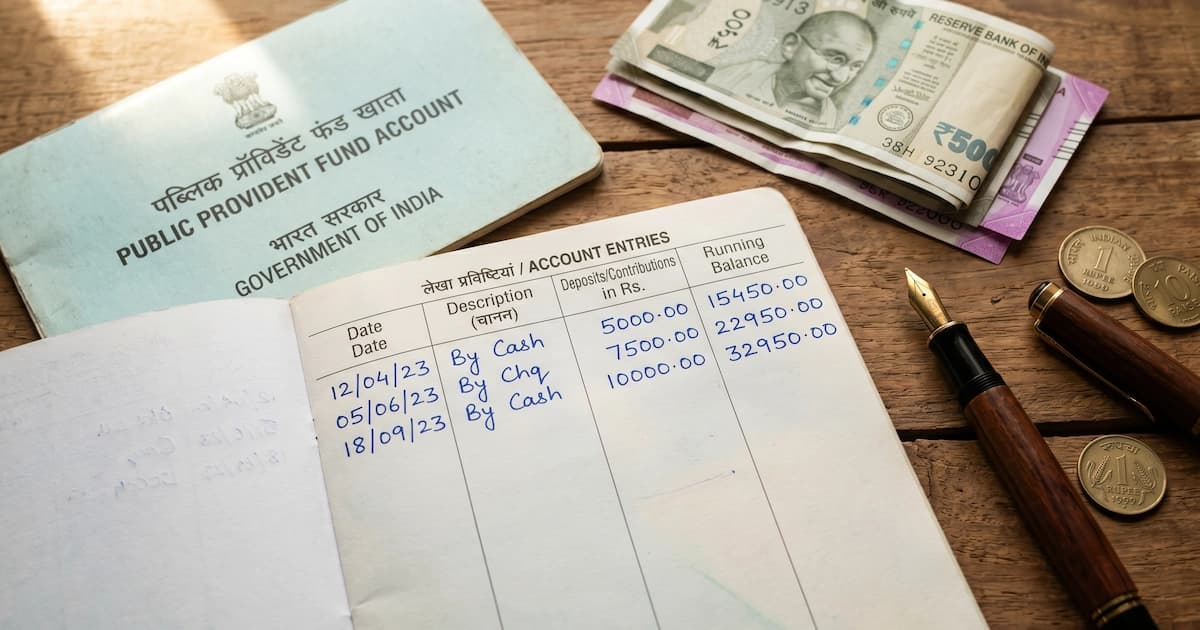
PPF pays 7.1% for Oct-Dec 2026, unchanged since 2020. See the Rs 500 to Rs 1.5 lakh limits, EEE tax, 15-year lock-in, withdrawal rules and a maturity example.
16 min read

The formula, worked rupee examples, and why compounding daily rather than yearly is worth far less than most people assume.
11 min read

The deposit is never the whole bill. RBI's lending caps plus stamp duty mean a Rs 60 lakh flat needs Rs 15,60,000 in cash, not the 10% most buyers plan for.
12 min read