Pillar 6
Financial Literacy Basics
Most people were never taught how money actually works, not in school, not at home. This section covers the foundational concepts: what inflation means for your savings, how credit scores are calculated, what net worth actually measures, and the financial terms that show up in real life but rarely get explained clearly. Start here if you are new to personal finance.
34 articles

Fidelity says 3x salary by 40. T. Rowe Price says 1.5x to 2.5x. Indian pages copy the American ladder into a country with half the pension replacement rate.
16 min read

18 finance documentaries grouped by subject, with a dated streaming check for India and the US, and a note on which famous titles are not documentaries at all.
21 min read

36 business, entrepreneur and startup movies plus 8 series, grouped by subject, with a streaming check for India dated 10 September 2026.
28 min read

15 stock market movies and series from India and the US, what each gets right and wrong about how markets work, and where you can actually watch them today.
24 min read

SEBI's advertisement code tells a fund exactly how to report returns, and the word XIRR never appears in it. That is why your statement differs.
13 min read

After 60 months a claim cannot be contested for non-disclosure. A rejection needs committee approval and the exact clause it rests on.
11 min read

SEBI's own example shows the expense ratio gap and stops before computing it. Finished, it reaches Rs 1,02,957 at twenty years.
11 min read

The same question asked of thirty ranking pages returns 58 lakh to 21.8 crore. The spread is not disagreement about India. It is one assumption.
21 min read

A SIP is a way of buying a mutual fund. What that means for risk, what happens if you miss one, and when your money actually gets invested.
16 min read

Simple interest is charged on the original amount only. The formula, a worked rupee example, and why a 10% flat-rate loan really costs about 17.9% a year.
15 min read

The gap between simple and compound interest is zero in year one and Rs 6.66 lakh by year thirty. The comparison, plus the shortcut formula exams ask for.
11 min read

The 21 November 2025 Labour Code trims monthly take-home by about 3.2%, but the money shifts into your PF and even cuts your tax. The numbers, by salary band.
9 min read

A beginner's guide to managing money in India and the US, built as an order of operations: what to do first, then next, with worked rupee and dollar examples.
25 min read

What a recession is, why two quarters of negative GDP isn't the official US definition, who declares one and how late, and India's own recession history.
16 min read

The 2026 index puts US financial literacy at 47%. India's last national survey said 27% and is seven years old. What the numbers mean, and where to begin.
12 min read
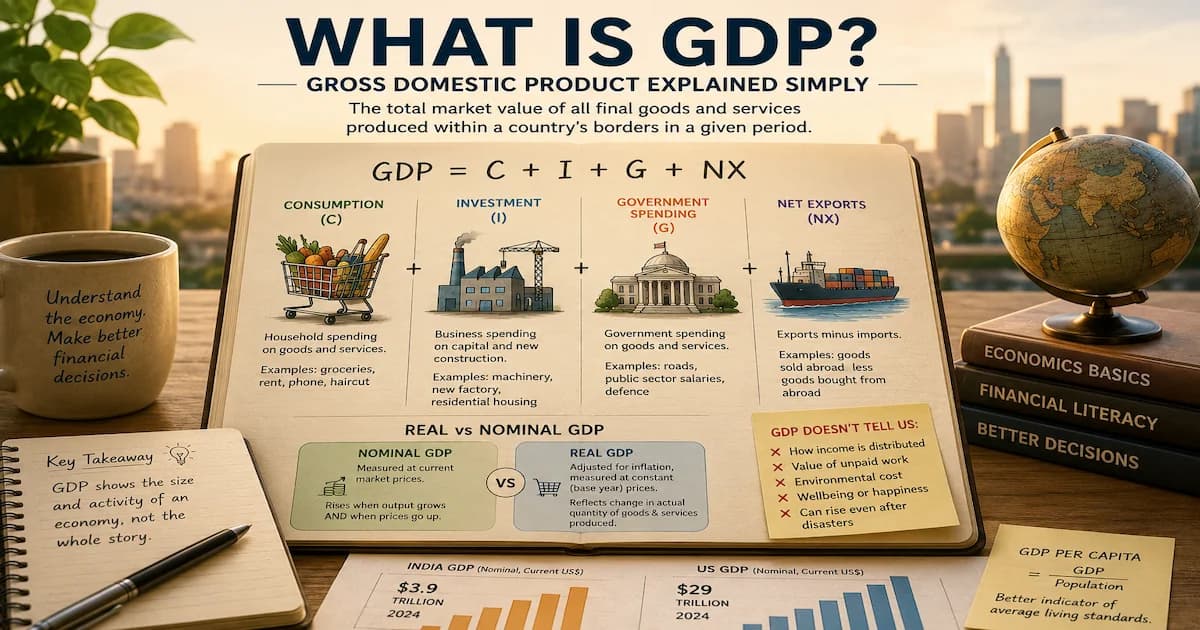
India reports GDP growth year-on-year over a fiscal year. The US annualises one quarter. The two headline numbers are built differently and do not compare.
11 min read

What is the FIRE movement? A plain-English explanation of Financial Independence Retire Early, the math, the variants, and the trade-offs of the FIRE framework.
11 min read

What does financial freedom mean? A plain-English definition, the levels people commonly talk about, and what the term actually requires in practical terms.
10 min read

How spreading investments reduces risk, the different ways to diversify, and why the idea gets repeated more often than it gets explained.
10 min read

The formula, worked rupee examples, and why compounding daily rather than yearly is worth far less than most people assume.
11 min read

What a W-2 form is, why Box 1 is smaller than your salary, every Box 12 code explained, the 2026 deadline, and how to get a copy. A plain-English US guide.
17 min read

Indian lenders now report credit data on four dates a month, not two, since 1 July 2026. What a credit report is, who can correct it, and what a delay is worth.
13 min read

The 1099-NEC threshold rose from $600 to $2,000 for payments made after 31 December 2025. What each variant reports, and the Indian form that matches it.
10 min read

Where federal, state and local tax money actually goes, and why knowing the breakdown changes how you read your own payslip.
11 min read

Every line on a US pay stub and an Indian salary slip, what the law requires, and why the total never matches the CTC you were offered.
23 min read

India quotes CTC. The US quotes gross. Neither is what lands in your account, and the US employer's 7.65% is the part nobody puts in the offer letter.
12 min read

Indian floating-rate bank loans must reset at least once every three months under an RBI rule. What sets your rate, and which benchmark it is tied to.
13 min read

APR is the rate plus fees, but the rules exclude a specific list. What India's Key Facts Statement requires, and why credit cards sit outside it.
14 min read

At 4.38% inflation and 2.70% savings interest, Rs 1,00,000 loses Rs 14,978 of buying power over ten years. What inflation does to cash, pay and debt.
10 min read

What is net worth? A plain-English explanation of the most foundational personal finance number, plus how to calculate yours in five minutes.
10 min read

What is inflation? A plain-English explanation of how prices rise, how it is measured, and what it actually means for everyday savings, wages, and debt.
10 min read

What CIBIL, UPI, EMI and TDS mean, and their US equivalents FICO, ACH and withholding. Plain definitions with real numbers, plus the pairs people mix up.
15 min read

What is financial literacy? A plain-English explanation of the skill that helps people make informed money decisions. No jargon, no advice, just clear research.
11 min read

Personal finance basics explained in plain English: income, saving, debt, credit, and investing, the small set of concepts every adult tends to encounter.
10 min read