What Is a W-2 Form? Every Box and Code Explained

By Tapabrata Biswas · Updated July 12, 2026 · 17 min read
Researched with AI assistance, reviewed and edited by Tapabrata Biswas.

Line up your W-2 next to your salary and the first number will not match. Box 1 is almost always lower than what you think you earned, and that gap is the single most common thing that confuses people reading the form for the first time. It's not a mistake. It's the whole logic of how a W-2 works, and once it clicks, the rest of the boxes fall into place.
Most guides to this form march through the same order: what it is, who gets one, when it arrives, then a box-by-box list. This one starts where the real questions are. Why Box 1 is smaller than your paycheck. What those cryptic Box 12 codes actually mean. Where your AGI hides (spoiler: not here). And how to get one when it never shows up.
What is a W-2 form?
A W-2, formally the Wage and Tax Statement, is the annual IRS form your employer issues to report the wages it paid you and the income, Social Security, and Medicare taxes it withheld. The Internal Revenue Service requires every employer to file one for each employee they paid $600 or more during the year, or any amount if tax was withheld.
Two copies of every W-2 exist. One goes to you. One goes to the Social Security Administration, which shares the data with the IRS and your state tax agency. Because the government already has its copy when you file, the numbers on your return have to match what's on the form.
Anyone classified as an employee gets a W-2, whether full-time, part-time, salaried, or hourly. Independent contractors get a different form instead, which we cover in what a 1099 form is. India's rough equivalent of the W-2 is Form 16, explained in what Form 16 is. Everything below is US-specific.
One change worth flagging: the $600 reporting floor rises to $2,000 for 2026 wages under a 2025 tax law, indexed for inflation from 2027. For the 2025 W-2 in your hands right now, the $600 threshold still applies.
Why is Box 1 smaller than my salary?
Box 1 is your federally taxable wages, meaning your gross pay minus pre-tax deductions, so it lands below your salary and often below the other wage boxes too. The reason two boxes can differ comes down to which deductions dodge which tax.
A traditional 401(k) contribution escapes federal income tax but not Social Security or Medicare tax. Pre-tax health premiums under a Section 125 cafeteria plan escape all three. So the boxes diverge depending on what you put away.
Work a real example. Say your salary is $60,000, you contribute $5,000 to a traditional 401(k), and $1,800 comes out for pre-tax health premiums.
| Box | What it shows | Amount |
|---|---|---|
| Box 1 | Federal taxable wages (minus 401k and premiums) | $53,200 |
| Box 3 | Social Security wages (minus premiums only) | $58,200 |
| Box 5 | Medicare wages (minus premiums only) | $58,200 |
The 401(k) pulls Box 1 down by $5,000 but leaves Boxes 3 and 5 alone, which is exactly why Box 1 is the smallest. Flip the situation for a high earner and the opposite happens: someone earning $200,000 with no pre-tax deductions sees Box 1 and Box 5 both at $200,000, while Box 3 stops at the Social Security wage base ($176,100 for 2025). Box 3 is capped; Box 5 never is.
The number on Box 1 should equal the year-to-date gross on your final pay stub of the year, minus those pre-tax deductions. If you want the running mid-year version of every one of these figures, our pay stub walkthrough reads each line, and gross vs net income covers why take-home differs from gross in the first place.
How do you read each box on a W-2?
The form looks dense because it packs a year of payroll into about two dozen boxes. They split into four groups.
The lettered boxes at the top identify everyone. Box a is your Social Security number. Box b is the employer's EIN, the nine-digit number written NN-NNNNNNN that people often go hunting for. Box c is the employer's address, and boxes e and f are your name and address. Box d is a control number that payroll software assigns for its own tracking, and it's frequently blank. A blank Box d trips up tax software imports, but you can leave that field empty and type the rest in by hand.
Boxes 1 through 6 hold the federal money, and they matter most at filing time:
- Box 1: wages subject to federal income tax
- Box 2: federal income tax withheld
- Box 3: Social Security wages (capped at the wage base)
- Box 4: Social Security tax withheld, 6.2% of Box 3, maxing at $10,918.20 for 2025
- Box 5: Medicare wages, with no cap
- Box 6: Medicare tax withheld, 1.45% of Box 5 plus the 0.9% Additional Medicare Tax above $200,000 single or $250,000 married filing jointly
Boxes 4 and 6 are the employee half of FICA, and your employer quietly matches them. For how that payroll tax is built and where the wage base comes from, see FICA tax explained.
Boxes 7 through 11 are blank for most people. They cover tips (7 and 8), a reserved box (9), dependent care benefits (10), and nonqualified plans (11). Box 13 has three checkboxes worth knowing: statutory employee, retirement plan participant (checking it can limit your IRA deduction), and third-party sick pay. Box 14 is a free-form "Other" bucket where employers drop items like state disability, union dues, or educational assistance.
Boxes 15 through 20 handle state and local tax: state ID and wages (15 and 16), state tax withheld (17), and the local equivalents (18 through 20). Box 20 is the locality name. Worth stating plainly, because a widely-cited finance site gets this wrong: Box 20 is not the control number. The control number is Box d. If you worked in two states during the year, you may see extra rows here or even a second W-2.
Box 12 is its own puzzle, so it gets its own section.
What do the Box 12 codes mean?
Box 12 is a set of coded entries for special items like retirement contributions and health coverage, where a letter code beside each dollar amount tells you what it represents. First, clear up the most-searched confusion: the labels 12a, 12b, 12c, and 12d are just the four blank lines. They are not codes. The actual code is the letter your employer prints next to the money, so "12a" with a "DD" beside $9,000 means code DD, not code A.
The full current code list, straight from the IRS General Instructions for Forms W-2 and W-3. Codes I, O, U, and X are deliberately unused.
| Code | What it means |
|---|---|
| A | Uncollected Social Security or RRTA tax on tips |
| B | Uncollected Medicare tax on tips |
| C | Taxable cost of group-term life insurance over $50,000 |
| D | Elective deferrals to a 401(k) |
| E | Elective deferrals to a 403(b) |
| F | Elective deferrals to a 408(k)(6) SEP |
| G | Deferrals and employer contributions to a 457(b) plan |
| H | Elective deferrals to a 501(c)(18)(D) plan |
| J | Nontaxable sick pay |
| K | 20% excise tax on excess golden parachute payments |
| L | Substantiated employee business expense reimbursements |
| M | Uncollected Social Security tax on group-term life over $50,000 (former employees) |
| N | Uncollected Medicare tax on group-term life over $50,000 (former employees) |
| P | Excludable moving expense reimbursements (Armed Forces) |
| Q | Nontaxable combat pay |
| R | Employer contributions to an Archer MSA |
| S | Employee contributions to a 408(p) SIMPLE plan |
| T | Adoption benefits |
| V | Income from exercising nonstatutory stock options |
| W | Employer and employee HSA contributions |
| Y | Deferrals under a 409A nonqualified deferred comp plan |
| Z | Income under a 409A plan that fails the rules |
| AA | Roth contributions to a 401(k) |
| BB | Roth contributions to a 403(b) |
| DD | Cost of employer-sponsored health coverage |
| EE | Roth contributions to a governmental 457(b) |
| FF | Permitted benefits under a QSEHRA |
| GG | Income from qualified equity grants under 83(i) |
| HH | Aggregate deferrals under 83(i) elections |
| II | Medicaid waiver payments excluded under Notice 2014-7 |
Four codes drive nearly all the searches. Code D is your traditional pre-tax 401(k). Code AA is the Roth version. Code W is HSA money, which you carry to Form 8889 at filing, and it's already excluded from Box 1. Code DD is the one that scares people: it shows the total cost of your health coverage, employer and employee share combined. The IRS states it directly on its health coverage reporting page: reporting that cost "does not mean that the coverage is taxable." DD is informational. It doesn't raise your tax by a cent.
What's changing on 2026 W-2s: a 2025 tax law adds three new Box 12 codes for the 2026 form, TA (employer contributions to a new type of savings account), TP (total cash tips), and TT (qualified overtime), and it splits Box 14 into 14a and 14b. None of that appears on the 2025 form you're reading now, but it will on the one you get in early 2027.
Where is my AGI on the W-2? And where's my EIN?
Your adjusted gross income is not on your W-2, because AGI is calculated on Form 1040 line 11, not reported by your employer. This is one of the most-searched W-2 questions, and the honest answer is that people are looking in the wrong place.
Box 1 is only the starting point. It flows onto line 1a of your Form 1040, then you add any other income (interest, dividends, a side gig), subtract the adjustments on Schedule 1 (such as student loan interest or HSA deductions), and the result on line 11 is your AGI. So your W-2 feeds your AGI, but it never states it.
The EIN, the other number people scan the form for, is your employer's tax ID in Box b, printed as NN-NNNNNNN. If you need it before your W-2 arrives, it's usually on an old pay stub too.
W-2 vs W-4 vs 1099 vs W-9: which form is which?
A W-4 sets your withholding at hire, a W-2 reports your wages after year-end, a W-9 collects a contractor's tax details, and a 1099-NEC reports what that contractor was paid. The forms get mixed up because several start with "W" and all involve an employer, but each does one job in one direction.
| Form | Who fills it out | Who gets it | When | What it does |
|---|---|---|---|---|
| W-4 | You (employee) | Your employer | At hire, or when life changes | Tells payroll how much to withhold |
| W-2 | Employer | You + the SSA | After year-end (by Jan 31) | Reports your wages and withholding |
| W-9 | Contractor | The paying business | Before work starts | Gives the payer your tax ID |
| 1099-NEC | Payer | Contractor + the IRS | After year-end (by Jan 31) | Reports what the contractor was paid |
The clean way to hold it in your head: the W-4 is to the W-2 as the W-9 is to the 1099. One pair is for employees, the other for contractors, and in each pair the first form is the input you provide up front and the second is the output filed after the year closes. The core legal line, per the IRS worker-classification guidance, is control: an employer directs how an employee works and withholds their taxes, while a contractor controls their own work and pays their own. The full contractor side, including self-employment tax and quarterly estimates, lives in what a 1099 form is.
When should you get your W-2, and what if it never comes?
Employers must furnish your W-2 by January 31, but for 2025 wages that deadline is Monday, February 2, 2026, because January 31 falls on a Saturday and rolls to the next business day. The IRS prints exactly that date on Topic 752. Most large employers now post it to a payroll portal on the same schedule, and by law they can only deliver it electronically if you've given affirmative consent to go paperless. Otherwise a paper copy has to be mailed.
If yours doesn't show, the IRS lays out a step ladder:
- By the end of January, contact your employer or its payroll department to confirm it's coming and that your address is current.
- By the end of February, if it still hasn't arrived, call the IRS at 800-829-1040. Have ready your name, address, and phone; your Social Security number; the dates you worked; and the employer's name, address, and phone.
- The IRS contacts the employer and sends you Form 4852, a substitute you complete by estimating wages and withholding from your final pay stub.
Filing with Form 4852 can slow your refund while the IRS verifies the figures, and if the real W-2 later differs you file an amended return on Form 1040-X. If the employer went out of business, the process is the same, since the IRS already holds the wage data the employer reported.
How do you get a copy of an old W-2?
The fastest copy is from your employer or its payroll provider; the IRS only keeps a free wage and income transcript; it does not hold an image of the form itself. That distinction matters, because the transcript drops your state and local figures.
Order your options by speed and cost:
| Source | What you get | Cost | Speed |
|---|---|---|---|
| Employer or payroll portal | The actual W-2 | Free | Fastest |
| IRS wage and income transcript | Federal W-2 data, up to 10 years | Free | Available early February |
| Form 4506-T | The same transcript by mail | Free | A few weeks |
| Form 4506 | An actual copy (only if you paper-filed it) | Fee | Up to 75 days |
You can pull the wage and income transcript from your IRS online account or by calling 800-908-9946. The Social Security Administration can also provide older copies for a fee. For most people, though, the employer route is quickest and gives the complete form.
What if your W-2 has an error?
Contact payroll first. They issue a corrected form called a W-2c, which supersedes the original. The errors worth catching immediately are your name and Social Security number, since a mismatch there can jam your whole filing. If the employer won't fix it before the deadline, you can file on time using Form 4852 and amend later once the corrected copy lands. This is process, not tax strategy, and for anything genuinely complicated about your specific return, a CPA or enrolled agent is the right call.
What this post deliberately does not cover
To keep the scope honest and avoid repeating our other guides:
- The contractor side (1099-NEC, self-employment tax, quarterly estimates) is in what a 1099 form is.
- How FICA is calculated, the wage base, and the surtax are in FICA tax explained.
- Reading each line of your paycheck is in the pay stub walkthrough.
- Turning your W-2 into a filed return touches standard vs itemized deductions and marginal vs effective rates, covered there.
- India's Form 16 is the local equivalent, in what Form 16 is.
- This is general education, not tax advice for your situation. For that, consult a CPA or enrolled agent.
Frequently asked questions
What is a W-2 form? A W-2, formally the Wage and Tax Statement, is the annual IRS form a US employer issues to each employee. It reports the wages the employer paid and the federal, state, Social Security, and Medicare taxes it withheld during the year. You use it to file your income tax returns, and a copy also goes to the Social Security Administration, so the figures on your return must match.
When should I receive my W-2? By January 31 each year under federal law. For 2025 wages that deadline lands on Monday, February 2, 2026, because January 31, 2026 is a Saturday and the date rolls to the next business day, per IRS Topic 752. If you have not received yours by mid-February, contact your employer's payroll first, and if that fails, call the IRS at 800-829-1040 and it will send you Form 4852 to file without the W-2.
Why is Box 1 smaller than my salary? Box 1 is your federally taxable wages, which is your gross pay minus pre-tax deductions, so it is usually lower than your salary. A traditional 401(k) contribution lowers Box 1 but not Box 3 or Box 5, while pre-tax health premiums under a Section 125 plan lower all three. That is why Box 1 is often the smallest of the three wage boxes, and it is correct, not an error.
Is my adjusted gross income on my W-2? No. Your AGI is not printed on your W-2. It is calculated on Form 1040 line 11 after you combine all your income and subtract adjustments. Box 1 of your W-2 is the starting point that flows to line 1a of the 1040, but it is not your AGI. Your employer's EIN, another commonly hunted number, is in Box b.
What is the difference between a W-2, a W-4, and a 1099? A W-4 is the form you fill out at hire to tell your employer how much tax to withhold. A W-2 is the form your employer sends you after year-end to report what you actually earned and had withheld. A 1099-NEC is the equivalent of a W-2 for independent contractors, who fill out a W-9 first instead of a W-4. In short, the W-4 is to the W-2 as the W-9 is to the 1099.
How do I get a copy of an old W-2? The fastest copy comes from your employer or its payroll portal (ADP, Workday, Gusto, Paychex), which is free. The IRS holds a free wage and income transcript that shows the federal W-2 data for up to 10 years, but it is not an image of the form and it drops state and local figures. An actual copy from the IRS via Form 4506 carries a fee and only exists if you paper-filed the W-2 with your return.
In summary
A W-2 is the annual record of what you earned as an employee and what was withheld from it, and nearly every box is easier to read once you know that Box 1 is taxable wages, not your salary. The letter codes in Box 12 tell you where your retirement and health money went. Your AGI lives on the 1040, not the form. And the copy you can't find is almost always one payroll login away.
The most useful thirty-second check on a fresh W-2: compare Box 1 to the year-to-date gross on your last pay stub, minus your traditional 401(k) and pre-tax premiums. If those don't reconcile, something needs a look before you file. From here, what a 1099 form is covers the contractor equivalent, and the tax concepts pillar connects the W-2 to the wider US tax picture. Reading one is part of the broader financial literacy toolkit.
Sources
- US Internal Revenue Service, About Form W-2, Wage and Tax Statement: irs.gov/forms-pubs/about-form-w-2
- US Internal Revenue Service, General Instructions for Forms W-2 and W-3 (Box 12 codes): irs.gov/instructions/iw2w3
- US Internal Revenue Service, Topic no. 752, Filing Forms W-2 and W-3: irs.gov/taxtopics/tc752
- US Internal Revenue Service, If you don't get a W-2 or your W-2 is wrong: irs.gov/filing/if-you-dont-get-a-w-2-or-your-w-2-is-wrong
- US Internal Revenue Service, Form W-2 reporting of employer-sponsored health coverage: irs.gov/affordable-care-act/form-w-2-reporting-of-employer-sponsored-health-coverage
- US Internal Revenue Service, Transcript types and ways to order them: irs.gov/individuals/transcript-types-and-ways-to-order-them




You might also like

Every line on a US pay stub and an Indian salary slip, what the law requires, and why the total never matches the CTC you were offered.
23 min read

The 1099-NEC threshold rose from $600 to $2,000 for payments made after 31 December 2025. What each variant reports, and the Indian form that matches it.
10 min read
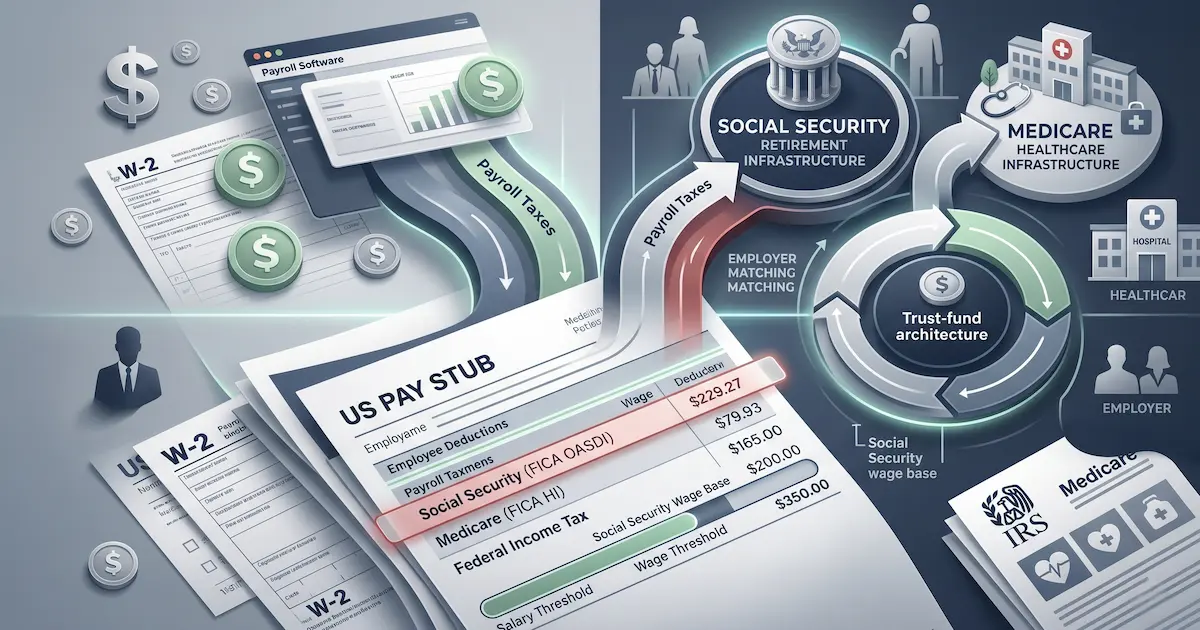
FICA is the US payroll tax funding Social Security and Medicare. What Fed OASDI/EE and Fed MED/EE mean on your paycheck, the 2026 rate, and the wage base.
12 min read