Tax Concepts Explained: India and US Terms, Defined

By Tapabrata Biswas · Updated August 29, 2026 · 19 min read
Written and fact-checked by Tapabrata Biswas. How I write
Reviewed by Subir Kumar Debsharma, Tax, GST and ROC professional with 20+ years of experience.
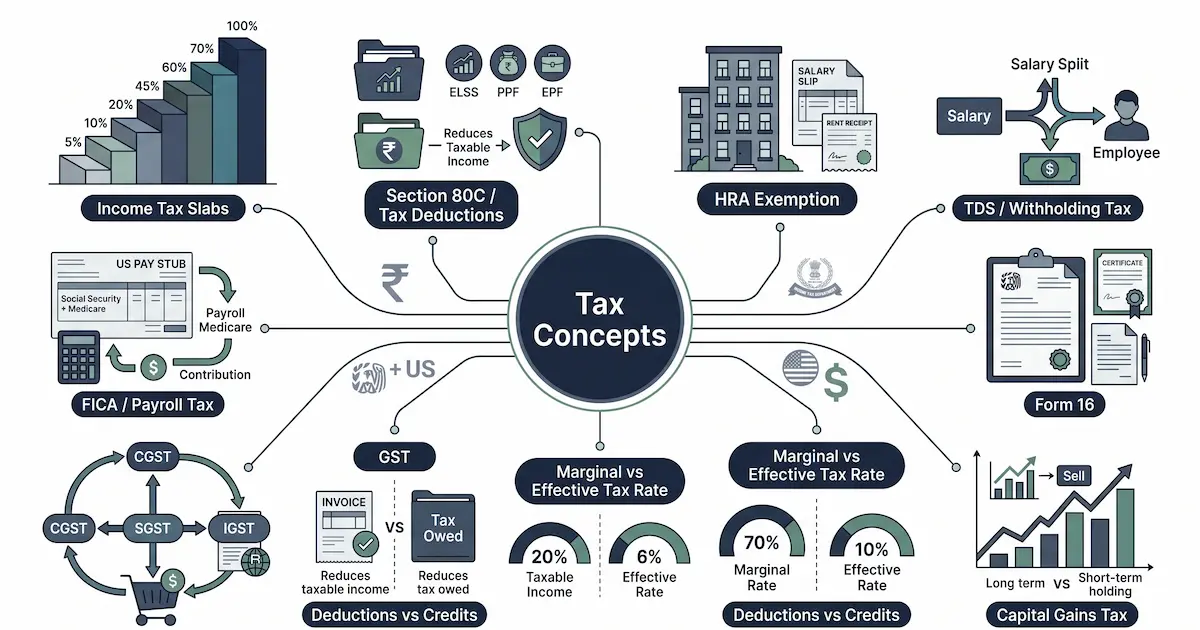
Tax is mostly a vocabulary problem. Once you know what a slab is, how a deduction differs from a rebate, and what TDS actually does, the annual scramble in July gets a lot quieter. This is the hub page for The Money Decoded's tax cluster, and it defines the core concepts for both India and the United States, then points you to a full guide on each. For how taxes fit into the bigger picture of managing money as a beginner, our complete personal finance guide places tax in the full sequence.
Nothing here is tax planning, filing, or compliance advice. Tax law is statutory, it changes with every Union Budget in India and every Tax Act in the US, and it applies to your situation in ways only a qualified Chartered Accountant (India) or Certified Public Accountant (US) can assess. For any decision that turns on your own numbers, talk to one.
For salaried filers: our Indian income tax guide for salaried employees (FY 2025-26) pulls the most-used concepts here, regime choice, Form 16, Section 80C, HRA, and step-by-step filing, into one walkthrough for the return due 31 July 2026.
What does "tax concepts" mean?
A tax is a compulsory payment to the government that funds public spending, and tax concepts are the building-block terms that describe how that payment is calculated and collected. Learn a dozen of them and most tax content stops feeling like a foreign language.
Taxes split into two broad families. A direct tax is charged on income or wealth and is paid straight to the government by the person who owes it, like income tax. An indirect tax is charged on goods and services and reaches the government through a seller, like India's GST or a US sales tax.
| Direct tax | Indirect tax | |
|---|---|---|
| Charged on | Income, profits, or wealth | Goods and services you buy |
| Who pays it in | The taxpayer, directly | The seller, who collects it from you |
| India example | Income tax, capital gains tax | GST |
| US example | Federal income tax, FICA | State and local sales tax |
Both India and the US run their income tax on a progressive slab or bracket structure, meaning the rate climbs in steps as income rises, so higher earnings are taxed at higher rates only on the portion inside each higher band. That single idea, tax by bands, is the root of half the concepts below.
The income-tax vocabulary, defined
The core income-tax concepts are the terms that decide how your gross earnings become a final tax figure: who the taxpayer is, which year is which, what counts as income, and what gets subtracted along the way. The India-side vocabulary, in plain terms:
A taxpayer, called an assessee in Indian tax law, is any person or entity liable to pay tax or file a return. Your income gets sorted into five heads: salary, house property, business or profession, capital gains, and other sources (which sweeps up interest and the rest). Add them and you get gross total income; subtract your eligible deductions and you reach total income, the figure the slabs actually apply to.
The one timing quirk that trips up every first-time filer is the two-year naming. India separates the year you earn from the year you file.
| Term | What it means | Example |
|---|---|---|
| Financial year (FY) | The 1 April to 31 March year in which you earn | FY 2025-26 |
| Assessment year (AY) | The next year, in which you file and are assessed | AY 2026-27 |
So salary earned in FY 2025-26 is filed in AY 2026-27, with the deadline 31 July 2026 for most salaried people. The US skips this entirely and uses one tax year, normally the calendar year. The full mechanics of rates and heads sit in income tax slabs explained.
What the Income-tax Act 2025 renames
From 1 April 2026 the Income-tax Act 2025 replaces the 1961 Act, and it changes several of the words defined on this page. One of them stops existing.
Section 3 of the new Act is short enough to quote: "For the purposes of this Act, 'tax year' means the twelve months period of the financial year commencing on the 1st April." Search the whole Act for "assessment year" and it returns nothing. The FY and AY pairing that Indian tax vocabulary has run on since 1961 becomes one tax year.
That is worth stating flatly, because it is being reported the other way round. One widely-read tax site lists "Assessment years, financial years, and tax calendar, no change" under a heading of what has not changed. The Act uses the phrase zero times.
The section numbers behind the terms on this page move as well:
| Concept | 1961 Act | 2025 Act |
|---|---|---|
| Section 80C deductions | 80C | 123 |
| Education loan interest | 80E | 129 |
| Rebate for small incomes | 87A | 156 |
| New regime | 115BAC | 202 |
| Filing a return | 139 | 263 |
| Salary TDS | 192 | 392(1) |
| The whole 194 series | 194A, 194J and the rest | 393, one table |
| Long-term capital gains, equity | 112A | 198 |
| Short-term capital gains, equity | 111A | 196 |
| Salary TDS certificate | Form 16 | Form 130 |
| Annual tax statement | Form 26AS and the AIS | Form 168, merged |
None of this changes the return you are filing now. Section 536(1) repeals the 1961 Act, but Section 536(2)(c) preserves it for "any tax year beginning before the 1st April, 2026". FY 2025-26 began on 1 April 2025, so that return is made under the old Act with the old numbering, which is why this page still teaches both.
The scale of the rewrite is worth a line. CBDT's own transition material puts the new Act at 536 sections and 16 schedules against 819 sections and 14 schedules, with the rules cut from 511 rules and 399 forms to 333 rules and 190 forms. The full old-to-new map is in our Income-tax Act 2025 section mapping.
Income tax slabs and the two regimes (FY 2025-26)
India runs two parallel income-tax regimes, and for FY 2025-26 the new regime makes income up to ₹12 lakh effectively tax-free through the Section 87A rebate. You pick one regime each year; the new one is the default.
The new-regime slabs for FY 2025-26 (AY 2026-27), per the Income Tax Department, run like this:
| Income (new regime) | Rate |
|---|---|
| Up to ₹4,00,000 | Nil |
| ₹4,00,001 to ₹8,00,000 | 5% |
| ₹8,00,001 to ₹12,00,000 | 10% |
| ₹12,00,001 to ₹16,00,000 | 15% |
| ₹16,00,001 to ₹20,00,000 | 20% |
| ₹20,00,001 to ₹24,00,000 | 25% |
| Above ₹24,00,000 | 30% |
The Budget 2025 change that matters most: the Section 87A rebate rose to ₹60,000, which zeroes out tax on taxable income up to ₹12 lakh under the new regime. Add the ₹75,000 standard deduction for salaried filers and the real break-even climbs to about ₹12.75 lakh of salary. The old regime keeps its narrower slabs (nil up to ₹2.5 lakh, then 5%, 20%, and 30% above ₹10 lakh) and a ₹50,000 standard deduction, and it only pays off if your deductions are large.
Deductions, exemptions, and rebates: the trio people confuse
A deduction lowers your taxable income, an exemption removes certain income from tax entirely, and a rebate cuts the final tax itself, and they act at three different points in the calculation. Getting these three straight is the single biggest jump in tax literacy.
| Mechanism | Where it acts | India example | What it's worth |
|---|---|---|---|
| Deduction | Reduces taxable income | Section 80C, up to ₹1.5 lakh | Your marginal rate times the amount |
| Exemption | Keeps income out of tax | HRA exemption, agricultural income | The full tax on the exempt slice |
| Rebate | Reduces the tax due | Section 87A | Rupee for rupee off the tax |
A quick worked number shows why the distinction pays. If you're in the 20% band and invest the full ₹1.5 lakh eligible under Section 80C, that deduction cuts your tax by ₹30,000 (20% of ₹1.5 lakh), not by ₹1.5 lakh. Section 80C is an old-regime benefit only, as is the extra ₹50,000 for NPS under 80CCD(1B). The HRA exemption works on a separate three-part formula for people who rent, and it too belongs to the old regime.
How tax gets collected, and the documents that prove it
Most Indian income tax is collected before you ever file, through TDS, and three documents record what was taken so you can reconcile it against your return. This is where abstract concepts meet the paperwork in your inbox.
TDS, or tax deducted at source, is tax your employer or bank withholds and deposits with the government on your behalf, under Section 192 for salary and the 194-series for interest, rent, and professional fees. If your total tax runs ahead of what TDS covers, you top it up as advance tax during the year and self-assessment tax at filing. The concept in full is in what TDS is.
Three documents prove all of this, and they're the reconciliation trio every salaried filer should know:
- Form 16 is the certificate your employer issues showing your salary and the TDS deducted from it.
- Form 26AS is the tax-credit statement showing all TDS, TCS, and tax paid against your PAN.
- The AIS (Annual Information Statement) is the wider record of your reported income and transactions, from interest to securities to GST turnover.
The three should agree before you file, and a gap is a signal to fix at source, not to file over. No abstract slab or deduction means much until you can see it land in these three.
GST: India's indirect-tax concept (updated 2025)
GST (Goods and Services Tax) is India's unified indirect tax on the supply of goods and services, and since 22 September 2025 it runs on a simplified two-rate structure. It replaced 17 older central and state taxes when it launched on 1 July 2017.
The 56th GST Council meeting collapsed the old four-slab system into a cleaner set of rates, effective 22 September 2025:
| GST rate | Applies to |
|---|---|
| Nil | Essentials, many food items, individual health and life insurance |
| 5% | Merit and mass-consumption goods |
| 18% | The standard rate for most goods and services |
| 40% | Luxury and sin goods (special rate) |
The earlier 12% and 28% slabs were removed, though tobacco and pan masala temporarily stay at 28% plus compensation cess until older cess dues are cleared. GST splits into CGST plus SGST within a state and IGST across states, with input tax credit flowing through the chain so tax isn't charged on tax. The full structure sits in GST India explained.
Capital gains, in one concept
A capital gain is the profit from selling a capital asset such as shares, mutual funds, or property, and the rate depends on how long you held it. Short-term gains are taxed harder than long-term ones, to reward holding.
After Budget 2024, India taxes long-term gains on listed equity at 12.5% above a ₹1.25 lakh yearly exemption, and short-term equity gains at 20%, with indexation removed and the holding-period line drawn at 12 months for listed securities and 24 months for most other assets. The US uses its own 0/15/20% long-term brackets and taxes short-term gains as ordinary income. Both systems, and the exemption routes in each, are in capital gains tax, short vs long term.
The US tax concepts, and how they map to India
The US tax system shares India's core ideas, progressive brackets, deductions, credits, and payroll tax, but arranges them differently, most visibly in its standard-versus-itemized choice. If you know the India side, the US side is mostly a relabeling exercise.
Adjusted gross income (AGI) is the US version of income after certain adjustments, roughly parallel to gross total income. From there a filer either takes the flat standard deduction or itemizes actual expenses, whichever is larger, a fork India doesn't have. A deduction reduces taxable income while a credit cuts the tax dollar for dollar, and the deductions vs credits guide walks the US structure with its India parallels. The gap between your top bracket and your average rate is the subject of marginal vs effective tax rate. And FICA is the US payroll tax funding Social Security and Medicare, the counterpart to India's EPF.
India and US tax terms, side by side
No single glossary on the internet defines tax terms for both India and the US, yet the two systems map onto each other concept by concept. This side-by-side is the translation table cross-border readers, NRIs, and US-employed Indians rarely find in one place.
| Concept | India | United States |
|---|---|---|
| The tax year | Financial year to earn, assessment year to file | A single tax year |
| Income before deductions | Gross total income | Adjusted gross income (AGI) |
| Fixed-list itemized deductions | Chapter VI-A (80C, 80D, 24b) | Itemized deductions |
| Flat deduction | Standard deduction, ₹75,000 (new regime) | Standard deduction, $15,750 single (TY 2025) |
| Cut to the final tax | Section 87A rebate | Tax credit |
| Employer withholding | TDS on salary (Section 192) | Federal income-tax withholding (W-4) |
| Payroll social-security tax | EPF (12% plus 12%) | FICA (7.65% plus 7.65%) |
| Indirect / consumption tax | GST | State and local sales tax |
| Rent tax break | HRA exemption | No direct equivalent |
| Filing categories | None, individual assessment | Single, married joint, married separate, head of household |
The honest gaps are as useful as the matches. GST, HRA, and Section 80C have no US analog. Filing status, the W-2, and the standard-versus-itemized choice have no India analog. And TDS is broader than US withholding, reaching rent, interest, and professional fees well beyond wages.
Common misconceptions about tax concepts
The costliest tax mistakes come from misreading a concept, not from missing a form. Three misconceptions do the most damage.
The first is the tax-bracket myth: the belief that a raise pushing you into a higher slab cuts your take-home pay. It can't, because the higher rate applies only to the rupees inside the higher band, which is exactly why the marginal rate and the effective rate differ. The second is treating a deduction like a refund; a ₹1.5 lakh deduction saves you your marginal rate on that amount, not the whole ₹1.5 lakh. The third is treating the AIS or a prefilled return as final; it's a reference the department builds from third-party reports, and income missing from it is still yours to declare.
Where to start
The posts read in any order, but a few sequences make sense by situation.
Indian salaried filer: slabs, then marginal vs effective, then 80C and HRA, then the document trio Form 16, Form 26AS, and AIS to reconcile before filing.
US salaried filer: marginal vs effective, then deductions vs credits, then FICA, then capital gains if you invest.
Selling an asset: capital gains first, then marginal vs effective to see which band the gain lands in.
The authorities behind these concepts
Every figure in this cluster traces to a primary authority, not a secondary financial-media source.
| Authority | Jurisdiction | What it governs |
|---|---|---|
| Income Tax Department / CBDT | India | Direct tax administration and policy |
| Ministry of Finance | India | Union Budget and Finance Acts |
| GST Council / CBIC | India | Indirect tax policy and administration |
| TRACES | India | TDS reconciliation and Form 26AS |
| US Internal Revenue Service (IRS) | US | Federal tax administration |
| US Social Security Administration | US | Social Security and the FICA wage base |
What this pillar deliberately does not cover
The hub gives you the vocabulary; the specialist gives you the filing. Deliberately out of scope here:
- ITR form selection (ITR-1 vs ITR-2 vs ITR-3), the full filing walkthrough, and regime choice in context, which live in the salaried income tax guide.
- Deep mechanics of each concept, which each linked cluster post owns in full.
- Specialised areas: Section 54/54EC/54F exemptions, NRI and DTAA provisions, corporate and business tax, GST return filing (GSTR-1/3B/9), and US S-corp, AMT, and estate tax.
- This is general education, not filing advice. For anything turning on your own numbers, consult a Chartered Accountant in India or a Certified Public Accountant in the US.
Frequently asked questions
Does the Income-tax Act 2025 change these terms? Several of the Indian ones, yes, and it removes one of them. Section 3 of the Income-tax Act 2025 states that for the purposes of that Act, tax year means the twelve months period of the financial year commencing on the 1st April. The phrase assessment year appears nowhere in the Act at all, so the FY and AY pair that Indian tax vocabulary has run on for sixty years collapses into a single tax year. Section numbers move too: Section 80C becomes Section 123, the Section 87A rebate becomes Section 156, the new regime under Section 115BAC becomes Section 202, and the return under Section 139 becomes Section 263. None of this touches the return you file for FY 2025-26, because Section 536(2)(c) keeps the 1961 Act alive for any tax year beginning before 1 April 2026. The Act is also much shorter, at 536 sections against 819.
What are tax concepts? Tax concepts are the foundational terms and mechanics of a tax system: what counts as taxable income, the slabs or brackets that set the rate, the deductions and exemptions that reduce taxable income, the credits and rebates that cut the final tax, and the ways tax is collected such as TDS in India or withholding in the US. Understanding them lets you read your pay slip, follow a Budget announcement, and hold an informed conversation with your accountant. This pillar defines the most-used concepts for both India and the US and links each to a detailed guide.
What is the difference between the financial year and the assessment year in India? The financial year (FY) is the 12 months from 1 April to 31 March in which you earn income, and the assessment year (AY) is the next 12 months in which you file the return and the income is assessed. So income earned in FY 2025-26 (1 April 2025 to 31 March 2026) is filed in AY 2026-27, with the return due by 31 July 2026 for most salaried filers. The US has no such split; it uses a single tax year, usually the calendar year. India is heading the same way: the Income-tax Act 2025 defines a single tax year in Section 3 and never uses the phrase assessment year, so this two-name split applies to FY 2025-26 and then stops.
What is the difference between a deduction, an exemption, and a rebate? A deduction reduces your taxable income before tax is calculated, so its value equals your marginal rate times the deduction, like the ₹1.5 lakh under Section 80C. An exemption keeps a specific type of income out of the tax net entirely, like the House Rent Allowance exemption or agricultural income. A rebate reduces the final tax itself, rupee for rupee, like the Section 87A rebate that makes income up to ₹12 lakh tax-free under India's new regime. They act at three different stages of the calculation.
Is India's new tax regime better than the old one? There is no universal answer. The new regime is the default from FY 2023-24 and suits most people with few deductions, because the Section 87A rebate makes income up to ₹12 lakh tax-free and the slabs are wider. The old regime can still work out lower if your deductions are large, such as a full ₹1.5 lakh under 80C, significant HRA, and home-loan interest under Section 24(b). Which is cheaper for you is an arithmetic question specific to your numbers, and a Chartered Accountant can compute both before you choose.
Does India have a standard deduction like the US? Yes, but it works differently. India gives salaried taxpayers a flat standard deduction of ₹75,000 under the new regime or ₹50,000 under the old regime for FY 2025-26, applied automatically with no itemizing. The US standard deduction is much larger (for example $15,750 for a single filer in tax year 2025) and is an either-or choice against itemizing your actual expenses. India has no US-style itemize-versus-standard election; its itemized-style deductions live in a separate fixed list under Chapter VI-A.
Is TDS the same as US tax withholding? They are close cousins but not identical. Both take tax at the source before you receive the money, but US federal withholding applies mainly to wages via your W-4, whereas India's TDS is much broader, covering salary under Section 192 plus interest, rent, dividends, professional fees, and contractor payments under the 194-series. TDS you have paid shows up in your Form 26AS and AIS, which you reconcile before filing, the rough equivalent of matching your W-2 and 1099s in the US.
In summary
Tax stops being intimidating once the vocabulary clicks. A slab taxes income in bands, a deduction shrinks the income that's taxed, a rebate erases part of the tax, and TDS quietly collects most of it before you file, all of it landing in your Form 16, Form 26AS, and AIS for you to check. India and the US arrange these pieces differently, but the pieces are the same, which is why one glossary can hold both.
The thing worth remembering is that this vocabulary makes you a sharper client, not your own accountant. Concepts are fixed and public; your situation is specific and changes yearly. Read here to understand what your CA or CPA is doing, then let them apply it to your actual numbers.
Sources
-
Income-tax Act, 2025, Section 3 (tax year), Section 536 (repeal and savings), and the section renumbering, as recorded in our own verified-law notes from the gazetted Act and CBDT's per-form FAQs: Income-tax Act 2025 section mapping
-
Income Tax Department of India, income tax slabs FY 2025-26 and Section 87A rebate: incometax.gov.in
-
Central Board of Direct Taxes (CBDT): incometaxindia.gov.in
-
Ministry of Finance, Government of India, Union Budget: indiabudget.gov.in
-
GST Council, GST rate structure: gstcouncil.gov.in
-
Central Board of Indirect Taxes and Customs (CBIC): cbic.gov.in
-
US Internal Revenue Service (IRS): irs.gov
-
US Social Security Administration (SSA), FICA wage base: ssa.gov




You might also like
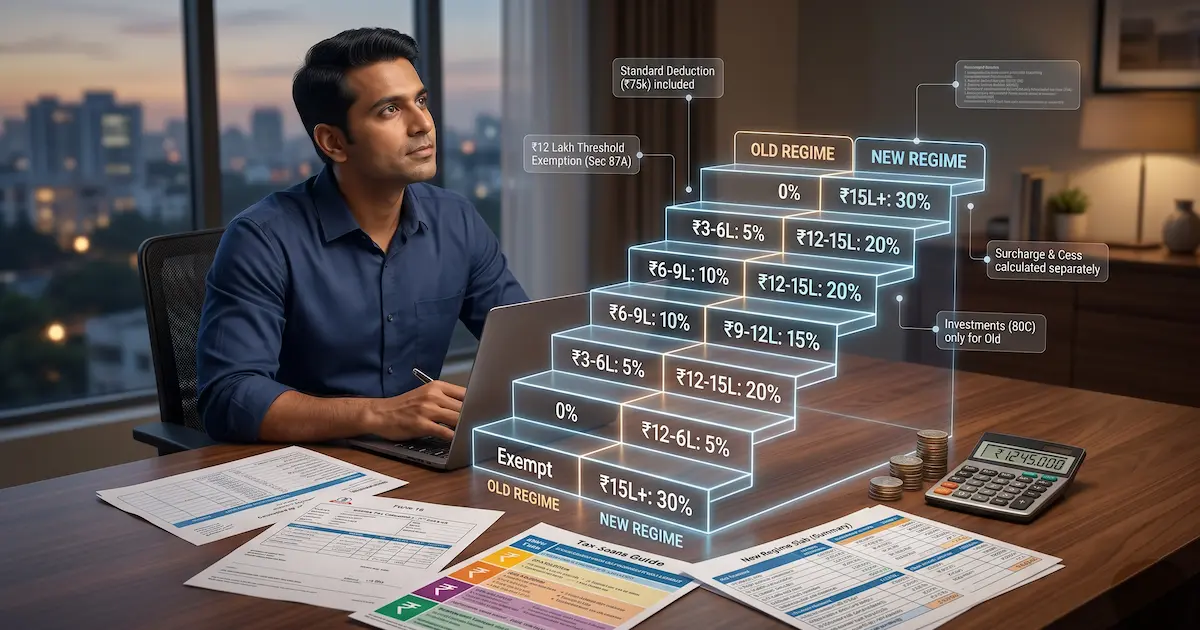
Income tax slabs in India for FY 2025-26 (AY 2026-27): new and old regime rates, the ₹12.75 lakh salaried zero-tax point, the 87A rebate, surcharge, and cess.
18 min read

The Form 26AS password is your date of birth as DDMMYYYY, the same for PDF, text and Excel. PAN plus date of birth is a different form entirely.
18 min read

The AIS PDF password is your PAN in lowercase plus date of birth as DDMMYYYY. Form 26AS uses a different rule, and both merge into Form 168.
19 min read