HRA Exemption: The 8-City Rule and the Formula

By Tapabrata Biswas · Updated August 25, 2026 · 16 min read
Researched with AI assistance, reviewed and edited by Tapabrata Biswas.
Reviewed by Subir Kumar Debsharma, Tax, GST and ROC professional with 20+ years of experience.
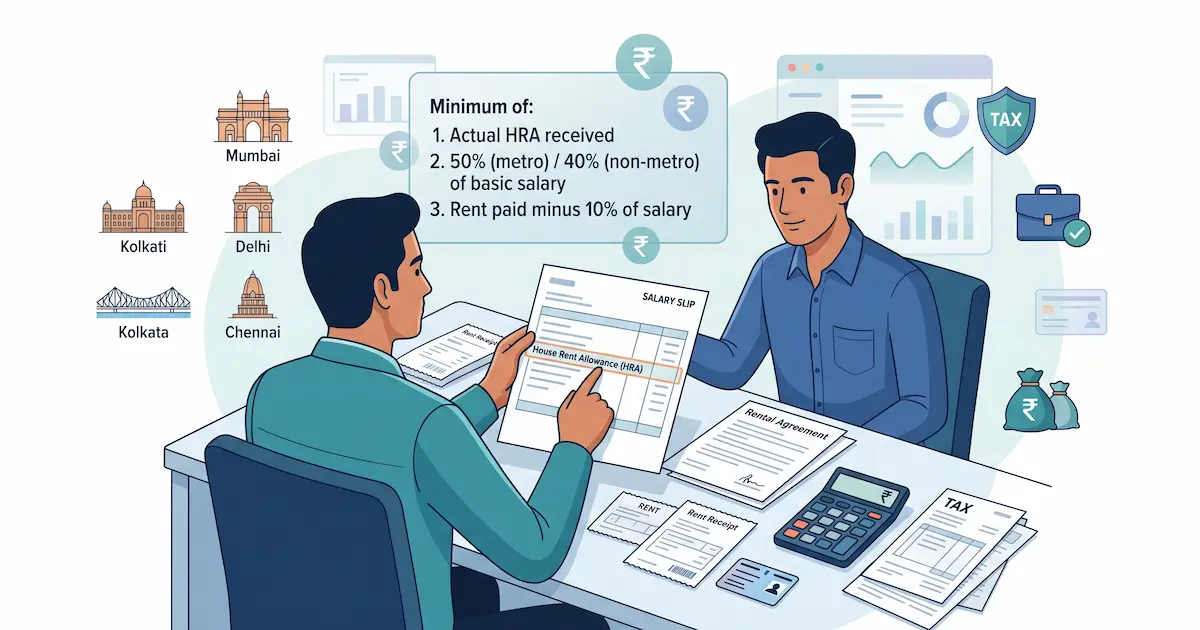
Four cities got the 50% house rent allowance rate for more than twenty years. On 1 April 2026 that list became eight, and Bengaluru, Hyderabad, Pune and Ahmedabad joined it.
Most coverage of that change gets one thing wrong and leaves another out. The thing it gets wrong is timing: the return most people are filing right now does not use the new list. The thing it leaves out is that the upgrade frequently makes no difference to the exemption at all.
What is HRA exemption?
HRA exemption is the part of your House Rent Allowance that is not taxed, and it equals the lowest of three amounts rather than any fixed sum. Your employer pays you HRA as part of salary. If you pay rent and don't own the place you live in, some of that allowance escapes tax.
Two conditions gate it before any arithmetic starts. You have to actually pay rent for the home you occupy, and you must not own that home. Both come straight from the law: Schedule III of the Income-tax Act 2025 sets out, at Table Serial Number 11, that the accommodation is "not owned by him" and that the person "has actually incurred expenditure on payment of rent."
The third gate is your tax regime, and it disqualifies most people by default. More on that below.
Which cities get the 50% HRA rate?
From FY 2026-27, eight cities get the 50% rate: Mumbai, Kolkata, Delhi, Chennai, Hyderabad, Pune, Ahmedabad and Bengaluru. Every other place in India gets 40%.
The instrument is worth naming, because almost nothing that ranks for this question names it. The Act itself contains no city list. Schedule III says only that the allowance is exempt "to such extent as may be prescribed having regard to the area or place in which such accommodation is situated." The prescribing is done by Rule 279 of the Income-tax Rules 2026, notified by the CBDT on 20 March 2026 under section 533 of the Income-tax Act 2025. Rule 279 carries a two-row table: the eight cities at 50%, and "any other place" at 40%.
| Where you live | Rate | Which years |
|---|---|---|
| Mumbai, Kolkata, Delhi, Chennai | 50% | FY 2025-26 and FY 2026-27 |
| Hyderabad, Pune, Ahmedabad, Bengaluru | 50% | FY 2026-27 onwards only |
| Anywhere else | 40% | both years |
One rule catches people out regardless of year. The rate follows where you live, not where your employer is registered. Someone living in Chennai who works for a Coimbatore company gets 50%. Someone living in Coimbatore who works for a Chennai company gets 40%.
Does the eight-city rule apply to the return I am filing now?
No. The return being filed in 2026 covers FY 2025-26, and that year still runs on the old four-city list.
This is the single most expensive thing to get wrong on this topic right now, and it is easy to get wrong, because the new rule is genuinely in force and the news about it is everywhere.
The reason sits in the repeal clause of the new Act. Section 536(1) repeals the Income-tax Act 1961. Then section 536(2)(c) preserves it, stating that the repealed Act "shall continue to apply to any proceeding pending on the date of commencement of this Act and to any proceedings initiated on or after the 1st April, 2026 ... in respect of any tax year beginning before the 1st April, 2026."
FY 2025-26 began on 1 April 2025. So it began before 1 April 2026, and it stays under the old law: section 10(13A), Rule 2A, four cities. A person in Pune filing for FY 2025-26 is a 40% taxpayer, whatever the current rule says.
The eight-city list first applies to FY 2026-27, the year running now, which most people will file in mid-2027.
Does the 50% rate actually increase my exemption?
Often not. The exemption is the lowest of three amounts, so raising the city limb helps only when that limb is the one setting the cap.
Nearly every page covering the change treats it as a straightforward win for the four new cities. It isn't, and the arithmetic shows why in about thirty seconds.
Call the three amounts A, B and C:
- A is the actual HRA you received
- B is 50% or 40% of salary, depending on your city
- C is the rent you paid minus 10% of salary
Your exemption is whichever is smallest. Moving B up from 40% to 50% changes your answer only if B was the smallest to begin with. If C was already the lowest, C stays the lowest, and nothing happens.
A case where the change helps
Rohan is salaried in Bengaluru, renting, with a basic salary of Rs 60,000 a month and HRA of Rs 30,000 a month. His rent is Rs 40,000 a month.
| FY 2025-26 (40%) | FY 2026-27 (50%) | |
|---|---|---|
| A, actual HRA | Rs 3,60,000 | Rs 3,60,000 |
| B, % of salary | Rs 2,88,000 | Rs 3,60,000 |
| C, rent minus 10% | Rs 4,08,000 | Rs 4,08,000 |
| Exempt (lowest) | Rs 2,88,000 | Rs 3,60,000 |
B was the binding limb, so lifting it lifts the exemption by Rs 72,000. At a 20% slab that saves roughly Rs 15,000 of tax; at 30%, roughly Rs 22,000.
A case where it changes nothing
Priya is also in Bengaluru, on the same Rs 60,000 basic and Rs 30,000 HRA. Her rent is Rs 25,000 a month, because she shares a flat.
| FY 2025-26 (40%) | FY 2026-27 (50%) | |
|---|---|---|
| A, actual HRA | Rs 3,60,000 | Rs 3,60,000 |
| B, % of salary | Rs 2,88,000 | Rs 3,60,000 |
| C, rent minus 10% | Rs 2,28,000 | Rs 2,28,000 |
| Exempt (lowest) | Rs 2,28,000 | Rs 2,28,000 |
C was already the smallest and still is. Priya's exemption does not move by a single rupee, and neither does her tax. Same city, same salary, same reclassification, entirely different outcome, and the only thing separating her from Rohan is how much rent she pays relative to what she earns.
The general shape: the 50% rate helps people whose rent is high relative to their salary. Where rent is modest, the rent limb caps the exemption and the city rate is decorative. You can run your own three numbers in our HRA exemption calculator, which shows which limb is capping you and why.
What counts as salary in the HRA formula?
Salary here means basic pay plus dearness allowance, and the dearness allowance counts only if your terms of employment provide for it. Rule 279 puts it plainly: salary "includes dearness allowance, if provided for under the terms of employment, but excludes all other allowances and perquisites."
So your special allowance, your conveyance allowance, your bonus and your perquisites are all outside this calculation. A lot of published guidance says "basic salary" and then quietly uses basic plus DA in its own worked table, which hands two different answers to readers depending on whether they follow the words or the arithmetic.
One more term matters. Rule 279 works on the relevant period, meaning the stretch of the tax year you actually occupied the rented home. Someone who rented for seven months and lived with family for five computes on seven months, not twelve.
What is HRA called under the Income-tax Act 2025?
HRA moved from section 10(13A) of the 1961 Act to Schedule III, Table Serial Number 11, of the Income-tax Act 2025, read with section 11. The computation moved from Rule 2A to Rule 279.
The renumbering is worth having in one place, because published guidance is split between the two systems and some pages have adopted the new section numbers while keeping old substance.
| What it is | Old law | New law |
|---|---|---|
| HRA exemption | Section 10(13A) | Schedule III, Table Sl. No. 11 (see section 11) |
| The computation | Rule 2A, Income-tax Rules 1962 | Rule 279, Income-tax Rules 2026 |
| Rent deduction with no HRA | Section 80GG | Section 134 |
| New tax regime | Section 115BAC | Section 202 |
| Declaration to employer | Form 12BB | Form 124 (Rule 205) |
| Form 10BA, for the rent deduction | Form 10BA | Form 31 (Rule 65) |
Both numbering systems are live at once, which is the confusing part. The 1961 Act governs FY 2025-26 and the proceedings that flow from it, while the 2025 Act governs FY 2026-27 onwards. Quoting the right section depends on which year you are talking about.
What documents does an HRA claim need?
Rule 205 of the Income-tax Rules 2026 requires your landlord's name, address and PAN where the rent paid during the tax year is more than Rs 1,00,000.
Two things changed here and both are easy to miss. The requirement now sits in the Rules themselves, where it used to rest on a departmental circular. And Rule 205 adds a disclosure that did not exist before: alongside the PAN, you must state your relationship with the landlord, if any.
That addition is pointed at rent paid to parents and other relatives. Paying rent to a parent is legal and always has been, provided the arrangement is genuine, the money actually moves, and the parent declares the rent as income on their own return. The new disclosure makes the arrangement visible on the face of the declaration rather than something that surfaces only under scrutiny.
The declaration itself is now Form 124 under Rule 205, replacing Form 12BB. Most published guidance still describes Form 12BB as current. Whatever you declare here flows through to the Form 16 your employer issues, which is where the exempt figure finally shows up.
Beyond that, the practical file has not changed: rent receipts, and a bank trail showing rent actually leaving your account. Cash rent with handwritten receipts and no transfer record is the weakest position to be in if a claim is questioned.
Can you claim HRA under the new tax regime?
No. Section 202(2)(a)(i) of the Income-tax Act 2025 computes total income under the new regime without any exemption under Schedule III Table Sl. No. 11, which is the HRA entry.
The new regime is the default under section 202(1), applying unless a person actively exercises the option to leave it. So the position for a renter is the reverse of what many assume: HRA is not something you claim on top of your normal filing, it is something you have to opt out of the default regime to reach at all.
The same bar applied for FY 2025-26 under the old law, where the exemption lived in section 10(13A) and the new regime in section 115BAC. Whether leaving the default is worth it depends on your whole deduction profile, not on HRA alone, and that comparison is worth walking through with a CA. Our post on income tax slabs in India sets out what each regime charges.
What if your salary has no HRA?
Section 134 of the Income-tax Act 2025 gives a rent deduction to people who pay rent but receive no house rent allowance. This is the provision that used to be section 80GG.
The limit is tight. Section 134(2) allows rent paid in excess of 10% of total income, capped at Rs 5,000 a month or 25% of total income, whichever is less. So the ceiling is Rs 60,000 a year for most claimants, which rarely covers real rent in any of the eight cities.
Two bars apply. Section 134(4)(a) blocks the deduction if you, your spouse or your minor child own residential accommodation where you live or work. Section 134(4)(b) blocks it if you have income falling under Schedule III Table Sl. No. 11, which is to say if you receive HRA at all. The two provisions are alternatives, never a pair. The declaration is Form 31 under Rule 65.
Like HRA, this deduction is old-regime only, which puts it in the same bracket as the Section 80C deductions that the default regime also switches off.
Common mistakes that get HRA disallowed
Working the exemption against gross salary rather than basic plus qualifying dearness allowance inflates every limb and produces a number the assessing officer will not accept.
Claiming the city rate for the wrong year is the live risk this year, in both directions. Someone in Pune claiming 50% on a FY 2025-26 return is claiming a rate that year did not offer. Someone still using 40% for Pune in FY 2026-27 is understating a real entitlement.
Using twelve months when you rented for seven ignores Rule 279's relevant-period test.
Paying rent in cash with no bank trail, or holding receipts without the landlord's PAN once rent crosses Rs 1,00,000, leaves a claim with nothing behind it.
And treating HRA and a home loan as mutually exclusive. They are not. They sit in different provisions and can both apply, most cleanly when you own a home in one city and genuinely rent in another for work. Claiming both in the same city is possible but needs a real reason your owned home is not where you live, plus the documents to show it.
What this post deliberately does not cover
This explains how the exemption is computed and which rules govern which year. It does not tell you which tax regime to choose, because that turns on your entire deduction profile and your own numbers.
It does not cover house rent allowance for armed forces personnel, government accommodation, or the rules for people posted abroad.
It does not settle whether a specific rent arrangement will survive scrutiny. Rent to a family member, part-year occupancy of shared accommodation and simultaneous home-loan claims all turn on facts this page cannot see.
One point of genuine uncertainty, which I would rather state than smooth over: the Income-tax Rules 2026 were notified on 20 March 2026 and a corrigendum followed on 16 April 2026 carrying a set of corrections. Secondary reporting describes those corrections as typographical and cross-referential, and none of it points at Rule 279, but I have not read the corrigendum text. If you are relying on Rule 279's exact wording for a filing position, have a CA confirm it against the current gazette.
Tax provisions applied to a real salary are a chartered accountant's work, and this post is not a substitute for that.
Frequently asked questions
Which cities get the 50% HRA rate?
From FY 2026-27, eight cities get 50%: Mumbai, Kolkata, Delhi, Chennai, Hyderabad, Pune, Ahmedabad and Bengaluru. Every other place gets 40%. This comes from Rule 279 of the Income-tax Rules 2026, notified by the CBDT on 20 March 2026. For FY 2025-26, the return being filed in 2026, only the original four count: Delhi, Mumbai, Kolkata and Chennai. Bengaluru, Hyderabad, Pune and Ahmedabad were 40% cities that year.
How is HRA exemption calculated?
The exempt amount is the lowest of three figures. First, the actual HRA you received for the period you occupied the rented home. Second, 50% of salary if you live in one of the eight listed cities, or 40% anywhere else. Third, the rent you actually paid minus 10% of salary. Salary here means basic pay plus dearness allowance, and the dearness allowance counts only if your terms of employment provide for it. Whichever of the three is smallest is your exemption, and the rest of your HRA is taxable.
Does the new 50% rate mean a bigger exemption?
Only sometimes. The exemption is the lowest of three amounts, so raising the city limb from 40% to 50% helps only when that limb is the one setting the cap. When rent minus 10% of salary is already the smallest figure, it stays the smallest, and the exemption does not move at all. Whether the change helps depends on your rent relative to your salary, which is why running your own three numbers matters more than knowing your city's rate.
Can I claim HRA in the new tax regime?
No. Section 202(2)(a)(i) of the Income-tax Act 2025 computes income under the new regime without any exemption under Schedule III Table Sl. No. 11, which is the HRA entry. The new regime is the default under section 202(1), so a renter who wants HRA has to actively opt for the old regime. The same bar applied for FY 2025-26 under the old law, where HRA sat in section 10(13A).
What is HRA called under the new Income-tax Act?
HRA moved from section 10(13A) of the Income-tax Act 1961 to Schedule III, Table Serial Number 11, of the Income-tax Act 2025, which is read with section 11. The computation moved from Rule 2A of the 1962 Rules to Rule 279 of the Income-tax Rules 2026. The deduction for renters who get no HRA moved from section 80GG to section 134, and the declaration you give your employer moved from Form 12BB to Form 124.
Do I need my landlord's PAN?
Yes, once the rent adds up. Rule 205 of the Income-tax Rules 2026 requires the landlord's name, address and PAN where the rent paid during the tax year is more than Rs 1,00,000. From FY 2026-27 the same rule adds a new requirement: you must also state your relationship with the landlord, if any. That disclosure is aimed squarely at rent paid to parents and other family members.
Sources
Statutory text was read directly from the Income-tax Act 2025 as amended by the Finance Act 2026, and the figures below are quoted from that text, not from secondary summaries.
- Income Tax Department, Income-tax Act 2025 for section 11 and Schedule III Table Sl. No. 11 (the HRA conditions), section 202 (the new regime and its exclusion of Sl. No. 11), section 134 (the rent deduction where no HRA is received), section 533 (the rule-making power) and section 536 (repeal and savings)
- Central Board of Direct Taxes for the Income-tax Rules 2026, notified by Notification 22/2026, G.S.R. 198(E), dated 20 March 2026, containing Rule 279 (the city table and the meaning of salary), Rule 205 (Form 124 and the landlord PAN and relationship disclosure) and Rule 65 (Form 31)
- Income Tax Department e-filing portal for the statement that HRA is exempt under the old regime and not available under the new regime
A note on how this was checked. The Act text above was verified by reading the consolidated Act. Rule 279's city table could not be re-read directly at the time of writing, because the Income Tax Department's site blocked automated access and the archived copy of the Rules was truncated before Rule 279. Its content is corroborated across several independent tax publishers and matches the delegation the Act sets up. Anyone relying on the exact wording for a filing position should confirm it against the current gazette with a CA.
This is general educational information about how the HRA exemption is computed, not tax advice for your situation.




You might also like
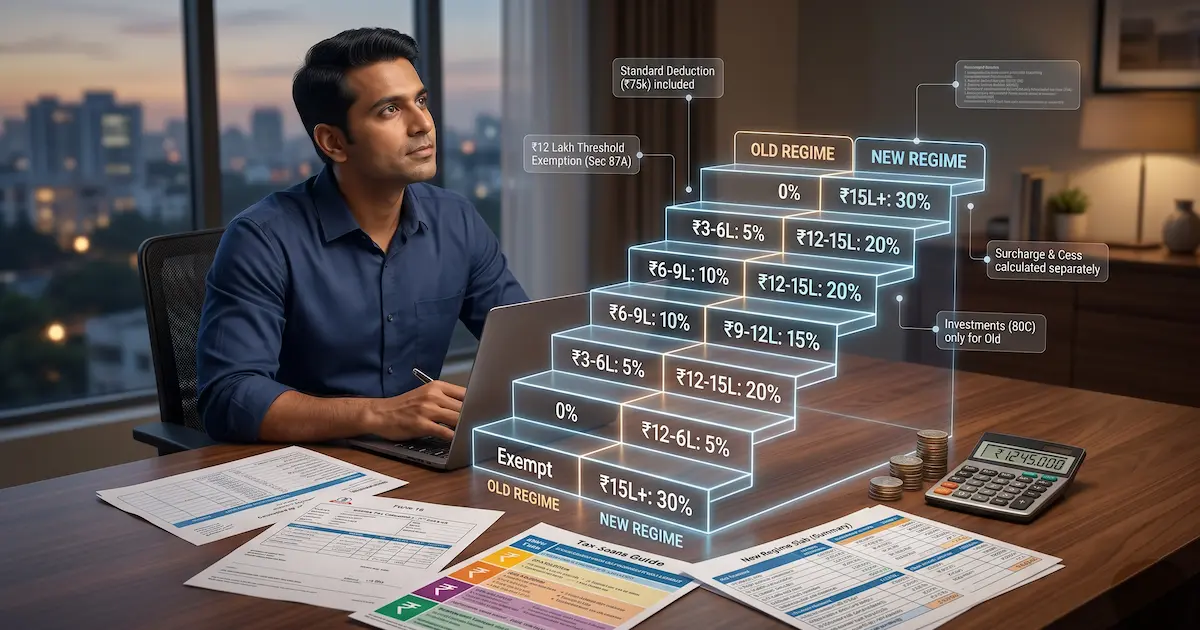
Income tax slabs in India for FY 2025-26 (AY 2026-27): new and old regime rates, the ₹12.75 lakh salaried zero-tax point, the 87A rebate, surcharge, and cess.
18 min read
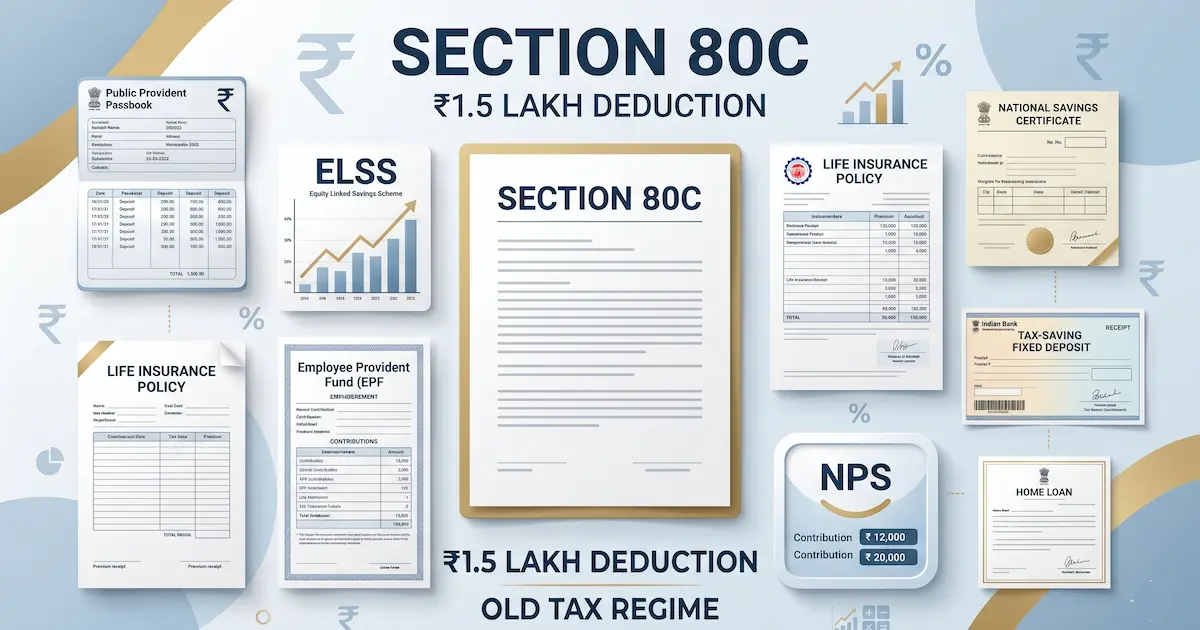
Section 80C cuts up to Rs 1.5 lakh off taxable income under the old regime only. The list, the limit, and where it lands as Section 123.
16 min read
Form 16 becomes Form 130 from Tax Year 2026-27, and a different Form 16 now certifies research donations. Plus the password and filing without it.
20 min read