US Tax Deductions vs Credits, and Standard vs Itemized

By Tapabrata Biswas · Updated July 20, 2026 · 14 min read
Written and fact-checked by Tapabrata Biswas. How I write
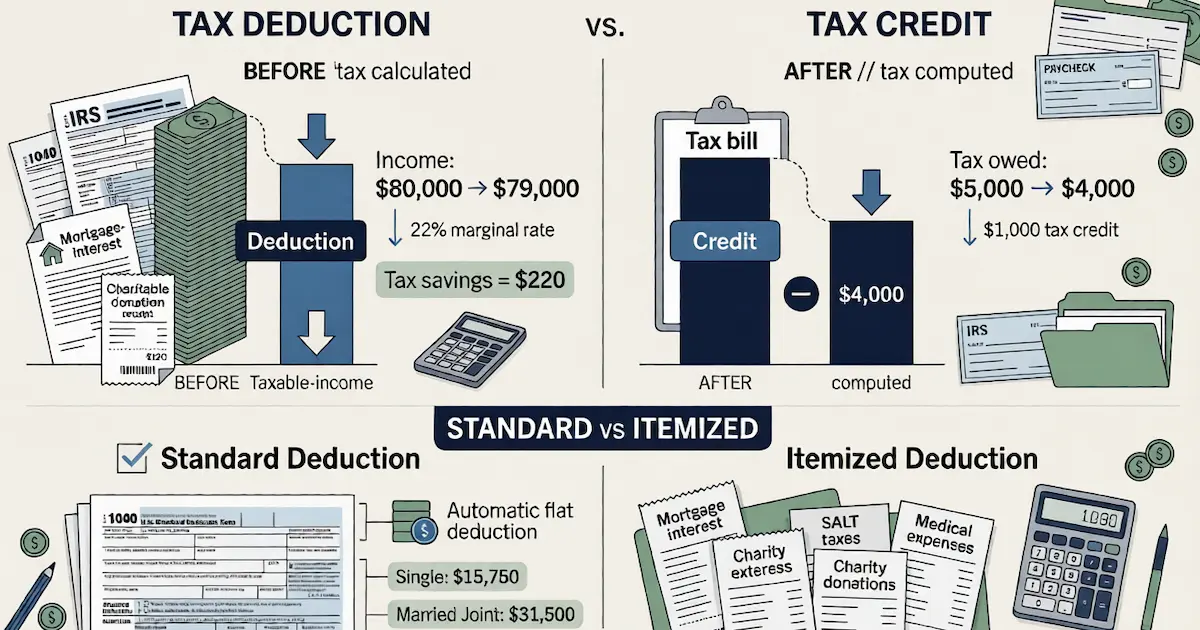
An Indian taxpayer reading American tax advice hits a question that has no answer for them: should you itemize?
There's no Indian version of that decision. India's standard deduction under Section 16(ia) is automatic. No election, no Schedule A equivalent, no comparison to run. Chapter VIA deductions sit alongside it. The single most-searched American tax question of the season is, for an Indian filer, a non-question.
That asymmetry is worth understanding in both directions, and this post covers both. It's US-first, because deductions-versus-credits and standard-versus-itemized are US structures, with the India contrast drawn where it clarifies, never as an afterthought.
One correction up front, because it's live on a great many pages right now. The 2017 standard-deduction increases were widely reported as expiring after tax year 2025. They didn't. The One Big Beautiful Bill Act made them permanent and raised the base, for tax years beginning after 31 December 2024.
This is educational, not filing advice. US tax computation and the choice between standard and itemized both turn on individual circumstances, and a CPA or IRS Enrolled Agent who has seen your numbers is the right person to run it.
What's the difference between a tax deduction and a tax credit?
A deduction reduces the income that gets taxed, and a credit reduces the tax itself. Where each sits in the calculation is what decides its value.
| Deduction | Credit | |
|---|---|---|
| Applies to | Taxable income | Tax owed |
| Worth | Amount multiplied by your marginal rate | Its full face amount |
| $1,000 at a 22% rate | Saves $220 | Saves $1,000 |
| $1,000 at a 37% rate | Saves $370 | Saves $1,000 |
The pattern in that table explains a lot about how tax policy is written. A deduction is worth more to a higher earner, mechanically, because it removes income that would have been taxed at a higher rate. A credit is worth the same to everyone. So relief aimed at lower earners is usually delivered as a credit, and relief that happens to favour higher earners often arrives as a deduction.
The combination, worked through on one taxpayer, which only one of the eighteen ranking pages we read attempts.
Take a single filer with $70,000 of gross income in tax year 2026, claiming the standard deduction of $16,100 and a $1,000 non-refundable credit.
| Step | Amount |
|---|---|
| Gross income | $70,000 |
| Less standard deduction | ($16,100) |
| Taxable income | $53,900 |
| Tax computed on the brackets | (per the rate schedule) |
| Less the $1,000 credit | ($1,000) |
| Tax owed | Computed tax minus $1,000 |
The deduction shrank the base before any rate touched it. The credit came off the end. Same taxpayer, same year, two mechanisms doing structurally different jobs, and the credit is the one whose value doesn't depend on which bracket the income landed in. How brackets stack is covered in our marginal versus effective rate explainer.
What is the standard deduction, and what are the current amounts?
The standard deduction is a flat amount subtracted from income with no receipts, proof or itemising required. Figures come from Revenue Procedure 2025-32, the IRS's inflation-adjustment document.
| Filing status | Tax year 2026 | Tax year 2025 |
|---|---|---|
| Married filing jointly and surviving spouses | $32,200 | $31,500 |
| Head of household | $24,150 | $23,625 |
| Single | $16,100 | $15,750 |
| Married filing separately | $16,100 | $15,750 |
Both years appear here on purpose. In July 2026 two different readers land on this page: someone on extension still filing tax year 2025, and someone planning for tax year 2026. Only one of the eighteen pages we read serves both, and its own date stamp contradicts its tables.
Additional amounts apply for age and blindness. For tax year 2026 that's $1,650, rising to $2,050 for a taxpayer who is unmarried and not a surviving spouse. A dependent's standard deduction is the greater of $1,350 or $450 plus earned income.
Did the 2017 increases actually expire?
No. The One Big Beautiful Bill Act made them permanent and raised the base, effective for tax years beginning after 31 December 2024.
This matters because the opposite is still being published. The Tax Cuts and Jobs Act increases were legislated with an expiry after tax year 2025, and for years every explainer carried some version of "scheduled to sunset unless Congress extends." Congress acted. Pages written before that, and pages never revisited since, still describe a sunset that no longer exists.
An earlier version of this post said it too. That's the reason it's called out here and not quietly corrected: a reader who absorbed the sunset framing from any source is carrying a wrong premise into planning decisions, and the fix belongs in a sentence, not a footnote.
What can you itemize, and when does it beat the standard deduction?
Itemizing means listing specific deductible expenses instead of taking the flat amount, and it only helps when the total exceeds the standard deduction. Since the standard deduction was roughly doubled, most filers never reach that threshold.
The main categories are state and local taxes, home mortgage interest, charitable contributions and medical expenses above a percentage of adjusted gross income. Each carries its own limit, and this is where a warning belongs more than a table of numbers does.
We're not publishing a current SALT cap figure. The cap was $10,000 under the Tax Cuts and Jobs Act, but the One Big Beautiful Bill Act changed the regime, and the figure is statutory, not inflation-adjusted. It doesn't appear in Revenue Procedure 2025-32, in IRS Topic 501, or on the IRS's own OBBBA provisions page. Several commercial pages assert a number anyway. Since we could not verify one from a primary IRS source, the honest position is that the cap exists, it changed, and the amount needs confirming for your filing year with the IRS or a CPA.
The same caution applies to the charitable AGI floor, where three sources we read give three different start years for a recent change.
What can be said cleanly: the decision is arithmetic. Sum the eligible expenses, compare against the standard deduction for the filing status, and the larger number wins. Households with a large mortgage in a high-tax state, substantial charitable giving, or a heavy medical year are the ones for whom the sum sometimes clears the bar.
What's the difference between a refundable and a non-refundable credit?
A non-refundable credit reduces tax to zero and stops. A refundable one pays out the excess.
Someone owing $800 who qualifies for a $2,000 credit gets a very different outcome depending on which type it is:
| Non-refundable | Refundable | |
|---|---|---|
| Tax owed before | $800 | $800 |
| Credit applied | $800 | $2,000 |
| Tax owed after | $0 | $0 |
| Cash received | Nothing | $1,200 |
| Value of the credit | $800 | $2,000 |
Identical headline amount. More than twice the value in one case.
That difference is the whole reason refundable credits exist as policy: they reach people whose tax liability is already near zero, which a deduction structurally cannot do. Eight of the eighteen pages we read omit the distinction entirely, and the top-ranking IRS page mentions that "some credits are refundable" without ever defining non-refundable or labelling a single credit as one.
Does any of this apply in India?
India has a standard deduction, almost nothing resembling a US tax credit, and no itemizing whatsoever. Taking those in reverse order, because the last is the biggest difference and the least discussed.
No itemizing exists. Section 16(ia)'s salaried standard deduction is automatic. There's no alternative regime to elect into, no Schedule A analogue, no calculation. Chapter VIA deductions like Section 80C and 80D sit alongside it. An Indian taxpayer either qualifies for a listed deduction and claims it, or doesn't. The American "should I itemize" decision has no counterpart.
The credit concept barely exists on the individual side. The Income Tax Department's own portal material uses "tax credit" almost exclusively for the Foreign Tax Credit, claimed on Form 67 as double-taxation relief under a treaty. That's a mechanism for avoiding being taxed twice on the same income, not a subsidy delivered through the tax system.
The Section 87A rebate is the nearest analogue, and it's strictly non-refundable. It reduces computed tax to zero and stops there. Nothing pays out. India has no counterpart to the Earned Income Tax Credit, no instrument that transfers cash to a filer whose liability is already nil. Set against the refundable-versus-non-refundable table above, India's entire individual-side relief architecture sits on the non-refundable side of that line.
That's the structural comparison worth carrying, and none of the eighteen US pages we read mentions India at all. The rebate thresholds and how they interact with the slabs are in our income tax slab explainer, and the filing mechanics are in the salaried income tax guide.
The Indian section numbers above are changing, and both sets are live at once. The Income-tax Act 1961 was repealed on 1 April 2026 and replaced by the Income-tax Act 2025. The return you file for FY 2025-26, in assessment year 2026-27, is still made under the 1961 Act, so the old numbers are the correct ones on that return. From Tax Year 2026-27 the new numbering applies:
| Under the 1961 Act | Under the Income-tax Act 2025 |
|---|---|
| Section 80C | Section 123, read with Schedule XV, which is where the qualifying list now sits |
| Section 80D | Section 126 |
| Section 87A rebate | Section 156 |
| Section 80TTA and 80TTB | Section 153, the two merged into one |
The full mapping, read from the gazetted Act rather than from other people's summaries, is in our Income-tax Act 2025 section map. Section numbering on your own return is a question for a chartered accountant, since which Act applies turns on the year the income was earned.
What this post deliberately does not cover
This explains how two tax structures work. It doesn't tell anyone which to claim, whether to itemize, or how to plan around either, and the worked figures exist to show the mechanics.
Three numbers are deliberately absent, each because a primary source could not be reached. The current SALT cap, since it changed under OBBBA and appears in no IRS document we could retrieve. The charitable AGI floor start year, where three sources disagree. And the Section 16(ia) rupee amount, which the Income Tax Department's salaried portal page does not state, though the Budget announcement of 1 February 2025 gives ₹75,000 for the new regime.
It also doesn't cover the specific credits themselves. The Child Tax Credit, the Earned Income Tax Credit and the education credits each have their own eligibility rules, phase-outs and refundability status, and a page that listed them all with current amounts would be stale within a year.
Tax questions turn on filing status, income, family circumstances and state of residence. A CPA or IRS Enrolled Agent for US filings, and a chartered accountant for Indian ones, is the right place for anything that depends on your own figures.
Frequently asked questions
What is the difference between a tax deduction and a tax credit? A deduction reduces the income that gets taxed. A credit reduces the tax itself. That placement is what decides their value. A deduction is worth its face amount multiplied by your marginal rate, so a $1,000 deduction saves $220 for someone in the 22% bracket and $370 for someone at 37%. A credit of $1,000 reduces tax owed by $1,000 for both of them. The consequence is that deductions are worth more to higher earners while credits are worth the same to everyone, which is why targeted relief in the US tax code usually arrives as a credit and not as a deduction.
What is the standard deduction for 2026? Per Revenue Procedure 2025-32, the tax year 2026 standard deduction is $16,100 for single filers and married filing separately, $32,200 for married filing jointly and surviving spouses, and $24,150 for head of household. Those returns are filed in 2027. For tax year 2025, the year most extension filers are still working on, the figures are $15,750, $31,500 and $23,625 respectively. Additional amounts apply for taxpayers who are aged 65 or over or blind, at $1,650 for 2026 rising to $2,050 if unmarried and not a surviving spouse.
Did the 2017 tax cuts expire after 2025? No, and this is the most common stale claim on the subject. The increased standard deduction from the Tax Cuts and Jobs Act was widely reported as scheduled to sunset after tax year 2025. The One Big Beautiful Bill Act changed that: it made the increases permanent and raised the base amount, effective for tax years beginning after 31 December 2024. Pages published before that legislation, and pages that were never updated after it, still describe a sunset that no longer applies. Anything asserting that the increases lapse after 2025 should be checked against the IRS directly.
What is the difference between a refundable and a non-refundable tax credit? A non-refundable credit can reduce tax owed to zero and no further. A refundable credit pays out the difference in cash. Consider someone who owes $800 in tax and qualifies for a $2,000 credit. If the credit is non-refundable, $800 of it is used and the remaining $1,200 is lost. If it is refundable, the tax goes to zero and $1,200 arrives as a refund. That distinction decides whether a credit reaches people with little or no tax liability at all, which is the entire point of a refundable credit as a policy instrument. Roughly half the pages ranking on this topic omit the distinction entirely.
Does India have a standard deduction and itemizing like the US? India has a standard deduction but no itemizing whatsoever, and that is the sharper difference. Under Section 16(ia) the salaried standard deduction is automatic; there is no alternative to elect, no Schedule A analogue, and no calculation to run. Chapter VIA deductions such as Section 80C and 80D sit alongside it, never in place of it. So the American question of whether to itemize simply does not arise for an Indian taxpayer. The deduction list is fixed by statute: a taxpayer either qualifies for an item and claims it, or does not.
Does India have anything like a refundable tax credit? No individual-side equivalent exists. The Income Tax Department's own material uses the phrase tax credit almost exclusively for the Foreign Tax Credit, a double-taxation relief mechanism claimed on Form 67 under a tax treaty, which is not a subsidy. The nearest analogue to a US credit is the Section 87A rebate, and it behaves as a strictly non-refundable one: it reduces computed tax to zero and stops. India has no counterpart to the Earned Income Tax Credit, meaning no mechanism that pays money to a filer whose liability is already nil. For how the rebate works within the Indian slabs, our income tax slab explainer covers the thresholds.
Sources
-
Internal Revenue Service, Revenue Procedure 2025-32 (the tax year 2026 standard deduction amounts by filing status under Section 63(c), the aged and blind additional amounts, and the dependent calculation) irs.gov
-
Internal Revenue Service, IRS releases tax inflation adjustments for tax year 2026, 9 October 2025 (corroborating the same figures, and confirming they apply to returns filed in 2027) irs.gov
-
Internal Revenue Service, One Big Beautiful Bill provisions, updated 17 July 2026 (the provisions hub, which notably states no SALT cap amount) irs.gov
-
Internal Revenue Service, Topic no. 501, Should I itemize?, updated 5 June 2026 irs.gov
-
Income Tax Department of India, Salaried Individuals for AY 2026-27, page last updated 9 July 2026 (that the portal's only use of tax credit is the Foreign Tax Credit, and the Section 87A rebate limits) incometax.gov.in
-
Press Information Bureau, Ministry of Finance, Union Budget 2025-26, 1 February 2025 (the Rs 75,000 standard deduction under the new regime) pib.gov.in




You might also like
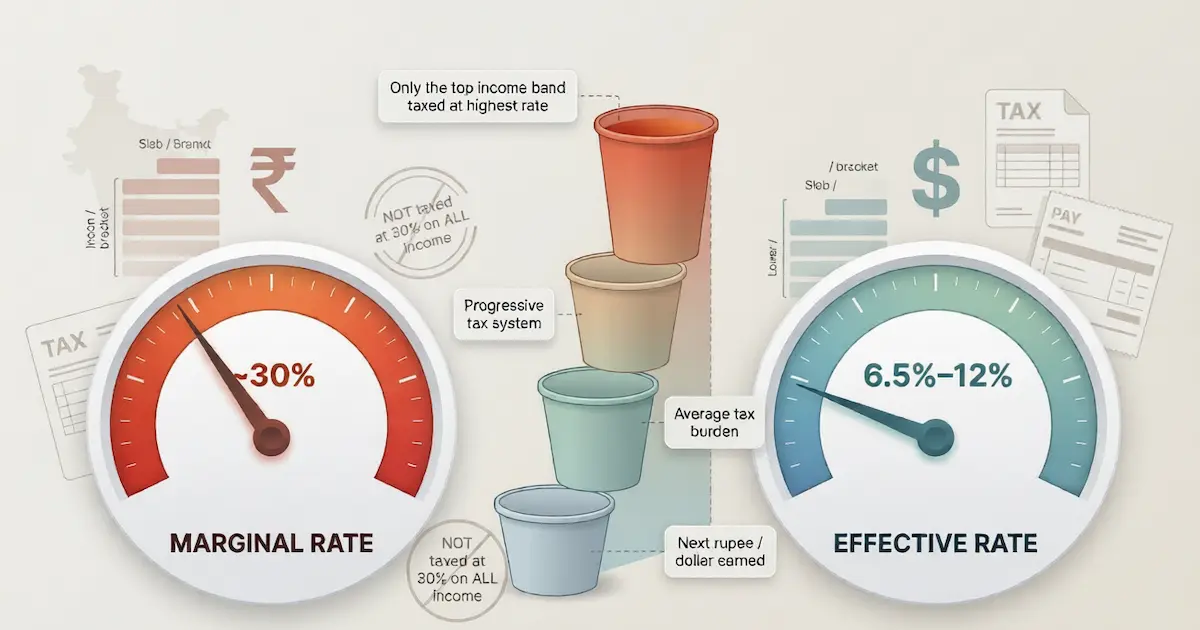
Marginal vs effective tax rate explained: the tax on your next rupee versus total tax over total income, with worked India and US examples and the bracket myth.
15 min read
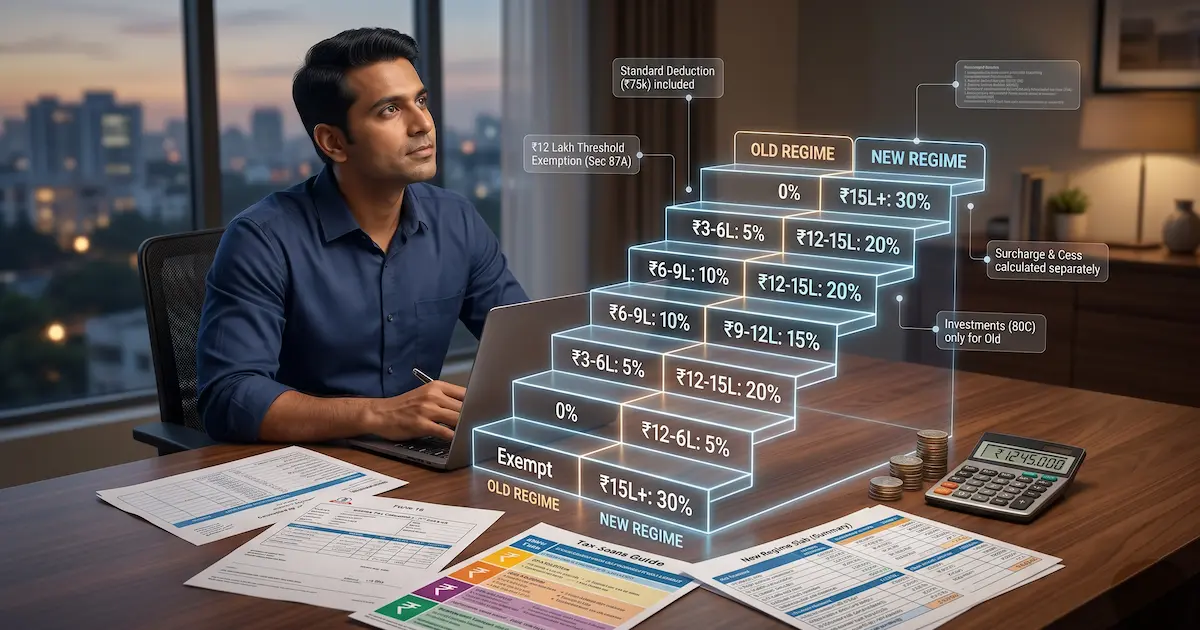
Income tax slabs in India for FY 2025-26 (AY 2026-27): new and old regime rates, the ₹12.75 lakh salaried zero-tax point, the 87A rebate, surcharge, and cess.
18 min read
Section 80C cuts up to Rs 1.5 lakh off taxable income under the old regime only. The list, the limit, and where it lands as Section 123.
16 min read