What Is FICA Tax? Paycheck Codes, 2026 Rate & Wage Base

By Tapabrata Biswas · Updated July 11, 2026 · 12 min read
Written and fact-checked by Tapabrata Biswas. How I write
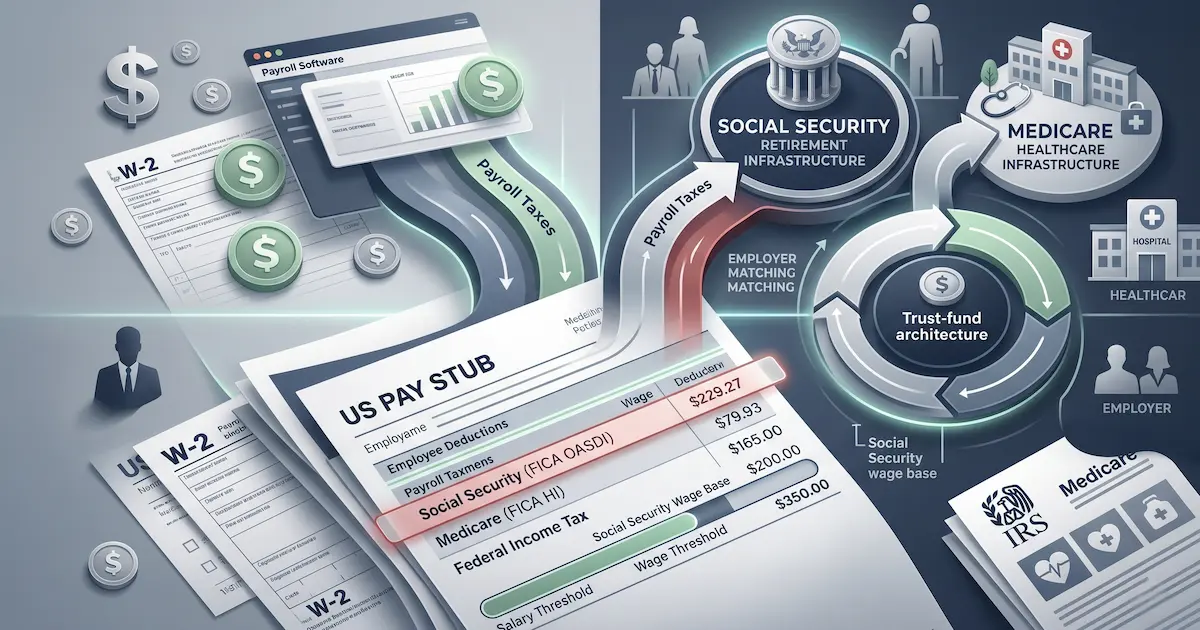
Look at a US pay stub and you probably won't find the word "FICA" anywhere. What you'll find instead is two cryptic lines, something like Fed OASDI/EE and Fed MED/EE, quietly taking 7.65% of your gross pay. Those two lines are FICA. This is a plain-English explainer of what that tax is, what those paycheck codes mean, and the 2026 rate and wage base. It is not tax advice; for your own filing, a CPA or IRS Enrolled Agent is the right person to check the specifics.
What is FICA?
FICA is the Federal Insurance Contributions Act, the US payroll tax that funds Social Security and Medicare, and it takes 7.65% of an employee's wages. That 7.65% splits into 6.2% for Social Security and 1.45% for Medicare. Your employer pays a matching 7.65%, so 15.3% of your wages flows to these two programs in total.
The law dates to 1935, when the Social Security payroll tax began; Medicare was added in 1965. FICA is a flat tax, meaning the rate doesn't climb through brackets the way income tax does. And it's dedicated: the money is legally earmarked for the Social Security and Medicare trust funds, not the general federal budget. That last point is the cleanest way to separate FICA from the other big deduction on your stub, federal income tax, which we compare directly further down.
Why does my paycheck say Fed OASDI/EE and Fed MED/EE instead of FICA?
Your paycheck shows FICA as two separate lines, Fed OASDI/EE for Social Security and Fed MED/EE for Medicare, because the law requires the two halves to be reported separately. Add them together and you get FICA's 7.65%. Payroll systems use a handful of different labels for the same two taxes, which is where the confusion starts.
| Code you might see | What it actually is | 2026 rate |
|---|---|---|
| FICA | Federal Insurance Contributions Act (the umbrella term) | 7.65% employee |
| FICA-EE | FICA, employee share (the money leaving your pay) | 7.65% |
| FICA-ER | FICA, employer share (your employer's matching payment) | 7.65% |
| Fed OASDI/EE | Old-Age, Survivors and Disability Insurance = Social Security, employee | 6.2% |
| FICA-SS, SS Tax, OASDI | Social Security portion (other labels) | 6.2% |
| Fed MED/EE | Medicare tax, employee share | 1.45% |
| FICA-Med, Med, FICA-HI | Medicare portion (other labels) | 1.45% |
| Fed, FIT, Federal Withholding | Federal income tax, which is NOT FICA | progressive, set by your W-4 |
The suffix trips people up, so here it is plainly: EE means employee, ER means employer. The "/EE" inside Fed OASDI/EE and Fed MED/EE simply marks it as your line, the amount withheld from you. If your stub also listed the employer side, those would carry an ER. You pay one 6.2% Social Security line and one 1.45% Medicare line; your employer pays a mirror-image pair you never see.
What is the FICA tax rate for 2026?
The FICA tax rate for 2026 is 7.65% for an employee, split into 6.2% for Social Security and 1.45% for Medicare, with the employer matching it for a combined 15.3%. These rates are set in statute and haven't changed in years; what changes each year is the wage base, covered in the next section.
| Program | Employee | Employer | Combined |
|---|---|---|---|
| Social Security (OASDI) | 6.2% | 6.2% | 12.4% |
| Medicare (HI) | 1.45% | 1.45% | 2.9% |
| Total FICA | 7.65% | 7.65% | 15.3% |
The employer match is the part most people miss. The 6.2% and 1.45% you see are only half the story; an equal amount goes from your employer to the same trust funds on the same wages. So the real cost of funding your future Social Security and Medicare is 15.3% of your pay, not 7.65%. Self-employed people feel this directly, because they pay both halves themselves, as we cover below.
What is the Social Security wage base for 2026?
The Social Security wage base for 2026 is $184,500, meaning the 6.2% Social Security tax applies only to your first $184,500 of wages, per IRS Topic 751. That's up from $176,100 in 2025, a 4.8% rise, and the figure resets every January based on national wage growth. The most an employee can pay in Social Security tax for 2026 is 6.2% of $184,500, which is $11,439.
Medicare works differently. There's no wage base on the 1.45% Medicare tax, so it applies to every dollar you earn, whether that's $40,000 or $4 million. On top of that, high earners pay an Additional Medicare Tax of 0.9% on wages above these thresholds:
| Filing status | Additional Medicare Tax starts above |
|---|---|
| Single or head of household | $200,000 |
| Married filing jointly | $250,000 |
| Married filing separately | $125,000 |
The 0.9% has been fixed at these dollar amounts since it began in 2013, and unlike the Social Security wage base, the thresholds don't rise with inflation. One quirk: your employer must start withholding the extra 0.9% once your own wages pass $200,000, regardless of your filing status, so a dual-earner couple may reconcile the difference at tax time on Form 8959.
How much FICA comes out of a paycheck?
On a $60,000 salary, an employee pays $4,590 in FICA for the year, and the employer matches it, sending a combined $9,180 to Social Security and Medicare. The math is simple because FICA is flat.
| On a $60,000 salary | Rate | Amount |
|---|---|---|
| Social Security | 6.2% | $3,720 |
| Medicare | 1.45% | $870 |
| Employee FICA total | 7.65% | $4,590 |
| Employer match | 7.65% | $4,590 |
| Combined | 15.3% | $9,180 |
Above the wage base the picture shifts, and this is where a lot of people get surprised. Take a single filer earning $250,000 in 2026. Social Security stops at the $184,500 cap, so that portion maxes out at $11,439 even though they earned more. Medicare keeps going on the full $250,000, and the 0.9% surtax kicks in on the slice above $200,000:
| On $250,000 (single, 2026) | Calculation | Amount |
|---|---|---|
| Social Security | 6.2% of $184,500 (capped) | $11,439 |
| Medicare | 1.45% of $250,000 | $3,625 |
| Additional Medicare | 0.9% of ($250,000 minus $200,000) | $450 |
| Employee total | $15,514 |
Notice how Social Security flattens out at the cap while Medicare and the surtax keep climbing. That's why a high earner's Social Security tax, as a share of total pay, actually falls as income rises.
FICA vs federal income tax: what's the difference?
FICA and federal income tax are two separate taxes on your paycheck: FICA is a flat 7.65% funding Social Security and Medicare, while federal income tax is progressive and funds the general government. They sit on different lines and behave in opposite ways, which is why "is FICA the same as my federal withholding" is such a common question.
| FICA | Federal income tax (FIT) | |
|---|---|---|
| Rate structure | Flat 7.65% | Progressive, rises through brackets |
| Applies to | Earned wages only | Nearly all income, earned and unearned |
| Funds | Social Security and Medicare | General federal budget |
| Set by your W-4? | No, the rate is fixed | Yes, your W-4 adjusts it |
| Wage cap | Yes, on the Social Security half | No |
The practical takeaway is on your stub. The line labeled Federal Withholding or FIT is the one you can influence by changing your W-4; the OASDI and Medicare lines are fixed by law and won't budge no matter what you file. For how the progressive brackets themselves work, see marginal vs effective tax rate explained, since FICA is flat and not bracketed at all.
Who is exempt from FICA?
A few groups are exempt from FICA, most notably students working at their own school and certain nonresident aliens on student or exchange visas. For nearly everyone with a W-2, though, FICA is mandatory and automatic.
The student exemption under Internal Revenue Code section 3121(b)(10) covers a student who works for the same school where they're enrolled and regularly attending classes, where the job is incidental to the studies. A full-time career employee who happens to take a class does not qualify. Nonresident aliens in F-1, J-1, or M-1 visa status are generally exempt from Social Security and Medicare tax on authorized work for their first five calendar years in the US, until they become resident aliens for tax purposes. Some state and local government workers covered by their own pension systems, and members of certain religious groups who file for exemption, also sit outside FICA.
Do the self-employed pay FICA?
Self-employed people pay the equivalent of FICA under a separate law called SECA, and because there's no employer to split it with, they pay both halves themselves, a total of 15.3%. A freelancer or sole proprietor won't see a Fed OASDI/EE line at all; instead they calculate the tax on Schedule SE with their annual return.
The rate mirrors FICA: 12.4% for Social Security on net earnings up to the same $184,500 wage base, plus 2.9% for Medicare on all net earnings, plus the 0.9% surtax above the income thresholds. There's one break built in. Self-employed taxpayers deduct half of their SECA tax, the "employer-equivalent" portion, as an adjustment to income, which softens the sting of covering both sides. The exact computation runs through Schedule SE, so a CPA is the right person to confirm the figure for a given year.
What this post deliberately does not cover
This explains what FICA is and how it appears on your paycheck, not how to plan around it. It doesn't cover how to read the rest of your pay stub (that's in how to read a pay stub), how FICA totals get reported at year-end (they land in Boxes 3 through 6 of your W-2 form), where federal tax dollars actually go (what are taxes used for), or Social Security claiming strategy and trust-fund solvency, which are policy and planning questions for the SSA and a financial planner. Tax situations vary, so confirm anything specific with a qualified CPA or Enrolled Agent. For the wider set of tax terms, see the tax concepts explained guide.
Frequently asked questions
What does FICA stand for? FICA stands for the Federal Insurance Contributions Act, the 1935 law that created the US payroll tax funding Social Security, with Medicare added in 1965. It is a flat tax of 7.65% on an employee's wages, split into 6.2% for Social Security and 1.45% for Medicare, and the employer pays a matching 7.65%. FICA is separate from federal income tax: it funds Social Security and Medicare specifically, not the general government budget.
What are Fed OASDI/EE and Fed MED/EE on my paycheck? Fed OASDI/EE and Fed MED/EE are the two halves of FICA as they appear on a US pay stub. Fed OASDI/EE is the Social Security tax (OASDI means Old-Age, Survivors, and Disability Insurance), withheld at 6.2%. Fed MED/EE is the Medicare tax, withheld at 1.45%. The EE means employee, so both lines are your share; an ER suffix would mean the employer's share. Together the two lines add up to FICA's 7.65%, which is why you may never see the word FICA itself.
What is the FICA tax rate for 2026? The FICA tax rate for 2026 is 7.65% for an employee, made up of 6.2% for Social Security and 1.45% for Medicare, and the employer matches it for a combined 15.3%. The Social Security 6.2% applies only to the first $184,500 of wages in 2026 (a maximum of $11,439), per IRS Topic 751, while Medicare's 1.45% applies to all wages with no cap. Wages above $200,000 also carry an extra 0.9% Additional Medicare Tax that the employer does not match.
Is FICA the same as federal income tax? No. FICA and federal income tax are two separate taxes that appear as separate lines on your paycheck. FICA is a flat 7.65% that funds Social Security and Medicare and applies only to earned wages, and your W-4 does not change it. Federal income tax (often shown as Federal Withholding or FIT) is progressive, rising through brackets as income grows, applies to nearly all income, funds the general government budget, and is the one your W-4 controls.
In summary
FICA is the payroll tax funding Social Security and Medicare, and the reason it confuses people is that it hides in plain sight. You look for "FICA" and instead see Fed OASDI/EE and Fed MED/EE, two lines taking 6.2% and 1.45% that together make up the 7.65% the law charges. Your employer matches it, so 15.3% of your wages is really at work here.
The one number to keep an eye on each year is the Social Security wage base. For 2026 it's $184,500, capping the Social Security tax at $11,439, while Medicare keeps taking 1.45% of every dollar with a 0.9% surcharge stacked on high earners. Everything else about FICA has stayed remarkably still since the 1960s; only that ceiling moves.
Sources
- US Internal Revenue Service, Topic 751, Social Security and Medicare Withholding Rates: irs.gov/taxtopics/tc751
- US Internal Revenue Service, Self-Employment Tax (Social Security and Medicare Taxes): irs.gov
- US Internal Revenue Service, Questions and Answers for the Additional Medicare Tax: irs.gov
- US Internal Revenue Service, Student Exception to FICA Tax: irs.gov
- US Social Security Administration, Contribution and Benefit Base: ssa.gov/oact/cola/cbb.html
- US Social Security Administration, History of Social Security and Medicare: ssa.gov/history




You might also like

Every line on a US pay stub and an Indian salary slip, what the law requires, and why the total never matches the CTC you were offered.
23 min read

What a W-2 form is, why Box 1 is smaller than your salary, every Box 12 code explained, the 2026 deadline, and how to get a copy. A plain-English US guide.
17 min read
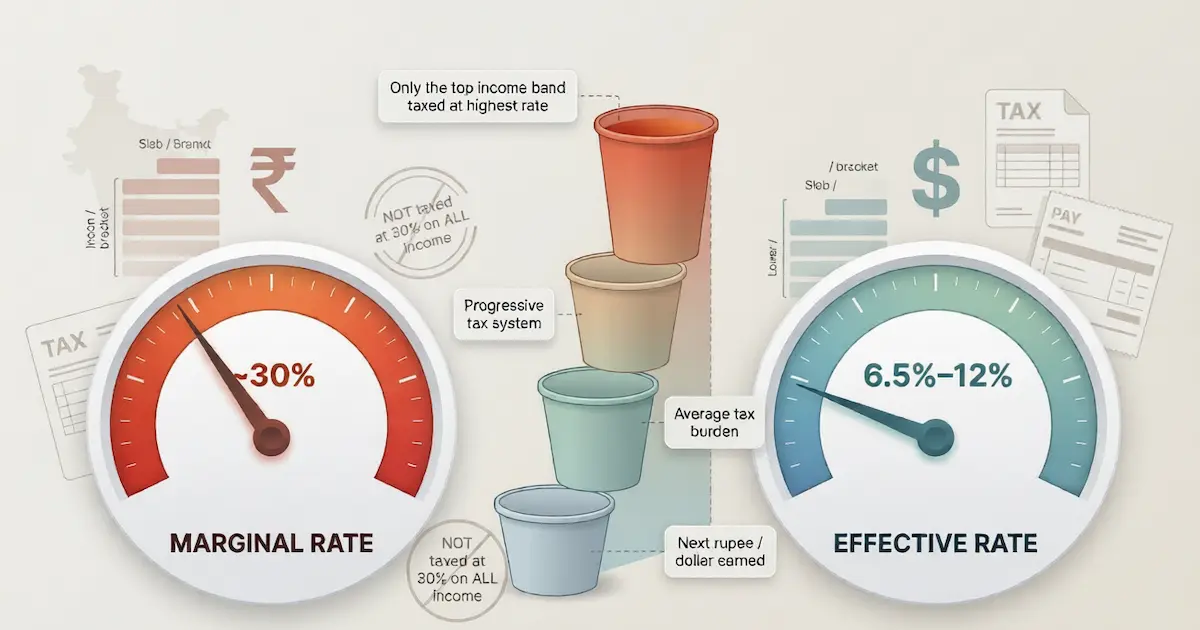
Marginal vs effective tax rate explained: the tax on your next rupee versus total tax over total income, with worked India and US examples and the bracket myth.
15 min read