What Is GST in India? New Rates, Types, and Basics

By Tapabrata Biswas · Updated July 13, 2026 · 12 min read
Written and fact-checked by Tapabrata Biswas. How I write
Reviewed by Subir Kumar Debsharma, Tax, GST and ROC professional with 20+ years of experience.
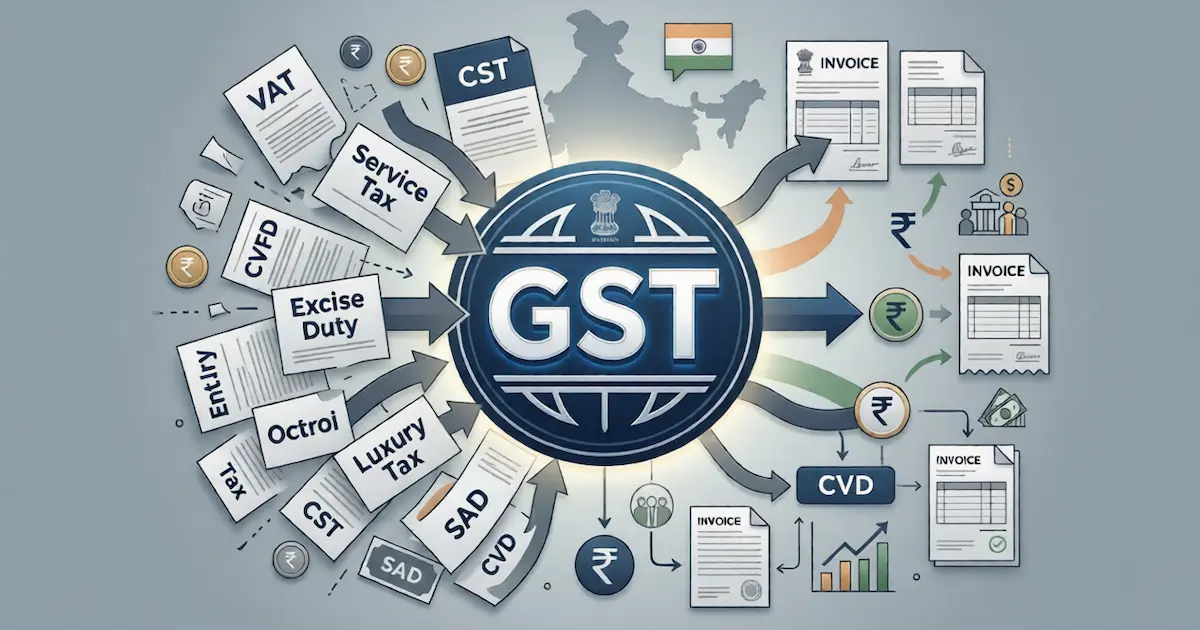
If you read a GST explainer written before late 2025, half of it is now wrong. On 22 September 2025 India rebuilt its rate structure, scrapping the 12% and 28% slabs and adding a 40% band for luxury and sin goods, yet a lot of pages still list the old five slabs as if nothing changed. This guide covers what GST is, the current rates, and how the pieces fit together, all as of the reform. To run the numbers on a specific price, our GST calculator uses the current 5/18/40 slabs, adds or removes GST either way, and splits any amount into CGST, SGST, or IGST.
Nothing here is tax advice. GST rules turn on your specific business, turnover, and supply type in ways only a qualified Chartered Accountant can assess, so for anything affecting your own situation, consult one. What follows is the definitional picture: what the tax is and how it's structured.
What is GST?
GST (Goods and Services Tax) is India's unified, destination-based indirect tax on the supply of goods and services, launched on 1 July 2017. It folded roughly 17 separate central and state taxes, including central excise, service tax, and state VAT, into one system, which is why the government branded it One Nation, One Tax.
Three features define it. It's multi-stage, charged at every step from manufacture to final sale, but through input tax credit (covered below) the tax isn't paid twice on the same value. It's destination-based, so the revenue goes to the state where the goods or services are finally consumed, not where they were made. And it's a consumption tax, meaning the burden ultimately falls on the end consumer, per the CBIC's own definition.
The legal backbone is the Constitution (101st Amendment) Act, 2016, which created the framework, and the GST Council under Article 279A, a joint body of the central and state finance ministers that sets rates and rules by a weighted vote. That council is where the 2025 overhaul was decided, which is where the rates start.
What are the current GST rates? (GST 2.0)
Since 22 September 2025, GST runs on three main rates, nil, 5%, and 18%, plus a special 40% rate on sin and luxury goods. The change, often called GST 2.0, was decided at the 56th GST Council meeting held on 3 and 4 September 2025 and given effect through CBIC notifications issued on 17 September.
| GST rate | What it covers |
|---|---|
| Nil (0%) | Essentials: UHT milk, paneer, roti, many food items, 33 lifesaving drugs, education materials, and individual life and health insurance |
| 5% (merit) | Daily-use and mass-consumption goods, packaged foods, agricultural inputs, footwear |
| 18% (standard) | Most goods and services, electronics, white goods, small cars, construction material |
| 40% (special) | Sin and luxury goods: tobacco, pan masala, aerated drinks, large cars, motorcycles above 350cc, yachts, casinos, online money gaming |
The reform's headline is the two slabs that vanished. The old 12% and 28% bands were scrapped, with most 12% items moving down to 5% and most 28% items down to 18%, so a small car that carried 28% now attracts 18%. The before and after:
| Old structure (before 22 Sep 2025) | New structure (from 22 Sep 2025) | |
|---|---|---|
| Main slabs | 0%, 5%, 12%, 18%, 28% | 0%, 5%, 18% |
| Top rate | 28% plus compensation cess | 40% (sin and luxury only) |
| Slabs removed | 12% and 28% |
One consumer change stands out. Individual life and health insurance premiums moved from 18% GST to nil, exempt from 22 September 2025 under CBIC Notification 16/2025, though group policies still carry 18%. Niche rates carried over untouched: gold and jewellery stay at 3%, rough diamonds at 0.25%.
A word on the 40% band, because it gets misread. It's not a new default ceiling that raises everyday prices; it applies only to a short list of demerit items that used to sit at 28% plus cess. Tobacco, pan masala, cigarettes, and gutkha are the awkward case: they were held back from the 22 September switch and kept at the old 28% plus compensation cess while the government wound down the cess's remaining loan obligations, with the flat 40% applying once that was settled. For the full slab-and-regime context, see tax concepts explained.
CGST, SGST, and IGST: the four types of GST
The four "types" of GST are CGST, SGST, IGST, and UTGST, the components that decide which government collects the tax, and they are a separate thing from the rate slabs. People often confuse the four component taxes with the four rate bands; they answer different questions. The rate (5%, 18%) is how much; the component (CGST, IGST) is who gets it.
| Component | Collected by | Applies to |
|---|---|---|
| CGST | Central government | A sale within one state (intra-state) |
| SGST | The state government | A sale within that same state |
| IGST | Central government, then shared with the consuming state | A sale across state lines, plus imports |
| UTGST | A union territory without its own legislature | A sale within that union territory |
The mechanics are simpler than the acronyms suggest. On a sale inside one state, the GST splits evenly into CGST and SGST. On a sale between states, a single IGST is charged at the full rate. Take an 18% sale of a ₹1,00,000 appliance: sold within Maharashtra, it's ₹9,000 CGST plus ₹9,000 SGST; sold from Maharashtra to Karnataka, it's ₹18,000 IGST. The customer pays ₹18,000 either way. Only the routing of the money differs, which is the whole point of a destination-based tax.
What is input tax credit (ITC)?
Input tax credit is the mechanism that lets a registered business subtract the GST it paid on its purchases from the GST it collects on its sales, so it hands the government only the difference. This is the single feature that stops GST from becoming a tax on a tax.
A quick number shows why it matters. Say a garment maker buys cotton yarn for ₹10,000 and pays 5% GST on it, which is ₹500. It sells the finished garments and collects ₹2,400 of GST from customers. It offsets the ₹500 it already paid, so it remits ₹2,400 minus ₹500, which is ₹1,900, to the government. Without that credit, the ₹500 would get taxed again inside the ₹2,400, and the cost would cascade down the chain to you. ITC is a business-only mechanism, though. A final consumer pays the GST on the shelf price and cannot claim any of it back. The GST Council's own material frames ITC as the backbone that keeps the tax on final consumption alone.
How is GST calculated?
To add GST, multiply the price by the rate; to pull GST out of a price that already includes it, divide by one plus the rate. Both directions come up constantly, because Indian shelf prices (MRP) are usually GST-inclusive.
Adding it is straightforward. A ₹20,000 item at 18% carries ₹20,000 times 0.18, which is ₹3,600 of GST, for a total of ₹23,600. Working backwards from that ₹23,600 inclusive price, divide by 1.18 to get the ₹20,000 base, and the difference, ₹3,600, is the GST inside it. That reverse formula answers the common question of how much tax was hidden in a bill. And of that ₹3,600 on an intra-state sale, half is CGST and half SGST.
Who needs to register for GST?
GST registration becomes mandatory once your annual turnover crosses ₹40 lakh for a goods business or ₹20 lakh for a services business, in most states. In special-category states the limits are lower, at ₹20 lakh for goods and ₹10 lakh for services. The 2025 reforms left these thresholds untouched, despite proposals to raise them.
Two traps sit inside those numbers. The ₹40 lakh goods limit applies only to a business supplying goods exclusively; earn even a rupee of taxable service income and your threshold falls to ₹20 lakh. And a few special-category states, including Assam and Jammu and Kashmir, opted up to the ₹40 lakh goods limit rather than the default ₹20 lakh. Registration itself is a separate process handled on the GST portal, which this explainer doesn't walk through.
What is the composition scheme?
The composition scheme is a simplified option that lets a small business pay GST at a flat rate on its total turnover instead of tracking the tax on every invoice. It trades away paperwork for a fixed, usually lower, compliance burden.
The turnover ceilings are ₹1.5 crore for goods businesses (₹75 lakh in specified special-category states) and a separate ₹50 lakh for service providers. The flat rates run 1% of turnover for traders and manufacturers, 5% for restaurants that don't serve alcohol, and 6% for other eligible service providers. There's a real catch worth naming: a composition dealer cannot claim input tax credit and cannot charge GST to customers, so it absorbs the tax itself. That makes the scheme a fit for small businesses selling to consumers, less so for those selling to other GST-registered businesses that would want the credit.
What this post deliberately does not cover
To keep the scope honest on a tax topic:
- GST return filing (GSTR-1, GSTR-3B, GSTR-9) and the filing calendar, which are a compliance topic for your accountant.
- The step-by-step registration walkthrough on the GST portal.
- HSN and SAC code lookup and item-by-item rate finding.
- Sector-specific rules for real estate, e-commerce, exports, and SEZs.
- This is general education, not compliance advice. For your business's registration, rate classification, or filing, consult a Chartered Accountant. For how GST sits alongside income tax, the salaried income tax guide, the income tax slabs, and what taxes fund give the wider picture.
Frequently asked questions
What is GST in simple terms? GST (Goods and Services Tax) is India's single, unified tax on the supply of goods and services, launched on 1 July 2017. It replaced roughly 17 separate central and state taxes such as excise duty, service tax, and state VAT, which is why it was branded One Nation, One Tax. It is a destination-based consumption tax, meaning it is ultimately paid by the final consumer and collected by the state where the goods or services are consumed. A business collects GST on its sales, offsets the GST it paid on its purchases, and pays the difference to the government.
What are the current GST rates in India? Since 22 September 2025, India's GST runs on a simplified structure of three main rates plus one special rate: nil (0%) on essentials, 5% on merit and daily-use goods, and 18% as the standard rate for most goods and services, with a special 40% rate reserved for sin and luxury goods such as tobacco, pan masala, aerated drinks, and large cars. The earlier 12% and 28% slabs were removed at the 56th GST Council meeting; most 12% items moved down to 5% and most 28% items down to 18%. Niche rates continue, including 3% on gold and 0.25% on rough diamonds.
What is the difference between CGST, SGST, and IGST? CGST, SGST, and IGST are the components that route GST to the right government. On a sale within a single state (intra-state), the tax splits evenly into CGST, collected by the central government, and SGST, collected by that state; an 18% sale becomes 9% CGST plus 9% SGST. On a sale across state lines (inter-state), a single IGST is charged at the full rate (18%) by the central government, then shared with the consuming state. UTGST is the union-territory equivalent of SGST. The buyer pays the same total either way; only the collection routing changes.
What is input tax credit in GST? Input tax credit (ITC) is the mechanism that lets a registered business subtract the GST it already paid on its business purchases from the GST it collects on its sales, so it pays the government only the difference. For example, a business that collects ₹450 of GST on sales and paid ₹300 of GST on purchases pays only ₹150 in cash. ITC is what stops tax from stacking on tax at each stage of the supply chain, so the burden lands on the final consumer rather than on intermediate businesses. It is a business mechanism; final consumers cannot claim it.
What is the GST registration turnover limit? GST registration is mandatory once your annual aggregate turnover crosses ₹40 lakh for a business supplying only goods, or ₹20 lakh for a business supplying services, in most states. In special-category states the limits are lower, at ₹20 lakh for goods and ₹10 lakh for services. The GST 2.0 reforms of September 2025 did not change these thresholds. One catch: the ₹40 lakh goods limit applies only if you supply goods exclusively; earn any taxable service income and the threshold drops to ₹20 lakh.
In summary
GST is the single indirect tax that sits inside almost every price you pay in India, and as of 22 September 2025 it runs on nil, 5%, and 18%, with a 40% band kept aside for luxury and sin goods. The old 12% and 28% slabs are gone, individual insurance is now exempt, and the CGST-SGST-IGST split just decides which government banks the money, not how much you pay.
The detail worth carrying is the date. If a GST rate you read looks like it belongs to a five-slab world, it predates the reform, and the number to trust is the current one on a bill or a CBIC notification. For how GST connects to the rest of the Indian tax system, start with tax concepts explained.
Sources
- Central Board of Indirect Taxes and Customs (CBIC), About GST, definition and dual model: cbic-gst.gov.in
- GST Council, rate structure and Council decisions: gstcouncil.gov.in
- Press Information Bureau, 56th GST Council meeting recommendations (September 2025): pib.gov.in
- Central Board of Indirect Taxes and Customs, GST goods and services rates: cbic-gst.gov.in
- Ministry of Finance, Government of India: finmin.nic.in

You might also like
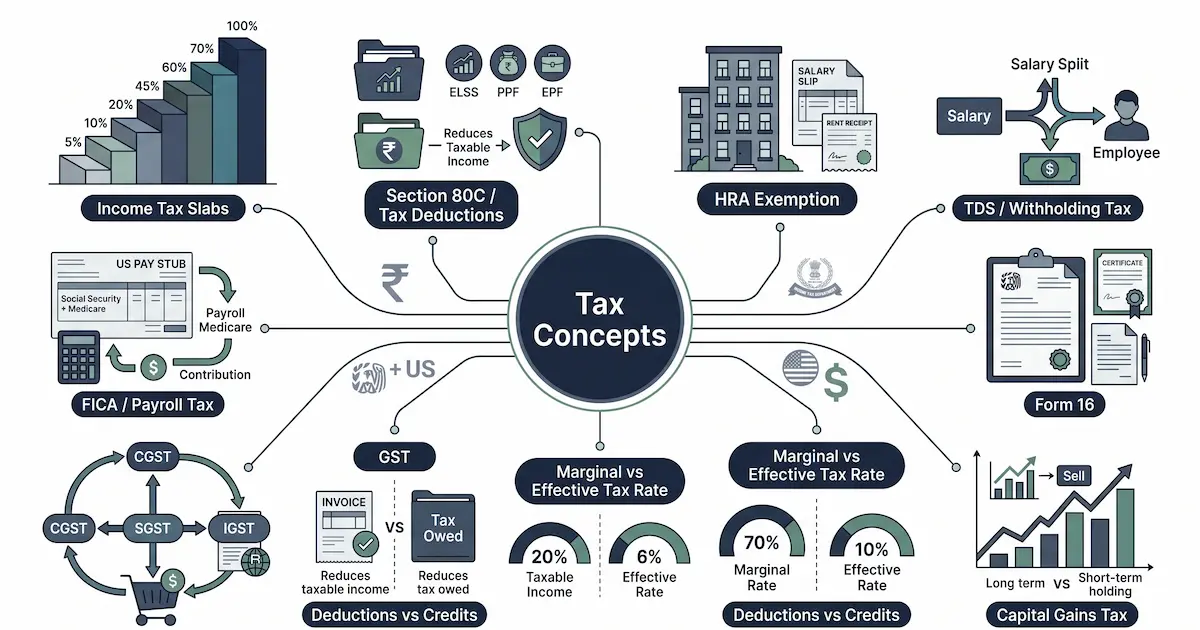
A plain-English guide to the core tax concepts in India and the US: slabs, deductions, TDS, GST, capital gains, FICA, plus what the Income-tax Act 2025 renames.
19 min read
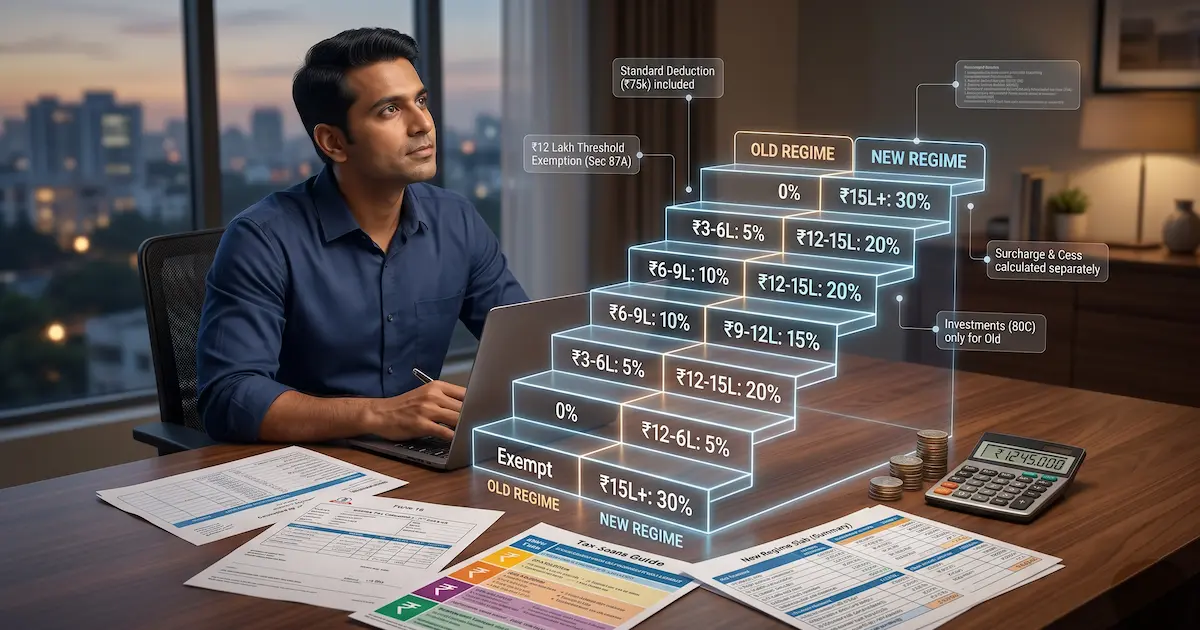
Income tax slabs in India for FY 2025-26 (AY 2026-27): new and old regime rates, the ₹12.75 lakh salaried zero-tax point, the 87A rebate, surcharge, and cess.
18 min read
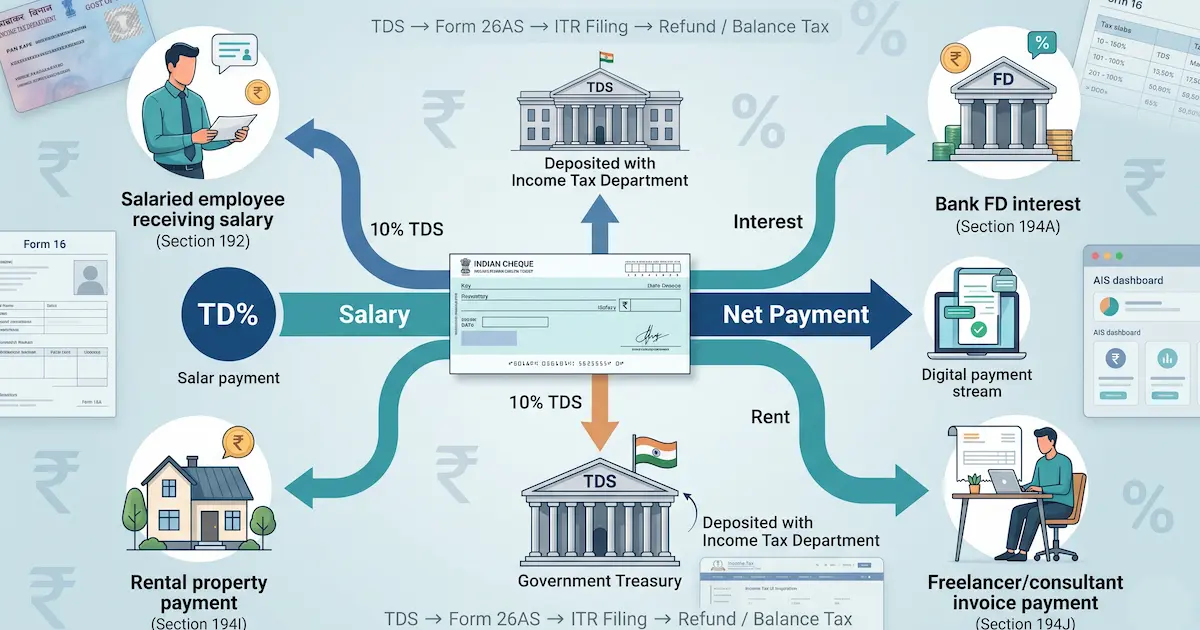
TDS is tax withheld from your salary, interest, and rent. The FY 2025-26 section rates and thresholds, what Budget 2025 changed, and how TDS differs from TCS.
15 min read