Pillar 10

Behavioral Finance

Personal finance isn't really about money — it's about behaviour. Decades of behavioural-economics research from Daniel Kahneman, Amos Tversky, Richard Thaler, and others have documented the systematic biases and mental shortcuts that drive financial decisions. This section explains those concepts in plain English: loss aversion, sunk cost fallacy, anchoring, mental accounting, the latte factor, lifestyle inflation, FOMO investing, and more. Knowing what these biases are doesn't make them disappear — but it does make them easier to catch.

9 articles

A crowd of investors all moving in the same direction toward a cliff while a single contrarian figure stands still, illustrating how herd mentality leads collective investment decisions toward predictable failures
PsychologyWhat Is Herd Mentality in Investing — Why 'Everyone Is Doing It' Reliably Produces Bad Outcomes

What is herd mentality in investing? The pattern of following the investment decisions of others rather than independent analysis — driven by social conformity, information cascades, and reputational concerns. Covers the Asch conformity experiments (1951), Banerjee's information cascade model (1992), Shiller's research on herd-driven bubbles, the difference between herd mentality and FOMO, and the structural defences that work.

9 min read

A split image showing a person reaching for an immediate small reward while ignoring a larger delayed reward on one side, and clutching an ordinary mug as if it were valuable on the other, illustrating hyperbolic discounting and the endowment effect
PsychologyHyperbolic Discounting vs Endowment Effect — Two Biases That Quietly Distort How You Value Time and Ownership

What is hyperbolic discounting vs the endowment effect? Two advanced behavioural-finance biases — hyperbolic discounting (the asymmetric preference for immediate rewards over delayed ones) and the endowment effect (overvaluing things you already own). Covers Laibson's 1997 hyperbolic discounting research, the Kahneman-Knetsch-Thaler 1990 mug experiment, the retirement-saving problem, the future-self continuity research, and the structural mitigations that work for each.

10 min read

A diagram of eight interconnected cognitive biases surrounding a central decision-maker, illustrating how behavioural finance documents the systematic deviations from rational economic decision-making
PsychologyBehavioral Finance Explained — The Psychology Behind Money Decisions

What is behavioural finance? A comprehensive introduction to the systematic cognitive biases that drive financial decisions — loss aversion, sunk cost fallacy, anchoring, mental accounting, hyperbolic discounting, the endowment effect, FOMO investing, and herd mentality. Covers the foundational research from Kahneman, Tversky, Thaler, and Shiller, why awareness alone doesn't fix bias, and the structural mitigations that actually work.

12 min read

A trader chasing a rocket-shaped asset that has already passed its peak, with other investors visible cashing out at the top, illustrating the late-entry pattern of FOMO investing
PsychologyWhat Is FOMO Investing — Why Chasing Returns You Missed Is Almost Always a Losing Strategy

What is FOMO investing? The behavioural pattern of jumping into an asset class, stock, or trend because of the fear of missing out on returns others appear to be capturing — typically after the bulk of the run-up has already happened. Covers the 2021 meme stock craze, the 2017 crypto bubble, Shiller's narrative economics research, the SEBI investor survey on retail trading losses, and why mean reversion makes late-cycle FOMO entries statistically disastrous.

9 min read

Multiple labelled jars holding identical coins, illustrating how mental accounting treats functionally identical money differently based on which mental bucket it sits in
PsychologyWhat Is Mental Accounting — Why Your Brain Treats Identical Rupees and Dollars Differently

What is mental accounting? Richard Thaler's behavioural-economics concept showing that humans treat money differently based on its source, intended use, or current location — violating the basic principle of fungibility. Covers Thaler's 1985 and 1999 research, the tax-refund vs salary spending difference, the 'house money' effect, sinking-fund psychology, and how to use mental accounting deliberately rather than letting it use you.

9 min read

A boat anchored to a numeric '100' sitting at the bottom of the sea while smaller estimates float nearby, illustrating how the first number encountered anchors subsequent judgements
PsychologyWhat Is Anchoring Bias in Money Decisions — Why the First Number You See Shapes Every Decision That Follows

What is anchoring bias? The cognitive pattern from Kahneman and Tversky's 1974 Science paper showing that humans rely too heavily on the first piece of information encountered — the 'anchor' — when making decisions, even when the anchor is obviously irrelevant. Covers the original spinning-wheel experiment, anchoring in salary negotiation, real estate list prices, stock purchase prices, and the 'reference price' tactic in retail pricing.

9 min read

A figure standing in front of two doors — one labelled 'continue because you've already paid' and the other 'walk away' — illustrating how the sunk cost fallacy biases decisions toward continuing failed commitments
PsychologyWhat Is the Sunk Cost Fallacy — Why Past Spending Should Never Drive Future Decisions

What is the sunk cost fallacy? The cognitive bias of letting irrecoverable past spending dictate future decisions — keeping a money-losing stock because you've already lost too much to sell, finishing a bad film because you paid for the ticket, holding an underperforming mutual fund 'until it recovers'. Covers the Arkes and Blumer 1985 research, real finance and life examples, and the decision-rule reframe that breaks the bias.

9 min read

A coffee cup beside a house upgrade in scale comparison, illustrating how lifestyle inflation on fixed expenses dwarfs the latte factor on small discretionary spending
PsychologyLatte Factor vs Lifestyle Inflation Explained — Two Different Patterns That Quietly Drain Savings

What is the latte factor vs lifestyle inflation? Two related but distinct patterns of unconscious spending — the latte factor (small recurring discretionary spends like daily coffee) and lifestyle inflation (the upward creep of fixed expenses as income rises). Covers the original David Bach concept, the lifestyle-inflation research from behavioural economics, worked examples in INR and USD, and why lifestyle inflation usually costs more than the latte factor.

10 min read

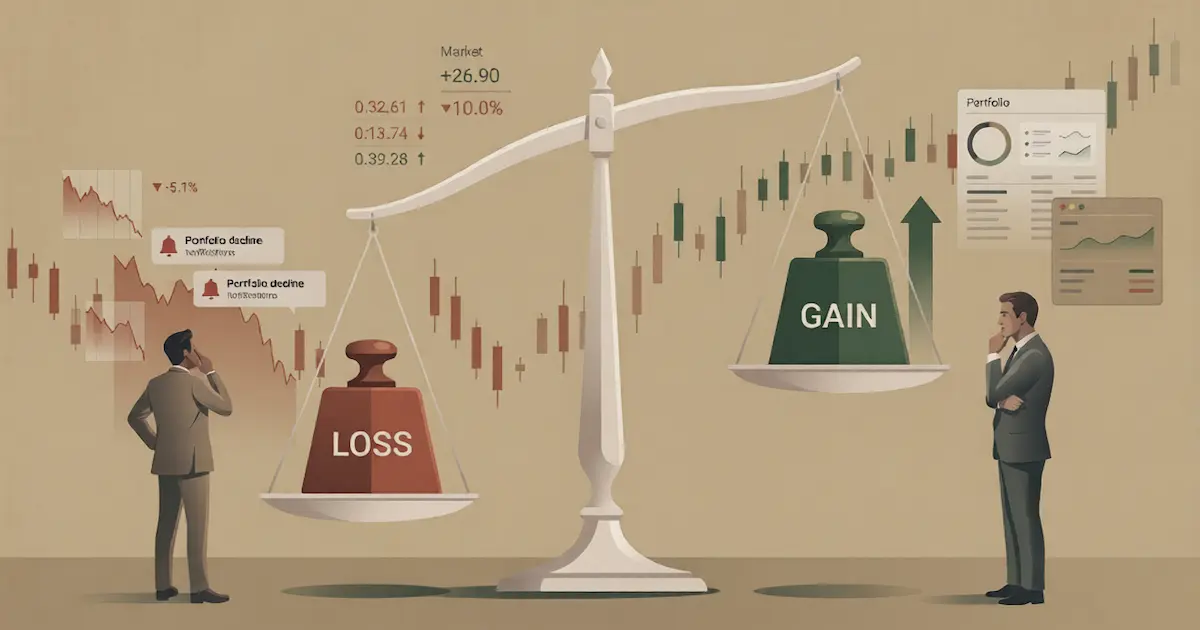
Tilted balance scale with a red losing weight outweighing a green gaining weight despite both being the same size, illustrating how loss aversion makes losses feel heavier than equivalent gains
PsychologyWhat Is Loss Aversion in Finance — Why Losses Feel Twice as Painful as Equivalent Gains

What is loss aversion? The behavioural-finance principle from Kahneman and Tversky's 1979 Prospect Theory paper showing that losses feel roughly 2× as painful as equivalent gains feel pleasant — driving investors to hold losing stocks too long, avoid rational risk, and refuse positive-expected-value bets. Covers the original research, real-world finance scenarios, and how investor underperformance traces directly to loss aversion patterns.

9 min read