Lifestyle Creep & the Latte Factor: What They Cost

By Tapabrata Biswas · Updated July 6, 2026 · 15 min read
Researched with AI assistance, reviewed and edited by Tapabrata Biswas.
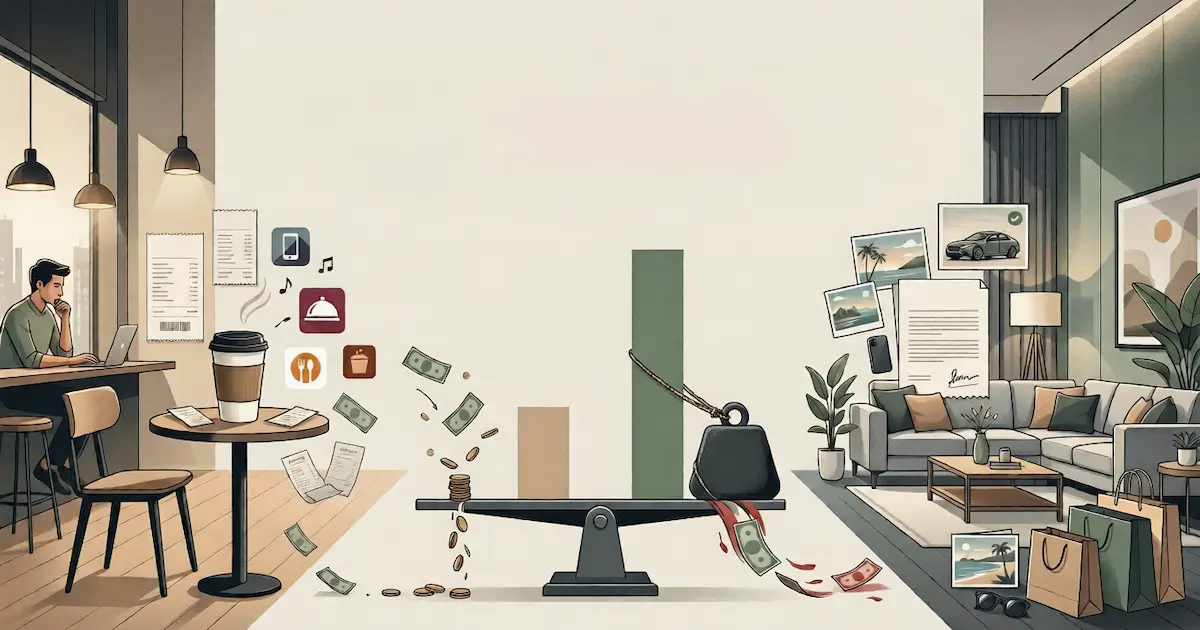
One number should end the coffee argument: 48% of Americans earning over $100,000 a year live paycheck to paycheck, and 36% of those earning over $200,000 do too (PYMNTS/LendingClub, April 2024). These are not people who cannot afford rent. They are people whose spending rose to swallow every raise they ever got. That pattern has a name, lifestyle creep, and it drains far more wealth than the daily latte that gets all the blame.
This guide covers both patterns and how they differ. Lifestyle creep, the bigger and quieter of the two, is spending that inflates to match income. The latte factor, the famous one, is the idea that small daily purchases compound into a fortune. One is heavily oversold; the other is barely discussed. This piece gives you the honest math on both, the behavioural reason creep is so hard to see, and worked examples in rupees and dollars, without telling you to give up your chai.
What is lifestyle creep?
Lifestyle creep, also called lifestyle inflation, is the pattern where your spending rises to match your income, so your savings rate stays roughly flat even as you earn more. The lifestyle inflates to fill the paycheck, and the two terms mean the same thing.
Picture a professional earning ₹40,000 a month who saves ₹8,000, a healthy 20%. A few promotions later they earn ₹1,20,000, and they feel like they are doing well. But check the numbers and they are still saving about ₹15,000 to ₹20,000, because a bigger flat, a car EMI, a cook and a maid, and a stack of subscriptions have absorbed almost the entire raise. Their income tripled; their savings barely moved. Nothing dramatic happened, which is exactly why nobody noticed.
That invisibility is the whole problem. Lifestyle creep does not show up as a purchase you can feel guilty about. It lives in your fixed costs, arrives one small upgrade at a time, and by the time you look up, your expenses have quietly re-based to a level that needs your new, higher income just to stand still.
Where lifestyle creep actually shows up
Lifestyle creep concentrates in a handful of big fixed costs, not in any single splurge, which is why it does so much damage. The upgrades feel individually reasonable and collectively enormous.
| Category | The typical upgrade |
|---|---|
| Housing | A ₹15,000 shared flat becomes a ₹35,000 solo flat, or a bigger home-loan EMI |
| Transport | A two-wheeler becomes a car, or an older car becomes a newer one on EMI |
| Household help | Self-managed becomes a cook, then a maid, then a driver |
| Food | Home cooking becomes regular food delivery and premium groceries |
| Subscriptions | A free tier becomes a stack of paid OTT, gym, and app subscriptions |
| Travel | One trip a year becomes three or four, and economy becomes business class |
Housing and transport do the heavy lifting. A ₹150 food-delivery order is rounding error next to a ₹30,000 EMI you signed up for after a promotion, and that is the point the coffee-shaming misses entirely.
Why does lifestyle creep happen?
Lifestyle creep happens because of the hedonic treadmill, a concept coined by Philip Brickman and Donald Campbell in 1971: every upgrade gives a short spike of happiness and then becomes your new normal, so you chase the next one. The joy of a nicer thing fades to indifference, and the spending it created does not.
The classic evidence is Brickman's 1978 study comparing lottery winners with people who had recently become paraplegic. About a year on, the winners were only slightly happier than a control group, and the accident victims were less far below baseline than you would expect. People drift back to a happiness set-point. Applied to money, a bigger flat thrills you in month one and just feels like home by month three, at which point your eye moves to the next upgrade while the higher rent stays on the treadmill under your feet.
That is why earning more rarely feels like enough. The floor of "normal" keeps rising with each thing you get used to, and income has to sprint just to stay level with a baseline that resets every time you climb.
What is the latte factor?
The latte factor is the idea that small, habitual daily purchases cost far more than their price tag once you count the investment returns you gave up. It was coined by David Bach in Smart Women Finish Rich (1999), popularized in The Automatic Millionaire (2004), and given its own book, The Latte Factor, in 2019; Bach registered the phrase as a trademark.
The name is a stand-in, and every serious source says so: it was never really about coffee. It stands for any trivial recurring spend, the daily chai, the cigarettes, the reflexive Swiggy order, the three OTT subscriptions you forgot you stacked. Bach's pitch was that redirecting a few dollars a day into investments, and automating it, quietly builds wealth over decades. The mechanism is just compound interest applied to a small, repeated amount.
Is the latte factor real, or a myth?
The latte factor is real as compounding math and oversold as a strategy, which is why it draws both true believers and sharp critics. The honest read sits in between.
Helaine Olen dismantled the marketed version in her book Pound Foolish. Her points are specific and fair: the $5 latte did not exist in 1999, so Bach padded the tab with biscotti and sodas to reach the number; he took $5 a day, which is $1,825 a year, and rounded it up to $2,000; and he assumed an 11% return when the long-run average was closer to 9% before tax and inflation. Recompute Bach's famous $2 million with realistic taxes and inflation and it shrinks to roughly $173,000. Her sharper argument is structural: the real drain on households is the big three of housing, healthcare, and education, which by the 2000s ate about three-quarters of the average family's discretionary income, not the coffee.
The counter-argument is also true, and worth keeping. Bach's actual prescription was "pay yourself first" and automate the investment, not "suffer without coffee," and a small automatable habit does train awareness and discipline in a way a spreadsheet does not. Small recurring spends are a useful diagnostic, the smoke that points to unconscious spending. So the concept earns the "myth" label only when it is sold as the cause of financial trouble. Read as awareness plus automation, it holds up fine.
How much do small daily spends really add up to?
Small daily spends do compound into large sums, though less than the viral figures claim once you state the assumptions honestly. The mechanism is real; the marketing is optimistic.
Take the Indian version first. A ₹150-a-day habit, one budget food-delivery order or a chai-and-cigarette routine, is about ₹4,500 a month. Redirected through a monthly SIP into a fund returning 12% a year (a SIP is the buying method, not the investment), that grows to roughly ₹45 lakh over 20 years, and about ₹1.57 crore over 30. Scale it to ₹300 a day, closer to Swiggy's average order value of ₹534 for a proper dinner, and 20 years at 12% reaches about ₹89 lakh. The US version is the classic: $5 a day is $1,825 a year, which at 8% for 30 years grows to about $207,000, and only reaches the mythical million if you assume 40 years and a 10% return.
Every one of those figures assumes a steady contribution and ignores tax and inflation, which is precisely why the headline numbers overstate reality. State that plainly and the latte factor stops being a scam and becomes what it always was: a clean illustration of compounding, useful as long as you do not confuse the illustration for a financial plan. To run your own number honestly, our compound interest calculator does the same math with your figures.
Which costs more, the latte factor or lifestyle creep?
Lifestyle creep costs more than the latte factor in almost every case, usually by 5 to 10 times over a career, because it works on big fixed costs instead of small discretionary ones. The scale difference is the whole story.
The latte factor targets spends of ₹100 to ₹500 a day. Lifestyle creep moves the numbers that dwarf it: rent, EMIs, help, subscriptions, travel class. A household that trades a ₹15,000 flat for a ₹35,000 flat after a promotion has absorbed ₹20,000 a month of creep, which is about ₹670 a day, every day, with no purchase to attach guilt to.
| Latte factor | Lifestyle creep | |
|---|---|---|
| Acts on | Small discretionary spends | Big fixed costs |
| Typical size | ₹100 to ₹500 a day | ₹5,000 to ₹50,000 a month |
| Visibility | A clear, guilt-triggering purchase | Invisible, embedded in fixed costs |
| Career cost | The smaller of the two | Usually 5 to 10 times larger |
So the coffee is the wrong place to look. If ₹670 a day of rent creep produces no guilt while a ₹150 order produces plenty, the guilt is pointed at the smaller number. That misdirection is exactly why the latte factor became famous and lifestyle creep stayed quiet.
How do you avoid lifestyle creep?
The most-cited defence against lifestyle creep is the save-half-the-raise rule: before a raise lands, pre-commit to sending half of it to savings and letting the other half expand your life. The timing is the key, because a raise is easiest to redirect before it embeds into your fixed costs.
Say your salary rises from ₹60,000 to ₹80,000. The rule routes ₹10,000 of the ₹20,000 increase into an SIP or savings, and lets ₹10,000 lift your lifestyle, so the raise still feels real and you are not white-knuckling deprivation. It works because it changes the default. Left alone, almost all of any raise is silently absorbed; with a rule set in advance, half is captured before you get used to spending it. Automating the savings half, an SIP or an auto-transfer scheduled for payday, removes the monthly decision, which is the same "pay yourself first and automate" idea underneath the latte factor.
A second rule keeps the individual upgrades in check: only take on an upgrade if its yearly cost stays under 10% of your annual raise. Land a ₹3 lakh raise and you can absorb about ₹30,000 a year of new fixed cost, roughly ₹2,500 a month, before you are back on the treadmill. That keeps one flashy commitment from eating the whole increase. For the mechanics of turning captured money into a habit, see how to save money every month.
What this guide does not cover
This guide explains lifestyle creep and the latte factor and works through illustrative numbers; it is not personalised financial advice. It does not tell you to cut your coffee or chai, quantify what you personally should save, or recommend any specific fund or SIP, and the compounding figures are opportunity-cost illustrations stated before tax and inflation, not forecasts of your returns. For choices tied to your own portfolio, a SEBI-registered adviser is the right call. For the wider family of money biases this sits within, see our behavioural finance overview.
Frequently asked questions
What is lifestyle creep in simple terms? Lifestyle creep, also called lifestyle inflation, is the pattern where your spending quietly rises to match your income, so your savings rate stays flat even as you earn more. A professional earning ₹40,000 a month who saves ₹8,000 often, after promotions to ₹1,20,000, still saves about the same in rupees while a bigger flat, a car EMI, and more subscriptions have absorbed the rest. It is why 48% of Americans earning over $100,000 a year live paycheck to paycheck (PYMNTS/LendingClub, April 2024). It is hard to spot because it lives in your fixed costs and happens gradually, with no single guilty purchase.
What is the latte factor? The latte factor is the idea that small, habitual daily purchases cost far more than their price tag once you count the returns you gave up by not investing that money. It was coined by David Bach in 'Smart Women Finish Rich' (1999), popularized in 'The Automatic Millionaire' (2004), and given its own book, 'The Latte Factor' (2019); Bach has registered it as a trademark. The name is a stand-in: it is not really about coffee but any recurring trivial spend, a daily chai, cigarettes, a food-delivery order, or a forgotten subscription. The mechanism is simply compound interest applied to a small, repeated amount.
Is the latte factor real, or is it a myth? Both, depending on how it is used. As compounding math it is real: money not spent and invested does grow. But the marketed figures are cherry-picked. Helaine Olen showed in 'Pound Foolish' that Bach padded a $5 latte with extras (it was never just coffee), rounded $1,825 a year up to $2,000, and assumed an unrealistic 11% return; recomputed with tax and inflation, his famous $2 million shrinks to about $173,000. The bigger criticism is that treating coffee as the cause of financial trouble ignores the real drain, the big three of housing, transport, and loans. The concept holds up as awareness plus automation, not as deprivation.
Why does lifestyle creep happen even to people who earn a lot? Because of the hedonic treadmill, a term coined by Brickman and Campbell in 1971. Each upgrade delivers a short burst of happiness and then becomes your new baseline, so the bigger flat that thrilled you in month one just feels like home by month three, and you start eyeing the next upgrade. Brickman's 1978 study of lottery winners found they were barely happier than non-winners a year on. That is the engine: satisfaction resets to a baseline, spending ratchets up to chase it, and income never quite catches the rising floor of fixed costs.
How much do small daily spends really add up to? More than the price tag, because of forgone growth, though less than the viral figures suggest. In India, ₹150 a day is about ₹4,500 a month; redirected into a fund returning 12% a year through a monthly SIP it grows to roughly ₹45 lakh over 20 years, or about ₹1.57 crore over 30 years. In the US, $5 a day ($1,825 a year) invested at 8% for 30 years grows to about $207,000. These assume a constant contribution and are before tax and inflation, which is exactly why the headline numbers overstate the real result. The mechanism is genuine; the marketing math is optimistic.
Which costs more, the latte factor or lifestyle creep? Lifestyle creep, usually by a wide margin. The latte factor works on small discretionary spends of ₹100 to ₹500 a day; lifestyle creep works on the big fixed costs that move by thousands or tens of thousands a month. A household that upgrades from a ₹15,000 flat to a ₹35,000 flat after a promotion has absorbed ₹20,000 a month, about ₹670 a day, with no visible spend to feel guilty about. Across a career the cumulative cost of lifestyle creep typically runs 5 to 10 times the latte factor, which is why behavioural researchers treat it as the more important pattern to manage.
How do you avoid lifestyle creep without feeling deprived? The most-cited technique is the save-half-the-raise rule: before a pay rise lands, commit to routing half of the increase into savings or investing, and letting the other half expand your lifestyle. A raise from ₹60,000 to ₹80,000 sends ₹10,000 a month to savings and ₹10,000 to a nicer life, so the raise still feels real. It works by changing the default, because without a rule almost all of any raise is quietly absorbed into fixed costs. Automating the savings half (an SIP or auto-transfer on payday) removes the monthly decision entirely.
In summary
Two patterns quietly move your money, and the famous one is the smaller one. The latte factor, small daily spends compounding, is real arithmetic wrapped in oversold marketing, and it earns its critics the moment coffee gets blamed for a problem that housing and EMIs actually caused. Lifestyle creep is the bigger, quieter drain: spending that rises to meet every raise, powered by a hedonic treadmill that resets your sense of normal each time you upgrade, until nearly half of six-figure earners are living paycheck to paycheck.
The useful move is not guilt about a ₹150 order. It is watching the ₹20,000-a-month upgrades that arrive without a receipt, and catching a raise before it embeds by sending half of it somewhere it can compound. Automate that half, and the treadmill loses its grip, because the one thing it cannot do is spend money you moved out of reach before you got used to having it.
Sources
- Brickman, P. and Campbell, D. (1971), Hedonic Relativism and Planning the Good Society (the hedonic treadmill), in Adaptation-Level Theory, Academic Press
- Brickman, P., Coates, D. and Janoff-Bulman, R. (1978), Lottery Winners and Accident Victims, Journal of Personality and Social Psychology 36(8), psycnet.apa.org
- Helaine Olen, Pound Foolish (2013), critique excerpted as "The latte is a lie", slate.com
- PYMNTS Intelligence and LendingClub, New Reality Check: The Paycheck-to-Paycheck Report (April 2024), pymnts.com
- David Bach, The Latte Factor and FinishRich trademarks, davidbach.com



You might also like
Loss aversion is feeling losses about twice as intensely as equal gains. The 2.25 ratio, examples, loss vs risk aversion, and how it quietly hurts returns.
14 min read

A sunk cost is money already spent and unrecoverable. The fallacy is continuing only because of it, how to avoid it, and why Concorde is the classic case.
12 min read

The structural system that produces monthly savings without willpower or month-end leftovers. The transfer order, the buffer, and what to automate.
10 min read