Banking Basics Explained: India and the US in One Guide

By Tapabrata Biswas · Updated July 26, 2026 · 12 min read
Written and fact-checked by Tapabrata Biswas. How I write
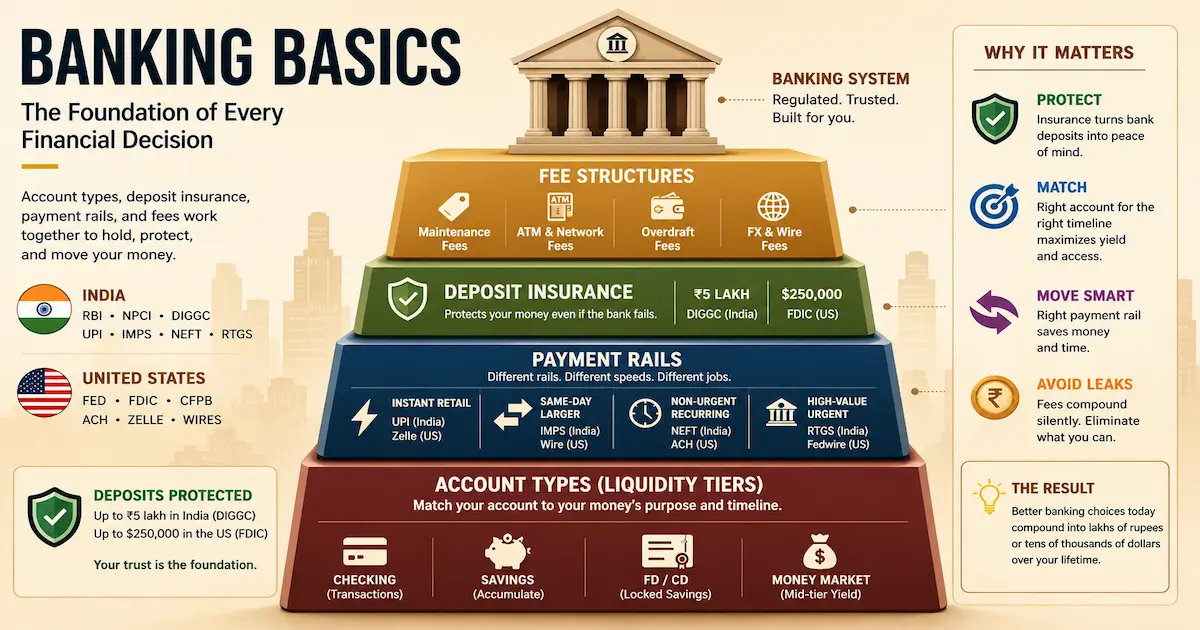
Every guide to banking is written for one country. The US ones explain checking, savings, CDs and FDIC. The Indian ones explain savings, current accounts, FDs and DICGC. Neither mentions the other, so a reader living between the two markets, or comparing them, ends up reading two guides and translating.
This one covers both, because the machinery is the same under different names. A US Certificate of Deposit is an Indian Fixed Deposit. A US routing number is an IFSC code. And it carries the numbers the evergreen bank pages leave out: the deposit rates and insurance limits as they actually stand in July 2026.
What follows defines banking basics once, states where the two systems line up, then routes you to the full guide on each account, rail and cost. If you're setting up your money from scratch, our complete beginner's guide shows where opening the right accounts fits in the wider sequence. If you hold an Indian account from abroad, the choice starts one step earlier, with NRE against NRO.
What are banking basics?
Banking basics are the account types, deposit insurance and payment rails that hold, protect and move your money. Everything else in personal finance sits on top of them, because money has to live somewhere safe and move somewhere accessible.
Three parts make up the whole, and the rest of this guide is really about telling them apart.
| Part | What it does |
|---|---|
| Account types | Hold your money, trading yield against how quickly you can reach it |
| Deposit insurance | Protects the balance up to a cap if the bank fails |
| Payment rails | Move value between accounts, each built for a different speed and size |
Account types line up along a single idea: how soon you need the money. A checking account, or an Indian savings account, holds this month's flow. A savings account holds the near term. A fixed deposit or CD holds money you can lock away. The yield rises as the access falls, which is the trade the whole shelf of products is built on.
Where do the numbers stand right now?
Bank explainer pages state no rates at all, so here are the current ones, dated, in one place. These frame every account decision and they move, so treat them as a July 2026 snapshot.
| Anchor | Value | As of |
|---|---|---|
| US national average savings rate | 0.38% | July 2026, FDIC |
| US national average interest checking | 0.07% | July 2026, FDIC |
| Top US high-yield savings | around 4.0% to 4.5% | mid-2026 rate trackers |
| US Fed funds target | 3.50% to 3.75% | held 17 June 2026 |
| SBI savings rate (India) | 2.50% | with effect from 15 June 2025 |
| FDIC insurance limit | $250,000 per depositor, per bank | current |
| DICGC insurance limit (India) | ₹5,00,000 per depositor, per bank | raised from ₹1 lakh, Feb 2020 |
The gap between the 0.38% national average and the roughly 4% a high-yield account pays is the single largest number on this page, and it is the reason what a savings account is spends time on where the money sits, beyond what the account is.
How do India and the US line up?
The two systems run identical logic under different names, and no single page anywhere puts the translation in one place. This is the table a cross-border reader, an NRI, or anyone comparing the two rarely finds.
| Concept | India | United States |
|---|---|---|
| Everyday transactional account | Savings account | Checking account |
| Business, no-interest account | Current account | Business checking |
| Interest on idle savings | Savings account | Savings account |
| Money locked for a fixed term | Fixed Deposit (FD) | Certificate of Deposit (CD) |
| Deposit insurer and limit | DICGC, ₹5,00,000 | FDIC, $250,000 |
| Bank branch identifier | IFSC code | Routing number |
| Instant retail payments | UPI | Zelle, FedNow |
| High-value urgent transfer | RTGS | Wire, Fedwire |
The honest gaps are as telling as the matches. India's UPI has no everyday US equivalent at the same scale. The US current-account naming does not exist in India, where "current account" means the business account. And a US checking account maps most closely onto how an Indian salaried person actually uses their savings account, which is the crossover that trips up newcomers to either system.
The accounts: where money sits
A deposit account is where your money lives, and the type you choose sets how much interest it earns against how freely you can spend it. Four cover almost every household need.
- The everyday transactional account, and why it pays almost nothing: what a checking account is.
- The interest-bearing account and where the rate gap hides: what a savings account is.
- The Indian naming question, savings versus current, which is not the US checking-versus-savings split: current account vs savings account in India.
- Two names on one account, and how ownership and survivorship work: what a joint bank account is.
- The higher-yield account with limited cheque-writing, and why India has no direct equivalent: what a money market account is.
Locked deposits: money set aside
A fixed-term deposit is a lump sum committed for a set period at a rate locked on the day it is booked, which is the same instrument the US calls a CD and India calls an FD. Locking the money is what buys the higher rate.
- The FD and the CD, the same idea under two names, plus the twist that India also has its own separate money-market CD: FD vs CD explained.
- The monthly-instalment version of a fixed deposit, its rules, rate and tax: what a recurring deposit is.
Moving money: the payment rails
A payment rail is the network that carries a transfer from one account to another, and each is tuned for a different mix of speed, cost and size. Picking the wrong one wastes either money or time.
- India's dominant retail rail, how it works and what it caps: what UPI is.
- The three Indian rails for jobs above UPI, with the limits and charges the RBI sets: IMPS vs NEFT vs RTGS.
- The branch codes, and why a routing number and an IFSC are not equivalents: routing number vs IFSC code.
- The two US rails for larger transfers, and the speed-versus-cost trade between them: ACH vs wire transfer.
Protection and cost
Deposit insurance and bank fees are the two forces that quietly decide how much of your money you keep. One protects the balance; the other chips at it.
- The government guarantee behind both systems, and the per-bank aggregation rule most pages skip: FDIC vs DICGC deposit insurance.
- The service that covers a shortfall, its fees, and the opt-in rules that changed in the US: what overdraft protection is.
- The recurring charges that add up, and what the RBI and US banks are allowed to levy: bank fees explained.
Where should you start?
The posts read in any order, but a few sequences make sense by situation.
Setting up banking from scratch: what a checking account is, then what a savings account is, then FDIC vs DICGC to understand what protects the balance.
Comparing India and the US: start with this page's bridge table, then FD vs CD and routing number vs IFSC, the two clearest cases of one idea under two names.
Trying to stop leaking money: bank fees explained, then what overdraft protection is, then the savings-rate gap in what a savings account is.
The authorities behind these rules
Every figure in this cluster traces to a primary authority, never a secondary financial-media source.
| Authority | Jurisdiction | What it governs |
|---|---|---|
| Reserve Bank of India | India | Banks, monetary policy, and payment-system oversight |
| National Payments Corporation of India | India | UPI, IMPS, RuPay, and NACH |
| DICGC | India | Deposit insurance up to ₹5,00,000 per depositor per bank |
| Federal Reserve | US | Monetary policy, bank supervision, and Fedwire and FedNow |
| FDIC | US | Deposit insurance up to $250,000 per depositor per bank |
| Consumer Financial Protection Bureau | US | Consumer protection, fee disclosure, and overdraft rules |
What this pillar deliberately does not cover
This hub defines banking basics for both markets and routes you to the deep guides. It does not tell you which bank or account to choose, how to move your money, or what to do with a particular balance, since those turn on numbers a general page cannot see.
Several things sit elsewhere on purpose. The full mechanics of each account, rail and fee live in the linked cluster posts. Lending, credit cards and loans are a separate subject with their own pillar. Investment accounts, brokerage and mutual funds are outside banking. And the current-as-of-July-2026 rates at the top will move, so the FDIC national rates page and the RBI and bank rate pages are where to re-check them rather than trusting a figure on age.
For anything turning on your own balances, particularly keeping large deposits within the insurance cap, the bank's own disclosures and a qualified adviser are the right sources.
Frequently asked questions
What is the difference between a checking account and a savings account? A checking account is built for everyday transactions, with debit and ATM access and bill payment, and pays little or no interest. A savings account is built to hold money and earn interest, and historically limited how often you could withdraw. In the US the split is checking versus savings; in India the everyday account is called a savings account and the business equivalent is a current account, which pays no interest but allows unlimited transactions. As of July 2026 the US national average savings rate was 0.38% per the FDIC, against top high-yield accounts around 4.0% to 4.5%, while Indian savings rates run from about 2.5% at SBI to higher at some private and small finance banks.
Is my money safe in a bank? Deposits at a regulated bank are insured up to a per-depositor cap, and below that cap they are protected even if the bank fails. In the US the FDIC covers $250,000 per depositor, per insured bank, per ownership category. In India the DICGC covers ₹5,00,000 per depositor per bank, a limit raised from ₹1 lakh with effect from February 2020. Both cover principal plus interest within the cap. Above the cap, the excess becomes an unsecured claim in the bank's liquidation, which is why balances larger than the cap are often spread across more than one insured bank. Co-operative banks in India are covered by DICGC too, but that is worth confirming and not assuming.
Is a US checking account the same as an Indian savings account? Functionally, for daily use, they line up, but the names cross over in a way that confuses cross-border readers. In the US, the everyday transactional account is a checking account and a savings account is a separate interest-bearing account. In India, the everyday account most people use is called a savings account, and it both pays interest and handles daily transactions, while a current account is the business account that pays no interest. So a US checking account maps most closely to how an Indian salaried person uses their savings account. The same naming crossover runs through the system: a US CD is an Indian FD, and a US routing number is an IFSC code.
Which payment rail should I use for which transfer? It depends on the amount, the urgency, and the country, and each rail is built for a different job. In India, UPI handles instant everyday payments up to its cap, IMPS handles instant transfers above it, NEFT settles non-urgent transfers in batches, and RTGS handles high-value urgent transfers. In the US, Zelle and FedNow handle instant transfers between supported banks, ACH handles low-cost recurring transfers over one to three business days, and a wire handles same-day high-value transfers for a fee. The current caps, timings and charges for each rail sit in the dedicated cluster posts, since they change and vary by bank.
What savings rate should I expect right now? As of July 2026, the US national average savings rate was 0.38% and interest-checking 0.07%, per the FDIC's national rates page dated 20 July 2026, while top high-yield savings accounts paid around 4.0% to 4.5% according to mid-2026 rate trackers, against a Fed funds target of 3.50% to 3.75%. In India, a large public bank like SBI paid 2.50% on savings balances with effect from 15 June 2025, while some private and small finance banks pay more. These figures move, so the linked account posts carry the live numbers and their sources, and this page avoids a table that ages.
Sources
-
Federal Deposit Insurance Corporation, National Rates and Rate Caps, page dated 20 July 2026 (the 0.38% national average savings rate and 0.07% interest-checking rate) fdic.gov
-
Federal Deposit Insurance Corporation, Deposit Insurance (the $250,000 per depositor, per insured bank, per ownership category limit) fdic.gov
-
Deposit Insurance and Credit Guarantee Corporation, Guide to Deposit Insurance (the ₹5,00,000 per depositor per bank limit, principal plus interest) dicgc.org.in
-
State Bank of India, Savings Bank Deposit interest rates (2.50% per annum across balances, with effect from 15 June 2025) sbi.bank.in
-
Board of Governors of the Federal Reserve System, FOMC (the federal funds target range of 3.50% to 3.75% held on 17 June 2026) federalreserve.gov
-
National Payments Corporation of India, UPI (the operator of UPI, IMPS and the Indian retail payment rails) npci.org.in



You might also like

Why RBI makes every Indian bank pay the same rate below Rs 1 lakh, how savings interest is actually calculated, and what DICGC and FDIC really cover.
17 min read

DICGC insures ₹5 lakh per Indian bank; FDIC insures $250,000 per US bank. The rules, what is and isn't covered, the 90-day payout, and FDIC vs NCUA vs SIPC.
16 min read

UPI explained: what it is, the current limits and who gets the higher ones, why it is free, who pays for that, and what the August 2026 MDR Bill would change.
20 min read