Bank Fees Explained: What RBI and US Banks Can Charge

By Tapabrata Biswas · Updated July 18, 2026 · 17 min read
Written and fact-checked by Tapabrata Biswas. How I write
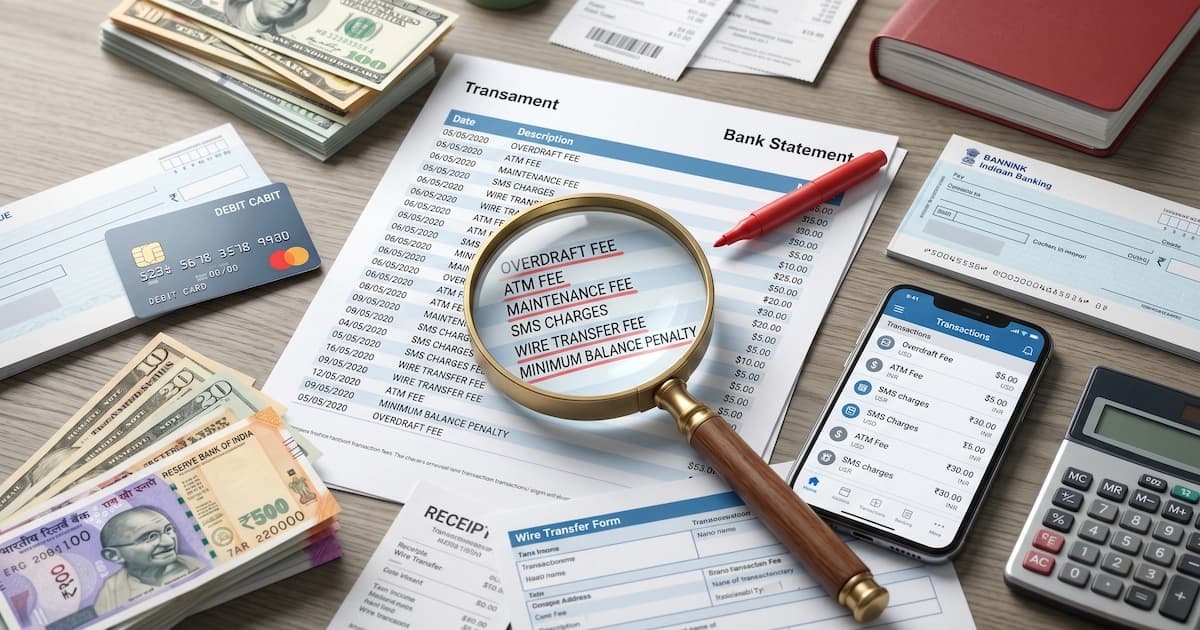
Your own bank's ATM owes you an unlimited number of free balance enquiries every month. That is RBI's rule, stated plainly in its ATM FAQ, and I could not find one Indian comparison page that gets it right. Most fold balance enquiries into the five-transaction free limit, which is a different rule governing a different thing.
That gap is the shape of this whole topic. Bank charges in both countries are governed by published rules that set ceilings, mandate free allowances, and exempt entire categories of account. The pages ranking for fee questions are mostly written by people who earn a commission when you open an account, and "the account you already have is exempt" is not a sentence an affiliate funnel can afford to write.
What follows covers what RBI permits and forbids, why some Indian banks abolished minimum-balance penalties in 2025 while others tightened them, what the US numbers actually are once you look past the average, a fee cap that many pages still describe as law despite Congress killing it, and what a year of ordinary banking costs in each country. It describes rules and charges. It isn't a recommendation to move your money anywhere.
What are bank fees, and how many are actually optional?
Bank fees are the recurring charges a bank levies for holding an account, moving money, and using its infrastructure, and in both India and the US most of them are conditional. Conditional means they attach to a state you may or may not be in: a balance under a threshold, a withdrawal past a quota, a transaction at someone else's machine.
The surface is wider than most people picture.
| Category | India | US |
|---|---|---|
| Minimum balance shortfall | Non-maintenance charge, formula varies by bank | Monthly maintenance fee, usually waivable |
| ATM beyond free limit | Capped at Rs 23 plus tax by RBI | Averaged $4.86 combining both banks, Bankrate 2025 |
| Overspending the balance | Overdraft interest on current accounts | Overdraft fee per item, averaged $26.77 |
| Payment returned unpaid | Cheque or mandate return charge | Non-sufficient funds fee, averaged $16.82 |
| Domestic transfer | NEFT and RTGS free online since 2020, IMPS varies | Wire transfer, $25 to $30 domestic |
| Card annual fee | Debit card annual charge | Usually none on debit |
| Spending abroad | Forex markup plus GST | Foreign transaction fee, commonly 1% to 3% |
| Paper and alerts | SMS alert charges, statement charges | Paper statement fee at some banks |
One line sits outside the avoidable framing entirely and deserves flagging early. GST at 18% applies on top of Indian bank charges, and RBI's own fee tables write it as an addition, using the phrasing "plus applicable GST" against each slab. A Rs 23 ATM charge leaves your account as Rs 27.14.
What can your bank charge for an ATM withdrawal in India?
RBI caps the charge at Rs 23 per transaction plus applicable taxes, and its ATM FAQ updated 4 July 2025 also fixes minimum free allowances that most pages misreport. The cap is a ceiling and not a price. Banks may charge less, and some do.
The allowances split by whose machine you use, and the distinction inside the own-bank rule is the one the field loses:
| Where | Free allowance per month |
|---|---|
| Your own bank's ATM | At least five free financial transactions, plus an unlimited number of free non-cash transactions |
| Another bank's ATM, six metro cities | At least three free transactions, counting financial and non-financial together |
| Another bank's ATM, everywhere else | At least five free transactions, counting financial and non-financial together |
Read the first row twice. At your own bank's machine, balance enquiries, mini statements and PIN changes are free without limit and do not consume the five withdrawals. RBI's wording leaves no room: any number of non-cash withdrawal transactions will be provided free. Yet the pages we checked either state the five transactions cover financial and non-financial services, or apply the other-bank rule everywhere. Two national business outlets carry the identical error.
The rule names the six locations and not defining metro: Bengaluru, Chennai, Hyderabad, Kolkata, Mumbai and New Delhi.
Two protections in the same FAQ appear on no fee page we read. A transaction that fails for technical reasons cannot be counted against your free limit or charged for. And where an account is debited without cash being dispensed, the bank must re-credit within five calendar days, after which RBI sets compensation at Rs 100 per day of delay.
Then the exemption that reframes the section. Basic Savings Bank Deposit Accounts fall outside these charging rules altogether, because withdrawals from a BSBDA are governed by that account type's own conditions, and a BSBDA carries no minimum balance requirement at all. It is the largest single fee exemption in Indian retail banking, available at every bank, and it appears on almost none of the pages ranking for Indian bank charges. The absence isn't mysterious. Those pages earn when a reader opens a chargeable account.
Why did some Indian banks stop charging minimum-balance penalties?
Through 2025, public sector banks abolished non-maintenance penalties while private banks kept theirs, and that divergence is now the sharpest practical difference between the two groups. No page we read tells it as one story.
The public sector moves, each from the bank's own announcement:
| Bank | Non-maintenance penalty | Effective |
|---|---|---|
| State Bank of India | Waived | 11 March 2020 |
| Canara Bank | Waived across all savings account types, including salary and NRI | 1 June 2025 |
| Punjab National Bank | Waived on all savings accounts | 1 July 2025 |
Canara's wording is unusually broad, covering all savings account types including salary and NRI accounts, where waivers of this kind often carve those out.
Private banks went the other way, and their charges are formulas:
| Bank | Non-maintenance charge |
|---|---|
| ICICI Bank | 6% of the shortfall on the required monthly average balance |
| Axis Bank | Rs 6 per Rs 100 of shortfall, or Rs 300, whichever is lower |
A formula behaves differently at the extremes. Miss a Rs 10,000 requirement by Rs 500 at ICICI and the charge is Rs 30. Miss it by Rs 8,000 and it is Rs 480. Axis caps its own exposure at Rs 300 however large the shortfall, so the two structures diverge sharply at the top end.
We are deliberately publishing no bank-by-bank table beyond these two. HDFC Bank's and IDFC FIRST Bank's fee pages return no readable content to an automated reader, and figures for those banks circulating on aggregator sites could not be traced to either bank's own schedule. A fee table we cannot source to the institution doing the charging is worse than no table, which is the standard our recurring deposit explainer already sets for rates.
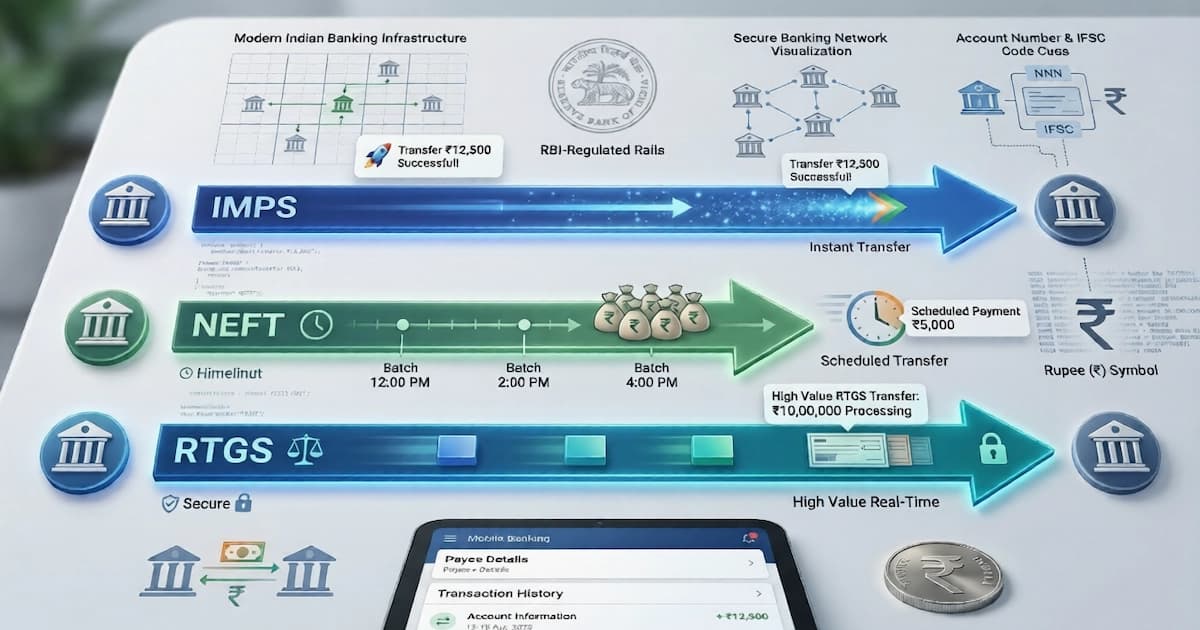
One more India-side fact worth carrying. Online NEFT and RTGS transfers have been free for savings account holders since 1 January 2020, under an RBI directive instructing banks to pass the benefit on. Branch-initiated transfers still carry small slab-based charges, and the rail-by-rail detail sits in IMPS vs NEFT vs RTGS.
What do US banks charge, and what happened to the $5 overdraft cap?
The average US overdraft fee was $26.77 in Bankrate's 2025 study of 245 institutions, and the more useful fact is that four large issuers charge nothing while another charges $35. The distribution here is close to bimodal, which makes the average the least informative number available.
Bankrate's survey, fielded between 2 June and 3 July 2025:
| Fee | Average |
|---|---|
| Overdraft | $26.77 |
| Non-sufficient funds | $16.82 |
| Out-of-network ATM, both banks combined | $4.86 |
| Monthly maintenance, non-interest checking | $5.47 |
| Monthly maintenance, interest checking | $15.65 |
A second survey by MoneyRates, updated 9 January 2026, put the overdraft average at $30.82 and the combined ATM cost at $4.55 from a different sample. That four-dollar gap between two credible surveys is itself the lesson: these estimate a distribution, and no bank quotes one.
What the distribution looks like matters more than either average. Wells Fargo charges $35 for an overdraft. Bank of America charges $10. Capital One, Citi, Ally and Discover charge nothing. A reader who takes $26.77 as what banks charge has the wrong model, because no bank charges $26.77.
Now the part a live search will actively mislead you on. In December 2024 the CFPB finalised a rule capping overdraft fees at $5 for institutions above $10 billion in assets, due to take effect 1 October 2025. It never did. Congress nullified the rule under the Congressional Review Act and the resolution was signed into law on 9 May 2025. Under that Act the agency cannot reissue a substantially similar rule without fresh legislation.
Several pages ranking for overdraft queries right now say otherwise. One, dated May 2026 with no named author and no citations, presents the $5 cap as having taken effect in 2026 and names a bank that supposedly cut its fee to comply. That did not happen. And if you meet a $10 cap dated March 2026, that one is real but Canadian, applying to federally regulated banks there; search summaries conflate it with US policy routinely.
On the aggregate, the Financial Health Network put US overdraft and NSF revenue at $12.1 billion in 2024, and revised its 2023 estimate upward from $7.9 billion to $11.8 billion once credit unions above $1 billion in assets began reporting the two fees separately in early 2024. The revision showed credit unions were roughly 45% of the total, against the 18% previously assumed. Worth knowing when you meet an older, smaller number: those figures weren't wrong so much as blind to half the sector. Our own earlier version of this page carried one of them.
The CFPB's own overdraft data hub has not been updated since April 2024 and still ends at 2023 data, so any page implying current federal figures is recycling three-year-old numbers.
What does a year of bank fees actually cost?
A household that pays fees and not avoiding them loses roughly Rs 2,000 a year in India and about $290 in the US, and nearly all of it is conditional in both cases. The arithmetic below is ours, built on the verified figures above.
The Indian case assumes a private-bank savings account with a Rs 10,000 monthly average balance requirement, missed by Rs 5,000 in three months, plus two out-of-limit ATM withdrawals a month and a debit card annual fee:
| Item | Working | Annual |
|---|---|---|
| Non-maintenance charge | 6% of Rs 5,000 shortfall, 3 months | Rs 900 |
| ATM beyond free limit | Rs 23 plus 18% GST, 24 times | Rs 651 |
| Debit card annual fee | Rs 300 plus GST | Rs 354 |
| SMS alerts | 25 paise per alert, capped at Rs 15 a quarter | Rs 60 |
| Total | Rs 1,965 |
Add one returned cheque or failed mandate at Rs 500 plus GST and the year clears Rs 2,500. Every line here except the transfer charges, which are already free online, disappears in a BSBDA.
The US case, on Bankrate's 2025 averages, for a household holding non-interest checking that doesn't meet the waiver condition:
| Item | Working | Annual |
|---|---|---|
| Monthly maintenance | $5.47, 12 months | $65.64 |
| Out-of-network ATM | $4.86, twice a month | $116.64 |
| Overdraft | $26.77, four times a year | $107.08 |
| Total | $289.36 |
Two out-of-network ATM trips a month cost more across a year than the maintenance fee, which is the line most people actually watch. And that overdraft row is $0 at four of the large banks named earlier.
Which bank fees can you not avoid?
A small set are genuinely structural: taxes, third-party costs, and charges attached to services you actively requested. Most fee content implies everything is dodgeable, which leaves readers feeling cheated by charges that were always going to apply.
GST is the clearest Indian case. It applies at 18% on bank charges and isn't a bank decision, which is why RBI's own tables show it as an addition. Incur a charge, pay tax on it.
Third-party costs behave the same way. A US ATM operator's surcharge is set by whoever owns the machine, so your bank waiving its side still leaves the other half standing. Correspondent banks in an international wire chain can each take a cut, which is why a quoted sending fee understates the total. Currency conversion carries a spread whatever card you use.
And some charges simply price a service performed: a demand draft, a duplicate statement, a branch cash deposit beyond a free limit. You chose those.
The dividing line is worth stating plainly, because the field's "ten ways to avoid bank fees" format obscures it. Charges attached to which account you hold are structural and mostly optional. Charges attached to what you asked the bank to do are neither.
What this post does not cover
This describes what banks charge and what the rules permit. It doesn't rank banks or recommend opening, closing or switching anything. Credit card charges are a separate surface covered in how credit card interest works, overdraft mechanics and the US opt-in rules in what is overdraft protection, transfer-rail charges in IMPS vs NEFT vs RTGS and wire transfer vs ACH, and the account types themselves in what is a checking account and current account vs savings account.
On sourcing, because fee figures decay fast. RBI's ATM cap, the free-transaction allowances, the BSBDA exemption, the failed-transaction compensation and the NEFT position were read from RBI's own FAQ and notification pages. The Canara Bank and Punjab National Bank waivers come from each bank's own press release, SBI's from its own service-charges page, and the ICICI and Axis formulas from each bank's published schedule. The US averages are Bankrate's 2025 study with its field dates stated, plus MoneyRates as a second read.
Five things we deliberately left out. HDFC Bank and IDFC FIRST Bank figures, whose fee pages return no readable content and whose aggregator versions we could not trace to source. The NPCI interchange numbers underlying the Rs 23 cap, which appear only in media reports. A specific ICICI minimum balance amount, absent from its own schedule. The RBI circular number authorising the move from Rs 21 to Rs 23, which we could not locate even though the cap itself is confirmed in RBI's FAQ. And a reported April 2026 change making UPI-QR ATM withdrawals count toward free limits, for which we found no primary source. Bank charges change without notice, so the schedule on your own bank's site is what governs your account.
Frequently asked questions
What is the maximum ATM charge in India? Rs 23 per transaction plus applicable taxes, and that is a ceiling rather than a price. The Reserve Bank of India's ATM FAQ, updated 4 July 2025, states that charges cannot exceed a maximum of Rs 23 per transaction plus applicable taxes by the customer's own bank. Banks may charge less, and some do. The charge applies only once you exceed your free limit, which RBI sets at a minimum of five free financial transactions a month at your own bank's ATMs, three free transactions at other banks' ATMs in the six metro locations, and five free at other banks' ATMs elsewhere. Basic Savings Bank Deposit Accounts are outside this framework altogether.
How many free ATM transactions do you get in India? At least five free financial transactions a month at your own bank's ATMs, and separately an unlimited number of free non-cash transactions there. RBI's ATM FAQ states that any number of non-cash withdrawal transactions will be provided free at your own bank's ATMs, which covers balance enquiries, mini statements and PIN changes. Almost every comparison page gets this wrong by folding non-financial transactions into the five-transaction limit. At other banks' ATMs the limits are lower and do include both types: three free transactions a month in Bengaluru, Chennai, Hyderabad, Kolkata, Mumbai and New Delhi, and five free elsewhere.
Which Indian banks stopped charging minimum balance penalties? Several public sector banks dropped them during 2025, moving in the opposite direction from private banks. Canara Bank waived charges for non-maintenance of minimum balance across all savings account types, including salary and NRI accounts, with effect from 1 June 2025. Punjab National Bank waived penal charges on minimum average balance in all savings accounts from 1 July 2025. State Bank of India was well ahead of both, having waived the penalty on 11 March 2020. Private banks meanwhile kept theirs as formulas: ICICI Bank charges 6% of the shortfall, and Axis Bank charges Rs 6 per Rs 100 of shortfall or Rs 300, whichever is lower.
What is the average bank fee in the US? It depends which fee, and the averages hide more than they reveal. Bankrate's 2025 checking account and ATM fee study, which surveyed 245 institutions between 2 June and 3 July 2025, found an average overdraft fee of $26.77, an average non-sufficient funds fee of $16.82, an average out-of-network ATM cost of $4.86 combining both banks' charges, and average monthly maintenance fees of $5.47 on non-interest checking and $15.65 on interest checking. A second survey by MoneyRates, updated 9 January 2026, put the overdraft average at $30.82 from a different sample, a useful reminder that these are estimates of a spread rather than a posted price.
Did the CFPB cap overdraft fees at $5? No. The rule was finalised in December 2024 and would have capped overdraft fees at $5 for institutions holding more than $10 billion in assets from 1 October 2025, but it never took effect. Congress nullified it using the Congressional Review Act, and the resolution was signed into law on 9 May 2025. Several pages ranking for overdraft searches today still describe the $5 cap as active or as having taken effect in 2026, which is incorrect. A separate $10 cap on non-sufficient funds fees does exist from March 2026, but it applies to federally regulated banks in Canada and has nothing to do with US accounts.
Are bank fees avoidable? Most recurring ones are structural rather than behavioural, meaning they depend more on which account you hold than on how carefully you use it. In India, Basic Savings Bank Deposit Accounts carry no minimum balance requirement and sit outside the ATM charging rules, and online NEFT and RTGS transfers have been free since 1 January 2020 under an RBI directive. In the US, four large issuers, Capital One, Citi, Ally and Discover, charge no overdraft fee at all, while Wells Fargo charges $35 for the same event. Some charges are genuinely unavoidable: GST at 18% applies on top of Indian bank charges, and RBI's own published fee tables show it as an addition rather than an inclusion.
Sources
- Reserve Bank of India, FAQs on Automated Teller Machines, updated 4 July 2025 (the Rs 23 cap, free-transaction allowances, the BSBDA exemption, failed-transaction rules and the Rs 100 per day compensation) rbi.org.in
- Reserve Bank of India, FAQs on National Electronic Funds Transfer (online NEFT free for savings account holders since 1 January 2020) rbi.org.in
- Reserve Bank of India, Rationalisation of NEFT and RTGS charges, 11 June 2019 rbi.org.in
- Canara Bank, Waiver of charges for non-maintenance of minimum balance, 31 May 2025 canarabank.bank.in
- State Bank of India, Revised service charges (non-maintenance penalty waived with effect from 11 March 2020) sbi.bank.in
- ICICI Bank, Schedule of common service charges (the 6% of shortfall formula, transfer slabs and card charges) icici.bank.in
- Axis Bank, Fees and charges (Rs 6 per Rs 100 of shortfall or Rs 300, whichever is lower) axis.bank.in
- Bankrate, 2025 Checking Account and ATM Fee Study, fielded 2 June to 3 July 2025 bankrate.com
- MoneyRates, Bank fees research, updated 9 January 2026 moneyrates.com
- Holland and Knight, CFPB overdraft and digital payment rules repealed (the Congressional Review Act resolution signed 9 May 2025) hklaw.com
- Financial Health Network, Overdraft and NSF fees a bigger burden than previously estimated (the $12.1 billion 2024 figure and the 2023 revision) finhealthnetwork.org



You might also like

A checking account is the bank account you use for everyday spending. How it works, the types, what you need to open one, and the fees to watch for.
10 min read
Overdraft protection covers a short checking balance by a linked transfer or a flat fee. Reg E opt-in, the repealed $5 cap, and India's OD facility explained.
17 min read
RBI sets no maximum on NEFT and caps RTGS charges at Rs 25 and Rs 50. What each rail costs, how fast it credits, and where bank caps quietly replace RBI rules.
19 min read