What Is Overdraft Protection? Fees, Opt-In, and OD in India

By Tapabrata Biswas · Updated July 15, 2026 · 17 min read
Researched with AI assistance, reviewed and edited by Tapabrata Biswas.
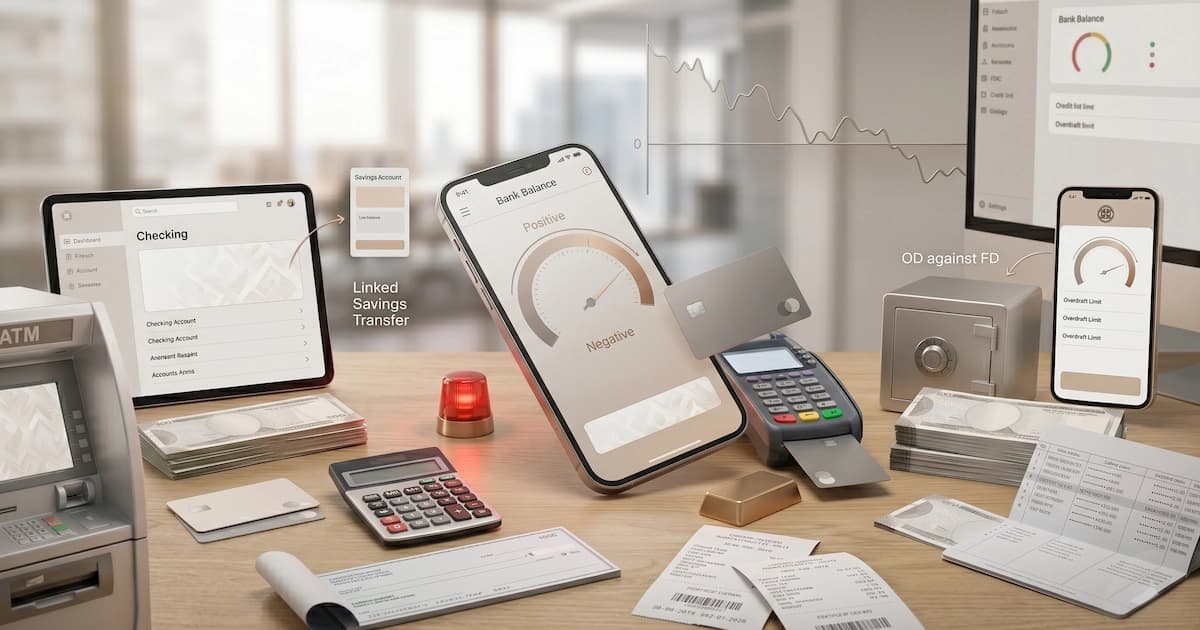
The word "overdraft" hides two completely different products. In the US, overdraft protection is a backstop on your checking account for the day a payment lands and your balance is too thin to cover it. In India, an overdraft is a credit line you apply for against a fixed deposit, your salary, or property, and draw on deliberately. Same word, opposite intent: one is an accident with a fee, the other is a planned loan you signed up for. Most articles cover only one side and never say the other exists.
US banks also muddle their own side. "Overdraft protection" that pulls your own linked savings is not the same thing as "standard overdraft coverage" that pays the item and charges you, yet the two get used as if they mean the same. This post separates all of it: what overdraft protection actually is, the Regulation E opt-in, the $5 cap that was repealed before it started, a worked cost example, and how India's overdraft facility works differently. It explains the products, not what you should do with your money.
What is overdraft protection?
Overdraft protection is a bank service that covers a transaction when your checking account balance is too low, either by transferring money from an account you already own or by the bank paying the item and letting your balance go negative for a fee. The name gets stretched to cover two mechanics that cost wildly different amounts, which is where most of the confusion starts.
The clean split banks like Wells Fargo and U.S. Bank draw, and most editorial pages don't, is between three things that can happen when a payment exceeds your balance:
| What it is | Whose money pays | Does the payment go through? | Typical cost |
|---|---|---|---|
| Overdraft protection | Yours, from a linked account | Yes | $0 to about $12.50 per transfer |
| Standard overdraft coverage (courtesy pay) | The bank's | Yes, balance goes negative | Flat fee, $26.77 average in 2025 |
| Non-sufficient funds (NSF) | Nobody, it bounces | No, returned unpaid | Flat fee, $16.82 average in 2025 |
Fee averages are from Bankrate's 2025 Checking Account and ATM Fee Study, published September 2025. Overdraft protection is the cheap, sensible-sounding one. Standard coverage is the one that generated the multi-billion-dollar fee controversy. Getting them confused is exactly what banks relied on for years.
The three forms of overdraft protection in the US
Overdraft protection in the US takes three forms, and all of them draw on money or credit you already hold, so the cost is a small transfer or interest well below a standard overdraft fee. The version your account uses is set in your overdraft preferences, and banks have historically defaulted new customers into the most expensive coverage.
A linked-account transfer is the most common. You connect a savings account, money market account, or another deposit account, and when checking runs short, the bank moves the difference over. Wells Fargo charges nothing for these Overdraft Protection transfers; U.S. Bank charges up to $12.50 and waives it when the negative balance is $50 or less. An overdraft line of credit is a small revolving credit line, often a few hundred to a few thousand dollars, that activates when the balance drops below zero and charges interest on the borrowed amount, so the cost scales with how much you use. A linked credit card can serve the same backstop role as a cash advance, though cash-advance fees and interest usually make it the priciest of the three.
Standard-coverage fees vary by bank, taken from their own current policy pages:
| Bank | Standard overdraft fee | Notable rule |
|---|---|---|
| Wells Fargo | $35 per item | No fee on items $10 or under; max 3 fees per day; no NSF fee |
| Bank of America | $10 per item | Balance Connect linked transfers avoid the fee |
| U.S. Bank | Transfer up to $12.50 | No transfer fee if negative balance is $50 or less |
| Fifth Third | $12 per item | Waived if overdrawn by $5 or less (per Bankrate) |
The industry average tells the trend. Bankrate's 2025 survey put the average overdraft fee at $26.77, down from a 2021 peak of $33.58, with 94% of checking accounts still charging one. The average NSF fee fell to a record-low $16.82, and only 61% of accounts charge it at all, as major banks quietly dropped it.
How does the Regulation E opt-in work?
Regulation E (12 CFR 1005.17) says a US bank cannot charge an overdraft fee on an ATM or one-time debit-card transaction unless you affirmatively opted in to that coverage. This is the single rule that puts the choice in your hands, and its scope is narrower than most people assume.
If you never opted in, an ATM withdrawal or a one-time debit-card purchase that exceeds your balance is simply declined at no cost. The catch is what the opt-in does not cover. Checks and recurring or pre-authorized ACH payments, such as auto-billed subscriptions and loan auto-debits, sit outside 12 CFR 1005.17 entirely. A bank can pay those into a negative balance and charge an overdraft fee, or bounce them and charge an NSF fee, whether or not you opted in. So opting out of debit and ATM overdraft does not switch off every possible fee, a point the CFPB spells out in its own consumer explainer.
The size of the choice is easy to underrate. The CFPB has found that accounts opted in to debit and ATM overdraft coverage rack up roughly seven times as many overdraft fees as accounts that stayed out. Consumers can change the setting at any time, in either direction, without a fee, and several online-first banks (Ally, Capital One 360, Chime, and others) removed overdraft fees as a default so there is nothing to opt into.
Did the CFPB cap overdraft fees at $5?
No federal cap on overdraft fees exists in 2026, because the rule that would have created one was repealed before it ever took effect. If you read an older article promising an upcoming $5 overdraft fee, it is describing a rule that is now dead.
The Consumer Financial Protection Bureau finalized that rule on December 12, 2024. It would have pushed banks and credit unions with more than $10 billion in assets to either cap the overdraft fee near a $5 benchmark, price it at their actual cost, or treat it as disclosed credit, with a planned start of October 2025. Congress then used the Congressional Review Act to overturn it: the disapproval resolution S.J.Res. 18 passed the Senate 52 to 48 in March 2025 and the House 217 to 211 in April, and the president signed it on May 9, 2025, as Public Law 119-10. A Congressional Review Act repeal does more than cancel the rule. It bars the agency from issuing another one in substantially the same form without fresh authorization from Congress. So overdraft pricing in 2026 runs on the pre-existing framework: the Regulation E opt-in plus standard fee disclosure, with the amount set by each bank.
What one short transaction can cost, four ways
The same insufficient-funds moment can end four different ways, and the gap between the cheapest and the most expensive is the whole point of understanding overdraft protection. Take a $45 debit-card purchase on a checking account holding $30, using 2025 average fees.
| Outcome | Payment goes through? | Fee | Ending checking balance |
|---|---|---|---|
| Opted out (debit or ATM) | No, declined at the till | $0 | $30 |
| Check or ACH, no coverage | No, returned unpaid | NSF, about $16.82 | about $13, plus a possible late fee from the payee |
| Standard overdraft coverage | Yes, bank pays it | Overdraft, about $26.77 (up to $35 at some banks) | about negative $42 |
| Overdraft protection (linked savings) | Yes, from your own savings | $0 to $12.50 transfer | $0, and savings down $15 |
The declined-transaction outcome carries a small social cost at the register and nothing more. The standard-coverage outcome turns a $45 purchase into an effective $71.77 event. Across all US deposit accounts, banks collected $5.83 billion in overdraft and NSF fees in 2023, down 51% from $11.96 billion in 2019, per a CFPB data spotlight. The decline came from regulatory pressure and banks dropping fees, not from a cap. Detailed bank fee schedules, including monthly maintenance and ATM charges, sit in our guide to bank fees.
What is an overdraft facility in India?
An overdraft facility in India is a sanctioned credit line attached to a bank account that lets you withdraw more than your balance up to a pre-approved limit, with interest charged only on the amount you draw and only for the days you keep it outstanding. This is a credit product you apply for, and it has almost nothing in common with the US surprise-fee model.
The mechanic that defines it is interest on utilisation. If your sanctioned limit is 1 lakh rupees and you draw 40,000 rupees for 10 days, you pay interest on 40,000 rupees for 10 days, and an untouched limit costs nothing. Facilities split into secured and unsecured. The flagship secured product is an overdraft against a fixed deposit. State Bank of India lets you borrow up to 75% of a term deposit or 90% of a special term deposit, priced at 1.00% above the FD rate, with a floor of 25,000 rupees. ICICI Bank offers up to 90% of the FD at the FD rate plus 2% for general customers and plus 1% for senior citizens, with no processing fee. Across the market the loan-to-value runs roughly 75% to 95% and the spread 1% to 4%. The deposit keeps earning its full interest the whole time, which is why this is often the cheapest credit an Indian saver can reach. The mechanics of the underlying deposit sit in our explainer on fixed deposits.
A worked example makes the cost visible. Say you hold a 3 lakh rupee FD earning 7%, and you take an overdraft against it at 8% (the FD rate plus 1%). You draw 50,000 rupees for 20 days to bridge a gap. The interest works out to roughly 50,000 times 8% times 20 divided by 365, about 219 rupees, while the full 3 lakh keeps earning its 7%. On the unsecured side, an overdraft against your salary account is a pre-approved line, often 2 to 3 times your monthly salary. ICICI's FlexiCash runs 11.65% to 13.40% a year with a tenure up to 12 months, and interest again applies only to the amount and period you actually use.
Overdraft, term loan, or cash credit in India
An overdraft, a term loan, and a cash credit are three separate credit products in India, and they differ mainly in who uses them, how the money is released, and how interest is charged. The distinction matters because banks and aggregator sites often use the words loosely.
| Feature | Overdraft | Term loan | Cash credit |
|---|---|---|---|
| Mainly for | Individuals and businesses | Individuals and businesses | Mainly businesses |
| How money is released | Draw as needed up to a limit | Full amount up front | Draw against stock or receivables |
| Interest charged on | Only the amount used, for the days used | The full sanctioned amount | Only the amount used |
| Repayment | Flexible, repay and redraw | Fixed EMIs | Renewed yearly |
| Typical security | FD, salary, property, or shares | Varies by loan | Business stock or receivables |
Kotak Mahindra Bank sums the loan-versus-overdraft split as borrowed funds against withdrawn funds: a loan is a lump sum repaid over the long term in EMIs, while an overdraft is short-term, interest is worked out daily, and there are no tax benefits on the interest. For the definition of a term loan itself, see our post on the personal loan. Which account can even carry an overdraft, and the RBI rule on holding a current account alongside a cash-credit or overdraft facility, sits in our current account versus savings account guide for India.
US overdraft protection versus India's overdraft facility
US overdraft protection and India's overdraft facility share a name and a rough idea, covering a shortfall, but they are opposite in how you get them, when they trigger, and what they cost. Setting them side by side is the clearest way to see why one word describes two products.
| US overdraft protection | India overdraft facility | |
|---|---|---|
| What it is | A backstop on a checking account | A credit line you apply for |
| Chosen in advance? | Often defaulted on at account opening | Yes, a limit is sanctioned to you |
| What triggers it | An accidental shortfall | A deliberate drawdown |
| Cost | A flat fee (about $26.77) or a cheap linked transfer | Interest only on the amount used, for the days used |
| Backing | Your linked savings, or the bank fronts it | FD, salary, property, shares, or insurance |
| Regulator framing | Regulation E opt-in for ATM and debit | An RBI-sanctioned credit facility |
The Indian framework does not permit the US pattern of approving a small everyday purchase on an empty account and charging a large flat fee for it. An Indian overdraft is a line you were granted and chose to use. That difference, an approved credit line versus an accidental negative balance, is the heart of why the same five-letter word means such different things in Mumbai and Minneapolis.
What this post does not cover
This is an explainer of what overdraft protection and overdraft facilities are, not advice on whether to opt in, opt out, or take an overdraft against your deposit. It does not rank specific bank accounts or overdraft products, and it does not cover full bank fee schedules (those sit in our bank fees guide), FD selection (see FD versus CD), or the RBI current-account eligibility rules for CC and OD holders (covered in the India current versus savings account post). Fee figures and the regulatory status described in this post reflect July 2026 and can change; a bank's own current disclosures are the authority for its fees. For a borrowing decision tied to your own finances, a qualified financial professional is the right source.
Frequently asked questions
What is overdraft protection in simple terms? Overdraft protection is a bank service that covers a transaction when your checking account balance is too low to pay it. When a payment would otherwise fail, the bank either transfers money from an account you own (a linked savings account or an overdraft line of credit) to cover the gap, or the bank pays the item itself and lets your balance go negative for a flat fee. The linked-transfer version is usually free or costs a small transfer charge (up to $12.50 at US Bank, $0 at Wells Fargo for its Overdraft Protection transfers). The bank-pays-it version, often called standard overdraft coverage or courtesy pay, is the expensive one, at a US average of $26.77 per item in 2025 according to Bankrate.
What is the difference between overdraft protection and overdraft coverage? Overdraft protection uses your own money: the bank transfers funds from a linked savings account, an overdraft line of credit, or a linked credit card to cover the shortfall, usually for a small fee or nothing. Standard overdraft coverage, which some banks call courtesy pay, uses the bank's money: it pays the transaction into a negative balance and charges you a flat overdraft fee that averaged $26.77 in 2025. A third outcome, a non-sufficient funds (NSF) fee, is different again: the bank declines and returns the payment unpaid and still charges a fee, which averaged $16.82 in 2025. Many pages blur the three, but they are separate: protection uses your funds, coverage fronts the bank's for a fee, and NSF is a bounced payment plus a fee.
Does opting out of overdraft stop all overdraft fees? No. Regulation E lets you opt out of overdraft fees only on ATM withdrawals and one-time debit-card purchases. If you opt out, those transactions are simply declined at no cost when your balance is short. Checks and recurring ACH payments, such as auto-billed subscriptions and loan auto-debits, sit outside the Regulation E opt-in, so a bank can still pay them into a negative balance and charge an overdraft fee, or return them unpaid and charge an NSF fee, regardless of your opt-in status. The CFPB has found that accounts opted in to debit and ATM overdraft coverage incur roughly seven times as many overdraft fees as accounts that stayed opted out.
Is there a $5 cap on overdraft fees in 2026? No. The Consumer Financial Protection Bureau finalized a rule in December 2024 that would have effectively capped overdraft fees near $5 for banks and credit unions with more than $10 billion in assets, with a planned effective date of October 2025. Congress overturned it under the Congressional Review Act (S.J.Res. 18), and the president signed the repeal on May 9, 2025, as Public Law 119-10. Because a Congressional Review Act disapproval was enacted, the rule never took effect and the CFPB cannot reissue one in substantially the same form without new legislation. So in 2026 there is no federal cap, and overdraft pricing is set by each bank under the existing Regulation E and disclosure framework.
What is an overdraft facility in India? An overdraft facility in India is a sanctioned credit line attached to a bank account that lets you withdraw more than your balance up to a pre-approved limit, with interest charged only on the amount you draw and only for the days you keep it outstanding. It is a credit product you apply for, not an accidental negative balance with a surprise fee. The common forms are secured, such as an overdraft against a fixed deposit (SBI lets you borrow up to 90% of an STDR at 1% above the FD rate) or against property or shares, and unsecured, such as an overdraft against your salary account (ICICI's FlexiCash runs 11.65% to 13.40% a year). Because interest accrues only on what you use, an unused sanctioned limit costs nothing.
What is the difference between an overdraft and a loan in India? A term loan gives you the full sanctioned amount up front, charges interest on the entire amount, and is repaid in fixed EMIs over a set period. An overdraft gives you a limit you can draw from as needed, charges interest only on the amount actually used for the days it is used, and is repaid flexibly by depositing back into the account, then redrawn if needed. Kotak Mahindra Bank frames the split as borrowed funds versus withdrawn funds: a loan is a lump sum with long-term EMIs, while an overdraft is short-term, interest is calculated daily, and there are no tax benefits on the interest. An overdraft usually suits short, uneven cash gaps, and a loan suits a large planned expense.
Sources
- Consumer Financial Protection Bureau, Regulation E, 12 CFR 1005.17 (overdraft opt-in) (consumerfinance.gov)
- Consumer Financial Protection Bureau, Overdraft and NSF revenue in 2023 down more than 50% versus pre-pandemic levels (Apr 2024) (consumerfinance.gov)
- Congressional Research Service, Congressional Review Act disapproval of the CFPB overdraft rule, S.J.Res. 18 (P.L. 119-10) (congress.gov)
- Bankrate, Checking Account and ATM Fee Study 2025 (bankrate.com)
- State Bank of India, Overdraft against deposits (sbi.bank.in)
- ICICI Bank, Overdraft against fixed deposit (icici.bank.in)
- Kotak Mahindra Bank, Key differences between a loan and an overdraft (kotak.bank.in)



You might also like

A checking account is the bank account you use for everyday spending. How it works, the types, what you need to open one, and the fees to watch for.
10 min read
Current account vs savings account in India: how they differ on interest, transaction limits, minimum balance, CASA, and deposit insurance.
14 min read

What your bank can charge and what it cannot: RBI's Rs 23 ATM cap, the free-transaction rules most pages get wrong, and US averages from Bankrate 2025.
17 min read