Routing Number vs IFSC Code: Which One Your Transfer Needs

By Tapabrata Biswas · Updated July 18, 2026 · 18 min read
Researched with AI assistance, reviewed and edited by Tapabrata Biswas.
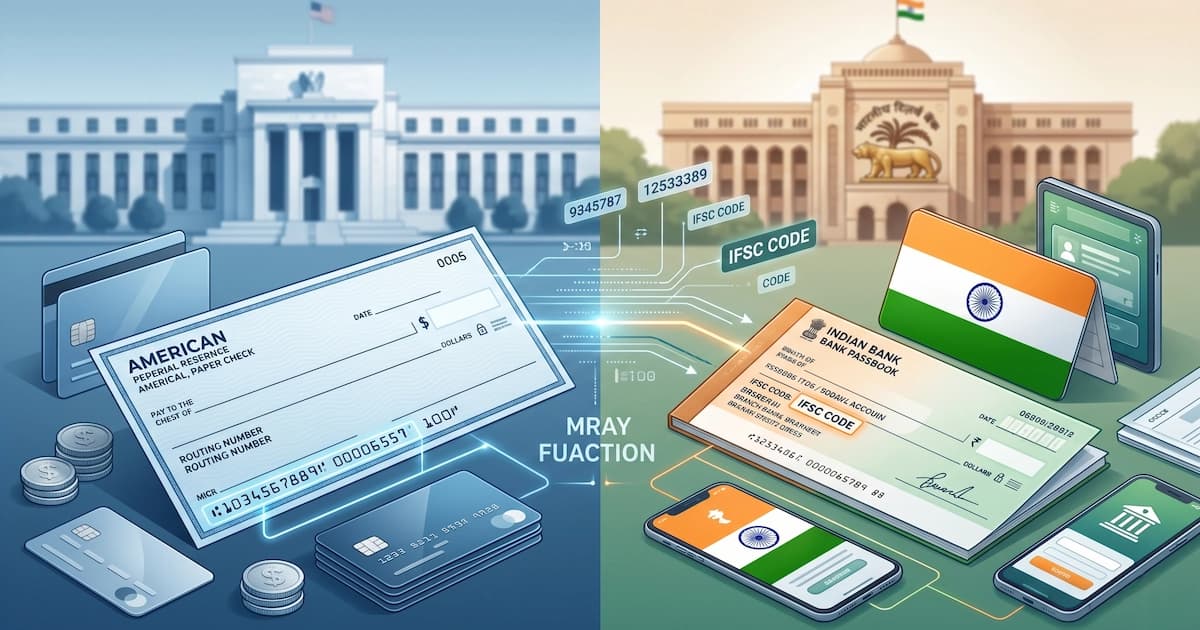
India has no routing number, and the American one carries a property almost nobody writes about. Take any US routing number, multiply its nine digits by 3, 7, 1 repeating, and add the results. The total always divides by 10.
Wells Fargo's 121000248 gives 3, 14, 1, 0, 0, 0, 6, 28, 8, summing to 60. That is neither a coincidence nor a trick. The ninth digit of every American routing number exists to force that outcome, so anyone can check a routing number is structurally sound in about fifteen seconds. Of the sixteen ranking pages we read on this topic, not one mentions it. India has no equivalent checksum, which is its own useful fact.
That absence is the shape of the whole subject. Bank identifier codes get explained as fixed labels you look up and copy, when they are structured objects with rules, expiry dates, and a specific way of failing. This post covers how the routing number, the IFSC and the SWIFT code are each built, how to check one before you use it, what actually happens when the code is wrong (worse than the field suggests), why Indian codes stop working, and which codes a cross-border transfer really needs. It explains the codes. It isn't advice about your money.
Does India have a routing number?
No. India uses the IFSC, and although it does a similar job, the two are not equivalents. The difference is what each code identifies.
RBI defines an IFSC as an 11-character alphanumeric code that uniquely identifies a bank branch participating in NEFT. An ABA routing number is nine digits and identifies the institution. That single distinction produces every other difference between them:
| IFSC (India) | Routing number (US) | SWIFT/BIC (international) | |
|---|---|---|---|
| Length | 11 characters, alphanumeric | 9 digits | 8 or 11 characters |
| Identifies | A specific branch | The bank | The bank, optionally a branch |
| How many per bank | Thousands, one per branch | Typically 1 to 3 | Usually one, plus branch variants |
| Assigned by | RBI | A registrar for the ABA | SWIFT |
| Example | SBIN0004093 | 021000021 | SBININBB |
| Works abroad | No | No | Yes |
A large Indian bank holds thousands of IFSC codes. A large US bank holds a handful. That is why an Indian transfer form asks which branch and an American one does not.
Worth naming a common miscount: the IFSC is not "an 11-digit number," a description that appears even on pages printing the correct XXXX0YYYYYY diagram directly underneath it. The first four characters are letters.
How is each code actually built?
Each code has a documented internal structure, which means you can read information out of a code and not only copying it.
An IFSC splits three ways. The first four characters are the bank: SBIN for State Bank of India, HDFC, ICIC, UTIB for Axis, PUNB for Punjab National Bank. The fifth character is 0. The last six identify the branch. So SBIN0004093 is State Bank of India, branch 004093.
RBI's wording on that fifth character deserves quoting precisely, because the field has added something to it. RBI says simply that the 5th character is 0 (zero). Nearly every explainer we read renders this as "reserved for future use," and we could find that phrase in no RBI source. It may well be true and it is repeated everywhere, but it is not what the regulator says. RBI also writes "the last 6 characters," which is why one bank's claim that they are "always in the numeric form" contradicts the regulator on the regulator's own specification.
A routing number splits four ways: the first two digits give the Federal Reserve district, the next two the Fed office and clearing arrangement, the next four identify the institution, and the ninth is the check digit. Chase's 021000021 decodes as district 02, New York.
A SWIFT/BIC code splits four ways too: four characters for the bank, two for the country, two for the location, and an optional three for the branch. SBININBB reads as SBIN, IN for India, BB for Mumbai.
Can you check a code is valid before using it?
For US routing numbers, yes, arithmetically, in about fifteen seconds. The ninth digit is a check digit calculated so that a weighted sum of all nine digits comes out divisible by 10.
Multiply the digits by 3, 7, 1, repeating across all nine positions, then add:
| Digit | 1 | 2 | 1 | 0 | 0 | 0 | 2 | 4 | 8 |
|---|---|---|---|---|---|---|---|---|---|
| Weight | 3 | 7 | 1 | 3 | 7 | 1 | 3 | 7 | 1 |
| Product | 3 | 14 | 1 | 0 | 0 | 0 | 6 | 28 | 8 |
That sums to 60, which divides by 10, so Wells Fargo's 121000248 is structurally sound.
We ran this against eight routing numbers taken from banks' own published pages, covering Wells Fargo, Bank of America's separate ACH and wire numbers, Ally, JPMorgan Chase, and the two partner banks behind Chime. All eight passed. Changing a single digit in any of them made the sum fail, which is exactly the job: the check digit catches transposition and mistyping, the errors people actually make.
One honest limitation, because a test you cannot break is not a test. 000000000 also passes, summing to zero. The checksum proves a number is well-formed, never that it belongs to a real bank. For that you need a lookup, and the American Bankers Association runs a free one with a limit almost nobody mentions: two searches a day, ten a month.
India has a weaker but still useful version of the same idea. If the fifth character of an IFSC is anything other than 0, the code is wrong. There is no checksum beyond that, so an IFSC has to be confirmed against RBI's own directory, which is published on rbi.org.in and, for the RTGS list, updated fortnightly.
What happens if the code is wrong?
The code routes the payment, but the account number decides who gets paid, and that asymmetry is where money actually goes missing. Both regulators say so directly, and the field mostly does not.
RBI is unambiguous in its NEFT FAQ: credit to the beneficiary account is released solely on the basis of the account number written by the remitter, and it is the remitting customer's responsibility to write the correct one. Its RTGS FAQ repeats the point, noting that real-time processing makes matching name against account number impossible, under a circular dated 14 October 2010.
So there are three cases, and they end very differently.
| What you entered | What happens |
|---|---|
| A malformed code | Rejected at validation. No money moves. |
| A valid code, wrong branch, no matching account | Processed, then returned. In India the destination bank must return it within two hours of the batch completing, and owes penal interest at the repo rate plus two percent for delay beyond that. |
| A valid code, and that account number exists there | Credited. To a stranger. |
That third row is the one worth sitting with, and the American documentation on it is blunter than anything published in India. The IRS, describing a tax refund sent to the wrong account, says that if the funds are not available or the bank refuses to return them, it cannot compel the bank to do so, and the case may become a civil matter between you, the bank, and whoever received your money. It also documents the timeline: Form 3911 to start a trace, banks allowed up to 90 days to respond, and up to 120 days for resolution.
One widely-read US explainer tells readers that a single incorrect number will cause the entire transaction to fail. True of a malformed number, false of a valid one, and the gap between those two cases is the entire risk.
This is also why the check digit matters. Nothing downstream catches your typo. There is no name check in either system.
Why do IFSC codes stop working?
Because banks merge, and the absorbed bank's branches get reissued codes under the anchor bank's prefix. India consolidated ten public sector banks into four anchors on 1 April 2020, and every branch involved eventually changed its IFSC.
| Absorbed bank | Anchor | New prefix |
|---|---|---|
| Oriental Bank of Commerce, United Bank of India | Punjab National Bank | PUNB |
| Syndicate Bank | Canara Bank | CNRB |
| Andhra Bank, Corporation Bank | Union Bank of India | UBIN |
| Allahabad Bank | Indian Bank | IDIB |
The detail that catches people, and which we could not find on any competing page, is that the code change lags the merger by months. Indian Bank absorbed Allahabad Bank on 1 April 2020. Its own published notice states that the two databases were merged on 13 and 14 February 2021, and that the modified branch codes, MICR codes and IFSC codes took effect from 15 February 2021, ten months after the amalgamation.
The pattern repeats. State Bank of India absorbed its associate banks in April 2017, and reporting from August 2018 documented changes to 1,295 branch codes, well over a year later.
So a payee saved before a merger can keep working for months and then quietly stop. Several pages published around the 2020 merger assured readers that account numbers and IFSC codes would remain unchanged until further notice. Those pages are still live, still say it, and events have falsified them.
Is MICR the same as IFSC, and is it still used?
A MICR code is a nine-digit number printed on cheques, an IFSC is an 11-character code for electronic transfers, and the more surprising point is that MICR clearing no longer runs.
RBI's own account of India's payment systems states that all sixty-six MICR centres were subsumed into the cheque truncation system and that MICR clearing was discontinued with effect from July 2014. Cheque truncation replaced the physical movement of cheques with image-based processing, and the migration finished when the remaining ECCS centres moved across in September 2020.
The MICR code survives as a printed branch identifier and still appears in systems such as NACH, where destination accounts can be identified by account number, IFSC or MICR. But the clearing mechanism the code was built to serve was retired twelve years ago, which is not the impression left by explainers describing how MICR speeds up your cheque processing today.
The nine digits break down as three for the city, three for the bank and three for the branch. We attribute that structure to industry consensus and not to RBI, because the RBI document carrying it is a PDF we could not extract text from.
What do you actually need to send money between the US and India?
Both a SWIFT code and the recipient's local identifier, because they do different jobs at different stages of the journey. The SWIFT code gets the payment to the right bank in the right country. The local code and account number get it to the right branch and person.
Sending to India, a remittance provider will typically ask for the recipient's name, account number, the bank's SWIFT or BIC code, and the IFSC. Sending to the US, the equivalent set is name, account number, the bank's SWIFT code, and the routing number, and it is worth checking which routing number the form wants.
Which brings up a correction we owe readers. Our earlier version of this page said foreign banks do not recognise IFSC codes. That is wrong. The SWIFT message format itself has a field for it. The standard defines national clearing system codes that travel inside a payment message, and the India entry is two characters, IN, followed by an 11-character Indian Financial System Code. The 11!c notation in the specification is SWIFT's own confirmation of the IFSC's length, arrived at independently of any Indian source.
So the honest framing is that an IFSC cannot route an international payment by itself, and it is not invisible to the network either. It rides inside the SWIFT message to tell the receiving Indian bank which branch to credit.
On the US side, one more trap. Many banks publish different routing numbers for ACH and for wires. Bank of America uses 121000358 for ACH in California and 026009593 for wires nationwide. Wells Fargo uses 121000248 for both. So the rule is not that they always differ, only that they often do, and the form will say which it wants. Choosing between the two rails belongs to wire transfer vs ACH.
Where do you find each code?
On your own statement or in your banking app first, and in the regulator's directory when you need to confirm someone else's.
An IFSC is printed on your chequebook and passbook and shown in your banking app, and RBI publishes a searchable directory alongside a separate MICR lookup. A routing number sits at the bottom-left of a US cheque, before the account number, and appears in online banking under account details. The ABA's public lookup is the authoritative check, subject to that two-a-day limit.
One thing will trip up anyone following older instructions: Indian banks have moved to RBI-mandated .bank.in domains. State Bank of India is now sbi.bank.in, HDFC is hdfc.bank.in, ICICI is icici.bank.in. Old links redirect where the bank has configured it and simply fail where it hasn't.
For everyday domestic transfers within India, none of this may apply at all. A UPI payment identifies the recipient by a Virtual Payment Address and needs no IFSC from you, as covered in what is UPI. The rails that do use IFSC are compared in IMPS vs NEFT vs RTGS.
What this post does not cover
This explains the identifier codes and how they behave. It doesn't recommend a bank, a transfer provider, or a route for your money, and it isn't tax or legal advice; anyone trying to recover a misdirected payment should talk to their bank first and, if it escalates, a professional. Transfer speeds, charges and rail selection sit in IMPS vs NEFT vs RTGS and wire transfer vs ACH, bank charges in bank fees explained, and the wider pillar in banking basics.
On sourcing, since a wrong code costs real money. The IFSC structure, the fifth-character rule, the account-number-only crediting rule, the two-hour return requirement and the repo-plus-two-percent penalty all come from RBI's own NEFT and RTGS FAQ pages. The July 2014 MICR discontinuation comes from RBI's published overview of India's payment systems. The Indian Bank cutover dates come from Indian Bank's own notice. The misdirected-deposit consequences come from the IRS.
Four things we left out or qualified. The routing number checksum is verified by our own testing against eight bank-published numbers, because we could not retrieve the formula from the ABA or the Federal Reserve directly, so treat the arithmetic as demonstrated and not as officially cited. The MICR nine-digit breakdown is industry consensus and not an RBI quote, because the RBI PDF carrying it would not yield its text. The consolidated old-to-new IFSC mapping published by NPCI is real but blocked to automated access, so we cite individual banks instead. And reported 2026 merger plans involving further public sector banks appear only in low-authority outlets with no government confirmation, so nothing about them appears here.
Frequently asked questions
Does India have a routing number? No. India uses the IFSC, or Indian Financial System Code, and while it does a similar job the two are not equivalents. RBI defines an IFSC as an 11-character alphanumeric code that uniquely identifies a bank branch, with the first four characters representing the bank and the last six the branch. An ABA routing number is nine digits and identifies the bank rather than the branch, which is why a US bank typically holds only one to three routing numbers while a large Indian bank holds thousands of IFSC codes, one for every branch. Neither code works outside its own country, so a transfer between the two needs a SWIFT or BIC code as well.
How can you check if a routing number is valid? Multiply the nine digits by the repeating weights 3, 7 and 1, add the results, and check the total divides by 10. Every US routing number carries a check digit in the ninth position specifically to make this work. Take Wells Fargo's 121000248: the products are 3, 14, 1, 0, 0, 0, 6, 28 and 8, which sum to 60, and 60 divides by 10, so the number is structurally sound. We tested this against eight routing numbers published by banks on their own pages and all eight passed, while deliberately altering a single digit made each one fail. One caveat worth knowing: 000000000 also passes, so the check catches typos rather than proving a number belongs to a real bank.
What happens if you use the wrong IFSC or routing number? It depends on whether the code is malformed or merely wrong, and the second case is the dangerous one. A code that fails validation is rejected outright. A code that is valid but belongs to the wrong branch or bank gets processed, because in both countries the payment is credited on the account number rather than on a name match. RBI states that credit is released solely on the basis of the account number given by the remitter. If no such account exists at that branch the destination bank must return the money within two hours of the batch completing, and owes penal interest at the repo rate plus two percent for any delay beyond that. In the US the IRS documents the worse outcome plainly: if the money reaches a real account belonging to someone else, it cannot compel the bank to return it, and the matter can become a civil dispute between you and the stranger who received your money.
Is MICR the same as IFSC? No, and the more surprising point is that MICR clearing no longer operates. A MICR code is a nine-digit number printed at the bottom of a cheque that identifies the city, bank and branch, while an IFSC is an 11-character alphanumeric code used for electronic transfers. RBI's own record of India's payment systems states that all sixty-six MICR centres were absorbed into the cheque truncation system and that MICR clearing was discontinued with effect from July 2014. The MICR code itself survives as a printed branch identifier and is still referenced in systems such as NACH, but the mechanism it was built for has been retired for over a decade, which is not what most explainers describe.
Why did my IFSC code stop working? Almost certainly a bank merger. When Indian public sector banks were consolidated, the absorbed banks' branches were issued new IFSC codes under the anchor bank's prefix, and the old codes were eventually deactivated. Oriental Bank of Commerce and United Bank of India moved to Punjab National Bank's PUNB prefix, Syndicate Bank to Canara's CNRB, Andhra Bank and Corporation Bank to Union Bank's UBIN, and Allahabad Bank to Indian Bank's IDIB. The timing catches people out because the code change lags the merger: Indian Bank absorbed Allahabad Bank on 1 April 2020, but the new branch codes, MICR codes and IFSC codes only took effect on 15 February 2021, ten months later.
Can you use an IFSC code for an international transfer? Not on its own, though the common claim that foreign banks do not recognise IFSC at all is wrong. An international transfer is routed by SWIFT or BIC code, and without one the payment cannot leave the sending country. But the IFSC is not invisible to the network: the SWIFT message format itself reserves a national clearing code field for India, defined as two characters IN followed by an 11-character Indian Financial System Code, so the sending bank can carry your IFSC inside the message to tell the receiving Indian bank which branch to credit. In practice most remittance providers ask for both the SWIFT code and the IFSC for exactly that reason.
Sources
- Reserve Bank of India, Frequently Asked Questions on NEFT (the IFSC definition, the 11-character structure, the fifth character, and credit released solely on account number) rbi.org.in
- Reserve Bank of India, Frequently Asked Questions on RTGS (the two-hour return requirement, penal interest at repo plus two percent, and the fortnightly IFSC list update) rbi.org.in
- Reserve Bank of India, Payment and Settlement Systems overview (all sixty-six MICR centres subsumed into CTS, MICR clearing discontinued from July 2014) rbi.org.in
- Reserve Bank of India, IFSC and MICR code lookup rbi.org.in
- Indian Bank, New IFSC, MICR and branch codes following the Allahabad Bank amalgamation (databases merged 13 and 14 February 2021, new codes effective 15 February 2021) indianbank.bank.in
- Internal Revenue Service, Refund inquiries, deposits made to the wrong account (Form 3911, the 90 and 120 day windows, and the civil-matter outcome) irs.gov
- American Bankers Association, Routing number lookup (the two per day and ten per month limit) routingnumber.aba.com
- Federal Reserve Financial Services, E-Payments Routing Directory (separate FedACH and Fedwire participant lists, updated daily) frbservices.org
- Bank of America, Routing number FAQs (separate ACH and wire routing numbers) bankofamerica.com
- Wells Fargo, Routing numbers (a single number used for both ACH and domestic wires) wellsfargo.com


You might also like
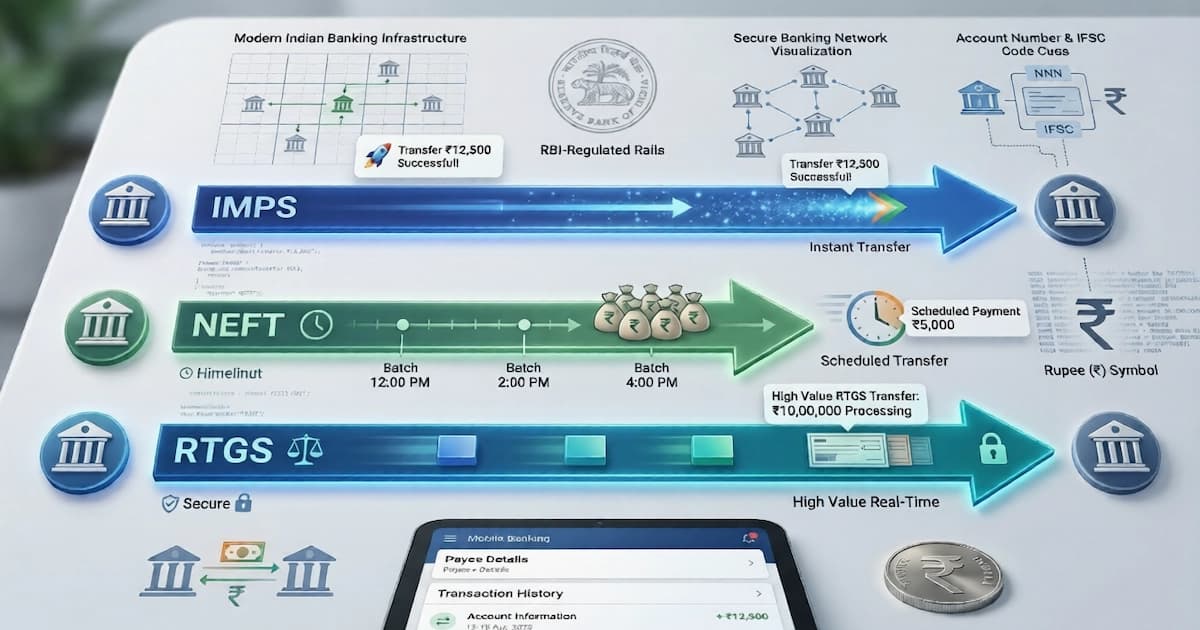
RBI sets no maximum on NEFT and caps RTGS charges at Rs 25 and Rs 50. What each rail costs, how fast it credits, and where bank caps quietly replace RBI rules.
19 min read
ACH vs wire transfer on speed, cost and reversibility, why the $10,000 reporting rule covers cash and not wires, and which routing number each rail uses.
27 min read
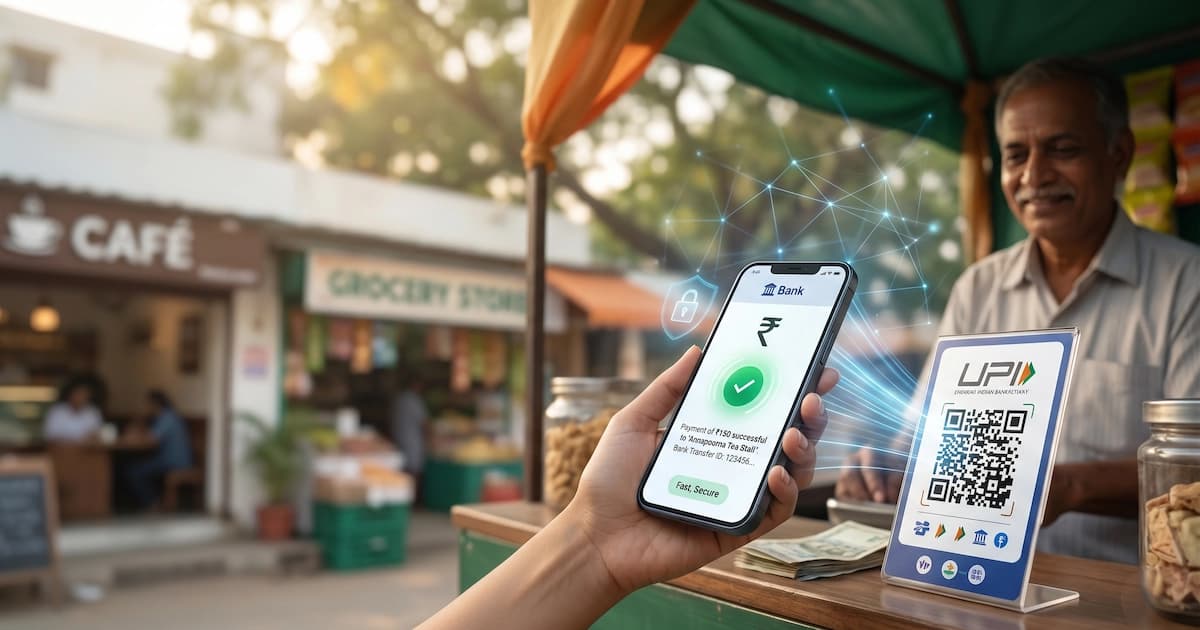
UPI explained: what it is, the current limits and who gets the higher ones, why it is free, who pays for that, and what the August 2026 MDR Bill would change.
20 min read