What Is UPI? How India's Payment System Actually Works

By Tapabrata Biswas · Updated August 8, 2026 · 20 min read
Researched with AI assistance, reviewed and edited by Tapabrata Biswas.
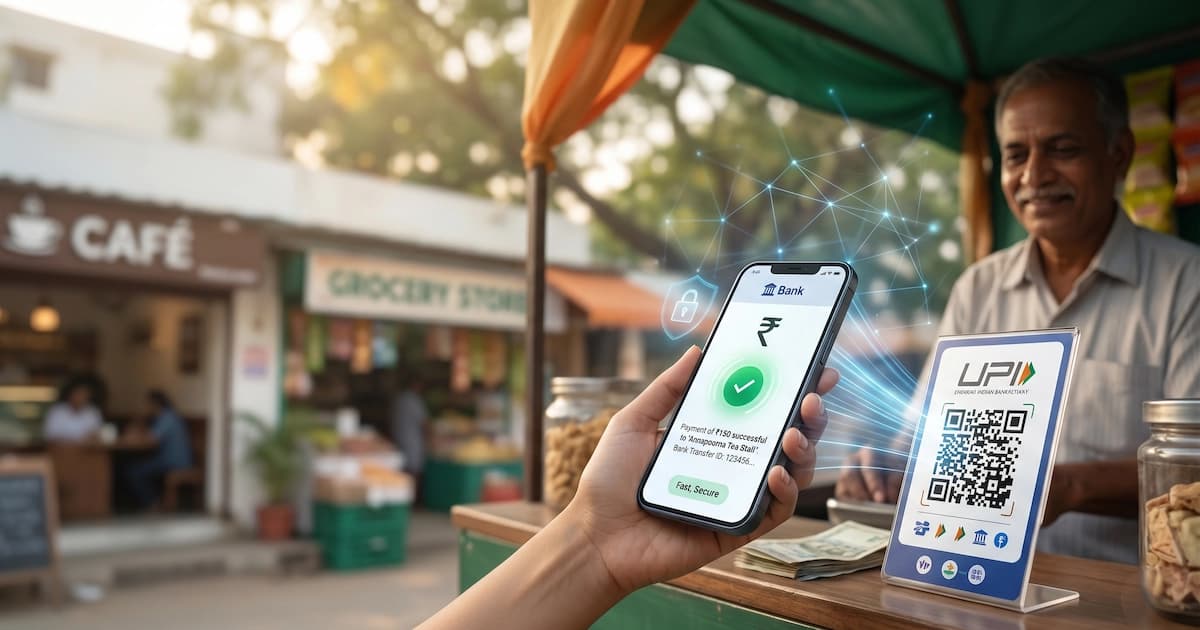
In April 2016, UPI's first month, the system processed 373 transactions. In July 2026 it processed 2,366 crore of them, worth Rs 29.88 lakh crore, in thirty-one days.
That is the number people reach for, and on its own it misleads. UPI is not where India's money is. Person-to-merchant payments make up 63% of its volume, and 86% of those are under Rs 500. Person-to-person transfers, a minority of the count, carry 71% of the value. UPI is a rail built for the small and constant, and it won by making the smallest payments free for everyone involved. Understanding who actually pays for that turns out to explain most of the rest.
What follows covers what UPI is and how the layers fit together, how big it now is with figures dated properly, what the transaction limits genuinely are and who qualifies for the higher ones, why it costs users nothing and who absorbs that cost, what UPI Lite and Autopay add, and what the fraud data shows. It describes the system. It isn't advice about how to use your money.
What is UPI?
UPI, the Unified Payments Interface, is a real-time payment system that moves money between two Indian bank accounts using an identifier like a mobile number or a Virtual Payment Address, without either side sharing an account number or IFSC code. The National Payments Corporation of India built it and launched it on 11 April 2016.
The design decision that mattered was making it a layer on top of an existing rail. UPI does not settle money itself. It sits on top of NPCI's existing IMPS infrastructure and adds three things: an addressing system so a payee can be named as someone@bank in place of a sixteen-digit account number, an authentication step where a PIN entered on your phone is verified by your bank rather than by the app, and an interoperability rule that means any compliant app can pay into any bank.
That last piece is why the ecosystem looks the way it does. A Google Pay user can pay a PhonePe QR code drawn on a Paytm merchant's account, and none of those three companies has to agree to anything bilateral. It also explains why UPI apps are free and why none of them can lock you in.
Four steps run under a single tap: the app sends a request to NPCI naming the payee's VPA, NPCI resolves that to a bank and account, your bank verifies the PIN and debits you, and the payee's bank credits them. Settlement between the banks happens afterwards. The user-facing surface is deliberately minimal, which is what made adoption possible across a range running from street vendors to national retailers.
How big is UPI, and where is the money actually going?
UPI carried 24,162 crore transactions worth Rs 314 lakh crore in FY 2025-26, which the Ministry of Finance puts at 85% of India's digital payments by volume. Those figures come from a PIB release of 30 April 2026 marking the system's tenth year.
| Metric | FY 2025-26 |
|---|---|
| Annual transactions | 24,162 crore, up 30% year on year |
| Annual value | Rs 314 lakh crore, up 20.6% |
| Share of India's digital payments | 85% |
| Daily average transactions | About 66 crore |
| Banks live on UPI | 703, as of March 2026 |
| Record month | July 2026, 2,366 crore transactions worth Rs 29.88 lakh crore, per NPCI. The value peak was May 2026 at Rs 29.90 lakh crore |
The most recent month at the time of writing is June 2026, at over 22 billion transactions worth about Rs 28.92 lakh crore, up roughly 23% on the year.
Now the split that reframes all of it, and which we have not seen on another page:
| Segment | Share of volume | Share of value |
|---|---|---|
| Person to merchant | 63% | 29% |
| Person to person | 37% | 71% |
Merchant payments dominate the count and person-to-person transfers dominate the money. Push further and it gets sharper: 86% of merchant transactions are under Rs 500. UPI is not the rail that carries India's large payments. It is the rail that replaced small cash, at enormous frequency, which is a different achievement and arguably a harder one.
That distinction also explains a figure worth handling carefully. RBI's Bulletin of September 2025 recorded UPI at about 84% of digital payment volume but roughly 9% of digital payment value in FY 2024-25. Both numbers are true and they describe the same instrument. High frequency, low ticket.
What are the current UPI transaction limits?
Rs 1 lakh per transaction for ordinary use, and a Rs 5 lakh limit that applies far more narrowly than most pages imply. The higher limit took effect on 15 September 2025 under an NPCI circular dated 28 August 2025.
| Payment type | Limit |
|---|---|
| Person to person | Rs 1 lakh per day |
| Ordinary person to merchant | Rs 1 lakh |
| Verified merchant, listed categories | Rs 5 lakh per transaction, Rs 10 lakh daily aggregate |
| Digital account opening | Rs 2 lakh |
The listed categories cover capital markets, insurance, government services and collections, travel, credit card bill payments, EMI and loan collections, foreign exchange and term deposits.
Two conditions decide whether you ever see Rs 5 lakh, and the field prints the number while skipping both. The first is that the merchant must be rated Verified by NPCI. An ordinary merchant in a listed category does not qualify. The second is that your own bank may impose a lower cap regardless, and many do.
So three ceilings stack on any single payment: NPCI's category limit, your bank's internal limit, and your app's limit. A payment fails at the lowest of the three, which is why a reader who has read "Rs 5 lakh for insurance" still gets declined at Rs 1.2 lakh and concludes the rule is broken. It isn't. They met a different ceiling.
Our earlier version of this page stated these limits in a way that contradicted itself, listing capital markets under both Rs 2 lakh and Rs 5 lakh in the same sentence. That has been corrected, and the correction is the reason the section now leads with the condition before the number.
One thing we are deliberately not stating: several sources give conflicting per-transaction limits for jewellery purchases, and we could not resolve it against a primary document, so no jewellery figure appears here.
Is UPI actually free, and who pays for it?
UPI is free to users because the merchant discount rate was set to zero by law in January 2020, and the revenue gap that creates is filled by a government incentive scheme. This is the part of UPI almost nobody writes about, and it is the most interesting thing about the system's economics.
Ordinarily a card or payment network funds itself through MDR, a percentage the merchant pays on each transaction. A PIB release records the position plainly: MDR of up to 0.90% applies across card networks for debit cards, and NPCI permits up to 0.30% for UPI person-to-merchant transactions. But since January 2020, MDR has been zero for RuPay debit cards and BHIM-UPI, through amendments to Section 10A of the Payment and Settlement Systems Act 2007 and Section 269SU of the Income-tax Act 1961.
Zero MDR means the acquiring bank earns nothing on the transaction while still carrying the cost of processing it. The government therefore compensates them. The incentive scheme for FY 2024-25 carried an outlay of Rs 1,500 crore, paying acquiring banks roughly 0.15% per transaction on small-merchant person-to-merchant payments up to Rs 2,000, with a portion of each claim contingent on the bank keeping technical declines below 0.75% and uptime above 99.5%.
Read that as what it is. UPI being free is a policy decision with an annual price tag attached and performance conditions on the payout. It is not a property of the software, and it is periodically debated. Any page telling you UPI is free without telling you who is paying has described half the arrangement. As of August 2026 that debate has moved into Parliament, which the next section covers.
Two smaller charging facts follow from the same structure. Payments funded from a prepaid wallet, in place of a bank account, carry an interchange above Rs 2,000, banded by merchant category, and the customer does not pay it. And RuPay credit cards can be linked to UPI, with merchant economics that differ from an ordinary swipe. We covered what we could verify of that in credit card vs debit card, and NPCI's own pages block automated access, so the precise interchange figures stay out of both posts.
Is UPI about to start charging?
UPI is still free, and the zero-MDR rule is still in force, but on 6 August 2026 the Lok Sabha passed a Bill that would remove the legal guarantee behind it. The Bill is the Taxation and Other Laws (Amendment) Bill 2026, introduced by the Finance Minister on 4 August 2026.
Two things are being reported loosely, so it's worth being exact about both.
It is not law yet. The Bill has passed the Lok Sabha only. It still needs the Rajya Sabha and the President's assent before it amends anything, and until that happens Section 10A stands as it is. A lot of coverage has described Parliament as having already amended the Act. On the date of this update, it hasn't.
And even after assent, nothing changes by itself. The amendment doesn't impose a charge. It rewrites Section 10A so the zero-MDR protection attaches to whichever payment modes the government notifies, and not being fixed in the statute.
The mechanism is worth spelling out, because it's the part that explains why the change matters more than it looks. Section 10A currently ties the zero-MDR mandate to "the electronic modes of payment prescribed under section 269SU of the Income-tax Act, 1961", which is the provision requiring businesses above Rs 50 crore turnover to offer BHIM-UPI QR and RuPay. The Bill replaces that phrase with "one or more electronic modes of payment as the central government may, by notification, specify". Severing that link is the whole amendment. It moves the decision out of the statute and into an executive notification, which means any future change needs no fresh trip through Parliament.
What would follow is not yet settled, and this is where reporting turns into expectation. The government has said consumers won't be charged, and that any MDR would apply to selected merchant transactions above a threshold at a nominal rate below card MDR. Figures of 0.25% to 0.4% on merchant payments above Rs 2,000 have been widely reported, with person-to-person transfers left out. A UPI and Services Steering Committee headed by NPCI is expected to set the rate. Treat all of that as reported intent rather than policy, because none of it has been notified.
For anyone using UPI to split a bill or pay a shopkeeper today, the practical answer is that nothing has changed. What has changed is the durability of the arrangement. Free UPI has rested since 2020 on a statutory guarantee. If this Bill completes its passage, it will rest instead on a decision the government can revisit whenever it chooses.
What do UPI Lite and Autopay add?
UPI Lite is an on-device wallet for small payments, capped at Rs 1,000 per transaction with a Rs 5,000 total balance, under an RBI circular dated 4 December 2024. The circular, numbered RBI/2024-25/93, amended the framework for small-value digital payments in offline mode and replaced the previous Rs 500 and Rs 2,000 caps.
The reason it exists is technical. An ordinary UPI payment makes a round trip to your bank's core banking system, which is where both the latency and the failure rate live. UPI Lite settles on the device against a pre-loaded balance, so it works where the network is poor and does not require a PIN for each payment. What you give up is the ceiling and the fact that money sitting in UPI Lite has left your bank account before you spend it.
UPI Autopay handles recurring payments by letting you approve a mandate once, after which the app debits on schedule. Mandates are revocable from inside the app.
We are stating less here than our previous version did. Several figures circulating for UPI Lite's daily cap, and for a device-to-device variant, conflict across sources and we could not settle them from a primary document, so they are omitted.
How does UPI differ from IMPS, NEFT and RTGS?
UPI runs on IMPS rails, so the difference is the layer above them: the identifier, the app, and the ceiling. UPI uses a VPA or mobile number where the older three need an account number and IFSC code, it runs through third-party apps in place of your bank's own channel, and it stops at Rs 1 lakh for ordinary transfers.
| Rail | Identifier | Ceiling | Online charge |
|---|---|---|---|
| UPI | VPA or mobile number | Rs 1 lakh ordinary | Free, though see the pending MDR Bill above |
| IMPS | Account number and IFSC | Rs 5 lakh | Varies by bank |
| NEFT | Account number and IFSC | No upper limit | Free since 1 January 2020 |
| RTGS | Account number and IFSC | Rs 2 lakh minimum | Free since 1 January 2020 |
That is deliberately a short table, because the full rail-by-rail comparison including branch charges and settlement mechanics belongs to IMPS vs NEFT vs RTGS.
What are the real fraud risks with UPI?
UPI fraud fell in value for two consecutive years while volume grew 30%, and the losses come from social engineering, never from a compromise of the system itself. Figures given to Parliament by the Minister of State for Finance:
| Year | Amount | Cases |
|---|---|---|
| FY 2021-22 | Rs 242 crore | Not stated |
| FY 2022-23 | Rs 573 crore | Not stated |
| FY 2023-24 | Rs 1,087 crore | 13.42 lakh |
| FY 2024-25 | Rs 981 crore | 12.64 lakh |
| FY 2025-26, to November | Rs 805 crore | 10.64 lakh |
Set that against the Rs 314 lakh crore UPI carried in FY 2025-26 and the fraud figure is roughly a quarter of one basis point of throughput. We have not seen another page compute that ratio, and it is worth computing, because the coverage tends to imply the opposite trend.
The mechanism is consistent across the documented cases, and it turns on one asymmetry in the interface: entering your UPI PIN only ever authorises money leaving your account. No PIN is required to receive money. Every major fraud pattern is a variation on getting someone to enter a PIN while believing they are receiving.
The collect request is the cleanest example. UPI lets one party request payment from another, and the notification can be crafted to read like an incoming transfer. Approve it with a PIN and you have paid, not been paid. Fake QR codes work the same way, as do fake refunds where a caller explains that a PIN entry is needed to process money coming back to you. Screen-sharing apps are the other family: the caller sees your screen while you authenticate. Fake customer-care numbers seeded into search results feed all of the above.
None of this touches UPI's cryptography. It targets the person, which is why the fix is informational, and why fraud volumes track public awareness more than system security.
What this post does not cover
This explains what UPI is, what it costs, and what its limits are. It isn't advice on which app to use, how to arrange your accounts, or what to do with your money. It also doesn't predict whether merchant charges will arrive, what they will be, or when. The Bill's remaining passage and any notification that follows are decisions we can report once they happen and won't guess at before then. Bank-side charges beyond UPI sit in bank fees explained, the other Indian payment rails in IMPS vs NEFT vs RTGS, the card-versus-account question at a QR code in credit card vs debit card, and using UPI history as a spending record in how to track spending.
On sourcing, since UPI's rules change often. The bank count, category shares and international footprint come from a PIB release of 30 April 2026 carrying NPCI's own statistics table, and the July 2026 monthly volume and value are NPCI's own figures as reported when it published them. The UPI Lite limits come from the RBI circular itself. The zero-MDR position and the incentive scheme come from a PIB Cabinet release. The fraud figures are those given to Parliament. For the August 2026 amendment we relied on the text of the substitution made to Section 10A and on the parliamentary record of the Bill's passage through the Lok Sabha, and we have deliberately kept the expected rates and thresholds labelled as reported expectation, because nothing has been notified.
Six things we left out on purpose. The jewellery transaction limit, where sources conflict. The NPCI circular number for the September 2025 limits, though its date is well attested. UPI Lite's daily cap and the device-to-device variant, both contested. The RuPay-on-UPI restricted category list and its interchange tiers, which exist only as search snippets of NPCI pages that block automated access. Reported 2026 rule changes including two-factor authentication and payee-name verification, which we found only in secondary reporting. And any country beyond the eight the Ministry of Finance lists as operational: the UAE, Singapore, France, Bhutan, Nepal, Sri Lanka, Mauritius and Qatar. Several widely-read pages list more.
Frequently asked questions
What is UPI in simple terms? UPI, the Unified Payments Interface, is a real-time payment system that moves money directly between two Indian bank accounts using an identifier like a mobile number or a Virtual Payment Address, without either party sharing an account number or IFSC code. It was built by the National Payments Corporation of India and launched on 11 April 2016 with 21 member banks and 373 transactions in its first month. It runs around the clock including holidays, settles in seconds, and is free for personal use. By March 2026 it was live across 703 banks, and the Ministry of Finance puts it at 85% of India's digital payments by volume.
What is the UPI transaction limit? Rs 1 lakh per transaction for ordinary use, including all person-to-person transfers. A higher limit of Rs 5 lakh per transaction, with a daily aggregate of Rs 10 lakh, took effect on 15 September 2025 under an NPCI circular dated 28 August 2025, but it is narrower than most pages suggest. It applies only to person-to-merchant payments where NPCI has rated the merchant as Verified, and only in specified categories including capital markets, insurance, government collections, travel, credit card bill payments, loan repayments, foreign exchange and term deposits. Digital account opening stays capped at Rs 2 lakh. Individual banks may also set their own lower caps, so three separate ceilings can apply to one payment.
Is UPI free, and who pays for it? It is free to users, and the cost is carried by the government rather than absorbed by the technology. Merchant discount rate was set to zero for BHIM-UPI and RuPay debit card transactions in January 2020 through amendments to Section 10A of the Payment and Settlement Systems Act 2007 and Section 269SU of the Income-tax Act 1961. Because zero MDR removes the revenue that normally funds a payment network, the government runs an incentive scheme to compensate acquiring banks, with an outlay of Rs 1,500 crore for FY 2024-25 paying roughly 0.15% per transaction on small-merchant payments up to Rs 2,000. Part of each claim is contingent on the bank meeting uptime and technical-decline targets.
Will UPI start charging users? Not currently, and nothing has been notified. UPI is still free and the zero-MDR rule still stands, but on 6 August 2026 the Lok Sabha passed the Taxation and Other Laws (Amendment) Bill 2026, which rewrites Section 10A of the Payment and Settlement Systems Act so that zero MDR applies only to the payment modes the central government notifies, rather than being fixed in the statute. The Bill is not law yet. It still requires the Rajya Sabha and Presidential assent, and even after that it imposes no charge by itself. The government has said consumers will not be charged and that any merchant discount rate would apply to selected merchant transactions above a threshold, with person-to-person transfers excluded, but no rate has been notified and that remains reported intent and not policy.
What are the UPI Lite limits? Rs 1,000 per transaction, with Rs 5,000 as the total balance held in the UPI Lite wallet at any one time. Those limits come from an RBI circular dated 4 December 2024, numbered RBI/2024-25/93, which amended the framework for small-value digital payments in offline mode and replaced the earlier Rs 500 and Rs 2,000 caps. UPI Lite exists so that small payments clear on the device without a full round trip to the bank's core system, which is why it works in poor network conditions and does not require a UPI PIN for each payment. The trade-off is the low ceiling and the balance sitting outside your bank account until spent.
How much UPI fraud is there? Less each year, in value terms, even as volume climbs. Figures given to Parliament by the Minister of State for Finance put UPI fraud at Rs 1,087 crore across 13.42 lakh cases in FY 2023-24, Rs 981 crore across 12.64 lakh cases in FY 2024-25, and Rs 805 crore across 10.64 lakh cases in FY 2025-26 up to November. Against the Rs 314 lakh crore UPI carried in FY 2025-26, that is roughly a quarter of a basis point of throughput. The pattern matters more than the total: the losses come from social engineering, principally collect-request scams, fake QR codes and screen-sharing apps, and not from any compromise of UPI itself.
How is UPI different from IMPS, NEFT and RTGS? UPI is an addressing and authentication layer built on top of NPCI's existing IMPS rails, so the underlying settlement is shared but the user experience is not. The practical differences are the identifier, the interface and the ceiling: UPI uses a Virtual Payment Address or mobile number where IMPS, NEFT and RTGS need an account number and IFSC code, UPI runs through third-party smartphone apps and not your bank's own channel, and UPI caps at Rs 1 lakh for ordinary transfers where NEFT has no upper limit and RTGS handles high-value transfers from a Rs 2 lakh floor. NEFT and RTGS have also been free on online channels for savings account holders since 1 January 2020.
Sources
- Press Information Bureau, Ministry of Finance, UPI completes 10 glorious years, 30 April 2026 (the FY 2025-26 volume and value, the 85% share, 703 banks, the P2M and P2P split, and the eight operational countries) pib.gov.in
- Press Information Bureau, Cabinet release on digital payment incentives (zero MDR for BHIM-UPI and RuPay debit since January 2020, and the incentive scheme mechanics) pib.gov.in
- Reserve Bank of India, Amendment to Framework for Facilitating Small Value Digital Payments in Offline Mode, RBI/2024-25/93, 4 December 2024 (the UPI Lite Rs 1,000 and Rs 5,000 limits) rbi.org.in
- Reserve Bank of India, Operation of Pre-Sanctioned Credit Lines at Banks through UPI, 4 September 2023 rbi.org.in
- Reserve Bank of India, Rationalisation of NEFT and RTGS charges, 11 June 2019 rbi.org.in
- News on AIR, NPCI announces new UPI P2M transaction limit effective 15 September (the Rs 5 lakh limit and the unchanged P2P cap) newsonair.gov.in
- India Brand Equity Foundation, UPI transactions rise 23% to over 22 billion in June, 2 July 2026 ibef.org
- PRS Legislative Research, The Taxation and Other Laws (Amendment) Bill, 2026 (introduced in the Lok Sabha 4 August 2026, passed by the Lok Sabha 6 August 2026, amending the Finance Act 2026 and the Payment and Settlement Systems Act 2007) prsindia.org
- National Payments Corporation of India, UPI product statistics (the monthly volume and value series, including July 2026) npci.org.in


You might also like
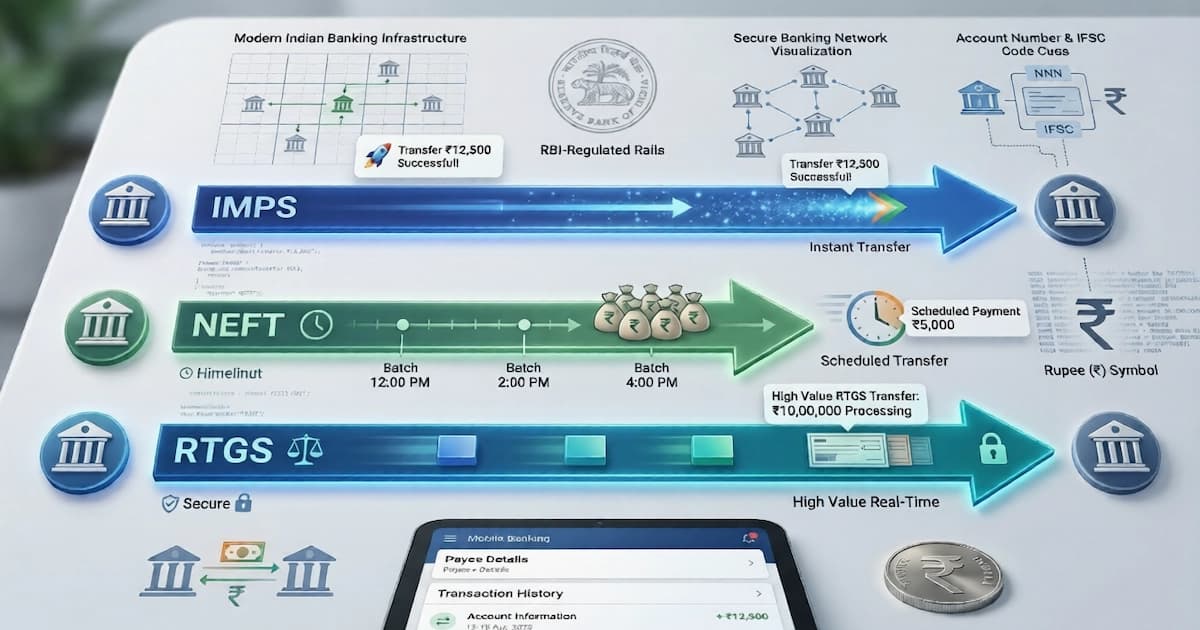
RBI sets no maximum on NEFT and caps RTGS charges at Rs 25 and Rs 50. What each rail costs, how fast it credits, and where bank caps quietly replace RBI rules.
19 min read
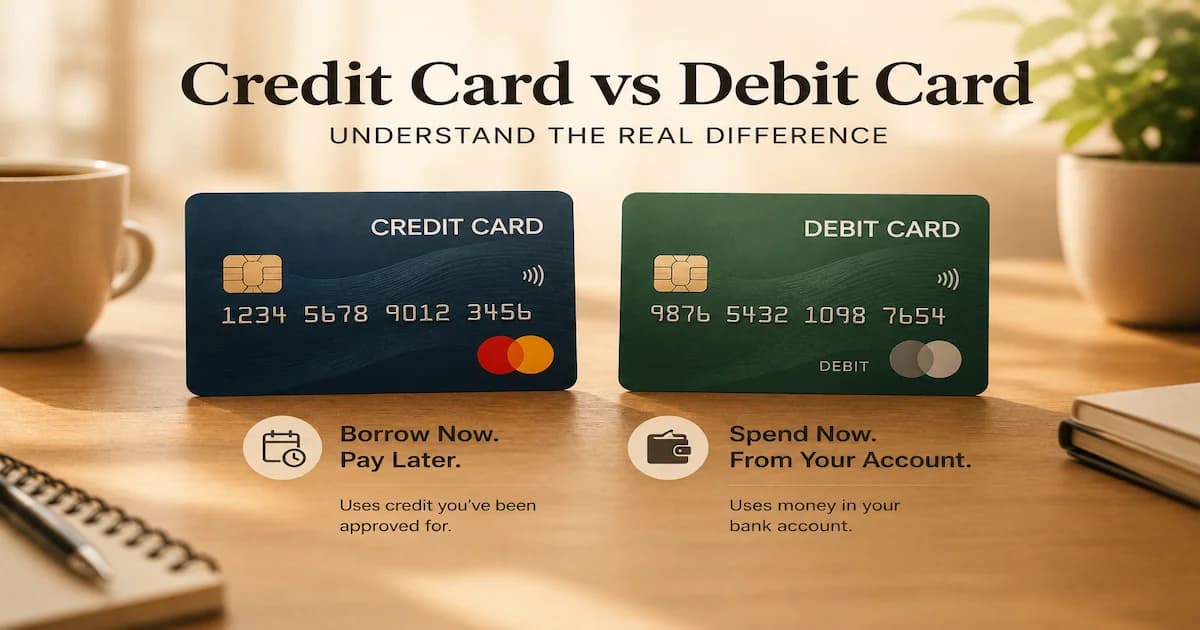
A debit card spends your money, a credit card borrows. How that changes fraud liability under RBI and US law, credit building, disputes, and merchant holds.
23 min read
What your bank can charge and what it cannot: RBI's Rs 23 ATM cap, the free-transaction rules most pages get wrong, and US averages from Bankrate 2025.
17 min read