IMPS vs NEFT vs RTGS: The Limits and Charges RBI Sets

By Tapabrata Biswas · Updated July 19, 2026 · 19 min read
Researched with AI assistance, reviewed and edited by Tapabrata Biswas.
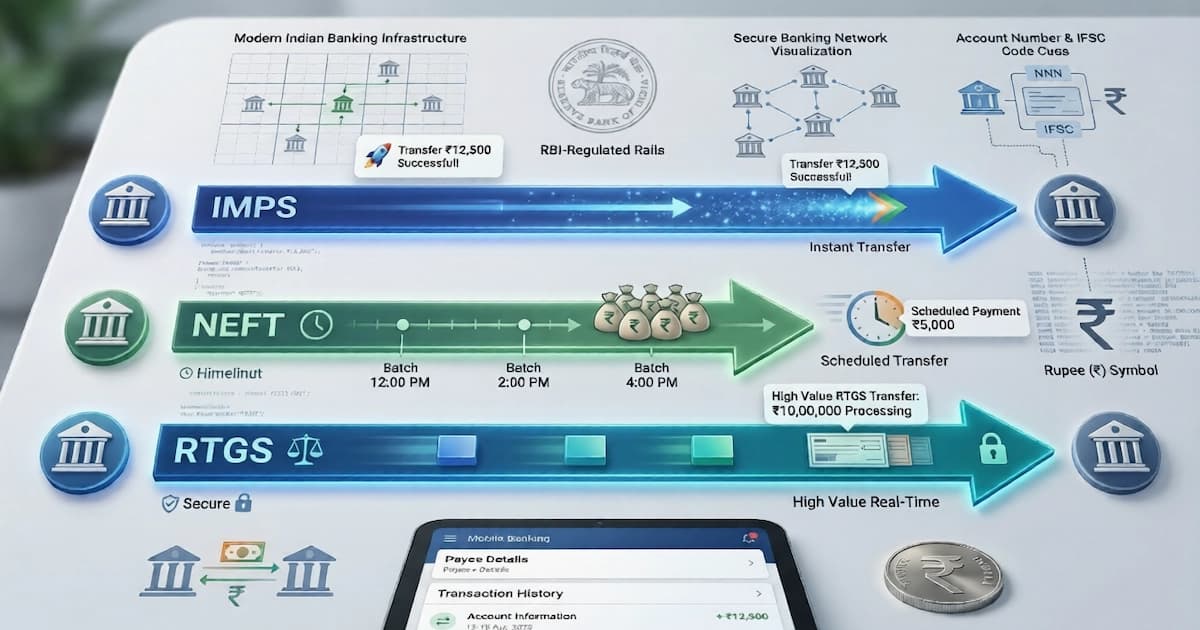
RBI answers the most-searched question about NEFT in a single sentence: "there is no limit imposed by the RBI for funds transfer through NEFT system."
Several pages ranking on page one say otherwise. Two of the largest state a ₹1 crore ceiling that kicks in after 7 PM and at weekends. One broker's help page gives NEFT a maximum of ₹50,000. A bank's own page, stamped with today's date, caps NEFT at ₹2 lakh. None of them is right, and none links to the regulator that would settle it.
We read fourteen pages ranking for these terms. Not one cites RBI's NEFT FAQ or its RTGS FAQ. Every meaningful number on this topic is set by the Reserve Bank of India and published free on its website, and the entire first page of results states those numbers from memory.
The most repeated error is about money. Almost every page tells you online NEFT and RTGS both became free in January 2020. RBI's waiver circular covers NEFT alone.
What follows works from the source documents: what each rail is, which limits are RBI's and which are your bank's, how fast each credits and what happens when one doesn't, what banks may charge, and why IMPS pricing behaves so differently.
What are IMPS, NEFT and RTGS?
NEFT, RTGS and IMPS are three inter-bank transfer systems that all move money using the recipient's account number and IFSC code, but differ in who operates them and how they settle. That ownership split explains more than any speed comparison does.
NEFT, the National Electronic Funds Transfer system, is an RBI-operated batch settlement system. Transfers queue and settle in groups at fixed intervals. RBI's circular of 6 December 2019 moved it to round-the-clock operation from 16 December 2019 and specified the mechanism precisely: there are 48 half-hourly batches every day. NEFT is also credit-push only, so a transaction can be originated by the sender alone.
RTGS, Real Time Gross Settlement, is an RBI-operated system that settles each transaction individually and immediately. In RBI's own words, real time means the processing of instructions at the time they are received, and gross settlement means the settlement of funds transfer instructions occurs individually, without netting. Because settlement happens in RBI's own books, the payments are final and irrevocable. It carries a ₹2,00,000 minimum with no upper ceiling.
RTGS has been available 24x7x365 since 14 December 2020, with one caveat almost nobody reproduces. RBI's circular says round the clock "except for the interval between 'end-of-day' and 'start-of-day' processes." There is a daily gap. NEFT's 48-batch cycle describes none.
IMPS, the Immediate Payment Service, is operated by the National Payments Corporation of India. It settles individually and instantly, runs around the clock, and caps at ₹5 lakh per transaction. RBI's own description calls it an important payment system providing 24x7 instant domestic funds transfer, accessible through internet banking, mobile apps, branches, ATMs, SMS and IVRS, with SMS and IVRS capped far lower at ₹5,000.
The ₹5 lakh ceiling arrived in October 2021, up from ₹2 lakh, and hasn't moved since. Reports suggesting otherwise are usually describing UPI: the ₹5 lakh and ₹10 lakh increases effective 15 September 2025 belong to that system, and conflating the two is the most common error in current coverage.
Keep the operator in mind. It turns out to determine what you pay.
Is there a maximum limit on NEFT?
RBI imposes no maximum on NEFT transfers. The FAQ puts it plainly, then adds the part that explains everyone's confusion: a member bank may place amount limits based on its own risk perception with the approval of its Board.
Two figures get mistaken for a ceiling. The first is ₹50,000, which is real but applies to cash remittances by people who don't hold an account with the bank. Someone walking into a branch with cash meets that cap. Someone transferring from their own account never does. At least one help page in the top five has converted this into a flat "NEFT maximum: ₹50,000."
The second is ₹1 crore, and it's more interesting because it isn't invented. Banks set their own internet-banking limits and ₹1 crore is a common one. What's wrong is the attribution. Two high-ranking pages present it as a property of NEFT that activates outside business hours, which would be strange behaviour for a system running 48 identical batches a day.
RTGS is the one place RBI sets a hard number, and it sets a floor. Below ₹2,00,000 the rail simply isn't available to you.
How fast does each rail credit, and what if it doesn't?
RBI requires the beneficiary bank to credit an RTGS transfer within 30 minutes of receiving the funds transfer message. That obligation sits in RBI's RTGS FAQ, and none of the fourteen ranking pages we read mentions it. Most compress RTGS to "real-time" or "immediate," which describes what happens between the banks and says nothing about when the recipient sees the money.
NEFT works on the batch clock. With 48 half-hourly batches a day, a transfer submitted at 10:14 AM joins the 10:30 AM batch, and RBI's two-hour expectation starts at that settlement.
The part worth knowing is what happens when it fails, which almost no page covers. If the destination bank can't credit the account, RBI requires it to return the transaction to the originating branch within two hours of the batch completing. And if it neither credits nor returns inside that window, the bank is liable to pay the affected customer penal interest at the current RBI repo rate plus two percent for the period of the delay. RBI's wording is emphatic on the mechanism: this is owed without waiting for a specific claim to be lodged by the customer.
That penal-interest rule is documented for NEFT. We found no equivalent clause in the RTGS FAQ, so it shouldn't be assumed to extend there.
| IMPS | NEFT | RTGS | |
|---|---|---|---|
| Operator | NPCI | RBI | RBI |
| Settlement | Individual, instant | 48 half-hourly batches daily | Individual, real time, no netting |
| Minimum | None | None | ₹2,00,000 |
| Maximum | ₹5 lakh | None set by RBI | None |
| Round the clock | Yes | Yes, since 16 Dec 2019 | Since 14 Dec 2020, apart from the daily EOD to SOD interval |
| Credit deadline | Seconds in practice | Two hours from batch settlement | 30 minutes, mandated |
| Penal interest for delay | Not found in RBI documents | Repo rate plus 2% | Not found in RBI documents |
| Charge ceiling published by RBI | No | Yes | Yes |
Are NEFT and RTGS actually free online?
NEFT is free online for savings account holders. RTGS carries no equivalent mandate. This is where nearly every page on the topic goes wrong, including the earlier version of this one.
RBI's circular of 16 December 2019 says member banks shall not levy any charges from their savings bank account holders for funds transfers done through the NEFT system which are initiated online, meaning internet banking or the bank's mobile app, effective 1 January 2020. Three limits are built into that sentence. It names NEFT and never mentions RTGS. It covers savings accounts, so current accounts fall outside. And it covers online initiation, so the same customer walking into a branch can still be charged.
The confusion has a plausible source. A separate circular of 11 June 2019 waived the processing and time-varying charges that RBI itself levies on banks for RTGS and NEFT from 1 July 2019, and asked banks to pass the benefit to customers. Banks were advised, and advice binds nobody.
For other outward transactions RBI publishes ceilings, not prices.
| Transfer | Maximum a bank may charge |
|---|---|
| NEFT up to ₹10,000 | ₹2.50 plus GST |
| NEFT above ₹10,000 to ₹1 lakh | ₹5 plus GST |
| NEFT above ₹1 lakh to ₹2 lakh | ₹15 plus GST |
| NEFT above ₹2 lakh | ₹25 plus GST |
| RTGS ₹2 lakh to ₹5 lakh | ₹25, exclusive of tax |
| RTGS above ₹5 lakh | ₹50, exclusive of tax |
| Inward NEFT or RTGS | Nil |
RBI states that banks may decide to charge a lower rate but cannot charge more than the rates prescribed. Two errors follow from reading these as prices. The figures ₹24.50 and ₹49.50 circulate everywhere and get attributed to RBI; they are bank pricing sitting just under the ceiling. And one major payments blog lists RTGS charges of ₹30 and ₹55, both above what RBI permits.
A worked case. Sending ₹3 lakh from a savings account through internet banking costs nothing on NEFT, under the January 2020 waiver. The same ₹3 lakh at a branch counter costs at most ₹25 plus GST on NEFT, and an RTGS transfer of that size costs at most ₹25 exclusive of tax whichever channel you use. The spread between the cheapest and dearest option here comes to roughly ₹30, which matters mainly because so much writing implies the choice is financially significant. Speed is the real variable.
Why do IMPS charges differ at every bank?
RBI publishes charge ceilings for NEFT and RTGS and publishes none for IMPS, because IMPS belongs to NPCI. This single fact explains the mess in every IMPS fee table you'll find, and no page we read connects the two.
Around eight of the fourteen ranking pages carry a table row naming each rail's operator. None draws the conclusion. RBI publishes no consumer FAQ for IMPS at all: its payment systems FAQ index lists NEFT, RTGS, UPI-PayNow and cheque clearing, and IMPS is absent. RBI regulates it; NPCI operates and documents it.
Without a ceiling to converge on, each bank publishes its own IMPS tariff. Comparison pages stating "IMPS costs ₹5 to ₹20" or "₹2.50 to ₹25" or "₹2.50 to ₹15" are each describing a different sample of banks, and one publisher gives two of those three ranges on two of its own pages.
The bank's own tariff is what a reader can rely on. ICICI Bank's IMPS charges for savings accounts, effective 1 July 2025, begin at ₹2.5 plus GST for the smallest slab and rise with transfer size, while the same page states that NEFT and RTGS initiated through online modes are nil. That contrast, on one bank's page, is the whole regulatory story in miniature. It's also the kind of source none of the fourteen ranking pages cites once: not one names a single actual bank's actual published limit or fee.
Can you check the recipient's name before sending?
Since 1 April 2025, banks have been required to offer free beneficiary name look-up on NEFT and RTGS. RBI's circular of 30 December 2024 observed that UPI and IMPS already let a remitter verify the beneficiary's name before initiating a transfer, and directed NPCI to build the same facility for RTGS and NEFT and onboard all banks no later than that date.
The facility pulls the beneficiary's account name from the destination bank's core banking system using the account number and IFSC. RBI mandated that it reach customers without any charge, and specified that NPCI shall store no data relating to it. Where the name can't be displayed, the remitter may still proceed at their own discretion.
This matters because of how these rails have always worked. Credit is released on the account number, and a valid account number belonging to the wrong person still gets paid. Name look-up is the first structural check against that on NEFT and RTGS. Both of RBI's FAQ pages predate the circular, the RTGS one having last been updated in October 2022 and the NEFT one in September 2024, so neither mentions the facility.
What the volumes say about who uses what
RBI's Payment System Indicators for May 2026 give each rail's real shape, and one trend runs against the usual telling.
| Rail | Volume, May 2026 | Value, May 2026 | Average ticket |
|---|---|---|---|
| RTGS | 31.5 crore | ₹1,86,18,676 crore | About ₹59.0 lakh |
| NEFT | 85.0 crore | ₹42,32,611 crore | About ₹4.98 lakh |
| IMPS | 35.8 crore | ₹6,95,701 crore | About ₹1.94 lakh |
RTGS moves roughly 4.4 times NEFT's value on about a twenty-seventh of its volume, which is the large-value split stated in one line.
IMPS is the interesting one. Against May 2025, its volume fell 22.8% while its value rose 8.6%. Fewer transfers, each substantially larger. That's consistent with UPI absorbing small-ticket payments from beneath while IMPS keeps the bracket above UPI's ₹1 lakh standard cap. The rail isn't fading so much as being squeezed upward into a narrower job.
How does this compare with the US?
The American high-value real-time system keeps business hours, and India's runs around the clock. That inverts the assumption most readers carry.
The Fedwire Funds Service is the closest analogue to RTGS, a real-time gross settlement system whose transfers the Federal Reserve describes as immediate, final and irrevocable once processed. Its business day runs from 9:00 p.m. ET on the preceding calendar day through 7:00 p.m. ET, Monday through Friday, excluding designated holidays, with a 6:45 p.m. ET deadline for initiating third-party transfers. India's RTGS has run 24x7x365 since December 2020.
The FedNow Service is the Federal Reserve's instant payment infrastructure and it does run around the clock, every day of the year, which puts it closer to IMPS in role. The broader point for anyone moving between the two countries: India's real-time payment infrastructure isn't a developing-market approximation of the American one. On availability, the Indian systems went first.
What this post deliberately does not cover
This explains how three payment systems work. It doesn't tell anyone which to use for their money, and the comparison table describes the rails without ranking them.
It leaves out per-bank transfer limits beyond the illustrative ones, because every bank sets its own across internet banking, mobile and branch channels, and any list would be stale within a month. A bank's own charges and limits page is the only reliable source for its numbers.
It doesn't cover UPI in depth, which has its own explainer, nor the account fees sitting alongside transfer charges, covered in our bank fees post. The broader Pillar 9 map is in banking basics explained.
Two limits on our own sourcing are worth stating. NPCI's website blocked every attempt to retrieve its IMPS circulars, across several methods, so the ₹5 lakh cap and the October 2021 increase are reported here from RBI's press release and banks' published tariffs, and we've flagged that instead of implying a primary citation we don't have. And on IMPS charges we can say only that RBI publishes no ceiling we could locate, which is a narrower claim than saying none exists.
Frequently asked questions
What is the difference between IMPS, NEFT and RTGS? They differ in who runs them, how they settle, and what they cost. NEFT and RTGS are operated by the Reserve Bank of India. IMPS is operated by the National Payments Corporation of India. NEFT settles in batches, 48 half-hourly batches a day, so a transfer waits for the next one. RTGS settles each transaction individually and in real time, which is why it carries a Rs 2,00,000 minimum and is built for high-value payments. IMPS settles individually and instantly with a Rs 5 lakh cap. The ownership split drives the pricing split: RBI caps what a bank may charge for NEFT and RTGS, and publishes no equivalent ceiling for IMPS, which leaves each bank to set its own.
Is there a maximum limit on NEFT? Not from RBI. Its NEFT FAQ answers the question in one sentence: there is no limit imposed by the RBI for funds transfer through the NEFT system. Two figures get mistaken for a NEFT ceiling. The first is Rs 50,000, the cap on cash remittances by people who do not hold an account with the bank, which has nothing to do with transfers from an account you own. The second is Rs 1 crore, which several ranking pages present as a NEFT rule applying after 7 PM or at weekends. That figure is an individual bank's internet-banking cap. RBI's own FAQ says a member bank may place amount limits based on its own risk perception with the approval of its Board, so the ceiling you actually hit comes from your bank.
Are NEFT and RTGS free online? NEFT is, for savings account holders. RTGS has no equivalent mandate, and this is the most repeated error on the topic. RBI's circular of 16 December 2019 states that member banks shall not levy any charges from their savings bank account holders for funds transfers done through NEFT which are initiated online, effective 1 January 2020. The word RTGS does not appear in that operative paragraph, and current accounts are not covered either. What RBI did for RTGS was separate: from 1 July 2019 it waived the processing charges it levies on banks, and advised banks to pass the benefit on. Advice is not a mandate, so an RTGS transfer can still carry a charge up to RBI's ceiling.
How long does each transfer take to credit? IMPS credits in seconds. RTGS is bound by a regulatory deadline few explainers mention: RBI states the beneficiary bank must credit the beneficiary's account within 30 minutes of receiving the funds transfer message. NEFT depends on the batch. The system runs 48 half-hourly batches every day, and RBI says a timeline of two hours from the batch settlement can be expected. A NEFT transfer submitted at 10:14 AM enters the 10:30 AM batch, and the two-hour clock starts at that settlement. If the destination bank cannot credit the account it must return the transaction within two hours of the batch completing, and if it does neither, RBI requires it to pay the customer penal interest at the repo rate plus two percent for the period of delay.
What do NEFT and RTGS cost? Inward transactions are free on both. For other outward NEFT transactions RBI caps the charge at Rs 2.50 up to Rs 10,000, Rs 5 above Rs 10,000 and up to Rs 1 lakh, Rs 15 above Rs 1 lakh and up to Rs 2 lakh, and Rs 25 above Rs 2 lakh, each plus applicable GST. For RTGS the ceilings are Rs 25 for transfers of Rs 2 lakh to Rs 5 lakh and Rs 50 above Rs 5 lakh, exclusive of tax. RBI states that banks may decide to charge a lower rate but cannot charge more than the rates prescribed. These are maximums, not prices, which is why the figures Rs 24.50 and Rs 49.50 circulate so widely: they are bank pricing sitting just under the ceiling, and they get misattributed to RBI itself.
Why do IMPS charges differ from bank to bank? Because RBI publishes no ceiling for them. NEFT and RTGS are RBI's own systems, so RBI sets the maximum a bank may charge. IMPS belongs to NPCI, RBI publishes no consumer FAQ for it and no equivalent charge cap, and each bank sets its own tariff. The result is visible on the banks' own pages: ICICI Bank's savings account IMPS charges, effective 1 July 2025, start at Rs 2.5 plus GST for the smallest slab and rise with transfer size, while its NEFT and RTGS charges through online modes are nil. Comparison pages state a single IMPS fee range as though it were a rule, and the ranges they publish contradict one another because no underlying rule exists for them to converge on.
Can you check the beneficiary's name before sending a NEFT or RTGS transfer? Yes, since 1 April 2025, and it costs nothing. RBI's circular of 30 December 2024 noted that UPI and IMPS already let a remitter verify the beneficiary's name before sending, and directed NPCI to build the same facility for RTGS and NEFT, with all member banks onboarded no later than 1 April 2025. The facility fetches the beneficiary's account name from the destination bank's core banking system using the account number and IFSC, and RBI mandated that it be made available to customers without any charge. NPCI stores no data from it. If the name cannot be displayed for any reason, the remitter can still proceed at their own discretion.
Sources
-
Reserve Bank of India, NEFT System, Frequently Asked Questions, updated 2 September 2024 (no RBI limit on NEFT, the Rs 50,000 cash-remittance cap, 48 half-hourly batches, charge slabs, the two-hour return rule and repo-plus-two-percent penal interest) rbi.org.in
-
Reserve Bank of India, RTGS System, Frequently Asked Questions, updated 31 October 2022 (the Rs 2,00,000 minimum with no ceiling, 24x7 from 14 December 2020, the 30-minute credit obligation and the RTGS charge caps) rbi.org.in
-
Reserve Bank of India, Availability of NEFT System on 24x7 basis, 6 December 2019 (the 16 December 2019 start date and the 48-batch cycle) rbi.org.in
-
Reserve Bank of India, 24x7 Availability of RTGS System, 4 December 2020 (round-the-clock operation apart from the end-of-day to start-of-day interval) rbi.org.in
-
Reserve Bank of India, Furthering Digital Payments, Waiver of Charges, NEFT System, 16 December 2019 (the waiver is NEFT, savings accounts and online initiation only, effective 1 January 2020) rbi.org.in
-
Reserve Bank of India, Rationalisation of NEFT and RTGS charges, 11 June 2019 (RBI waived its own charges on banks from 1 July 2019 and advised pass-through) rbi.org.in
-
Reserve Bank of India, Beneficiary bank account name look-up facility for RTGS and NEFT, 30 December 2024 (free name verification, all banks onboarded by 1 April 2025, no data stored by NPCI) rbi.org.in
-
Reserve Bank of India, Statement on Developmental and Regulatory Policies, 8 October 2021 (the IMPS per-transaction limit raised from Rs 2 lakh to Rs 5 lakh for channels other than SMS and IVRS) rbi.org.in
-
Reserve Bank of India, Payment System Indicators, May 2026, provisional (volumes, values and the IMPS year-on-year movement) rbi.org.in
-
ICICI Bank, IMPS, NEFT and RTGS charges, limits and timings (IMPS savings slabs effective 1 July 2025, and nil online NEFT and RTGS charges) icici.bank.in
-
Federal Reserve Board, Fedwire Funds Service (real-time gross settlement, and the Monday to Friday business day) federalreserve.gov
-
Federal Reserve Financial Services, About the FedNow Service (instant payments around the clock, every day of the year) frbservices.org



You might also like

UPI explained: what it is, the current limits and who gets the higher ones, why it is free, who pays for that, and what the August 2026 MDR Bill would change.
20 min read
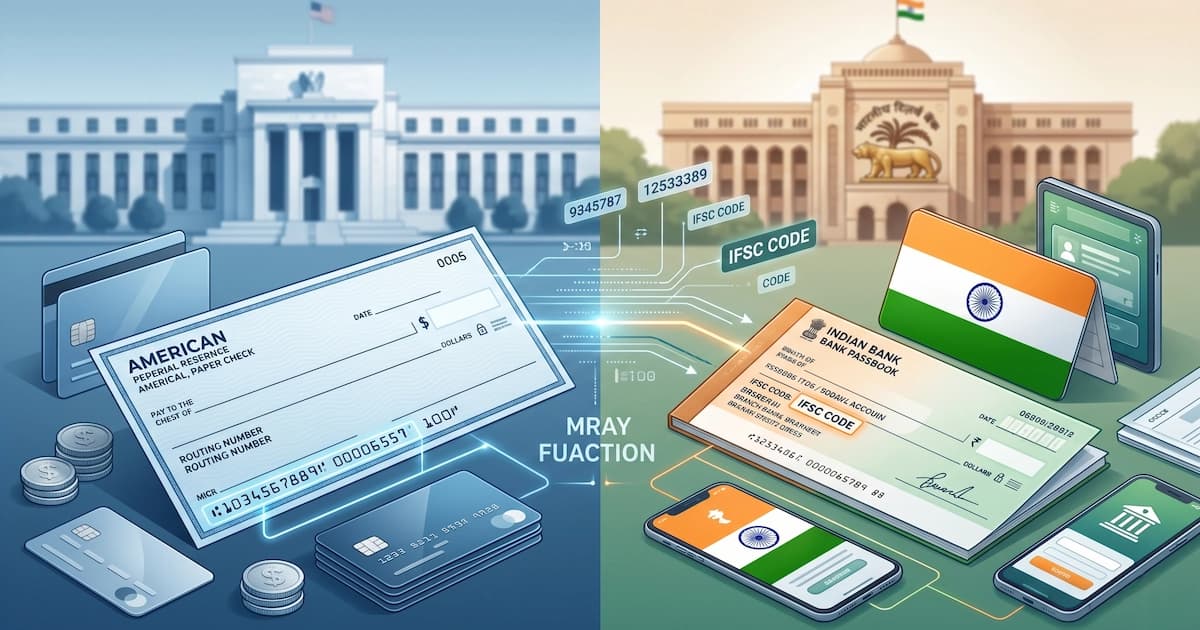
India has no routing number. How IFSC, ABA routing numbers and SWIFT differ, how to check a code is valid before you use it, and what happens when it is wrong.
18 min read

What your bank can charge and what it cannot: RBI's Rs 23 ATM cap, the free-transaction rules most pages get wrong, and US averages from Bankrate 2025.
17 min read