What Is a Money Market Account? Rates and the India Gap

By Tapabrata Biswas · Published May 23, 2026 · 13 min read
Researched with AI assistance, reviewed and edited by Tapabrata Biswas.
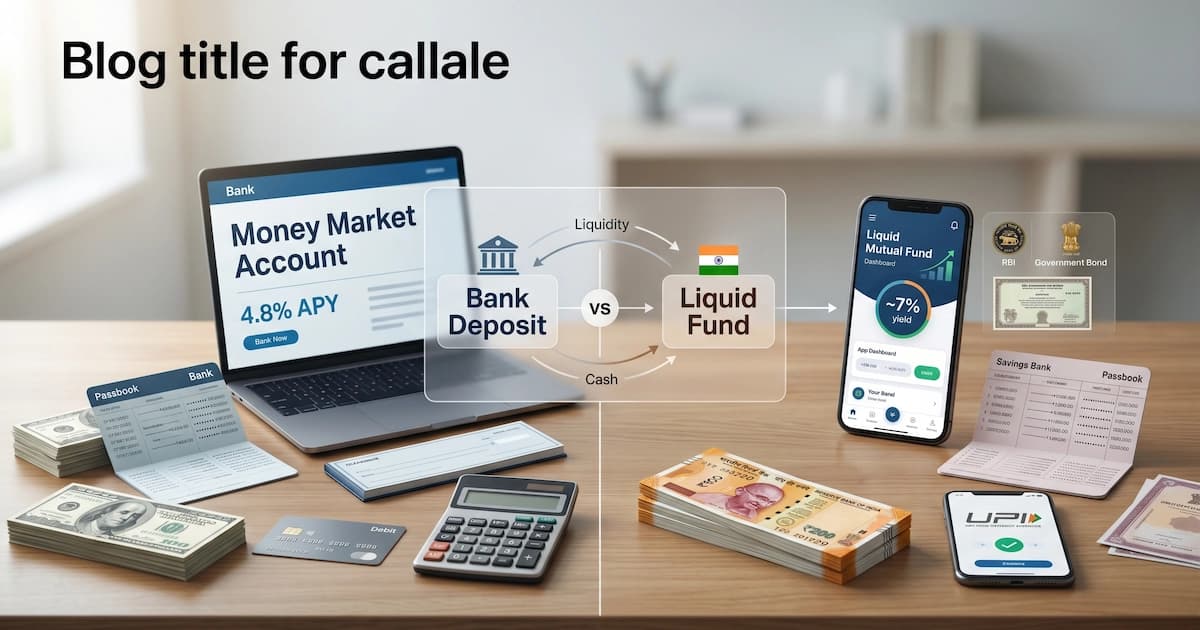
The average US money market account paid 0.66% APY in Q4 2025 per the FDIC weekly national rate survey, but top online MMAs paid 4.5-5.0% APY, a 7-8× gap on the same product depending on which bank you opened the account at. The product was created in 1982 as the US banking industry's regulatory response to competition from money market mutual funds, which had grown from $4 billion in 1977 to $230 billion by 1982 by offering depositors higher yields than the then-regulated savings-account interest cap. The Garn-St. Germain Depository Institutions Act of 1982 authorized banks to offer money market deposit accounts (MMDAs) with cheque-writing privileges and no rate cap, immediately bringing depositors back. Four decades later, MMAs remain a useful but increasingly niche product: most of what they originally offered is now also available via high-yield savings accounts at comparable rates.
This post covers what an MMA actually is, how it differs from money market mutual funds, the situations where an MMA still makes sense over a HYSA, why India's banking system doesn't have a direct equivalent, and what the liquid mutual fund category does instead.
What a money market account actually is
A money market account (MMA), also called a money market deposit account (MMDA), is a US bank deposit account that combines features of savings and checking accounts. The defining properties:
Higher interest than standard savings. Top online MMAs in Q1 2026 paid 4.5-5.0% APY, comparable to high-yield savings accounts and substantially above the 0.46% national average savings rate. Traditional brick-and-mortar bank MMAs pay closer to the 0.66% national MMA average, the gap between online and traditional banks is wider on MMAs than on most other deposit products.
Limited cheque writing. MMAs typically allow 3-6 cheques per month, payable to third parties, a feature that historically distinguished MMAs from savings accounts, which generally did not offer cheque privileges. The feature has become less differentiating since most banks now offer linked-account flexibility.
Debit card access. Most MMAs come with a debit card linked directly to the account, usable for purchases and ATM withdrawals, though many banks impose monthly transaction limits (often 6 per month, historically tied to the Regulation D limit that was suspended in April 2020).
Higher minimum balance. MMAs typically require $1,000-25,000 minimum balance to open and to avoid fees, compared with $0-100 for many savings and checking accounts. The minimum is the trade-off for the higher interest rate.
FDIC insurance. MMAs are FDIC-insured up to $250,000 per depositor per insured bank per ownership category: identical coverage to savings, checking, and CDs. See FDIC vs DICGC deposit insurance explained for the full coverage rules.
The structural pitch of an MMA: savings-account safety + slightly more checking-account flexibility + interest rate above typical savings, in exchange for a higher balance commitment.
Money market account vs money market mutual fund: completely different products
The names are similar enough to cause regular confusion. They are not the same thing:
| Feature | Money Market Account (MMA) | Money Market Mutual Fund (MMF) |
|---|---|---|
| Product type | Bank deposit account | Investment fund |
| Provider | Banks (Marcus, Ally, Discover, Vio Bank) | Mutual fund companies (Vanguard, Fidelity, Schwab) |
| Insurance | FDIC up to $250,000 | SIPC against broker failure only (not investment loss) |
| Yield basis | Fixed APY set by bank, adjusted periodically | Floating yield based on underlying short-term debt portfolio |
| Typical yield (Q1 2026) | 4.5-5.0% APY at top online banks | 4.8-5.3% on prime MMFs, 4.4-4.9% on Treasury MMFs |
| Minimum balance | $1,000-25,000 typically | $0-3,000 typically; some institutional funds $1M+ |
| Cheque writing | Usually 3-6/month | Rarely available on retail funds |
| Settlement | Instant within bank | T+1 (one business day) for redemptions |
| Tax treatment | Interest taxed as ordinary income | Same; some Treasury MMFs are state-tax-exempt on Treasury interest |
| Risk | Bank failure (mitigated by FDIC) | Underlying portfolio mark-to-market risk; "breaking the buck" historically rare (2008 Reserve Primary Fund) |
The key difference: an MMA is a deposit (a loan from you to the bank, FDIC-insured against bank failure). An MMF is an investment (a stake in a portfolio of short-term debt securities, not insured against investment loss but stable in practice due to short maturities and high credit quality).
For most everyday savers, the choice depends on where the money already is. If you have a brokerage account and are looking for a place to park idle cash earning interest, an MMF is often the most convenient choice. If you have a bank account and want to upgrade your idle savings to a higher-yield product, an MMA or HYSA is the bank-side equivalent.
Current Q1 2026 MMA rates compared
The rate range within MMAs is wide enough that bank choice matters more than the product choice between MMA and HYSA.
| Bank | MMA APY (Q1 2026) | Minimum balance | Cheque writing |
|---|---|---|---|
| Discover Bank Money Market | 4.30% | $2,500 | Yes (up to 6/month) |
| Ally Bank Money Market | 4.20% | None | Yes |
| Vio Bank Cornerstone MM | 5.10% | $100 | No |
| UFB Direct Premier Savings (functions as MMA) | 5.00% | None | No |
| Quontic Bank Money Market | 5.00% | $100 | Yes |
| Sallie Mae Bank Money Market | 4.65% | None | Yes |
| Synchrony Bank Money Market | 2.25% | None | Yes |
| Bank of America Advantage Savings | 0.04% | $100 | No |
| Chase Premier Savings | 0.02% | $15,000 | No |
| Wells Fargo Platinum Savings | 2.51% | $25,000 | Yes |
(Source: respective bank websites and FDIC weekly national rates Q1 2026. APYs subject to change.)
The pattern matches HYSAs: online and online-only banks pay materially higher rates than the traditional national banks. A 5% MMA at Vio Bank versus 0.04% at Bank of America is a 125× gap on the same FDIC-insured product. Most of the difference reflects the cost structure: online banks have no branch network to maintain, so they can pass more of the yield to depositors.
Why India doesn't have a direct money market account equivalent
India's banking and mutual-fund regulations split the role that MMAs play in the US into two separate product categories:
Banking side: regular savings accounts pay 3-4% (sometimes up to 7% at small finance banks and IDFC FIRST/Bandhan in tiered structures), with full liquidity, cheque writing, debit card, UPI, IMPS, and NEFT all included. The "savings account doing checking + savings duty" structure means there's no product gap to fill with an MMA-like hybrid.
Mutual fund side: liquid mutual funds invest in money-market instruments with maturity under 91 days. As of Q1 2026, liquid funds typically yield 6.5-7.5% pre-tax, offer instant redemption up to ₹50,000 per day (under SEBI's 'insta-redemption' framework) and T+1 redemption for any amount, and are considered very low risk among mutual fund categories.
Common Indian liquid funds and their structural mechanics:
| Liquid fund | Typical 1-year yield (Q1 2026) | Redemption | Insta-redeem cap |
|---|---|---|---|
| HDFC Liquid Fund | 7.1% | T+1 standard, instant via app | ₹50,000/day |
| ICICI Prudential Liquid Fund | 7.0% | T+1 standard, instant via app | ₹50,000/day |
| Aditya Birla Sun Life Liquid Fund | 7.0% | T+1 standard, instant via app | ₹50,000/day |
| SBI Liquid Fund | 6.9% | T+1 standard, instant via app | ₹50,000/day |
| Kotak Liquid Fund | 7.0% | T+1 standard, instant via app | ₹50,000/day |
The Indian "MMA-equivalent stack" for a saver wanting higher yield with high liquidity:
- Savings account at IDFC FIRST or Bandhan (tiered 6-7% on certain balance bands) for daily-transaction liquidity
- Liquid mutual fund for any amount above the savings-account interest sweet spot, redeem instantly when needed for amounts under ₹50K or T+1 for larger amounts
- Sweep FD (an auto-sweep facility offered by many Indian banks, which parks the excess in the fixed deposit you would otherwise have booked by hand: excess savings balance above a threshold automatically converts to short-tenure FD earning higher interest, reverses back when checking balance is short) as a third hybrid option
The two-product or three-product solution covers the same use cases as the US single-product MMA, with the advantage that the underlying yields are typically higher than US deposit rates.
When to choose an MMA versus a HYSA: the actual decision
For US savers, MMAs and HYSAs overlap substantially. The decision tree:
Pick an MMA if:
- You want cheque-writing capability on the savings balance (HYSAs typically don't offer cheques)
- You have a significant balance ($10,000+) and find a tiered MMA paying higher above a band
- You're holding a known short-to-medium-term obligation (down payment fund, tax reserve, college bridge fund) where occasional cheque payments might be needed
- The MMA at your existing bank has comparable rates to top HYSAs, saving you from opening a new account
Pick a HYSA if:
- You want the simplest possible setup: no minimum balance, no cheque book, just a higher-yield savings account
- You won't need cheque writing from the savings account itself
- The HYSA rate matches or beats available MMA rates at your balance band
- You'd rather link the savings to existing checking for the rare cases where you need to move money out
In practice, the top online HYSAs (Marcus, Ally, Discover) and top online MMAs (Vio Bank, Quontic, UFB) pay similar enough rates that the choice often comes down to which bank's account-opening experience you prefer. See what is a high-yield savings account for the HYSA mechanics in detail.
A worked example: when MMA tiered rates beat HYSAs
Take a household with $50,000 in cash savings, deciding between an MMA with tiered rates and a flat-rate HYSA:
| Option | APY structure | Annual interest on $50K |
|---|---|---|
| Flat HYSA at 4.4% | 4.4% on entire balance | $2,200 |
| Tiered MMA: 4.0% to $10K, 4.5% to $50K, 4.75% above | 4.0% × $10K + 4.5% × $40K = $400 + $1,800 | $2,200 |
| Flat MMA at 4.6% above $25K minimum | 4.6% on entire balance | $2,300 |
For $50K, the tiered MMA and the flat HYSA produce identical interest in this example. The flat MMA above a $25K minimum wins by $100/year. For balances above $100K, tiered MMA structures often pull ahead more meaningfully. For balances under $10K, the flat HYSA usually wins because of the lower-minimum-band penalty in MMAs.
The decision is rarely high-stakes: picking either option correctly puts the saver in the 4-5% APY band, which is roughly 10× better than leaving the money in a traditional bank's standard savings account. The marginal optimisation between MMA and HYSA matters far less than the structural decision to move idle cash out of a 0.46% national-average savings account in the first place.
What to actually do with this
Three takeaways:
For US savers: check what your existing bank offers. Many banks offer MMA tiers their customers aren't using. If your bank pays 4.5%+ APY on an MMA you can open in 5 minutes, that's often the lowest-effort path to a yield upgrade. If not, opening a top online HYSA (Marcus, Ally, Discover) or top online MMA (Vio Bank, Quontic) takes the same 20 minutes.
Don't confuse MMA with money market mutual fund. If you have a brokerage account at Fidelity/Schwab/Vanguard, the money market mutual fund there might already be yielding 4.8-5.3% on idle cash: slightly better than the MMA option for that bucket of money. Use the MMA for bank-side funds, the MMF for brokerage-side funds.
For Indian savers: think in terms of liquid mutual funds + tiered savings, not single MMA. A liquid fund at HDFC/ICICI/Kotak yielding 7%+ with T+1 redemption (or insta-redeem up to ₹50K) is the equivalent of an MMA for the higher-yield-with-liquidity use case. Pair it with a savings account at a bank offering tiered rates (IDFC FIRST, Bandhan, Equitas) for the daily-transaction layer. The two-product approach is the structural equivalent of the US single-product MMA.
Frequently asked questions
What is a money market account in simple terms? A money market account (MMA) is a US deposit account that pays higher interest than a typical savings account while allowing limited cheque writing, debit-card use, and ATM access: features usually associated with checking accounts. MMAs are FDIC-insured up to $250,000 per depositor per insured bank per ownership category, identical to savings and checking. Top online MMAs paid 4-5% APY in Q1 2026, comparable to high-yield savings account (HYSA) rates. The two structural differences from a savings account: MMAs usually require a higher minimum balance ($1,000-25,000 versus $0-100 for many savings accounts) and historically allowed limited cheque writing, though the cheque-writing feature has become less of a differentiator since most banks now offer linked-account checking flexibility on savings too.
How is a money market account different from a money market mutual fund? Completely different products despite the similar name. A money market account (MMA) is a bank deposit account, FDIC-insured up to $250,000, pays a fixed APY set by the bank. A money market mutual fund (MMF) is an investment product offered by mutual fund companies (Vanguard, Fidelity, Schwab, etc.) that invests in short-term debt securities (Treasury bills, commercial paper, certificates of deposit). MMFs are NOT FDIC-insured; they're SIPC-protected only against broker failure, not investment loss. MMF yields fluctuate daily based on the underlying portfolio (typically 4-5.3% APY in Q1 2026 for prime funds, slightly lower for government and Treasury MMFs). MMFs usually have no minimum or low minimums ($0-3,000), don't offer cheque writing on most retail funds, and settle redemptions T+1 (one business day).
Does India have an equivalent of a money market account? No direct equivalent. India's banking system doesn't separate 'money market account' as a distinct product class, the role of higher-yield-with-liquidity is filled by liquid mutual funds (e.g., HDFC Liquid Fund, ICICI Prudential Liquid Fund, Aditya Birla Sun Life Liquid Fund). Liquid funds invest in money-market instruments with maturity under 91 days, currently yield 6.5-7.5% before tax, and offer instant or T+1 redemption (₹50,000 instant via 'insta-redemption' under SEBI rules). They're not deposit products, so they're not DICGC-insured, but they're regulated by SEBI and considered low-risk. A larger Indian saver looking for the US MMA equivalent typically holds a high-yield savings account (3-4%) for daily liquidity plus a liquid fund (6.5-7.5%) for the higher-yield bucket, a two-product solution to what's a single-product solution in the US.
When should I choose an MMA over a high-yield savings account? Three scenarios where an MMA is structurally better: First, if you want cheque-writing capability on the savings balance (most HYSAs don't offer cheques; MMAs typically do). Second, if you're holding a significant balance: some MMAs pay tiered rates that beat HYSAs at higher balance bands (e.g., 4.75% APY above $25,000 vs a flat 4.4% HYSA). Third, if you want a separate account specifically for short-to-medium-term obligations (down payment fund, tax reserve, kid's college fund-of-the-next-2-years) where cheque writing might be useful. For the typical use case, high-yield savings on idle cash, a HYSA at the same APY is usually simpler with no minimum balance trap. See our piece on high-yield savings for the comparison.
Sources
- Reserve Bank of India, Master Direction on Interest Rates on Deposits: rbi.org.in
- Securities and Exchange Board of India (SEBI), Regulations on Liquid Mutual Funds and Insta-Redemption: sebi.gov.in
- Federal Deposit Insurance Corporation (FDIC), Weekly National Rates and Rate Caps: fdic.gov/resources/bankers/national-rates
- US Securities and Exchange Commission, Money Market Funds: investor.gov/introduction-investing/investing-basics/investment-products/mutual-funds-and-exchange-traded-1
- Federal Reserve, Garn-St. Germain Depository Institutions Act of 1982: Money Market Deposit Account Provisions: federalreserve.gov
- Investment Company Institute, Money Market Fund Statistics: ici.org/research/stats/mmf



You might also like
Why RBI makes every Indian bank pay the same rate below Rs 1 lakh, how savings interest is actually calculated, and what DICGC and FDIC really cover.
17 min read

How a high-yield savings account works, why its rate beats a traditional bank's by so much, what to look for, and how the Indian version differs.
12 min read

A checking account is the bank account you use for everyday spending. How it works, the types, what you need to open one, and the fees to watch for.
10 min read