What Is a High-Yield Savings Account: A Plain English Guide

By Tapabrata Biswas · Published May 11, 2026 · 12 min read
Researched with AI assistance, reviewed and edited by Tapabrata Biswas.
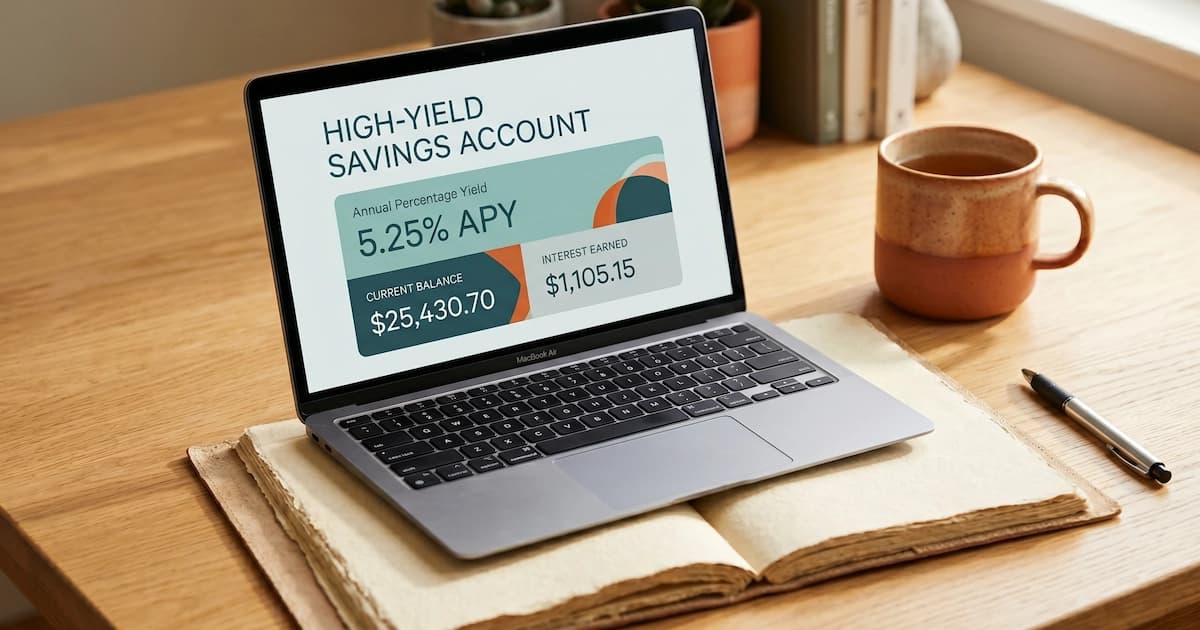
The average traditional U.S. bank savings account paid 0.42% APY in early 2026, according to FDIC data. The average online high-yield savings account paid roughly 4.0%, about 10x more. On a $10,000 balance, the difference is $358/year. On a $25,000 emergency fund, it's $895/year. The two products are functionally identical from the depositor's perspective: same FDIC insurance, same accessibility, same legal structure. The only real difference is which institution holds the deposit and how much overhead that institution carries.
The high-yield savings account is one of the simplest and highest-leverage financial moves available to most households, and the thing most people miss is how easy the switch is. Opening an HYSA takes about 15 minutes online. Linking it to your existing checking takes another 5. The first interest payment lands the next month. The annual difference shows up in the balance for as long as the rate stays competitive.
What is a high-yield savings account?
A high-yield savings account (HYSA) is a savings account that pays a meaningfully higher interest rate than a traditional bank savings account. The "high-yield" qualifier is what distinguishes it from the standard savings account that most traditional banks offer at almost-zero interest rates.
According to Investopedia's overview, an HYSA "is a savings account that pays a substantially higher rate of interest than the national average of a standard savings account." The exact rate gap varies with the broader interest rate environment, but high-yield accounts have reliably offered 5-20x the yield of traditional savings accounts since the category emerged in the early 2000s.
Regular vs high-yield: side by side (US and India)
The mechanics differ slightly between countries: U.S. depositors compare a regular savings account against a true HYSA, while Indian depositors usually compare a savings account against a fixed deposit (FD), which is the closest functional equivalent in terms of yield. A combined view:
| Feature | Regular savings (US) | HYSA (US) | Regular savings (India) | FD-equivalent / sweep (India) |
|---|---|---|---|---|
| Typical rate (2024-26) | 0.01-0.5% APY | 4.0-5.0% APY | 3.0-4.0% p.a. | 6.5-7.25% p.a. |
| Minimum balance | Often $0-$300 | Usually $0 | ₹0-₹10,000 (varies by bank) | ₹1,000-₹10,000 |
| Liquidity | Same-day, unlimited | 1-3 day external transfer; unlimited | Same-day, unlimited | Premature withdrawal allowed; small interest penalty |
| Deposit insurance | FDIC: $250,000 per depositor per bank | FDIC: $250,000 per depositor per bank | DICGC: ₹5 lakh per depositor per bank | DICGC: ₹5 lakh per depositor per bank |
| Best for | Day-to-day operating cash | Emergency fund, sinking funds, short-term goals | Day-to-day operating cash | Emergency fund, sinking funds, 1-3 year goals |
Both deposit insurance schemes, FDIC in the U.S. and DICGC in India, are backed by the central banking authority and apply per depositor per bank. Splitting balances across multiple banks is the standard approach for households exceeding either cap.
Three structural features make HYSAs different from traditional bank savings accounts:
The institution is an online-only or online-first bank in most cases: Marcus by Goldman Sachs, Ally, Capital One 360, Wealthfront, Discover, SoFi, Synchrony, American Express, and several others. Some traditional banks also offer competing high-yield products, but the leaders are the online-only ones.
The interest rate is variable, not fixed. It moves with broader market conditions. When the Federal Reserve raises rates, HYSA rates rise alongside (often within weeks). When the Fed cuts, HYSA rates fall. Traditional bank savings accounts often hold their near-zero rate regardless of what the Fed does, which is part of why the gap exists.
The account is functionally identical to a traditional savings account in every other respect: FDIC-insured up to $250,000 per depositor per bank, accessible within a day or two via electronic transfer, fully liquid, no withdrawal penalties.
Why HYSAs pay so much more than traditional banks
The gap exists because of cost structure, not magic.
Traditional brick-and-mortar banks carry significant overhead: branch networks, in-person staff, security, cash handling, vault infrastructure. The cost of running a physical branch network is substantial, and that cost gets recovered from the spread between what the bank pays depositors (very little) and what the bank charges borrowers (much more). For most traditional banks, the savings account is a low-cost funding source that subsidises the branch network.
Online-only banks have dramatically lower overhead. No branch network. Smaller staff. Less physical infrastructure. The same spread between deposits and loans exists, but the bank can afford to pay depositors more because the cost basis is so much lower.
The Federal Reserve's overall interest-rate environment also matters. When the Fed funds rate sits near zero (as it did 2009-2015 and 2020-2022), even high-yield accounts pay 0.5-1%. When the Fed funds target range sits higher, as it has since 2023, high-yield accounts track it upward while traditional accounts barely move from 0.01% to 0.5%. The range was 3.50% to 3.75% when this page was last checked on 22 July 2026, and top high-yield accounts were paying around 4%. The gap widens during higher-rate environments.
The math is structural. Same FDIC insurance. Same federal regulation. Same operational mechanics from the depositor's perspective. Different cost basis at the bank, passed through as different interest rates.
What FDIC insurance actually does (and doesn't)
The most common concern about HYSAs is safety. Are these online banks really safe? Could the money disappear?
The short answer: yes, they're safe, as safe as any traditional bank, provided the account is at an FDIC-insured institution. Every reputable HYSA provider is FDIC-insured. You can verify any specific bank using the FDIC's BankFind tool or the search feature on fdic.gov.
FDIC insurance covers up to $250,000 per depositor per insured bank for the same account type. If a bank fails, the FDIC pays out insured deposits, usually within a few business days, and the depositor doesn't lose principal up to the limit. This is the same federal protection that applies to traditional bank savings accounts.
What FDIC insurance doesn't cover: investments (stocks, bonds, mutual funds), money market mutual funds (different from money market deposit accounts), cryptocurrency, or any product that isn't a deposit at an FDIC-insured bank. If a financial product is described as "FDIC-insured" but the underlying structure isn't a deposit, that claim is misleading and worth investigating before depositing.
For households with more than $250,000 in cash savings (rare but possible), the standard approach is to split across multiple FDIC-insured banks to keep each balance within the insured limit. Some HYSAs (notably Wealthfront and SoFi) use cash sweep programs that automatically distribute deposits across partner banks to provide insurance well above $250,000.
What to look for when choosing a high-yield savings account
Three factors matter most:
APY (annual percentage yield), the actual interest rate, accounting for compounding. Compare APYs head-to-head. The difference between 4.0% and 4.5% on a $20,000 balance is $100/year, meaningful but not enormous. Don't chase the absolute highest APY at the expense of the other factors.
No monthly fees or minimum balance requirements: every leading HYSA in 2026 offers this. If a savings account charges a monthly maintenance fee or requires a minimum balance to earn the advertised rate, look elsewhere.
Transfer experience that fits how you'll use the account: most HYSAs allow electronic transfers to and from any linked external bank account. Transfers take 1-3 business days. Some banks offer faster transfers (instant in some cases) for an additional fee.
Secondary factors that matter for some households:
Sub-account or "bucket" support: some HYSAs (Ally, Capital One 360, Monzo, Chime) allow you to split a single account into named sub-accounts for different savings goals (emergency fund, vacation, down payment, etc.). This makes managing multiple sinking funds and savings goals significantly easier than juggling multiple accounts.
Mobile app quality, a well-designed mobile app makes the account easier to use day to day. The big online banks have solid apps; smaller ones vary.
Other accounts you might use: some banks offer combined HYSA + checking + credit card relationships with rewards or simpler integration.
Top U.S. providers in 2026 (rates and features change; verify current details before choosing): Marcus by Goldman Sachs, Ally, Capital One 360, Wealthfront, Discover, SoFi, Synchrony, American Express Personal Savings, CIT Bank. In India, the closest functional equivalents come from the leading private and small-finance banks running sweep-FD products: IDFC FIRST, RBL, AU Small Finance Bank, Equitas, and Bandhan have offered savings + auto-sweep yields in the 6.5-7.25% range, well above the 3-4% paid on a vanilla savings account at most public-sector banks.
How to actually open one
The mechanics are straightforward and take about 15-30 minutes total.
Pick a provider based on the criteria above. Visit the bank's website. Click "open an account." Enter your name, date of birth, address, Social Security number (required for U.S. tax reporting), and contact info. Verify your identity (the bank pulls a soft credit check that doesn't affect your credit score). Link an external bank account by providing routing and account numbers (or by logging into your existing bank to verify ownership).
Once the account is open, fund it with an initial transfer from your existing checking account. Transfers take 1-3 business days to clear. Set up an automatic recurring transfer (the pay-yourself-first move) to fund the account on each payday going forward.
The whole process takes less time than most people spend choosing a movie to watch. The compounding interest effect compared to a traditional savings account starts the next month.
Common misconceptions about high-yield savings accounts
Three patterns trip people up when first encountering HYSAs.
The first is suspicion that the high rates are "too good to be true." They aren't. The rate gap is structural, fully visible, and explained by overhead differences. Every leading HYSA is FDIC-insured at the same level as traditional banks. The math isn't tricky. It's just a different cost structure passed through to depositors.
The second is treating an HYSA as an investment. It isn't. An HYSA is a savings vehicle: designed for preservation and modest income, not growth. Long-term wealth building still requires investment in productive assets (stocks, bonds, real estate) where expected long-term returns are higher (and volatility is also higher). The HYSA is the right home for emergency funds, sinking funds, and short-term goals, not for retirement money or long-term wealth.
The third is keeping checking-account-sized balances in the HYSA. Some households make the mistake of moving everything to the HYSA, then needing to transfer back to checking constantly. The right approach is to keep operating cash in checking (1-2 months of expenses) and savings in the HYSA. The HYSA pays the higher rate; the checking handles the day-to-day.
What experts say
The FDIC's BankFind tool is the authoritative source for verifying whether any specific bank is FDIC-insured.
The Consumer Financial Protection Bureau's guide to savings accounts covers the basic mechanics of any savings account, including HYSAs.
NerdWallet's HYSA comparison provides up-to-date rate comparisons across major providers.
Investopedia's overview of high-yield accounts covers the conceptual background and rate-environment dynamics.
For the related comparison with checking accounts, see our companion piece on savings vs checking account. For the most common use case, building an emergency fund, see how to build an emergency fund from scratch. To see how the higher APY shortens the time-to-goal on any specific savings target, run the numbers in our savings goal calculator.
Frequently asked questions
What is the simplest definition of a high-yield savings account? A high-yield savings account (HYSA) is a savings account that pays a meaningfully higher interest rate than a traditional bank savings account. Most HYSAs are offered by online-only or online-first banks, which can pass on lower overhead costs as higher interest. As of 2026, leading HYSAs pay around 4% APY versus 0.01-0.5% at most traditional brick-and-mortar banks.
Why do HYSAs pay so much more than traditional savings accounts? Online banks have lower overhead: no branch network, smaller staff, less physical infrastructure. Those savings get passed to depositors as higher interest. Traditional banks treat savings accounts as a low-cost deposit product and use the rate spread (low pay-out, higher loan-out) as a primary profit centre. The math is structural: same FDIC insurance, same federal regulation, very different cost basis.
Is my money safe in a high-yield savings account? Yes, if the account is at an FDIC-insured bank (or NCUA-insured credit union). FDIC insurance covers up to $250,000 per depositor per insured bank for the same account type. Every reputable HYSA provider is FDIC-insured: verify this on the bank's website or via the FDIC's BankFind tool. The same federal protection applies to HYSAs as to traditional bank savings accounts.
How do I choose a high-yield savings account? Three factors matter most: APY (the actual interest rate, ideally 4%+ in 2026), no monthly fees or minimum balance requirements, and a transfer experience that fits how you'll use the account. Secondary factors: sub-account support (named buckets for sinking funds), mobile app quality, and whether the bank offers other accounts you might use. Top providers in 2026 include Marcus by Goldman Sachs, Ally, Capital One 360, Wealthfront, Discover, SoFi, and several others.
In summary
A high-yield savings account pays 5-20x the interest rate of a traditional bank savings account because of structural cost differences (online overhead vs branch network), not because of any difference in safety or accessibility. The same FDIC insurance applies. The money is fully liquid. Opening one takes about 15 minutes online and the rate difference compounds for as long as the account stays open.
The single most useful action this week if you don't have an HYSA: open one tonight at any major provider with no fees and a 4%+ APY (Marcus, Ally, Capital One 360, Wealthfront, Discover all qualify), and move your existing emergency fund and savings into it. Same money, dramatically more interest, no other change required.
Sources
- FDIC, BankFind: banks.data.fdic.gov
- Deposit Insurance and Credit Guarantee Corporation (DICGC), India: dicgc.org.in
- Investopedia, High-Yield Savings Account: investopedia.com/terms/h/high-yield-account.asp
- NerdWallet, Best High-Yield Online Savings Accounts: nerdwallet.com/best/banking/high-yield-online-savings-accounts
- Consumer Financial Protection Bureau, What is a savings account?: consumerfinance.gov/ask-cfpb/what-is-a-savings-account-en-1003


You might also like

Checking vs savings account: checking is for spending, savings is for growing. The interest gap, how much to keep in each, and why most people keep both.
10 min read

How to build an emergency fund from scratch, the four-stage path from $0 to a fully-funded six-month buffer, and what to do at each stage when life interrupts.
11 min read

An emergency fund is savings held apart from goals and investments. What counts as an emergency, and why other money decisions sit on top of it.
10 min read