Checking vs Savings Account: Differences and Which to Use

By Tapabrata Biswas · Updated July 11, 2026 · 10 min read
Researched with AI assistance, reviewed and edited by Tapabrata Biswas.

Almost every US household has both of these accounts. Per the Federal Reserve's 2022 Survey of Consumer Finances, 98.6% of families held a transaction account, with a median balance of $8,000. Yet the difference between the two, and which money belongs in which, trips people up constantly. The short version: a checking account is for spending, a savings account is for growing, and the gap between them is mostly interest.
This is a plain-English comparison of the two, US-focused, covering how they differ, what they have in common, how much to keep in each, and the withdrawal-limit rule that most articles still get wrong. For the standalone definitions, we link to the deeper explainers as we go.
What's the difference between a checking and savings account?
A checking account is built for spending and a savings account is built for growing: checking gives you a debit card and unlimited transactions with almost no interest, while savings pays interest but limits how often you touch it. That single split, spend versus grow, drives every other difference.
| Checking account | Savings account | |
|---|---|---|
| Primary use | Everyday spending | Growing a balance |
| Interest (US avg, June 2026) | 0.07% | 0.38% |
| Debit card | Yes | Usually no |
| Check writing | Yes | Usually no |
| Withdrawal limit | None | Often capped at 6/month by the bank |
| Direct deposit | Yes, the default | Yes, allowed |
| Typical balance | About one month of expenses | Three to six months of expenses |
| FDIC insured | Yes, to $250,000 | Yes, to $250,000 |
The interest figures are the FDIC national averages as of June 2026. For what each account is on its own, see what is a checking account and what is a savings account; here we're staying on the head-to-head.
How big is the interest gap between checking and savings?
The interest gap is the main reason the two accounts exist separately: as of June 2026 the FDIC national average was 0.07% for checking and 0.38% for savings, while top high-yield savings accounts paid around 4% APY per Bankrate's July 2026 roundup. Same money, very different outcomes.
Put $10,000 in each for a year and the spread is stark:
| Where the $10,000 sits | Rate | Interest in a year |
|---|---|---|
| Checking (FDIC avg) | 0.07% | about $7 |
| Savings (FDIC avg) | 0.38% | about $38 |
| High-yield savings | around 4.00% | about $420 |
A high-yield savings account earns roughly 60 times what the average checking account pays on the same balance, and about 11 times the average savings account. That's the whole case for not leaving spare cash in checking: it isn't doing anything there. The mechanics of how those higher rates work, and where to find them, sit in what is a high-yield savings account; this comparison just sizes the gap.
How much should you keep in checking vs savings?
A common rule of thumb keeps about one month of expenses plus a small buffer in checking, and three to six months of expenses in savings as an emergency fund. The point is to cover the bills that clear from checking without leaving a large idle balance there.
Say your monthly costs run $3,500. That points to roughly $3,500 to $4,500 in checking, enough for the month plus a cushion against a mistimed bill, and something like $10,500 to $21,000 in savings for the emergency fund. Anything beyond that cushion is where the "move it somewhere it earns more" logic kicks in. These are general framings; the right numbers depend on your own income, bills, and how steady they are.
Does the six-withdrawal savings limit still apply?
The federal six-withdrawals-per-month rule on savings accounts was suspended in April 2020 and remains suspended, so it is no longer a federal requirement. On 24 April 2020 the Federal Reserve issued an interim final rule that removed the six-transfer cap from the definition of a savings deposit under Regulation D. Most articles still describe it as a hard federal rule, which is out of date.
The catch is the part that matters in practice. The Fed's rule change only permits banks to drop the limit; it doesn't force them to. Plenty of banks still cap savings withdrawals at six per statement cycle and charge an excess-transaction fee, commonly $5 to $15 each, for going over. So you can still hit a limit, but it's now your bank's policy, not a law. If withdrawal flexibility matters, that's a question to check on the specific account's terms.
What do checking and savings accounts have in common?
Checking and savings accounts are alike in the ways that protect your money, and differ mainly in how you use it. The differences get all the attention, so the shared ground is worth stating plainly.
Both are deposit accounts at a bank or credit union, and both carry the same government insurance: up to $250,000 per depositor, per insured bank, per ownership category, through the FDIC (or the NCUA at a credit union). Both are liquid, meaning your money is available on demand, unlike a CD that's locked for a term. Both can receive a direct deposit, so a paycheck can land in either one. And both can sit at the same bank, linked together, so you move money between them in a tap. What separates them isn't safety or access to your own cash; it's the debit card, the interest, and the transaction limits.
Is a savings account safer than a checking account?
Neither account is safer than the other: both carry identical FDIC insurance up to $250,000 per depositor, per insured bank, per ownership category. If the bank fails, insured balances in either account are covered the same way and reimbursed the same way.
The one real difference is fraud surface, not insurance. A checking account comes with a debit card and more day-to-day activity, which gives a thief more ways in than a savings account that has no card and sees little movement. That's why a savings account can feel safer, but the money itself is equally protected in both. For how deposit insurance actually works and where its limits bite, see FDIC deposit insurance explained.
Can you use a savings account like a checking account?
You can spend from a savings account, but not easily, because it usually has no debit card and many banks still cap it at six withdrawals a month. It's built to sit still, so using it for daily spending fights its design and can trigger excess-withdrawal fees.
If you want an interest-bearing account with more spending access, the middle option is a money market account, which pays savings-like interest but often adds a debit card or check-writing, covered in what is a money market account. And direct deposit isn't an either-or: your paycheck can go entirely to checking, entirely to savings, or split between the two, which is a common way to make saving automatic before the money is ever in reach.
Three ways savings accounts differ from checking accounts
Savings and checking accounts differ in three core ways: purpose, interest, and how freely you can move money. If a homework question or a quick decision needs the short version, it's these:
- Purpose. Checking is for spending; savings is for holding money you're growing.
- Interest. Savings pays interest, and a high-yield savings account pays far more; checking pays almost nothing.
- Access. Checking has a debit card and unlimited transactions; savings usually has no card and a monthly withdrawal cap set by the bank.
Everything else, the fees, the minimums, the apps, follows from those three.
What this post deliberately does not cover
This is a comparison of the two account types, not a bank recommendation or advice on your money. It doesn't rank specific banks or accounts, and it deliberately keeps the standalone definitions and product deep-dives short and links out to the deeper explainers. The full "what is a checking account" and "what is a savings account" explainers live in what is a checking account and what is a savings account; high-yield savings rate-shopping is in what is a high-yield savings account; money market accounts and the deposit-insurance mechanics are in their own posts. Rates and terms vary by bank and change often, so confirm the current details on the bank's own site.
Frequently asked questions
What is the main difference between a checking and savings account? The main difference is purpose: a checking account is built for spending and a savings account is built for growing. Checking gives you a debit card, unlimited transactions, bill pay, and ATM access, and it pays almost no interest. Savings pays interest, is meant for money you don't need day to day, and usually has no debit card and a cap on monthly withdrawals. Both are FDIC-insured to $250,000, so they're equally safe; they just do different jobs.
Should you have both a checking and a savings account? Most people use both because the two accounts do different jobs and separating them helps. Checking handles the money moving in and out each month, while savings holds the money you're keeping, where a little friction protects it from impulse spending and it earns interest. The two-account setup is why a common piece of advice, keep spending and saving apart, actually works. There's no rule that you must have both, but the structure is what makes saving easier for most households.
How much money should you keep in checking vs savings? A common rule of thumb is to keep about one month of expenses plus a small buffer in checking, and three to six months of expenses in savings as an emergency fund. If your monthly costs are $3,500, that points to roughly $3,500 to $4,500 in checking and $10,500 to $21,000 in savings. Amounts above that emergency cushion often get moved to a higher-yield account or invested. How much any individual should hold depends on their own income and bills, so treat this as a general framing.
Is money safer in a checking or a savings account? Neither is safer: money in a checking account and a savings account at an FDIC-insured bank carries identical protection, up to $250,000 per depositor, per insured bank, per ownership category. The only practical difference is that a checking account comes with a debit card, which is a slightly larger surface for fraud than a savings account that has no card. That's a convenience trade-off, not a difference in the government insurance behind the money.
In summary
Checking and savings accounts split one job in two: checking moves your money, savings grows it. They're the same in the ways that count for safety, both FDIC-insured to $250,000 and both liquid, and different in the ways you touch them, the debit card, the interest, and the withdrawal cap. That's why most households run both and keep about a month of expenses in checking with the emergency fund in savings.
The one number worth staring at is the interest gap. At the June 2026 FDIC averages, checking pays 0.07% and savings pays 0.38%, while a high-yield savings account pays around 4%, which is roughly $420 a year on $10,000 versus $7 in checking. The accounts do different jobs, but leaving spending-level cash parked in checking is the quiet way that gap costs you.
Sources
- Federal Deposit Insurance Corporation, National Rates and Rate Caps: fdic.gov/national-rates-and-rate-caps
- Federal Deposit Insurance Corporation, Understanding Deposit Insurance: fdic.gov/resources/deposit-insurance
- Federal Reserve, Regulation D interim final rule, April 24, 2020: federalreserve.gov
- Federal Reserve, 2022 Survey of Consumer Finances: federalreserve.gov
- Bankrate, Best High-Yield Savings Accounts, July 2026: bankrate.com
- Consumer Financial Protection Bureau, Savings account transaction charges: consumerfinance.gov


You might also like
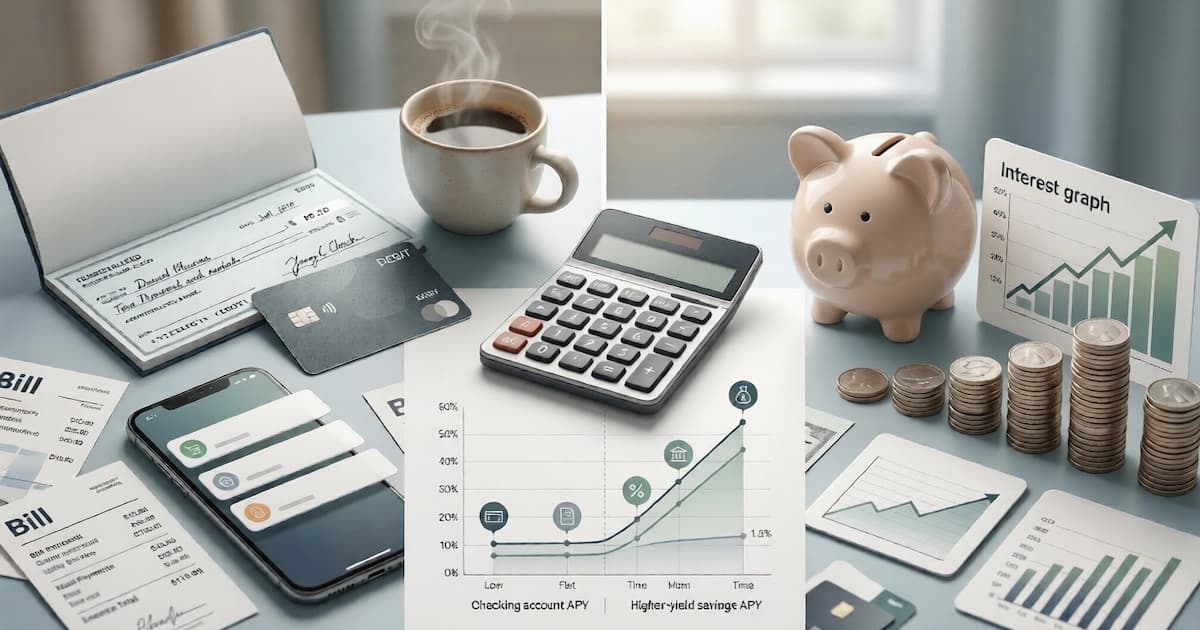
A checking account is the bank account you use for everyday spending. How it works, the types, what you need to open one, and the fees to watch for.
10 min read

Why RBI makes every Indian bank pay the same rate below Rs 1 lakh, how savings interest is actually calculated, and what DICGC and FDIC really cover.
17 min read
How a high-yield savings account works, why its rate beats a traditional bank's by so much, what to look for, and how the Indian version differs.
12 min read