Pay Yourself First Method Explained: A Beginner's Guide

By Tapabrata Biswas · Published May 10, 2026 · 10 min read
Researched with AI assistance, reviewed and edited by Tapabrata Biswas.

"A part of all you earn is yours to keep." That sentence, written in 1926 by George Clason in The Richest Man in Babylon, articulated the pay-yourself-first principle a hundred years before automatic bank transfers made it nearly frictionless. Most people who try to save what's left after paying their bills end up saving very little. The reason isn't lack of discipline. It's order. Whatever sits in checking at the end of the month tends to get spent, and the savings line gets whatever the discretionary categories don't claim.
Pay yourself first inverts that order. Savings comes first, and the rest of the budget is built around what remains.
What is the pay yourself first method?
Pay yourself first is a savings strategy where you transfer money to your savings or investment accounts the moment income arrives, before any bills are paid or any discretionary spending happens. The remaining amount in your checking account becomes the working budget for the month.
According to Investopedia's overview, pay yourself first is "a personal finance strategy of increased and consistent savings and investment while also promoting frugality." The mechanic is straightforward: define a fixed amount or percentage, set it to transfer automatically on payday, and treat the post-transfer balance as the only money available.
The "yourself" in the name refers to the saver's future self. Bills represent obligations to other people: landlords, utility companies, credit card issuers. Saving represents an obligation to the future version of you. Pay yourself first puts that obligation at the front of the queue rather than the back.
This is one of the most foundational ideas in personal finance and shows up across multiple budgeting frameworks. The 50/30/20 rule's 20% savings bucket and zero-based budgeting's emergency-fund line are both implementations of the same priority order.
Where the idea came from
Clason's Richest Man in Babylon presented household finance principles as parables set in ancient Babylon. The book's central rule, "a part of all you earn is yours to keep", articulated the priority-order idea in plain language. The book remains in print a century later and is one of the most cited foundational personal finance texts.
David Bach's 2004 book The Automatic Millionaire revived and modernised the concept for the era of automatic bank transfers and 401(k) contributions. Bach's argument was that the friction of manual saving ensures most people don't save steadily, but automated transfers remove the friction entirely, the saving happens whether the household feels disciplined that month or not.
The principle is now embedded in standard payroll systems. Every 401(k) contribution that comes out of a paycheck before the worker sees the money is, structurally, pay yourself first. Roth IRA auto-contributions, automated transfers to high-yield savings accounts, and "round-up" features in fintech apps all implement the same idea.
Why the order matters more than the amount
The intuitive approach to saving is to pay all your bills, spend on what you need and want, and save whatever is left. The math seems identical to pay yourself first, you're moving money around the same total, but in practice the outcomes diverge sharply.
Behavioural finance research finds that what economists call "the leftover" rarely materialises. Money that sits in checking gets re-evaluated against new opportunities to spend it. A planned $300 monthly saving becomes $200 after an unexpected dinner out, $100 after a sale, $0 after a small luxury that "I deserved." The amount that survives to month-end is almost always smaller than the planned amount.
Pay yourself first removes that decision from the month. The transfer happens before the household has any opportunity to redirect the money. The savings target becomes a sunk cost that the rest of the budget works around.
A second-order effect matters too: the household adapts. If $400 leaves the account on payday, the household budgets the remainder as if $400 doesn't exist. Spending compresses to fit. The same household trying to save $400 from "leftover" rarely finds $400 of leftover, because spending expanded to fill the available money.
Setting one up step by step
The first step is picking the destination. What account is the money going to? For households without an emergency fund, the destination is a high-yield savings account. For households with an emergency fund in place, the destination is usually a retirement account (Roth IRA, 401(k) above the employer match) or, if applicable, a brokerage account. Pick one: splitting between two destinations on day one adds complexity without value.
The second step is picking the amount. A common starting target is 10% of net income. For a household earning $4,000 net per month, that's $400 going out before bills. If 10% feels impossible, start at 5%, the discipline of the order matters more than the size for the first three months. Once the system is working, the amount can step up.
The third step is automating the transfer. Set the transfer to happen on payday or the day after, before any bills are scheduled. Most banks let you create a recurring transfer in five minutes. If your employer offers direct deposit splitting (sending part of your paycheck directly to savings), use that. It's even more friction-free than a same-day bank transfer.
The fourth step is budgeting the remainder. Whatever lands in checking after the transfer is the working budget. Build the rest of your spending plan, fixed bills, variable spending, discretionary categories, around that number. The transfer doesn't appear as a "savings line" in the budget because it has already happened.
The fifth step is increasing annually. When you get a raise, the easiest time to increase the transfer is before the new pay rate hits checking. A $200/month raise can become a $200/month savings increase if you adjust the auto-transfer the same week.
A simple worked example
Consider a household earning $3,800 net per month, with no current emergency fund.
Without pay yourself first, the household pays bills ($2,800), spends on groceries and discretionary ($900), and aims to save the remaining ~$100. Some months the $100 survives; many months it doesn't. After six months, the savings account holds maybe $300.
With pay yourself first at 10%, $380 transfers automatically to a high-yield savings account on payday. The household then operates on a $3,420 budget for the month. Bills ($2,800) and spending ($620) fit inside the lower number: by trimming discretionary categories or eating out less. After six months, the savings account holds $2,280.
The math is identical in theory. The behavioural difference produces an order-of-magnitude difference in actual savings. The household has done nothing requiring extra discipline beyond setting up the transfer once.
Where it works best
The method has clear strengths in three specific situations.
Households starting from zero savings benefit most directly. The first $1,000 emergency fund is the hardest to build because the household has no buffer to absorb shocks. Pay yourself first at even modest amounts ($50 per paycheck) builds the buffer mechanically.
Income-stable households are the easiest fit. Salaried workers with consistent paychecks can set transfers to a precise amount and forget them. The system runs itself.
Households with raise momentum get a structural advantage. Each raise is an opportunity to increase the transfer before lifestyle expands to absorb the new income. Households who do this regularly can hit a 20%+ savings rate within a few years without ever feeling like they cut spending.
Where it needs adaptation
Three situations require changes to the standard pattern.
Variable income households, freelancers, commission earners, seasonal workers, need a percentage approach rather than a fixed amount, or a manual transfer triggered by each deposit. Pay yourself first still works (the order matters identically), but automation is harder.
Households with high-interest debt may need to pause pay-yourself-first savings (above a small emergency fund) and redirect the same automated amount to debt payoff. The principle (priority order, automated execution) is identical; only the destination changes. Once the debt is cleared, the destination shifts back to savings.
Households genuinely living at the line can't automate savings that don't exist. If 100% of net income is consumed by basic essentials, the intervention has to come from the income side or the cost side first.
Common mistakes
Three patterns trip people up regularly when they first set up pay yourself first.
The first is starting too high. A 20% transfer in month one for a household that has never saved produces a cash crisis by week three. Start at 5-10% and step up after three successful cycles.
The second is keeping savings in checking. Money in the same account as spending money tends to get treated as available. Use a separate account, ideally at a separate bank, so seeing the savings balance requires a deliberate action.
The third is turning the transfer off when money gets tight. That's the pattern the method exists to prevent. If a month is genuinely tight, reduce the transfer temporarily; don't pause it entirely. Resuming a paused transfer requires willpower; reducing one only requires the action you'd take anyway.
What experts say
Investopedia's pay yourself first guide covers the strategy's history and the case for automation.
The Consumer Financial Protection Bureau's emergency fund guide describes automatic transfers as the most reliable way to build a savings buffer, consistent with the pay yourself first principle. The connection between the method and longer-term financial freedom is direct: the savings rate that pay yourself first enables is one of the strongest predictors of how soon a household reaches financial independence.
Frequently asked questions
What does pay yourself first actually mean? Pay yourself first means transferring money to your savings or investment accounts immediately when income arrives, before paying any bills or discretionary expenses. The remaining amount becomes the working budget for the month. The order matters: savings comes first, not last.
How much should I pay myself first? A common starting target is 10% of net income, increasing toward 20% as income and discipline grow. Households with no emergency fund typically prioritise that first; once an emergency fund is in place, the same automatic transfer redirects to retirement or other long-term goals.
Is pay yourself first the same as automatic savings? Automatic savings is the most common implementation of pay yourself first, but the principle is broader. Pay yourself first describes the priority order: savings before expenses. Automation is the mechanism that enforces it. You can pay yourself first manually with discipline; automation just makes it impossible to forget.
Does pay yourself first work if I have credit card debt? Most personal finance experts recommend a small emergency fund (often $1,000) before aggressively paying down credit card debt, then directing the pay yourself first amount to debt repayment until credit card balances are cleared. The ordering is about establishing the habit; the destination shifts as financial priorities change.
In summary
Pay yourself first is a budgeting strategy where savings or investment transfers happen automatically the moment income arrives, before any bills or spending. The remainder becomes the working budget. The idea was popularised by George Clason's 1926 Richest Man in Babylon and modernised for the automation era by David Bach's The Automatic Millionaire. Its strength is structural: by removing the saving decision from each month, it sidesteps the behavioural problem of leftover savings rarely materialising.
The single most useful action after reading about pay yourself first is the five-minute one: log into your bank, set up the recurring transfer for tomorrow's payday at whatever amount feels uncomfortable but possible, then close the tab. Once it's running, it requires no further attention until the next raise.
If you want to see where this strategy sits among the alternatives, here's the full guide to budgeting methods.
Sources
- Investopedia, Pay Yourself First: investopedia.com/terms/p/payyourselffirst.asp
- Consumer Financial Protection Bureau, An Essential Guide to Building an Emergency Fund: consumerfinance.gov/an-essential-guide-to-building-an-emergency-fund
- George S. Clason, The Richest Man in Babylon (1926): foundational text on the pay-yourself-first principle


You might also like
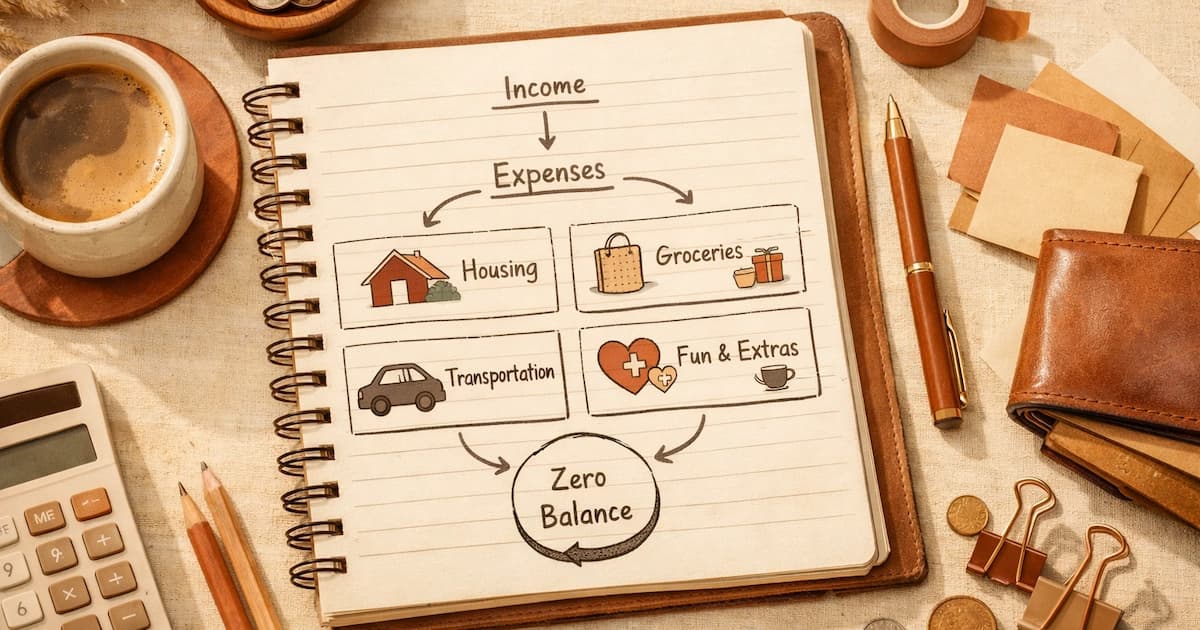
Give every rupee a job until income minus spending is zero. The five steps, a worked example in rupees and dollars, and where it breaks down.
14 min read

The rule everyone can recite leaves three things unresolved: which net income to use, where debt sits, and what to do when needs already eat 70%.
11 min read

What does financial freedom mean? A plain-English definition, the levels people commonly talk about, and what the term actually requires in practical terms.
10 min read