Zero-Based Budgeting: How It Works, Example & Template

By Tapabrata Biswas · Updated July 5, 2026 · 14 min read
Researched with AI assistance, reviewed and edited by Tapabrata Biswas.

Zero-based budgeting is the budgeting method where you give every dollar a job before you spend it, until the money left to assign reaches zero. It is the system behind Dave Ramsey's EveryDollar and the YNAB app, and it is the most hands-on of the mainstream budgeting methods. Done well, it is also the most revealing, because it forces a decision on every rupee or dollar and not letting money drift.
One clarification up front, because the term carries two meanings. This guide is about zero-based budgeting for your own money, the household version. There is a separate corporate and government version (the one that turns up in management-accounting courses and UPSC prep) where departments justify every expense from scratch each cycle. Same root idea, different world. Everything below is about your paycheck, in both dollars and rupees.
What is zero-based budgeting?
Zero-based budgeting is a method where your income minus everything you assign, bills, savings, debt, and fun, equals zero, so every dollar has a job before the month begins. The "zero" is the bottom line of the budget: once every unit of money has been given a category, there is nothing left to assign.
The part that trips up beginners is what "zero" means. It does not mean spending down to an empty account. Money you assign to an emergency fund, a mutual-fund SIP, or an extra debt payment is still assigned, it just has a savings job rather than a spending one. So a good zero-based budget can send a big chunk of income to savings and still balance to zero. The bank balance stays healthy; only the "left to budget" figure lands on zero.
If a household takes home $4,200 in a month, the budget is finished only when all $4,200 has a label. Leave $150 unassigned and the budget is not done, because that $150 is exactly the kind of money that disappears without a decision. The phrase people remember, borrowed from the YNAB community, is "give every dollar a job."
Who invented zero-based budgeting?
Zero-based budgeting was invented by Peter A. Pyhrr, an accounting manager at Texas Instruments in Dallas, around 1969 to 1970. He was frustrated that every department simply copied last year's budget and added a percentage, so he built a method that made each line justify itself from zero. He wrote it up in a 1970 Harvard Business Review article.
The idea jumped from the corporate world to government quickly. Jimmy Carter, then Governor of Georgia, hired Pyhrr to apply zero-based budgeting to the state's budget, and Georgia is usually named as the first US state government to try it. When Carter became US President in 1977, he pushed the method across the federal government. Decades later, personal-finance teachers adapted it for households. Dave Ramsey built his budgeting system and the EveryDollar app around it, and YNAB is built on the same "every dollar a job" principle. That household lineage is what this guide follows.
How to make a zero-based budget in 5 steps
Making a zero-based budget takes five steps: total your take-home pay, list every expense, assign every unit of money, track through the month, and rebuild before the next one. The math is simple. The value is in the visibility it forces.
- Total your take-home (net) income. Start with what actually lands in your account, not your gross salary. If you earn $5,000 gross but $3,650 arrives after tax and deductions, your budget starts at $3,650. Budgeting against gross is the single most common first-timer mistake. (The gap between the two is covered in gross vs net income.)
- List every expense you expect. Work from a couple of months of statements so nothing is forgotten. Group them: fixed essentials (rent, utilities, insurance, minimum debt payments), variable essentials (groceries, transport, health), goals and savings (emergency fund, retirement, sinking funds for annual bills), and discretionary (eating out, subscriptions, hobbies).
- Assign every unit of money until you hit zero. Take your income from step one and hand it out to the categories from step two, essentials first, savings before discretionary. When you have assigned the last rupee or dollar, income minus assignments should read zero. If you are over or under, adjust until it reconciles. That reconciliation is the whole method.
- Track and adjust through the month. A budget left untouched after the 1st is just a wish. Once a week, update what you have actually spent, and when one category runs short, move money in from another. You have not created money, only re-assigned it, so the total still reads zero.
- Build a fresh budget before the next month. Income and bills change month to month, so each cycle gets its own budget. Most people copy last month's as a template and tweak it, which is why month two takes just minutes.
A zero-based budget example
A zero-based budget example is a month's take-home pay split across categories until nothing is left to assign. The clearest way to see the method is a full month that reconciles to zero. Take a US household bringing home $4,200, with a small credit-card balance.
| Category | Assigned |
|---|---|
| Rent | $1,400 |
| Utilities, internet, phone | $300 |
| Insurance (post-tax portion) | $120 |
| Transport (fuel, transit) | $250 |
| Groceries | $500 |
| Eating out and entertainment | $200 |
| Personal spending (two adults) | $200 |
| Subscriptions | $50 |
| Credit card (min $40 + extra $210) | $250 |
| Emergency fund | $300 |
| Retirement (Roth) | $300 |
| Sinking funds (holiday, car registration) | $100 |
| Health and wellness | $50 |
| Giving | $50 |
| Buffer | $130 |
| Total assigned | $4,200 |
| Left to budget | $0 |
Savings shows up as several separate lines (emergency fund, retirement, sinking funds) rather than one vague "savings" bucket. That granularity is a signature of a mature zero-based budget: it lets you see, mid-month, exactly which goals are on track.
The same method runs identically in rupees, which no US template shows. Take an Indian household bringing home Rs 60,000 a month.
| Category | Assigned |
|---|---|
| Rent | Rs 15,000 |
| Groceries | Rs 8,000 |
| Utilities, internet, mobile | Rs 3,000 |
| Transport / fuel | Rs 3,000 |
| Insurance (term + health, monthly portion) | Rs 2,000 |
| EMI (bike or personal loan) | Rs 5,000 |
| Mutual-fund SIP | Rs 8,000 |
| PPF or recurring deposit | Rs 3,000 |
| Emergency fund | Rs 3,000 |
| Diwali / festival sinking fund | Rs 2,000 |
| Eating out and entertainment | Rs 3,000 |
| Household help | Rs 2,000 |
| Personal / miscellaneous | Rs 2,000 |
| Buffer | Rs 1,000 |
| Total assigned | Rs 60,000 |
| Left to budget | Rs 0 |
Zero-based budgeting vs 50/30/20 vs the envelope method
Zero-based budgeting and the 50/30/20 rule solve the same problem with opposite amounts of effort: zero-based assigns every unit of money by hand, while 50/30/20 uses three fixed percentages. The envelope method sits between them. The three compare like this.
| Zero-based budgeting | 50/30/20 rule | Envelope method | |
|---|---|---|---|
| How it works | Assign every unit of money until income minus outflows = 0 | 50% needs, 30% wants, 20% savings and debt | Cash or digital balances split into category envelopes; spend until empty |
| Effort | High: rebuild and track monthly | Low: set and review | Medium: fund and manage envelopes |
| Best for | Variable income, fast debt payoff, detail-lovers | Stable paycheck, low-maintenance starters | Overspenders who need a hard stop |
| Control | Maximum | Moderate | High on variable spending |
Pick zero-based budgeting if you want the tightest control or are paying down debt aggressively. Pick 50/30/20 if you want something you can run in ten minutes a month. Pick the envelope method if your problem is specifically overspending in a few categories and you need a wall that stops you. The three are not rivals; many people move from 50/30/20 to zero-based as their goals get more demanding.
Pros and cons of zero-based budgeting
The main advantage of zero-based budgeting is total control, since every unit of money is intentional; the main disadvantage is the time it takes every month. Weighed honestly, the trade looks like this.
What it does well:
- Every rupee or dollar gets a job, so there is no "where did my money go" at month end.
- It catches wasteful and forgotten spending, because nothing is assumed from last month.
- It adapts month to month, which makes it strong for variable and irregular income.
- It accelerates debt payoff and savings, because surplus is assigned on purpose and not left to drift.
Where it costs you:
- It is time-intensive; you rebuild it every month and track through the month.
- It can feel restrictive if the categories are set too tight.
- It is harder to forecast on an irregular income, since you are guessing next month's number.
- It is a poor fit for anyone who wants a set-and-forget system.
Does zero-based budgeting work with irregular income?
Zero-based budgeting works with irregular income by building the budget on your lowest reliable month and assigning anything extra as it arrives. For a freelancer who earns anywhere from Rs 40,000 to Rs 90,000, the budget is built on the Rs 40,000 floor. Every rupee of a stronger month is then assigned in order: first a tax set-aside (freelancers often reserve 25% to 30%), then a buffer that smooths the lean months, then goals like an emergency fund.
The trick that makes this bearable is paying yourself a steady "salary" from a buffer account and not living directly off each erratic payment. That approach pairs well with pay yourself first, and there is more detail in budgeting tips for freelancers.
Common mistakes to avoid
The most common zero-based budgeting mistake is budgeting gross income and not take-home pay. A few errors sink first-timers, and none of the big competitor guides list them plainly:
- Budgeting gross, not net. Assign only what actually reaches your account. Budgeting the pre-tax number creates a shortfall equal to your deductions every month.
- Forgetting annual and irregular bills. Insurance premiums, festival spending, and car maintenance do not vanish because they are not monthly. Divide each annual cost by 12 and fund a sinking fund.
- Leaving out a buffer. A small miscellaneous category absorbs the surprises that would otherwise blow up the whole budget.
- Confusing "zero to budget" with "zero in the bank." The target is zero unassigned money, not an empty account.
- Not tracking mid-month. The budget only works if you revisit it weekly and move money as reality disagrees with the plan.
Free zero-based budget template
A zero-based budget template is a sheet with income rows at the top, category rows below, and a "left to budget" cell that has to reach zero. You do not need a paid app to run one. A sheet of paper works, and a spreadsheet works better because the "left to budget" cell updates itself as you type.
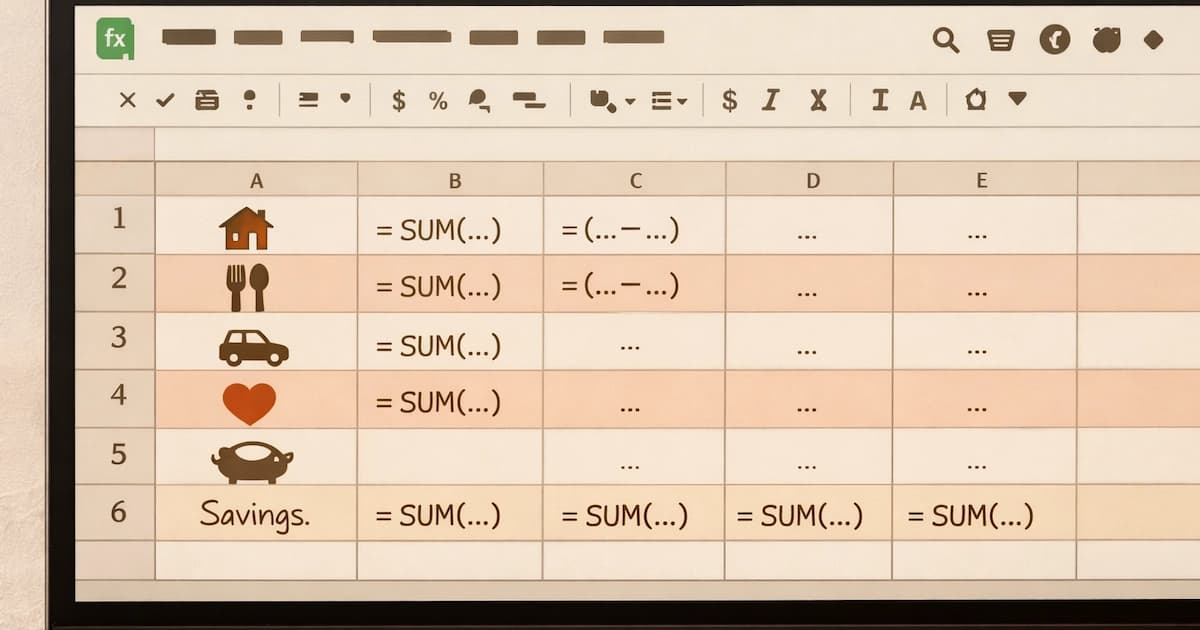
We ship a free, copyable version (no signup) in both rupees and dollars over in how to make a budget in Google Sheets, which walks through the exact formulas and gives you a make-a-copy link. If you want a simpler printable layout to start from, the monthly budget template covers the category structure. Either one can be run as a zero-based budget by adding a single "income minus assigned = 0" cell at the bottom.
Frequently asked questions
What is zero-based budgeting in simple terms? Zero-based budgeting is a budgeting method where you assign every unit of your take-home income to a specific job (rent, groceries, savings, debt, fun) until the money left to assign reaches zero. The name comes from that bottom line: income minus everything you have assigned equals zero. It does not mean you spend every rupee or dollar. Savings and debt payments are themselves categories, so 'assigning' money to your emergency fund still counts. The idea, often phrased as 'give every dollar a job', is that no money sits around unlabelled where it tends to get spent without a decision.
Does a zero-based budget mean spending every dollar? No. This is the most common misunderstanding. "Zero" refers to zero money left to assign on paper, while your bank balance stays positive. When you put Rs 8,000 or $300 into an emergency fund or a SIP, you have assigned that money, but you have not spent it. A healthy zero-based budget usually assigns a large share of income to savings and debt categories. The account balance stays positive; it is the "left to budget" figure that hits zero.
How do you make a zero-based budget? In five steps. Total your take-home (net) pay for the month and not your gross salary. List every expense you expect, including fixed bills, variable spending, debt payments, and savings goals. Assign money to each category, starting with essentials, until income minus all assignments equals zero. Track your spending through the month and move money between categories when one runs short. Then build a fresh budget before the next month begins. Most people reuse last month's budget as a starting template and not starting from a blank page each time.
Is zero-based budgeting better than 50/30/20? Neither is universally better; they trade effort for precision. Zero-based budgeting assigns every unit of money by hand, which gives maximum control and suits variable income and aggressive debt payoff, but it takes real time every month. The 50/30/20 rule splits take-home pay into 50% needs, 30% wants, and 20% savings and debt, which is far lower-maintenance but blunter. A practical path is to start with 50/30/20 to learn your numbers, then switch to zero-based budgeting when you want tighter control or are paying down debt fast.
What are the disadvantages of zero-based budgeting? The main drawbacks are time and maintenance. You rebuild the budget every month and track spending through the month, so it asks for more ongoing attention than a set-and-forget percentage rule. It can feel restrictive if categories are set too tight, and it is harder to forecast on an irregular income because you are guessing next month's number. It is a poor fit for people who want a system they can ignore. The upside is that the same hands-on quality is what makes it catch wasteful spending and accelerate debt payoff.
Who invented zero-based budgeting? Zero-based budgeting was developed by Peter A. Pyhrr, an accounting manager at Texas Instruments in Dallas, around 1969 to 1970, and he described it in a 1970 Harvard Business Review article. Jimmy Carter, then Governor of Georgia, hired Pyhrr to apply it to the state budget, and Georgia is commonly cited as the first US state government to use it. After Carter became US President in 1977, he pushed zero-based budgeting across the federal government. Decades later, personal-finance educators like Dave Ramsey and the app YNAB adapted the corporate method for household budgets.
Does zero-based budgeting work with irregular income? Yes, with one adjustment. Freelancers, commission earners, and seasonal workers build the budget on their lowest reliable month and not an average or a good month. Money above that baseline in stronger months gets assigned as it arrives, usually to a buffer, an emergency fund, or upcoming irregular bills. It also helps to set aside a fixed share for tax (often 25% to 30% in freelance income) as its own category before assigning the rest.
In summary
Zero-based budgeting assigns every unit of monthly income to a category, savings included, until the difference between income and assignments is zero. It came out of corporate budgeting under Peter Pyhrr around 1970, was adapted for households by Dave Ramsey and YNAB, and rests on one principle: give every dollar a job before the money lands. The mechanics are five steps, the math is trivial, and the payoff is visibility, seeing every month exactly where your money goes.
The first zero-based budget is almost never accurate, and that is the point. Month one is research, month two is correction, and by month three the categories settle and the method starts repaying the effort. If you are still choosing a method, it helps to see every budgeting method side by side first.
Sources
- Peter A. Pyhrr, Zero-Base Budgeting, Harvard Business Review (November to December 1970)
- Zero-based budgeting and Peter Pyhrr, en.wikipedia.org
- Ramsey Solutions, How to Make a Zero-Based Budget, ramseysolutions.com
- NerdWallet, Zero-Based Budgeting Explained, nerdwallet.com
- Fidelity, What Is Zero-Based Budgeting and How Does It Work?, fidelity.com
- Consumer Financial Protection Bureau, Financial Well-Being in America, consumerfinance.gov



You might also like

The rule everyone can recite leaves three things unresolved: which net income to use, where debt sits, and what to do when needs already eat 70%.
11 min read
Build a budget in Google Sheets step by step: the exact columns, the SUM and SUMIF formulas, conditional formatting, and a free template to copy, in ₹ or $.
12 min read

What is the envelope budgeting method? The cash-envelope system explained, how to set it up, the digital alternatives, and where it works (and doesn't).
10 min read