Credit Card vs Debit Card: How India and the US Differ

By Tapabrata Biswas · Updated July 17, 2026 · 23 min read
Researched with AI assistance, reviewed and edited by Tapabrata Biswas.
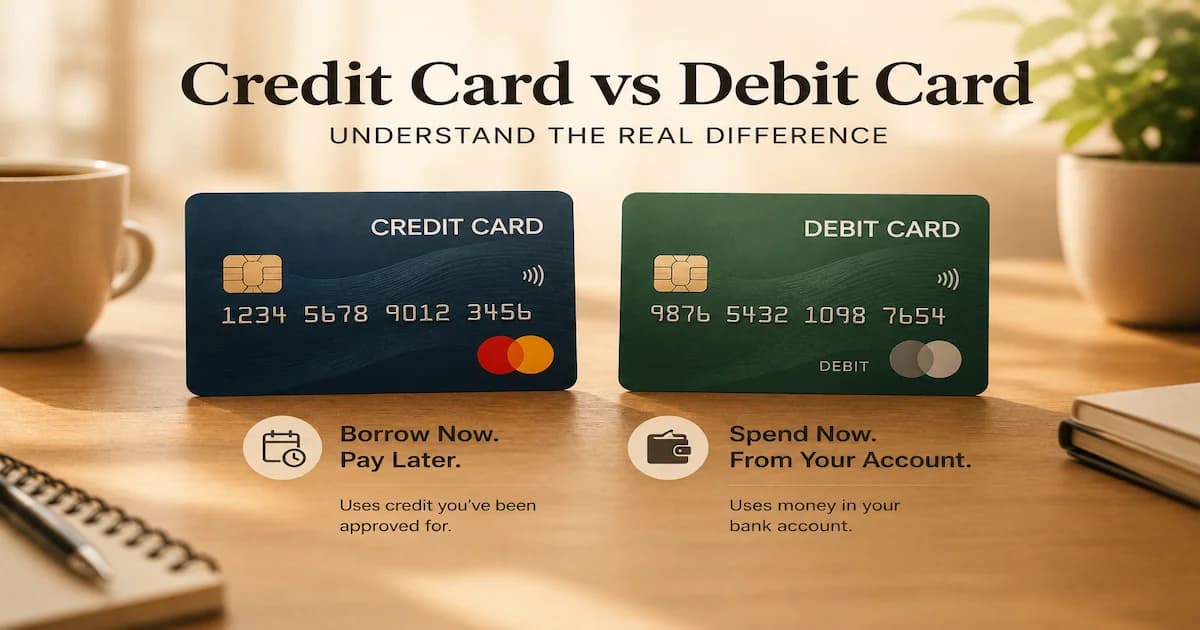
Both cards are the same rectangle with the same chip and the same network logo. What separates them is a question of law, and the two biggest card markets on earth answered it in opposite directions.
India made the clock the dividing line. RBI's framework barely cares which card was cloned; what it cares about is how fast you picked up the phone, and it applies the same ceiling to a savings account and to a credit card with a limit up to Rs 5 lakh. America made the card the dividing line. Lose a credit card there and federal law caps your exposure at $50. Lose a debit card and it can run to $50, then $500, then nothing at all standing between you and your balance. So "credit cards protect you better" is a true American sentence and a substantially false Indian one, and the Indian pages ranking for this question print it anyway, imported wholesale from US sources.
This post covers where the money comes from, which card builds a credit file and what to use if you can't get one, how fraud liability really works in each country, how long your money is actually gone, what a merchant hold freezes, and how UPI has quietly rewritten the question in India. It explains how the two products work. It isn't a recommendation to carry one over the other.
What is the difference between a credit card and a debit card?
A debit card is a payment card that draws money directly from your linked bank account. A credit card is a payment card that borrows from a revolving line of credit the issuer extends to you, repayable later, with interest if you don't clear the balance in full. The CFPB's own glossary puts the credit card side crisply: an open-ended loan that lets you borrow up to a limit and carry an unpaid balance from month to month.
Your money against borrowed money. That split decides whether a purchase can decline for insufficient funds, whether the card builds a credit file, what protection you get when fraud hits, how a dispute plays out, and whose cash a merchant hold ties up.
| Debit card | Credit card | |
|---|---|---|
| Source of funds | Your own bank balance | The issuer's credit line |
| Spending cap | Your available balance | Your approved credit limit |
| Builds a credit file | No | Yes, reported to the bureaus |
| Interest on purchases | None | Only if you carry a balance |
| Fraud liability, India | Rs 5,000 to Rs 25,000 by account type, zero if reported in 3 working days | Rs 10,000 up to a Rs 5 lakh limit, Rs 25,000 above, same 3-day rule |
| Fraud liability, US | $50, then $500, then uncapped | Capped at $50, often $0 |
| A disputed charge | Your money is gone until credited back | The issuer's money throughout |
| What a merchant hold freezes | Your actual cash | Credit headroom you weren't using |
One row in that table is doing far more work than the rest, and it's the one the field treats as a footnote. Fraud liability is the only difference between these two cards with a statutory floor underneath it. Everything else is a product feature that an issuer can change on a Tuesday.
Does a debit card build credit?
No. A debit card spends money you already own, nothing is borrowed, and a bureau only records borrowing. Experian states that most debit cards don't help you build credit because the activity isn't reported to the major bureaus. myFICO gives the mechanism in one line: debit cards generally won't impact your FICO Scores, because you're not borrowing money when you use the card.
Credit-card activity gets reported monthly, in India to TransUnion CIBIL and the other licensed bureaus, in the US to Equifax, Experian, and TransUnion. What lands on the file is your limit, your balance, your payment record, and the ratio between balance and limit. Debit spending reaches none of it. Run any amount you like through a debit card for a decade and the file stays empty, because from a lender's point of view nothing happened: you spent your own money, which tells them nothing about whether you repay other people's.
The ratio the bureaus watch is covered in credit utilization, how the models weigh it in how credit scores are calculated, and what the resulting number means in what is a good credit score. Indian readers can pull the file itself through our CIBIL checking guide.
A note on the pages that tell you otherwise. A cluster of fintech debit cards now report rent or cash-flow data to bureaus, and the pages recommending them are, without exception in the results we checked, owned by the company selling the product. A standard debit card builds nothing.
What builds credit if you can't get a credit card?
A secured credit card is a credit card backed by a refundable deposit that becomes the credit limit, which is why it's the standard entry route for someone with no credit file. The CFPB describes it in exactly those terms and adds the part that matters: secured cards are often used to build credit history.
This section exists because the search results have a hole in them and the reader falls straight into it. Every page ranking for "does a debit card build credit" answers no, and then stops. The reader's obvious next question, "then what do I use if nobody will give me a credit card?", falls off a cliff. Secured-card explainers do exist, and they're detailed, but they live on issuer product-education pages that never link back to the debit question. Two separate universes, one confused reader standing between them.
The Indian version differs in a way no US page mentions. American secured cards are backed by a cash security deposit, typically a few hundred dollars, which sets the limit and comes back when the account closes or converts. Indian secured cards are usually issued against a fixed deposit, so the collateral keeps earning FD interest while the card builds the file. Same mechanism, different collateral, and the Indian variant means the money isn't idle while it works.
The other route on both sides is a credit-builder loan, where the borrowed sum sits in a locked account and your repayments get reported. Either way, the file grows from repayment behaviour, and the debit card never enters into it.
Which card protects you better against fraud?
It depends which country you're in, and the two answers point in different directions. This is the section the field gets wrong, so it's worth doing properly.
Start with India, where the answer is counterintuitive. RBI's circular DBR.No.Leg.BC.78, dated 6 July 2017, on limiting customer liability in unauthorised electronic banking transactions, covers debit and credit alike. It sets two zero-liability limbs. Where the loss stems from the bank's own negligence or deficiency, your liability is zero regardless of when you report, with no deadline at all. Where a third party breached something and neither bank nor customer was at fault, liability is zero if you notify within three working days.
Miss that window and the caps arrive, set by what the account is rather than which plastic was used:
| What was compromised | Maximum liability, reported in 4 to 7 working days |
|---|---|
| Basic savings (BSBD) account | Rs 5,000 |
| Savings account, prepaid instrument, gift card | Rs 10,000 |
| Credit card with a limit up to Rs 5 lakh | Rs 10,000 |
| Current, cash-credit or overdraft account above Rs 25 lakh | Rs 25,000 |
| Credit card with a limit above Rs 5 lakh | Rs 25,000 |
Beyond seven working days, it's whatever the bank's board-approved policy says. And the cap is the transaction value or the table amount, whichever is lower, so a Rs 3,000 fraud on a savings account costs Rs 3,000 at worst, not Rs 10,000.
Look at rows two and three. A savings account and a credit card with a limit up to Rs 5 lakh carry an identical Rs 10,000 ceiling. That is the whole American thesis collapsing: in India, the card in your hand barely changes your liability. What changes it is the calendar. Two more provisions seal it, and neither appears on any Indian page we checked: RBI requires the bank to credit the disputed amount within 10 working days of notification, value-dated to the date of the fraud, and it states that the burden of proving customer liability lies on the bank. You are not required to prove your innocence.
So the honest Indian difference between the two cards is cash-flow timing, not liability exposure. With debit fraud your money is genuinely gone until the reversal lands. With credit fraud you're arguing about a bill you haven't paid yet. That's a real difference, and it's a much smaller one than "credit cards protect you better."
Now the US, where that sentence is true and the reason is statutory. Regulation Z, at 12 CFR 1026.12(b), caps liability for unauthorised credit-card use at the lesser of $50 or the amount obtained before you notify the issuer. The CFPB goes further: report a card lost or stolen before it's used and you can't be held responsible for anything.
Debit runs on Regulation E, and its structure is more complicated than the field's version:
| Regulation E, 12 CFR 1005.6 | Your maximum liability |
|---|---|
| You notify within 2 business days of learning of the loss or theft | The lesser of $50 or the amount taken |
| You don't notify within those 2 business days | Up to $500, on the terms in the rule |
| Transfers occurring more than 60 days after the statement was sent | Uncapped |
Read those rows as two separate clocks, because that's what they are. The $500 tier is triggered by failing to report within two business days of learning the card is gone. The 60-day rule is a different provision keyed to the statement, and it produces uncapped exposure. Most pages fuse them into one timeline and describe the $500 as a 60-day window, which misstates both.
Then the wrinkle that inverts everyday advice. CFPB's official commentary on Regulation E states that the first two tiers of liability don't apply to unauthorised transfers made without an access device. If your card number was skimmed while the card itself sat in your wallet, the $50 and $500 caps are simply not in play, and only the 60-day statement rule governs. Card-number-only compromise is the most common way debit fraud actually happens, and not one of the twelve pages we read explains this.
One more distinction the field flattens. Every "zero liability" promise you've seen advertised is a network or issuer policy, revocable, with exclusions. The $50 under Regulation Z and the ladder under Regulation E are law. Pages present the two as the same kind of protection. They are not, and knowing which one you're relying on matters precisely when a bank decides not to honour the voluntary one.
There's a structural reason the American field is vague here, and it's visible in the byline. Of the twelve US pages we fetched for this question, nine are owned by banks and card issuers. The only independent editorial page in the set was also the only one carrying real statistics, the only one naming a statute for the debit side, and the only one that mentioned merchant holds at all. An issuer has no particular reason to spell out how its own debit product leaves you exposed.
How long is your money actually gone?
In the US, Regulation E gives the bank 10 business days to investigate, and if it can't finish, it must provisionally credit your account within those same 10 business days while it keeps working. This is the reader's real question, and it is complete whitespace: none of the twelve pages we read mentions it.
The rule sits at 12 CFR 1005.11(c). The bank determines whether an error occurred within 10 business days of your notice. Where it needs longer, it can take up to 45 days total, but only if it provisionally credits the disputed amount inside the original 10 business days. CFPB's consumer-facing version adds the fine print: that temporary credit can be reduced by up to $50.
Two exceptions change the arithmetic, and both are unpublished anywhere on the first page of results:
| Situation | The window becomes |
|---|---|
| Account opened within the last 30 days | 20 business days, up from 10 |
| A point-of-sale debit card transaction | 90 days for the outer limit, up from 45 |
That second row deserves a stare. A point-of-sale debit transaction is the ordinary case, the everyday card fraud this entire post is about, and the regulation gives it the longest investigation window on the books. The most common scenario gets the slowest clock.
India runs a tighter rule in the customer's favour. RBI requires the bank to credit the disputed amount within 10 working days of notification, value-dated to the date of the fraud, so you don't lose the interest either. Ten working days is roughly two calendar weeks, and rent doesn't wait for it. That timing, more than the liability cap, is the substantive Indian argument for keeping large or unfamiliar payments off a debit card.
What is an authorisation hold doing to your balance?
An authorisation hold is a temporary block a merchant places on funds before the final amount is known. A pump can't know your total before you pump. A hotel can't know what you'll take from the minibar. So they reserve a guess.
The Georgia Attorney General's consumer protection division states that Visa and Mastercard authorise gas stations to hold up to $175 at the pump, and draws the distinction that actually matters: the merchant sets the amount of the hold, but the bank that issued the card is responsible for how long it lasts. The hold with the merchant generally clears within a day, while some issuers allow up to three days for banks to clear the transaction and release it. Georgia's warning is blunt about the consequence: payments can bounce even though the money is in the account to cover them.
Honesty about the numbers here, because the field can't keep its story straight. AARP, on a page live right now, says the hold can run from as little as $1 to more than $100 and states there is no official Visa or Mastercard maximum, which contradicts Georgia's $175 outright. Elsewhere you'll find 72 hours, three business days, seven business days, and ten business days all asserted as the release time, generally with no citation. We've cited the state regulator above because it's the strongest source we could actually retrieve, and the disagreement is worth naming.
What no source disputes is the asymmetry. On a credit card, a hold consumes limit you weren't going to use. On a debit card, it freezes cash you might need tonight. Identical price, identical card-shaped rectangle, and one of them can bounce your rent.
How does UPI change this question in India?
UPI accounted for 84% of India's digital payment volume but only 9% of its value in FY 2024-25, according to the RBI Bulletin published in September 2025. Sit with that split for a second, because it explains the whole Indian payments picture in two numbers.
UPI won the count and barely touched the money. It ate the small transactions: the chai, the auto fare, the vegetables, the ones a debit card used to serve. The big money still moves through other rails. The same RBI Bulletin records 18,586 crore UPI transactions worth Rs 261 lakh crore in that year, with users rising from around 30 million in 2017 to over 420 million by 2024.
Which means the Indian debit card has quietly changed jobs. It's become an ATM instrument and a fallback more than a payment one, and every comparison page ranking for this question still describes it as something you actively swipe at a counter. They're comparing a credit card to a product most Indians have stopped using the way the page assumes.
The bigger shift is on the other side. RBI permitted RuPay credit cards to be linked to UPI as part of its 2022-23 payments agenda, later extending the concept to pre-sanctioned credit lines from scheduled commercial banks. That collapses the credit-versus-debit question right at the QR code: the same scan can reach a credit line where it used to reach only your bank balance. Merchant economics differ from an ordinary swipe, and per an NPCI circular dated 4 October 2022, as reported by Moneylife, no merchant discount rate applies to these transactions up to Rs 2,000. Small offline merchants aren't charged on them at all.
Not one of the readable Indian pages ranking for this question explains any of it. Which is why, in 2026, an Indian reader typing "credit card vs debit card" is frequently asking a question the search results aren't answering: not which card to carry, but which one to link to their UPI app. The mechanics of the rail itself are in our UPI explainer.
What does each card actually cost?
A debit card charges no interest, because nothing is borrowed; a credit card charges interest only on a balance carried past the grace period. Pay the statement in full and the interest is zero.
The credit-card costs worth naming are the ones with numbers attached. A cash advance is the expensive one: a fee of around 3% to 5%, a higher rate than purchases, and no grace period, so interest starts the day you take the money. Annual fees, late fees, and a foreign transaction fee of roughly 3% sit alongside. The mechanics of how any of it compounds belong to how credit card interest works, and what happens when the bill goes unpaid to what happens if you don't pay.
Debit costs come from the account underneath. Overdraw and the bank charges a fee that averaged $26.77 in 2025, per Bankrate. Use an out-of-network ATM and you can pay twice, once to the machine's owner and once to your own bank. Some accounts levy monthly maintenance unless you hold a minimum balance. The full menu is in bank fees, the mechanics of going negative in overdraft protection, and the account underneath it all in what is a checking account.
One asymmetry to close on, since it's the practical shape of everything above. A debit card's worst case is a fee and a frozen balance. A credit card's worst case is a debt at 40% or more that compounds while you sleep. Both cards can hurt you. They just do it on different timescales.
What this post does not cover
This explains how the two products work. It doesn't rank cards or recommend one, and it stays out of credit repair and rewards optimisation. Business, corporate, prepaid, gift and charge cards follow different rules and aren't covered. The utilisation ratio belongs to credit utilization, the scoring models to how credit scores are calculated, the report itself to what is a credit report, and deposit insurance behind the bank balance to FDIC vs DICGC.
On sourcing, since fraud rules are the load-bearing part of this page. The Regulation E and Regulation Z texts were read from the regulations themselves, and RBI's liability circular from RBI. Three limits are worth stating plainly. The RBI circular we read is the July 2017 original, and we could not confirm from a primary fetch that no amendment has revised its liability table since, so verify the current caps with your bank. NPCI's site blocked every route we tried, so the RuPay-on-UPI detail below is limited to what a named secondary source attributed to a dated NPCI circular, and we've left the interchange and transaction-limit numbers out entirely, since we couldn't check them. And the current counts of debit versus credit cards in India sit inside an RBI spreadsheet we couldn't open, so we haven't quoted a card-count figure at all. Liability caps, dispute windows and fees change; confirm current figures with your bank, the RBI, or the CFPB before relying on them.
Frequently asked questions
What is the difference between a credit card and a debit card? A debit card draws money directly from your bank account, so you can only spend what you have. A credit card borrows against a revolving credit line the issuer extends to you, which you repay later, with interest if you don't clear the balance in full. The CFPB defines a credit card as an open-ended loan that lets you borrow up to a limit and carry an unpaid balance month to month. Everything else follows from that one split: only the credit card builds a credit file, the two carry very different fraud liability, and a merchant hold freezes your own cash on debit but only credit-limit headroom on a credit card.
Does a debit card build credit? No. A debit card spends your own money, nothing is borrowed, and so nothing is reported to a credit bureau. Experian states that most debit cards do not help you build credit because the account activity is not reported to the major bureaus, and myFICO puts the mechanism plainly: debit cards generally will not impact your FICO Scores because you are not borrowing money when you use the card. This holds in India too, where TransUnion CIBIL builds its file from credit facilities, and a bank account is not one. You could run any amount through a debit card for a decade and your score would not move.
Which card is safer against fraud in India? Less separates them in India than the internet suggests, because RBI's rules cover both cards on the same terms. Under RBI's 2017 circular on limiting customer liability, your liability is zero if the loss came from the bank's own negligence or deficiency, with no reporting deadline at all, and zero for a third-party breach you report within three working days. Report within four to seven working days and liability is capped at the transaction value or a table amount, whichever is lower: Rs 5,000 for a basic savings account, Rs 10,000 for a savings account or a credit card with a limit up to Rs 5 lakh, and Rs 25,000 for a credit card above Rs 5 lakh. The same Rs 10,000 ceiling covers a savings account and a mid-limit credit card, so the real Indian difference is cash-flow timing rather than liability exposure.
Which card is safer against fraud in the US? A credit card, and the gap is statutory rather than a matter of policy. Regulation Z caps liability for unauthorised credit-card use at the lesser of $50 or the amount obtained before you notify the issuer, and the CFPB states that if you report a card lost or stolen before it is used, you cannot be held responsible for any unauthorised charges. Debit runs on Regulation E instead, where liability is capped at $50 if you notify within two business days of learning of the loss, rises to $500 if you don't, and becomes uncapped for transfers occurring more than 60 days after the statement was sent. One wrinkle inverts the usual advice: those first two tiers apply only to a lost or stolen card, so if only your card number was skimmed, the $50 and $500 caps do not apply at all.
How long does a bank take to return money after debit card fraud? In the US, Regulation E gives the bank 10 business days to investigate, or 20 business days if the account was opened within the last 30 days. If it can't finish in that window it must provisionally credit your account, minus up to $50, within those same 10 business days, and it then has up to 45 days to conclude. The detail almost nobody publishes: a point-of-sale debit card transaction gets a 90-day outer limit rather than 45, which is precisely the everyday debit fraud scenario. In India, RBI requires the bank to credit the disputed amount within 10 working days of your notification, value-dated to the date of the transaction.
Why does a gas station or hotel hold more than the bill? It is an authorisation hold: a temporary block a merchant places on funds before the final amount is known, since a pump or a hotel desk cannot know your total in advance. The Georgia Attorney General's consumer division states that Visa and Mastercard authorise gas stations to hold up to $175 at the pump, and makes the distinction that matters: the merchant sets the amount of the hold, but the bank that issued the card decides how long it lasts. On a credit card a hold consumes credit-limit headroom you weren't using. On a debit card it freezes your actual cash, which is why a hold can bounce a payment even though the money is in the account.
Can you pay by UPI with a credit card in India? Yes, for RuPay credit cards, which RBI permitted to be linked to UPI as part of its 2022-23 payments agenda, later extending the idea to pre-sanctioned credit lines from scheduled commercial banks. This partly dissolves the credit-versus-debit question at the QR code, because the same scan can draw on a credit line and not your bank balance. Merchant economics differ from a normal card swipe: per an NPCI circular dated 4 October 2022, as reported by Moneylife, no merchant discount rate applies on these transactions up to Rs 2,000. Almost no comparison page mentions any of this, which is why an Indian reader asking credit versus debit in 2026 is often really asking which one to link to their UPI app.
Sources
- Reserve Bank of India, Customer Protection: Limiting Liability of Customers in Unauthorised Electronic Banking Transactions (DBR.No.Leg.BC.78/09.07.005/2017-18, 6 July 2017; the liability table, the working-day windows, the 10-working-day reversal, and the burden-of-proof provision are from this circular) rbi.org.in
- Reserve Bank of India, RBI Bulletin, September 2025 (UPI at 84% of digital payment volume and 9% of value in FY 2024-25) rbi.org.in
- Regulation E, 12 CFR 1005.6, Liability of consumer for unauthorized transfers law.cornell.edu
- Regulation E, 12 CFR 1005.11, Procedures for resolving errors (the 10 and 20 business-day windows, provisional credit, and the 45 and 90-day outer limits) law.cornell.edu
- Regulation Z, 12 CFR 1026.12, Special credit card provisions (the $50 cap) law.cornell.edu
- Consumer Financial Protection Bureau, How do I get my money back after an unauthorized transaction? consumerfinance.gov
- Consumer Financial Protection Bureau, Am I responsible for unauthorized charges if my credit cards are lost or stolen? consumerfinance.gov
- Consumer Financial Protection Bureau, Financial terms glossary (the credit card and secured credit card definitions) consumerfinance.gov
- Georgia Attorney General, Consumer Protection Division, Debit card holds (the $175 pump authorisation; merchant sets the amount, issuer sets the duration) consumer.georgia.gov
- myFICO, Do debit cards build credit? myfico.com



You might also like

Credit card interest is charged daily on your average daily balance once you carry a balance. The real math, grace periods, and the minimum trap, in ₹ and $.
13 min read

How credit scores are calculated: FICO's five published weights, why CIBIL publishes none, what both models ignore entirely, and what changed in 2026.
19 min read

UPI explained: what it is, the current limits and who gets the higher ones, why it is free, who pays for that, and what the August 2026 MDR Bill would change.
20 min read