How Credit Scores Are Calculated: FICO and CIBIL Factors

By Tapabrata Biswas · Updated July 17, 2026 · 19 min read
Researched with AI assistance, reviewed and edited by Tapabrata Biswas.
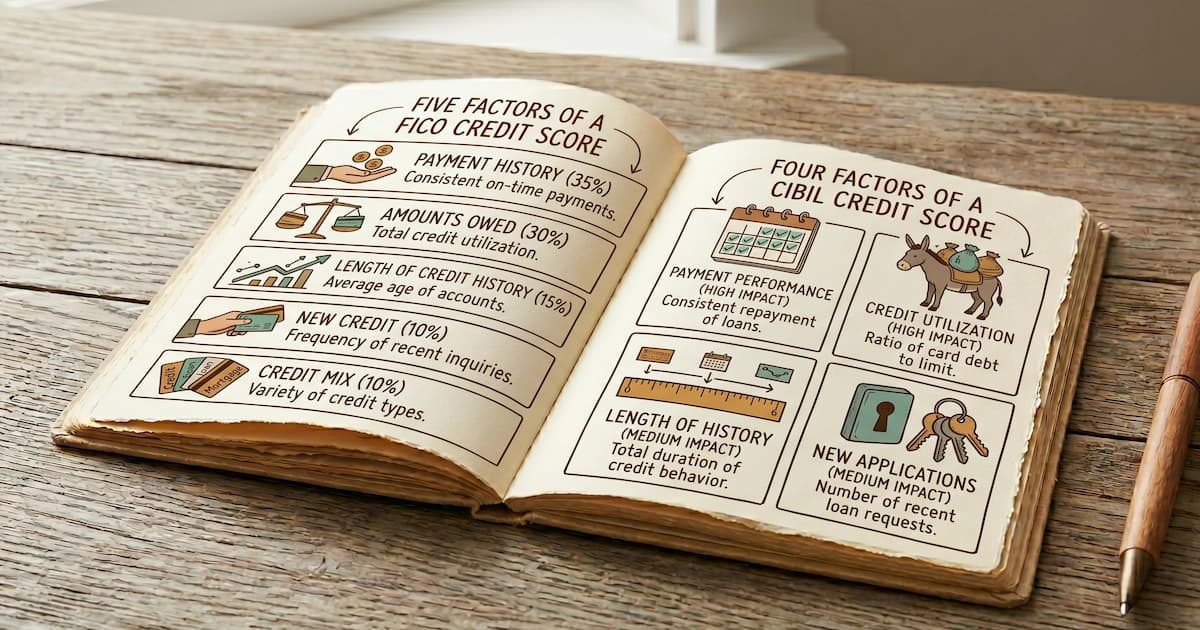
Almost every page explaining credit scores prints the same five numbers: 35, 30, 15, 10, 10. They come from FICO, so they're right. What those pages leave behind is the sentence FICO puts on the very same page, which says those levels are for the general population and may be different for different credit profiles. FICO's own FAQ hedges harder still, writing "approximately 35%" and adding that the importance of any factor depends on everything else in your report.
So the most-copied fact in personal finance is copied without its asterisk. India has a sharper version of the same problem: TransUnion CIBIL never published percentage weights at all, yet a 30/25/25/20 split circulates on dozens of Indian sites, unattributed, while the licensed bureaus that do publish, CRIF High Mark and Experian India, grade their factors High and Medium without ever assigning a percentage. This post covers what the models actually read, what FICO publishes and what CIBIL doesn't, what both models ignore completely, how long a score takes to exist, and the four things that changed in 2026. It explains how scoring works. It isn't advice about your credit, and it deliberately stays out of score-improvement territory.
How is a credit score calculated?
A credit score is a three-digit number produced by a statistical model that reads your credit report and predicts how likely you are to repay borrowed money on time. It's a prediction, not a report card, and it's built from one input only: your credit history.
The model looks at how reliably you've paid past dues, how much of your available credit you're using, how long your accounts have existed, what kinds of credit you hold, and how recently you've applied for more. That's the whole universe of inputs. In India the dominant score is the TransUnion CIBIL score, running 300 to 900, with Experian, Equifax, and CRIF High Mark also licensed by the RBI. In the US it's FICO, running 300 to 850, calculated on data from Experian, Equifax, and TransUnion, with VantageScore as the main competitor.
Both formulas are proprietary. Neither company has released the arithmetic, which is why every article on this subject, including this one, can only describe published summaries. Nobody outside those companies has seen the machine. The underlying data those summaries run on sits in your credit report, and how to actually pull yours in India is covered in our guide to checking your CIBIL score.
Does CIBIL publish factor weights?
No. TransUnion CIBIL names four factors and publishes no percentage weights, so every percentage split you'll see quoted for CIBIL is an industry approximation with no traceable primary source. CIBIL's own description names payment history, credit utilisation, age of credit, and enquiries, and calls the algorithm behind them proprietary.
The tell is a contradiction sitting unresolved across the Indian field: a page cannot call the algorithm proprietary and then publish its weights. Several do exactly that. The strongest evidence for what's really going on comes from the bureaus themselves, and the two whose pages are readable both publish the same shape of answer:
| Factor | CRIF High Mark | Experian India |
|---|---|---|
| Payment history | High impact | High |
| Credit utilisation or exposure | High impact | High |
| Age of credit | Medium impact | Medium |
| Total accounts or account types | Low impact | Low |
| Recent enquiries | Low to medium impact | Not separately labelled |
Licensed bureaus publish impact labels. Affiliate blogs publish percentages. That asymmetry is the story, and it's the reason our post on credit utilization has always said CIBIL doesn't publish exact weights.
Worse, a set of significant Indian pages prints FICO's American weights on Indian CIBIL pages. If you see 35/30/15/10/10 described as the CIBIL formula, you're reading the US model wearing an Indian label. One widely-read page even imports the American seven-year retention convention into an Indian context. The commonly-circulated 30/25/25/20 split, meanwhile, appears on aggregator sites and nowhere on cibil.com.
What are FICO's factor weights, and what does FICO say about them?
FICO publishes five weights: payment history 35%, amounts owed 30%, length of credit history 15%, new credit 10%, and credit mix 10%. The weights are real. The framing almost everyone gives them is not.
| Factor | FICO weight | What it reads |
|---|---|---|
| Payment history | 35% | Whether dues were paid on time; late payments, defaults, collections, bankruptcies |
| Amounts owed | 30% | Balances against limits, dominated by the credit utilisation ratio |
| Length of credit history | 15% | Age of oldest account, newest account, and the average across all |
| New credit | 10% | Recent hard enquiries and recently opened accounts |
| Credit mix | 10% | The spread across revolving credit and instalment loans |
Now the part the field drops. On the same page that carries the chart, FICO states that the importance of these categories may vary from one person to another, and that the levels shown are for the general population and may be different for different credit profiles. FICO's consumer FAQ goes further, writing "approximately 35%" and noting that the importance of any factor depends on the information in your entire credit report.
Read that carefully, because it changes what the chart means. It isn't the mechanism. It's a description of how the model behaves across a crowd. For a person with a thin file, length of history carries different force than it does for someone with twenty years of accounts. The same late payment costs two people different amounts. Seventeen consumer pages we checked reprint the percentages; none of them repeats the caveat.
VantageScore, FICO's competitor, made the opposite choice and refuses percentages entirely. VantageScore 4.0 describes payment history as extremely influential, credit usage and credit mix as highly influential, new accounts as moderately influential, and balances and available credit as less influential. The reason it gives is precisely the one FICO buries: percentages are calculated from population samples, while any individual is scored on what's in their own file. Several large US pages nonetheless publish a precise-looking VantageScore table of 41/20/20/11/6/2, and at least one labels 3.0-era numbers as 4.0. VantageScore itself publishes neither those figures nor any others.
Which factors move a score the most?
Payment history and amounts owed dominate both systems, accounting for about two-thirds of a FICO score between them, and carrying the only two High-impact labels the Indian bureaus assign. Everything else operates at the margins.
That much is solid. The point figures are not, and the honesty gap deserves naming. Ask how many points a 30-day late payment costs and the web answers 90 to 110 on a 780 score, attributed to FICO. Chase the citation and it evaporates: FICO's own late-payments page gives no point figure at all, describing impact only through recency, severity, and frequency. Every page quoting a number attributes it to FICO indirectly, and none links a primary FICO document. Our own earlier version of this page carried a 60 to 110 range and credited it to FICO's modelling; that attribution was not supportable, and the range didn't match the field's either.
What holds up is structural. A late payment is the single most expensive event because payment history is the largest factor. Higher scores fall further, because the model reads a high score as having more to lose. In the US, a late-payment mark stays on the report for seven years from the original delinquency.
The second factor, amounts owed, is dominated by the credit utilisation ratio, and there's a mechanical consequence people meet by accident: closing a credit card removes that card's limit from the calculation, which raises the ratio on whatever balances remain, even though no debt changed. The full mechanics of that ratio, including the statement-timing trap and whether the famous 30% figure is a rule at all, are in our credit utilization post, which owns that territory.
The three smaller factors get little attention and deserve a little. Length of history rewards age, which is why a decades-old account carries weight a new one can't replicate. Credit mix reads the spread across revolving and instalment credit. New credit counts recent enquiries, and the CFPB is more precise here than most explainers: enquiries for student, auto, and mortgage loans made 30 days before scoring have no effect at all, and multiple same-type enquiries within 14 to 45 days are treated as a single one. Credit card enquiries get no such bundling.
What does not affect your credit score?
Your income, savings balance, employer, and address are not in the score, in either country, because a credit score is built only from credit behaviour. This is the question readers ask most and the field answers least.
FICO publishes an explicit exclusion list, which lifts this out of folklore:
| Excluded from a FICO score | Excluded in India |
|---|---|
| Race, colour, religion, national origin, sex, marital status (prohibited by US law) | The same categories; a score reads credit conduct only |
| Age | Salary, business income, and profession |
| Salary, occupation, title, employer, employment history | Savings account balance, since it is not a credit facility |
| Where you live | Investments and deposits |
| Interest rates on your accounts | Interest rates you are charged |
| Child and family support obligations | Bank account activity that never reaches a lender's report |
| Receipt of public assistance | |
| Enquiries you make about your own report | Checking your own score, which is a soft enquiry |
Two consequences follow that surprise people. A raise doesn't lift your score and a pay cut doesn't lower it, except indirectly if the cut causes a missed payment. And banking mishaps that feel like credit events, an overdraft, a bounced cheque, an unpaid bank fee, don't reach a credit score at all, though they can surface on separate banking records.
A third consequence explains a rejection that otherwise makes no sense. Your income sits outside the score. It does not sit outside the lending decision, because lenders assess it separately under the heading Capacity, one of the five criteria a lender actually weighs. So a file built without any view of your salary can look excellent while your existing EMIs quietly disqualify you.
The one genuinely dangerous misconception in this territory is the belief that checking your own score damages it. It doesn't, and Indian calculation pages are the worst offenders: at least one widely-ranked page states flatly that every credit application produces a hard enquiry that reduces your score, without ever drawing the soft-versus-hard distinction. A reader lands there and stops checking. The distinction, and the RBI rules around it, sit in our CIBIL checking guide.
How long does it take to get a credit score?
Roughly six months of reported credit activity produces a first score in both countries, though India runs three different time windows that the field routinely conflates into one. Untangling them is worth a paragraph.
In the US, Experian states that at least six months are needed to generate a first FICO Score, while VantageScore can produce one within about a month of an account being opened. Reaching a good score takes a year or more, and a thin file, fewer than about five accounts, still limits terms even once a score exists.
India's three windows are where the confusion lives:
| Window | What it governs |
|---|---|
| 36 months | How far back the CIBIL Report shows your history |
| 24 months | The behaviour the CIBIL Score is mainly based on |
| About 6 months | How much history you need before a numeric score exists at all |
Plenty of pages collapse these into a single "36-month rule," which is a category error: 36 months is the report window, not the score gate. Before a score exists you carry NA or NH, and the numeric encoding almost nobody explains is that NH surfaces as minus 1 and NA as 0. Neither is a bad score. Both mean the bureau has nothing to work with, which to a lender reads very differently from a genuinely low number.
Which model is scoring you, and what changed in 2026?
You don't have one credit score; you have dozens, because each bureau holds different data and each scoring model reads it differently, and four separate things changed in 2026. The CFPB puts it plainly: you do not have just one credit score.
Start with the versions. FICO 8 remains the workhorse, but FICO 9 and 10 exist alongside industry-specific variants, and FICO's own FAQ discloses a "FICO Score NG" that runs 150 to 950, quietly contradicting the universal "300 to 850" claim every consumer page makes. VantageScore runs 3.0, 4.0, and now 5.0. Credit Karma, where millions check their number, still shows VantageScore 3.0, two generations behind. Even the tiers move: a FICO 8 good score starts at 670, while VantageScore's good band starts at 661, on the same 300 to 850 scale.
Four changes landed in 2026, and the field has caught almost none of them.
The one that matters most in India: from 1 July 2026 the RBI moved credit reporting from fortnightly to weekly incremental submission, with reference dates on the 9th, 16th, 23rd, and last day of each month, and full files due by the 5th of the following month. The change was issued in December 2025 and deferred from an original April 2026 start. Nearly every Indian page, including specialist ones, still tells readers their score updates every 15 days. Faster reporting cuts both ways: a cleared loan surfaces sooner, and so does a missed EMI.
In the US, VantageScore 5.0 launched on 8 July 2026, available immediately at all three bureaus, and it's the first mainstream model to factor in buy-now-pay-later plans, with its makers claiming up to 9% additional predictive lift on unsecured loans over 3.0. Nine days old at the time of writing, and absent from essentially every ranking explainer.
Mortgages moved too. The FHFA announced in April 2026 that Fannie Mae and Freddie Mac are immediately accepting VantageScore 4.0 from approved lenders, ending Classic FICO's monopoly on conforming mortgages, with FHA following. FICO 10T is approved but, per Freddie Mac's own wording, will be available at a later date; its historical data was published on 1 July 2026.
And a rule that many pages still describe as live is dead. The CFPB regulation that would have stripped medical debt from US credit reports was vacated by a federal court in July 2025, on the finding that the Bureau lacked the power to rewrite what belongs in a consumer report. Medical debt can legally appear today. The ruling went further than most coverage notes, holding that state laws attempting the same prohibition are preempted by the FCRA. What remains is voluntary bureau policy, paid medical collections removed and unpaid balances under $500 excluded, which the bureaus can revoke at will because no law compels it.
What this post does not cover
This explains how scoring models read a credit report and what they weigh. It stays out of improving, repairing, or boosting a score, which is where most of this topic's search results live and where advice about your money begins; our CIBIL checking guide draws the same line. The utilisation ratio and the 30% question belong to credit utilization. What counts as a good number, and the band tables for both countries, sit in what is a good credit score. The report itself, its sections, and your rights over it are in what is a credit report, and why a debit card builds no credit at all is in credit card vs debit card.
On sourcing, since this is a YMYL page: FICO's weights, its exclusion list, and its caveat were read from FICO's own pages, and the RBI compensation and alert rules from the RBI's Master Direction. Two things were not readable at source. VantageScore's site blocks automated access, so its influence levels here come via Experian, which co-owns VantageScore, and the exact category boundaries should be treated as unconfirmed. And cibil.com blocks access too, so CIBIL's four-factor description was recovered through search results quoting its live pages, never from the pages themselves. The RBI's move to weekly reporting is sourced from regulatory trackers carrying the December 2025 amendment; we could not fetch it on rbi.org.in directly. For a decision that turns on your own credit file, the bureau and a qualified professional are the right check.
Frequently asked questions
How is a credit score calculated? A credit score is calculated by a statistical model that reads the information on your credit report and predicts how likely you are to repay borrowed money on time. The model looks at how reliably you have paid past dues, how much of your available credit you are using, how long your accounts have existed, what types of credit you hold, and how recently you have applied for more. It never sees your income, savings, or employer. In India the dominant score is the TransUnion CIBIL score on a 300 to 900 scale; in the US it is FICO on a 300 to 850 scale. The exact formulas are proprietary in both countries.
Does CIBIL publish its factor weights? No. TransUnion CIBIL names four factors, payment history, credit utilisation, age of credit, and enquiries, and describes the algorithm behind them as proprietary. It publishes no percentage weights. The 30/25/25/20 split repeated across Indian lender and aggregator sites has no traceable primary source, and the pages printing it generally decline to attribute it. The two licensed bureaus whose pages are readable, CRIF High Mark and Experian India, both publish impact labels where the blogs publish numbers: payment history and credit utilisation are High Impact, age of credit is Medium, total accounts is Low. Treat any percentage split for CIBIL as an industry approximation.
What are the five FICO factors and their weights? FICO publishes payment history at 35%, amounts owed at 30%, length of credit history at 15%, new credit at 10%, and credit mix at 10%. The important part is the caveat FICO attaches on the same page and almost nobody repeats: those levels are for the general population and may be different for different credit profiles, and FICO's own FAQ hedges to approximately 35%. The percentages describe a crowd, not you. FICO also states that the importance of any single factor depends on everything else in your report, so the same late payment does not cost two people the same.
What does not affect your credit score? Your income, savings balance, employer, and address are not in the score. FICO publishes an explicit exclusion list: race, colour, religion, national origin, sex and marital status (prohibited by US law), age, salary, occupation, employer and employment history, where you live, the interest rates on your accounts, child and family support obligations, receipt of public assistance, and any enquiry you make about your own report. In India the same broad logic applies, since a credit score is built only from credit behaviour: a savings account is not a credit facility, so its balance never reaches your CIBIL report. Checking your own score is a soft enquiry and does not lower it.
How long does it take to get a credit score? About six months of reported credit activity in both countries, though the windows differ in ways that get conflated. In the US, Experian says at least six months are needed to generate a first FICO Score, while VantageScore can produce one within roughly a month of an account opening. In India three separate windows exist and the field mixes them up: a CIBIL Report covers the past 36 months, the CIBIL Score is based mainly on the past 24 months of behaviour, and around six months of history is needed before a numeric score exists at all. Until then you carry NA or NH, which appear as 0 and minus 1. Both mean the bureau has nothing to work with, which a lender reads very differently from a genuinely low number.
How many points does a late payment drop your score? Nobody outside FICO can answer this precisely, and it is worth knowing that FICO itself does not publish a number. Its own late-payments page describes the impact in terms of recency, severity, and frequency, without any point figure. The 90 to 110 point drop widely quoted across the web is attributed to FICO indirectly, and no page linking it points to a primary FICO document. What is verifiable is the direction and the structure: payment history is the single largest factor at 35%, higher scores have further to fall because the model assumes more to lose, and a US late-payment mark stays on the report for seven years from the original delinquency.
What changed in credit scoring in 2026? Four things. From 1 July 2026 the RBI requires Indian lenders to report credit information weekly in incremental cycles, with reference dates on the 9th, 16th, 23rd, and last day of each month, replacing the fortnightly rule that Indian pages still quote. VantageScore 5.0 launched on 8 July 2026 across all three US bureaus and factors in buy-now-pay-later plans. In April 2026 the FHFA confirmed Fannie Mae and Freddie Mac are immediately accepting VantageScore 4.0 for mortgages, while FICO 10T remains approved but not yet available for loan delivery. And the CFPB rule that would have removed medical debt from US credit reports was vacated by a federal court in July 2025, so medical debt can still legally appear.
Sources
- myFICO, What's in my FICO Scores (the five weights and the general-population caveat) (myfico.com)
- myFICO, What's not included in FICO Scores (the exclusion list) (myfico.com)
- FICO, FAQs about FICO Scores ("approximately 35%", score ranges) (ficoscore.com)
- Reserve Bank of India, Master Direction on Credit Information Reporting, 2025 (rbi.org.in)
- CRIF High Mark, Understanding your credit score in India (impact labels, no weights) (crifhighmark.com)
- Experian India, Consumer FAQ (300 to 900 range, impact labels) (experian.in)
- Experian, What is a VantageScore credit score (influence levels) (experian.com)
- Federal Housing Finance Agency, Credit score models (fhfa.gov)
- Consumer Financial Protection Bureau, What kind of credit inquiry has no effect on my score (consumerfinance.gov)


You might also like

TransUnion CIBIL calls 30% a healthy ratio but sets no official cut-off, and FICO publishes none either. What the data shows, and why top scores sit under 10%.
14 min read
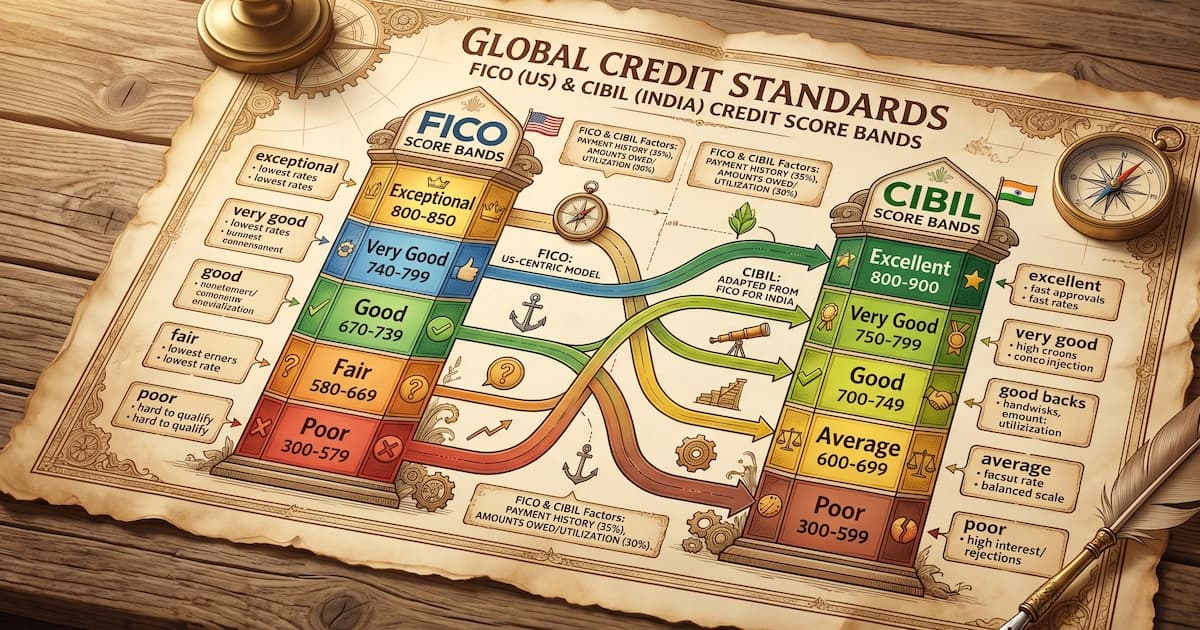
A good credit score is 670+ on FICO (max 850) and 750+ on CIBIL (max 900). See every band, what each one unlocks, and what a good score really saves you.
14 min read

Check your CIBIL score free in India: the two kinds of free, the RBI one-report-a-year rule, whether PAN works without OTP, and if self-checks hurt your score.
15 min read