What Happens If You Don't Pay Credit Card Debt: India and US

By Tapabrata Biswas · Updated July 18, 2026 · 21 min read
Researched with AI assistance, reviewed and edited by Tapabrata Biswas.

Miss a credit card payment in India and, for three days, nothing happens at all. No fee. No mark on your file. That grace period exists because RBI wrote it into the rules in March 2024, and almost no page explaining Indian credit card default mentions it.
What follows those three days is orderly. Both India and the US run a graded, published ladder, where every stage is triggered by a published rule with a number attached. India's ladder is about how the bank must classify the account on its own books, ending at Non-Performing Asset. America's ends at a charge-off that federal regulators require, not one the issuer chooses. Knowing which rung you are on tells you what is coming next, and roughly when.
This post walks that timeline in both countries: what the first month costs in rupees, how RBI's Special Mention Account ladder works and why the minimum due matters more than the balance, what a charge-off actually is, how long the damage lasts on each side, what collectors may and may not do, whether any of this can put you in jail, and what a settlement does to your tax position. It describes the process. It isn't advice about your own debt, and anyone actually facing this should talk to a professional.
What counts as defaulting on a credit card?
Default is the point at which an issuer stops treating a missed payment as an administrative lapse and starts treating the account as impaired, and each country fixes that point with a rule the lender does not get to set. Missing one payment is delinquency. Default is a classification.
India draws that first line unusually kindly. Under RBI's amendment to the Master Direction on credit cards, effective 7 March 2024, issuers may report an account as past due to a credit information company, or levy late payment charges, only when the account has remained past due for more than three days. The same amendment adds a second protection that matters more than it sounds: charges apply only to the amount outstanding after the due date, leaving the rest of the bill untouched. Miss a ₹50,000 bill by paying ₹45,000 on time, and the late charge attaches to the ₹5,000 gap.
Neither rule appears on the Indian pages ranking for this question, and one consequence is worth stating plainly: a payment that lands one or two days late, which many people assume has already damaged their file, has not been reported at all.
The US has no equivalent statutory grace. An account is past due the day after the due date, though issuers generally do not report to the bureaus until it reaches 30 days.
What does the first month actually cost?
In India, roughly 8% of the balance in the first month alone, once the late fee, the finance charge and GST are counted together. The field describes these three costs separately and almost never adds them up.
Take a ₹50,000 statement balance that goes entirely unpaid, at a representative finance charge of 3.5% a month, a ₹1,300 late fee, and 18% GST applied to both the fee and the interest:
| Month | Opening | Interest at 3.5% | Late fee | GST at 18% | Closing |
|---|---|---|---|---|---|
| 1 | ₹50,000 | ₹1,750 | ₹1,300 | ₹549 | ₹53,599 |
| 2 | ₹53,599 | ₹1,876 | ₹1,300 | ₹572 | ₹57,347 |
| 3 | ₹57,347 | ₹2,007 | ₹1,300 | ₹595 | ₹61,249 |
| 4 | ₹61,249 | ₹2,144 | ₹1,300 | ₹620 | ₹65,313 |
| 5 | ₹65,313 | ₹2,286 | ₹1,300 | ₹645 | ₹69,544 |
| 6 | ₹69,544 | ₹2,434 | ₹1,300 | ₹672 | ₹73,950 |
Six months of silence turns ₹50,000 into ₹73,950, a 47.9% increase, without a single new purchase. The GST line is the one readers rarely anticipate: tax applies to the interest and the penalty, so the government takes a cut of the cost of your default.
That arithmetic is ours, using representative rates. Actual finance charges run roughly 3% to 3.75% a month at most Indian issuers and late fee slabs vary by outstanding amount, so the shape holds while the exact figures depend on your card. The compounding mechanics behind that interest column belong to how credit card interest works.
One more thing about that RBI reform. In April 2024 the Reserve Bank overhauled penal charges across lending, banning penal interest in favour of penal charges and prohibiting interest on penalties. Cardholders are often told this protects them. It does not: the circular carves credit cards out by name, alongside external commercial borrowings, trade credits and structured obligations, on the basis that they are covered by product-specific directions. No page we read mentions the carve-out, and several imply the opposite.
How does India's default ladder actually work?
An Indian credit card becomes a Non-Performing Asset when the minimum amount due goes unpaid for 90 days from the statement's payment due date, and before that it climbs a published three-rung ladder the borrower never sees. RBI calls those rungs Special Mention Accounts.
| Stage | Days past due | What it means |
|---|---|---|
| SMA-0 | Up to 30 | Overdue but early; the first internal flag |
| SMA-1 | 31 to 60 | Escalated monitoring |
| SMA-2 | 61 to 90 | Final stage before impairment |
| NPA | More than 90 | Classified as non-performing on the bank's books |
Two details in RBI's July 2015 credit card circular change how this reads, and both are blurred almost everywhere. The trigger is the minimum amount due and nothing larger. And the clock runs from the payment due date printed on the statement, ignoring the purchase date and the billing date entirely.
The consequence is concrete. Run the same ₹50,000 balance while paying only the 5% minimum each month, and after six months the balance sits near ₹46,858, still expensive but never NPA, because the minimum was met every cycle. The same balance ignored entirely reaches ₹73,950 and NPA status. Paying the minimum is not a good outcome. It is a materially different one, and the pages that compress this into "don't pay for 90 days and you default" lose the distinction that decides it.
What is the US timeline, and why is 180 days the number?
US federal bank regulators require open-end credit that reaches 180 cumulative days past due to be classified as a loss and charged off, which is why the number is 180 and why it is not the issuer's choice. The FDIC's Uniform Retail Credit Classification policy states it directly, and the OCC issued the same instruction.
| Days past due | What typically happens |
|---|---|
| 1 to 29 | Late fee. Reg Z safe harbours are $32 for a first late payment and $43 for another within six billing cycles |
| 30 to 59 | Reported to the bureaus as delinquent. The first real credit damage |
| 60 to 89 | A penalty APR may apply at many issuers |
| 90 to 119 | Account typically closed to new charges, which also raises credit utilization; collection calls intensify |
| 120 to 179 | Prepared for charge-off; the issuer's own recovery efforts wind down |
| 180 plus | Charge-off required. Often sold to a debt buyer at a steep discount |
A precision point worth carrying, because half the field gets it wrong: the widely-quoted "120 to 180 days" range conflates two different regulatory categories. 120 days applies to closed-end installment loans. A credit card is open-end credit, so the figure is 180. The charge-off is also taken no later than the end of the month in which day 180 falls, so month-end is the practical trigger.
For scale, the Federal Reserve's G.19 release of 8 July 2026 put the average rate on credit card plans at 20.94% across all accounts and 22.15% on accounts assessed interest. New York Fed data for the first quarter of 2026, as reported by the ABA Banking Journal, put US credit card balances at $1.25 trillion, with transitions into early delinquency easing slightly to 8.6% annually.
Does a charge-off mean the debt is forgiven?
No. A charge-off is an accounting classification that moves a balance off the lender's performing books, and the obligation survives it intact. The Indian equivalent, NPA classification, works the same way: it describes the bank's ledger and not your liability.
What usually follows is the opposite of relief. The account is typically sold to a debt buyer at a fraction of face value, and that buyer has bought the right to pursue the full amount. Collection activity commonly intensifies at exactly the moment the original issuer appears to have stopped caring.
This matters because several widely-read US pages define a charge-off as the creditor having given up on collecting. One of them contradicts itself two headings later by asking whether you still have to pay. You do.
How long does the damage last?
In the US it is seven years plus 180 days from first delinquency, and essentially every page on the subject states it as seven years. The Fair Credit Reporting Act is precise about this at 15 USC 1681c(c)(1): the seven-year period begins upon expiration of the 180-day period that starts at the commencement of the delinquency. Real exposure is therefore closer to seven and a half years.
The confusion is not trivial, and its spread is remarkable. Across the pages we checked, five gave four different start dates: the charge-off event, the original delinquency, the first missed payment, and the date the missed payment was reported. A credit bureau's own explainer was among those that got it wrong.
India works on shorter windows, measured in months. A CIBIL report covers the past 36 months, and the score is based mainly on the past 24 months of behaviour. You will read almost everywhere that Indian bureaus keep negative marks for seven years. That figure appears to be the American convention imported wholesale, and no primary Indian source we could reach states it, which is why our credit score explainer treats it as unsupported. Both bureau sites returned access errors on every attempt, so we are declining to publish a retention figure for India rather than repeat one we cannot source.
The scoring mechanics themselves, including why the widely-quoted point-drop figures for a late payment have no primary source behind them, are covered in that same post. What holds up is the direction: payment history is the largest single input to a score in both countries, and a delinquency is the most expensive single event that can land in it. What counts as a good score in each country sits in what is a good credit score, and Indian readers can pull their own file through our CIBIL checking guide.
What can collectors actually do?
Both countries cap collector conduct with specific, enforceable numbers, and neither field publishes them.
In India, RBI's Master Direction restricts issuers' representatives to contacting customers only between 10:00 and 19:00 hours. Every communication from a recovery agent must carry the name, email, telephone number and address of a senior officer at the issuer whom the customer can contact. Before a default is reported to a credit information company, the issuer must follow a board-approved procedure and inform the cardholder beforehand. And once dues are settled after a default has been reported, the issuer must update the credit information company within 30 days.
Those hours are worth memorising, because the commonly published figure is wrong. Pages routinely state 7 a.m. to 7 p.m., which is three hours wider at the start of the day than the credit card rule allows. RBI's separate outsourcing circular sets 8 a.m. to 7 p.m. for recovery agents generally. Neither is 7 a.m.
In the US, Regulation F sets equally concrete limits. A collector is presumed compliant if it places calls no more than seven times in seven consecutive days, and must not call again within seven days of having spoken to you. Contact before 8 a.m. or after 9 p.m. in your local time is presumed inconvenient. You have the right to tell a collector to stop contacting you.
One US rule deserves a warning of its own. State statutes of limitation on debt generally run three to six years, and the CFPB notes some are longer. Once that period expires the debt is time-barred, meaning it cannot be successfully sued on. But making a partial payment or acknowledging the debt can restart the clock, which turns a well-meant token payment on an old account into a revival of full legal exposure. Of the pages we read, one mentioned statutes of limitation at all, and none carried the reset warning.
Can you go to jail for credit card debt?
Not for the debt itself, in either country. It is a civil matter, and in the US the CFPB says directly that a collector cannot threaten to have you arrested for an unpaid debt. This is the question Indian pages build whole sections around, and the answer deserves more precision than the usual flat reassurance.
Two real exceptions exist, and both attach to something other than the debt.
In the US, the risk is contempt of court. The borrowing itself never becomes criminal. If a court orders you to appear or produce information and you ignore it, a judge may issue a warrant. Same for failing to comply with a court-ordered installment plan. The debt never becomes criminal; disregarding the court handling it can.
In India the sharper exception is Section 138 of the Negotiable Instruments Act 1881. If a cheque given toward a settlement or lodged as security is dishonoured, that is a criminal offence carrying up to two years imprisonment, a fine up to twice the cheque amount, or both, subject to a demand notice within 30 days of dishonour and a 15-day window to pay. Courts frame it as punishing wilful non-payment after notice, which is a narrower thing than criminalising inability to pay. Separately, obtaining a card through forged documents is cheating, but that is fraud at the outset, not default afterwards.
So a recovery agent implying arrest for an unpaid balance is describing something the law does not provide for, and is breaching RBI's conduct rules by doing so. Complaints a bank fails to resolve within 30 days escalate to the RBI Ombudsman.
What happens if you settle the debt?
A settlement closes the account for less than the full balance, and its tax treatment is settled law in the US and genuinely unresolved in India. That asymmetry is worth knowing before anyone treats a waiver as free money.
The IRS is unambiguous. Topic 431 states that a debt cancelled, forgiven or discharged below the amount owed is generally taxable, reported on Schedule 1 of Form 1040, with bankruptcy and insolvency as the main exclusions claimed on Form 982. The $600 figure that circulates is the point at which a creditor must issue a Form 1099-C. It is a reporting threshold only: below it the income remains taxable, you simply may not receive the form.
India has no equivalent settled answer for an individual cardholder. The Supreme Court in CIT v. Mahindra and Mahindra held that a loan waiver falls under neither Section 28(iv) nor Section 41(1). That leaves Section 56(2)(x), covering money received without consideration, as the only live theory, and tax practitioners disagree over whether a negotiated commercial settlement counts. The practitioner lean is that a waived consumer balance is a capital receipt and generally not taxable, with the caveat that the position is fact-specific and litigable. This is precisely the kind of question a chartered accountant should answer on your particular facts.
On the credit file, a settled account reads differently from a paid one. Indian bureaus record a "settled" status, and lenders read that differently from "closed". Timing also shapes what an issuer will accept: creditors become materially more willing to negotiate once an account is well past due and charge-off is approaching, which is a description of how the incentive works and not a suggestion to wait.
What this post does not cover
This describes what happens and when, in both countries. It is educational, never legal or tax advice, and anyone actually facing collection, a lawsuit, or a settlement decision should speak to a lawyer or a chartered accountant, since the outcome turns on facts this page cannot see. It deliberately leaves out payoff strategy, covered in debt snowball vs avalanche; the minimum-payment math, covered in how long it takes to pay off a credit card; interest mechanics, in how credit card interest works; and score mechanics, in how credit scores are calculated. Bankruptcy, insolvency proceedings, and business or corporate card liability are out of scope entirely.
On sourcing, since this page is about legal consequences. RBI's three-day rule, the recovery-agent hours, the pre-reporting notice and the 30-day settlement update were read from RBI's own Master Direction pages, and the penal-charges carve-out from the circular itself. The FDIC and OCC charge-off requirement, the FCRA reporting clock, Regulation F's call limits and the IRS position were each read from the regulator or the statute. Four limits are worth naming. The RBI circular fixing credit card NPA at 90 days on the minimum due was recovered through trade press quoting it, because RBI's own document host returned a CAPTCHA on every attempt. The SMA day-bands come from a regulated NBFC's published restatement of RBI's norms after four primary routes failed, so they sit one step from the regulator. India's late fee slabs and finance charges are representative figures from secondary sources, because every issuer's terms page we tried returned a 404, a redirect loop or a timeout. And we could not verify any Indian bureau retention period, so none is stated.
Frequently asked questions
What happens if you don't pay your credit card bill? A sequence of graded consequences, each triggered by a rule rather than by the issuer's mood. In India, nothing at all happens for the first three days: RBI's amendment effective 7 March 2024 bars issuers from reporting an account past due or levying late charges until it has been past due for more than three days. After that a late fee applies to the unpaid amount, interest runs at roughly 3% to 3.75% a month, and 18% GST applies on top. The account is reported to credit bureaus and moves through RBI's Special Mention Account ladder, becoming a Non-Performing Asset if the minimum due goes unpaid for 90 days. In the US the ladder runs 30, 60, 90, 120 and 150 days, and federal bank regulators require the issuer to charge the account off at 180 days past due. Collections, and eventually a civil suit, can follow in either country.
When does a credit card become an NPA in India? A credit card account is treated as a Non-Performing Asset when the minimum amount due shown on the statement is not paid in full within 90 days of the statement's payment due date, per RBI's July 2015 circular on credit card asset classification. Two details matter and are widely blurred. The trigger is the minimum amount due and not the full outstanding balance, so paying the minimum each month keeps the account out of NPA classification even while the balance compounds expensively. And the clock runs from the payment due date printed on the statement, not from the purchase date or the billing date. Before NPA, the account passes through RBI's Special Mention Account stages: SMA-0 up to 30 days overdue, SMA-1 from 31 to 60 days, and SMA-2 from 61 to 90.
How long does a credit card default stay on your credit report? In the US, seven years plus 180 days from the date of first delinquency. The Fair Credit Reporting Act at 15 USC 1681c(c)(1) starts the seven-year clock upon expiration of the 180-day period beginning at the commencement of the delinquency, so real exposure runs about seven and a half years, not seven. Almost every US page states this incorrectly. In India the windows are different and shorter: a CIBIL report covers the past 36 months and the score is based mainly on the past 24 months of behaviour. The widely-repeated claim that Indian bureaus retain negative marks for seven years appears to import the American convention, and no primary Indian source we could reach states it.
Can you go to jail for not paying a credit card in India or the US? Not for the debt itself, in either country. Credit card default is a civil breach of contract, and in the US the CFPB states plainly that a debt collector cannot threaten to have you arrested for an unpaid debt. Two genuine exceptions exist and get conflated with the debt. In the US, ignoring a court order connected to the case, such as failing to appear when summoned, can lead a judge to issue a warrant, so the contempt is criminal even though the debt is not. In India, if a cheque given toward a settlement or as security bounces, that is a criminal offence under Section 138 of the Negotiable Instruments Act 1881, carrying up to two years imprisonment. Recovery agents who threaten arrest for the default itself are breaching RBI conduct rules.
What are the rules on credit card recovery agents in India? RBI's Master Direction on credit card operations restricts contact hours and requires a traceable escalation path. Issuers' representatives may contact customers only between 10:00 and 19:00 hours. Every communication from a recovery agent must carry the name, email address, telephone number and address of a senior officer at the card issuer whom the customer can contact. Before reporting a default to a credit information company, the issuer must follow a board-approved procedure and inform the cardholder in advance. If dues are settled after a default has been reported, the issuer must update the credit information company within 30 days of settlement. Complaints that a bank does not resolve within 30 days can be escalated to the RBI Ombudsman.
Does a charge-off mean the debt is forgiven? No. A charge-off is an accounting classification and not a discharge. US federal regulators require open-end credit that is 180 cumulative days past due to be classified as a loss and charged off, which moves the balance off the lender's performing books. The obligation survives intact, and in practice collection activity often intensifies rather than stops, because the account is typically sold to a debt buyer at a steep discount and that buyer pursues it. Several widely-read pages define a charge-off as the creditor giving up on collection, which misdescribes what follows. The same logic applies to an Indian account classified as an NPA: the classification describes the bank's books and not the borrower's liability.
Is a settled or written-off credit card debt taxable? In the US, generally yes. The IRS states in Topic 431 that if a debt is cancelled, forgiven or discharged for less than the amount owed, the cancelled amount is generally taxable, reported on Schedule 1 of Form 1040. Bankruptcy and insolvency are the main exclusions, claimed on Form 982. Worth knowing: the $600 figure people cite is the threshold at which a creditor must issue a Form 1099-C and not a threshold below which the income becomes untaxable. In India the position is genuinely unsettled for an individual cardholder. The Supreme Court in CIT v. Mahindra and Mahindra held that a loan waiver is taxable under neither Section 28(iv) nor Section 41(1), and practitioners disagree over whether Section 56(2)(x) can apply to a consumer settlement. A chartered accountant should decide this on your facts.
Sources
- Reserve Bank of India, Master Direction, Credit Card and Debit Card Issuance and Conduct Directions, 2022 (recovery agent hours, pre-reporting notice, 30-day settlement update) rbi.org.in
- Reserve Bank of India, Amendment to the Master Direction, RBI/2023-24/132, effective 7 March 2024 (the three-day past-due rule and charges on the outstanding amount) rbi.org.in
- Reserve Bank of India, Fair Lending Practice, Penal Charges in Loan Accounts (the credit card carve-out) rbi.org.in
- Federal Deposit Insurance Corporation, Uniform Retail Credit Classification and Account Management Policy (open-end credit charged off at 180 days) fdic.gov
- Office of the Comptroller of the Currency, Bulletin 2000-20 occ.gov
- Fair Credit Reporting Act, 15 USC 1681c (the seven-year clock and its 180-day start) law.cornell.edu
- Regulation F, 12 CFR 1006.14 (the seven-calls-in-seven-days limit) law.cornell.edu
- Consumer Financial Protection Bureau, Can I be arrested for an unpaid debt? consumerfinance.gov
- Consumer Financial Protection Bureau, What is a statute of limitations on a debt? (the reset warning) consumerfinance.gov
- Internal Revenue Service, Topic No. 431, Canceled Debt irs.gov
- Federal Reserve, G.19 Consumer Credit, released 8 July 2026 (average credit card rates) federalreserve.gov

You might also like

Credit card interest is charged daily on your average daily balance once you carry a balance. The real math, grace periods, and the minimum trap, in ₹ and $.
13 min read
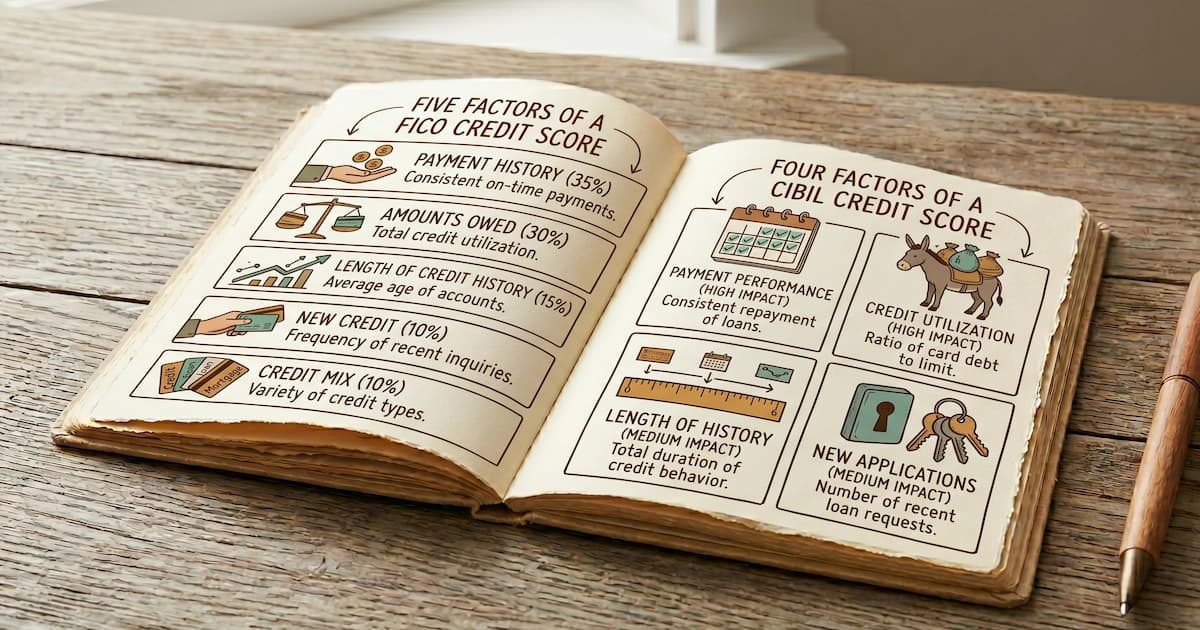
How credit scores are calculated: FICO's five published weights, why CIBIL publishes none, what both models ignore entirely, and what changed in 2026.
19 min read
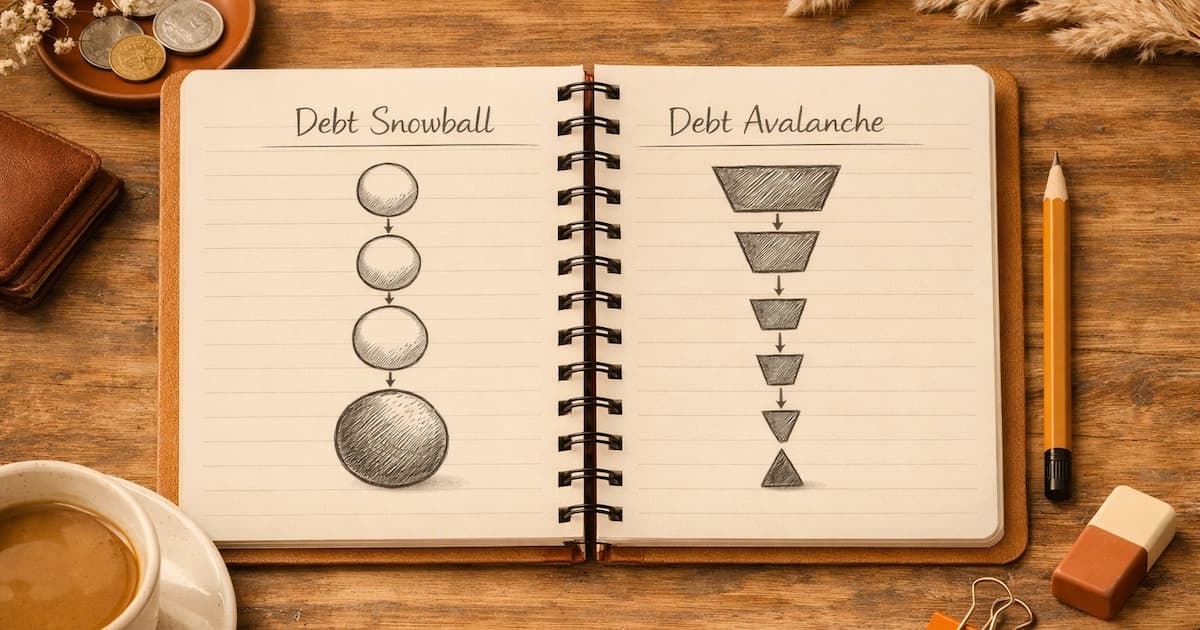
How each method works, the maths on which saves more, the behavioural research on which one people actually finish, and how to choose.
11 min read