How to Check Your CIBIL Score for Free (2026)

By Tapabrata Biswas · Updated July 17, 2026 · 15 min read
Written and fact-checked by Tapabrata Biswas. How I write
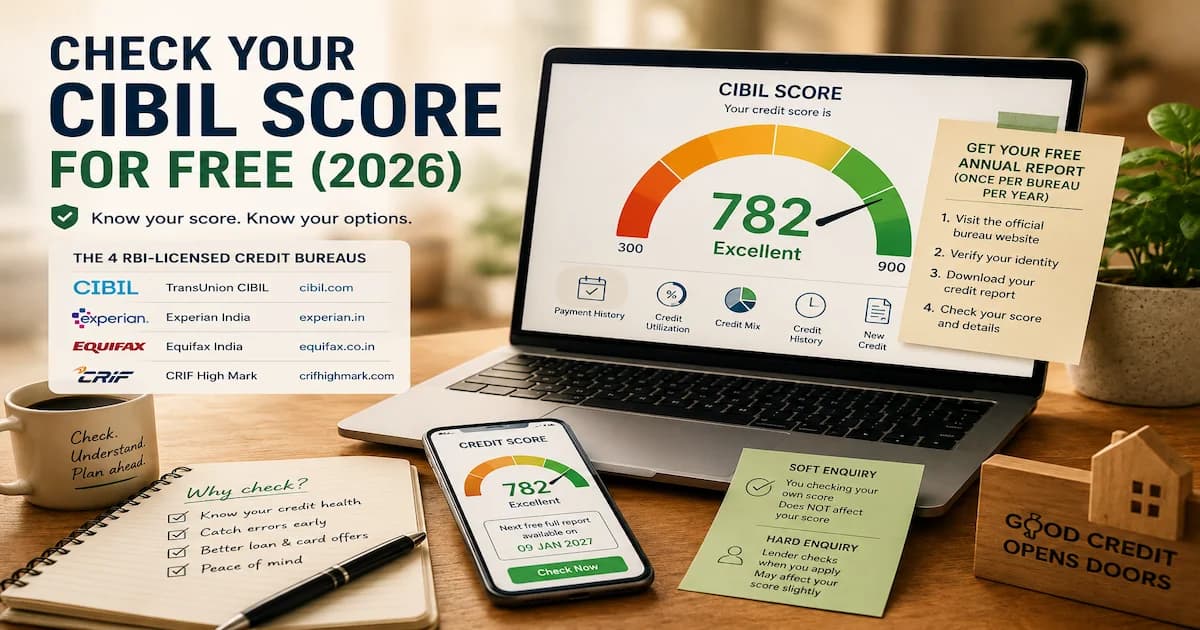
Checking your CIBIL score never has to cost you a rupee, and it never lowers your score either. Both of those are worth stating up front, because the pages that rank for this question tend to bury them under a wall of definitions or a "check free" button that turns into a paid plan. The regulator gives you a free full report every year, partner apps show a free score every month, and looking at your own number is a soft enquiry that leaves it untouched.
There's a catch worth knowing before you start: a genuine check always needs your PAN and a one-time password. The "check by mobile number" and "without OTP" shortcuts that people search for mostly don't exist, and the sites promising them are the ones to avoid. This guide covers the two kinds of free, the exact steps, whether self-checks hurt your score, and how to tell a real free check from a lead-generation trap. It's educational, not advice on how to improve or repair a score.
How do you check your CIBIL score for free?
You can check your CIBIL score for free two ways: one free full credit report a year from each of India's four credit bureaus, which the Reserve Bank of India requires, and a free score refreshed monthly through partner apps like Paisabazaar, Google Pay, or Moneyview. Most people only know one of these, which is why "how many times is it free" confuses everyone.
To pull the free report straight from TransUnion CIBIL, go to the official site and follow its flow:
- Open cibil.com and choose the free annual report option, taking care to use the real site and avoid look-alikes.
- Register with your PAN, first and last name, date of birth, email, and mobile number.
- Verify your identity with the OTP sent to your mobile.
- Enter your date of birth, PIN code, and gender when asked, then submit.
- Your score and full report appear on screen and are emailed to you.
The same broad flow works at the other three bureaus' sites. One eligibility point that surprises people: a CIBIL score only exists if you've had an active loan or credit card at some point in the last 36 months. With no borrowing history, the score field reads "NA" or "NH" instead of a number, which is normal for a first-time borrower.
How many times is it actually free?
You are entitled to one free full report a year from each of the four bureaus, which adds up to four free full reports a year, plus effectively unlimited free score checks through partner apps. No single competitor page states the layered answer plainly, so here it is as a table.
| Free route | What you get | How often |
|---|---|---|
| Each bureau's own site | Full report and score | Once per bureau per calendar year (so up to 4 a year across all four) |
| Partner apps (Paisabazaar, Google Pay, Moneyview) | CIBIL score, and a summary | Monthly, refreshed via a soft pull |
| CIBIL paid subscription | Full report plus alerts and monitoring | Unlimited, but this one costs money |
Rotating the four bureaus lets you space free full reports across the year without paying. The official cibil.com free report resets only on 1 January, so heavy users of that one site get steered toward CIBIL's paid subscription. Pairing one free bureau report with a free monthly app score sidesteps that entirely.
Free score versus free full report: what's the difference?
A CIBIL score is the three-digit number, and a CIBIL report, formally the Credit Information Report (CIR), is the detailed account-by-account history the score is calculated from. The score is derived from the CIR. Most free apps show you only the score; the RBI's annual free entitlement is the full report.
That distinction matters when your goal is more than curiosity. If you're hunting for an error, an unfamiliar loan, or a sign of identity fraud, you need the report, because that's where the account list, the payment history, and the enquiries live. The number alone won't show you a stranger's loan sitting on your file. For what the report contains in general terms, see what is a credit report.
Can you check CIBIL by PAN, by mobile number, or without OTP?
A legitimate CIBIL check always needs your PAN and an OTP, so you cannot get a real score from a mobile number alone, an Aadhaar number alone, or with no OTP. This is the honest answer the "shortcut" searches are looking for, and most ranking pages dodge it.
| Can you check with this alone? | Works? | Why |
|---|---|---|
| Mobile number only | No | The mobile number is only for the OTP and login; a PAN or other ID still pulls the report |
| Aadhaar number only | No | Not currently possible; Aadhaar can serve as a KYC document but not as the sole lookup |
| No PAN, using another government ID | Partly | The bureau's form accepts a Passport, Voter ID, Ration card, or Driving Licence, but your accounts are keyed to your PAN, so an alt-ID check can miss part of your history |
| Without OTP | No | OTP identity verification is mandatory on every genuine check |
The reason PAN sits at the center is not just identity, it's record matching: your loans and credit cards are recorded against your PAN, so it's the key that assembles your complete history. An alt-ID check verifies who you are but may return a thinner file.
Treat any site that promises a score on your PAN alone, with no verification, as a red flag. A genuine bureau or its partner will always send an OTP. A page that skips it is operating outside the RBI framework and is often just harvesting your PAN and mobile number.
Does checking your own CIBIL score lower it?
No. Checking your own score is a soft enquiry that has zero effect on it, while a hard enquiry, a lender pulling your report when you apply for credit, can slightly and temporarily lower it. This single distinction is why you can monitor your own score as often as you like.
The mechanism is straightforward. A burst of loan or card applications in a short window can signal financial stress to a lender, so hard enquiries are recorded and can nudge the score down a little. Looking at your own report is filed in a completely separate category and is never counted against you. Self-monitoring and a credit application aren't the same event, so there's no score-based reason to avoid checking. The only real limit is the once-a-year cap on the free full report from each bureau.
Is the score on Paisabazaar or Google Pay the "real" CIBIL score?
Yes. When an app shows a CIBIL score, it's the genuine TransUnion CIBIL number sourced directly from the bureau; a different figure on another app usually means that app pulled a different bureau, not that CIBIL is wrong. The "is Paisabazaar CIBIL correct" worry almost always comes down to which bureau you're looking at.
The mapping from app to bureau runs like this:
| App or site | Score it shows | Refresh |
|---|---|---|
| cibil.com (official) | TransUnion CIBIL, full report | Once a year free, then paid |
| Paisabazaar | TransUnion CIBIL, plus you can compare all four | Score monthly, report every 15 days (their stated cadence) |
| Google Pay | TransUnion CIBIL | Monthly |
| Moneyview | TransUnion CIBIL | Monthly |
| OneScore | CIBIL and Experian | On demand |
Work through an example. Say Google Pay shows 750 this week and another app shows 738 the same week. Both can be right. Google Pay reads your TransUnion CIBIL score, while the other app may read your Experian or CRIF High Mark score, and because a lender might report to one bureau a few days ahead of another, and each bureau now takes submissions on four reference dates a month, the 9th, 16th, 23rd and last day, the two numbers drift apart. They're two different scores from two different bureaus, and neither is an error.
The four credit bureaus in India
A credit bureau, officially a Credit Information Company (CIC), is an RBI-licensed agency that compiles your borrowing and repayment history into a report and a score. India has four, all licensed under the Credit Information Companies (Regulation) Act, 2005, and all scoring on the same 300 to 900 range.
| Bureau | Score range | Free annual report at |
|---|---|---|
| TransUnion CIBIL | 300 to 900 | cibil.com |
| Experian India | 300 to 900 | experian.in |
| Equifax India | 300 to 900 | equifax.co.in |
| CRIF High Mark | 300 to 900 | crifhighmark.com |
CIBIL is the score most Indian lenders reference, which is why "CIBIL score" gets used loosely to mean any credit score. What counts as a good score and what each band unlocks is a separate topic, covered in what is a good credit score, and what moves the number up or down is in how credit scores are calculated.
What changed in 2025 and 2026: the RBI rules worth knowing
Three recent RBI rules quietly reshaped how your credit information works, and most "how to check" pages haven't caught up.
Your credit information now reaches the bureau four times a month. The fortnightly rule that took effect on 1 January 2025, refreshing on the 15th and the last day of each month, was superseded on 1 July 2026. Under RBI amendment directions issued on 4 December 2025 and deferred from an original 1 April start, lenders report as on the 9th, 16th, 23rd, and the last day of every month, submitting incremental accounts within four calendar days of each reference date and a full file by the 5th of the following month. A repayment or a closed account can now surface within roughly a week. This is recent enough that nearly every Indian page, including specialist ones, still tells readers the cycle is 15 days, and the change cuts both ways: good news and a missed EMI both reach the bureau faster.
One distinction worth holding on to, because no page draws it. The RBI rule governs how often your lender sends data to the bureau. It says nothing about how often the app on your phone re-pulls that data, which is the app's own product decision. So a bureau can hold a fresher file than the score you're looking at, and an app still refreshing monthly is not doing anything wrong. The full report pulled from the bureau is the one that reflects the latest reporting cycle; a monthly app score is a snapshot of whenever it last looked.
You get an alert when a lender looks. Under RBI's January 2025 master direction, bureaus must send you an SMS or email whenever a lender accesses your credit report, which is a practical way to catch an enquiry you never authorised.
A stalled correction now pays you. Since 26 April 2024, if you report an error and it isn't fixed within 30 days, the bureau or lender owes you Rs 100 for every day of delay, split as 21 days for the lender to act and 9 for the bureau. It turns the dispute process from a favor into an obligation.
What to check on your free report
Pulling the report is only half the point; reading it is the rest. Five things reward a close look every time:
- Personal details. Your PAN, name, and date of birth should be correct, because an error here can merge your file with someone else's.
- Account list. Every loan and card should be one you actually hold. An account you don't recognize is often the first sign of identity fraud.
- Payment history. Confirm on-time payments are recorded as paid, not flagged late or defaulted.
- Balances and limits. These feed your utilization ratio, so they should match reality; the credit utilization explainer covers why that ratio matters.
- Enquiries. The list of recent hard enquiries. Several you don't recognize is another fraud flag.
If any entry is wrong, each bureau runs a formal dispute process, and the Rs 100-a-day rule above now backs your right to a timely fix. That's the real reason an annual free check is worth doing even when you aren't about to borrow.
What this post deliberately does not cover
To keep the scope honest on a money topic:
- What counts as a good score and the full band table are in what is a good credit score; this post keeps the 300 to 900 range to a one-line orientation.
- How the score is calculated and what affects it are in how credit scores are calculated.
- The ideal utilization percentage is in what is credit utilization.
- Improving, repairing, or "boosting" a score is out of scope, and no credit-repair service or paid monitoring product is endorsed here.
- This is general education on how to find and read your score for free, not advice on which loan or card to apply for. For a decision that turns on your score, a qualified financial professional is the right person to ask.
Frequently asked questions
How many times can I check my CIBIL score for free? You get one free full credit report a year from each of India's four RBI-licensed bureaus (TransUnion CIBIL, Experian, Equifax, and CRIF High Mark), so up to four free full reports a year if you use all of them. Separately, partner apps like Paisabazaar, Google Pay, and Moneyview show a free CIBIL score refreshed monthly. Because checking your own score is a soft enquiry, you can look as often as you like without any score impact.
Does checking my own CIBIL score lower it? No. Checking your own score is a soft enquiry, which has no effect on the score at all. Only a hard enquiry, when a lender pulls your report because you applied for a loan or credit card, can slightly and temporarily lower it. Self-monitoring and a credit application are recorded completely differently, so reviewing your own report regularly is safe.
Can I check my CIBIL score by PAN without OTP? No. Every legitimate CIBIL check requires OTP verification of your identity, and PAN is the identifier that pulls your credit history, because your loans and cards are keyed to your PAN. You cannot get a real score from just a mobile number or just an Aadhaar number. A site that offers a score on your PAN alone, with no OTP, is operating outside the RBI framework and should be avoided.
Is the CIBIL score on Paisabazaar or Google Pay the real one? Yes. When an app shows a CIBIL score, it is the genuine TransUnion CIBIL number, sourced directly from the bureau. If a different app shows a different figure, it usually pulled a different bureau (Experian, Equifax, or CRIF High Mark), or the two refreshed on different dates, so both can be correct at once. India has four RBI-licensed bureaus, and your CIBIL score is only one of them.
How often does my CIBIL score update now? Weekly, from 1 July 2026. The fortnightly cycle that ran from 1 January 2025, refreshing on the 15th and the last day of each month, has been replaced: under RBI amendment directions issued on 4 December 2025 and effective 1 July 2026, lenders report credit information as on the 9th, 16th, 23rd, and the last day of every month, submitting within four calendar days of each of those dates, with a full file due by the 5th of the following month. A repayment or a new account can now surface within roughly a week. Almost every Indian page still describes the 15-day cycle. Faster reporting cuts both ways, since a cleared loan and a missed EMI both surface sooner. Bureaus must also send you an SMS or email whenever a lender accesses your report, which is a useful way to spot an enquiry you did not authorise.
In summary
Checking your CIBIL score for free comes down to two routes: one free full report a year from each of the four bureaus, which is your right under RBI rules, and a free monthly score through a partner app. Between them, most people never need to pay. Every genuine check runs on your PAN plus an OTP, so the "by mobile number" and "without OTP" shortcuts are either impossible or a trap.
The most useful habit is to treat the free full report as a yearly health check and the free app score as routine monitoring, knowing that neither one costs anything and neither one dents your score. And with the newer RBI rules, your score now updates weekly, you get pinged when a lender looks, and a bureau that drags its feet on a correction owes you Rs 100 a day. For the wider Pillar 3 picture on credit, start with what is a credit report.
Sources
- Reserve Bank of India, Free Annual Credit Report to Individuals (RBI/2016-17/58, 1 September 2016): rbi.org.in
- Reserve Bank of India, Framework for compensation for delayed updation/rectification of credit information (RBI/2023-24/72, effective 26 April 2024): rbi.org.in
- Reserve Bank of India, Credit Information Reporting Amendment Directions, 2025 (RBI/DOR/2025-26/118, issued 4 December 2025, in force 1 July 2026; the 9th/16th/23rd/last-day reference dates, the four-calendar-day window, and the full file by the 5th are quoted from this notification. RBI issued parallel amendment directions of the same date for financial companies, which is the limb that covers banks and NBFCs): rbi.org.in
- Business Standard, RBI mandates fortnightly credit information reporting (the superseded 1 January 2025 rule, cited for the history): business-standard.com
- Experian India, Free credit report and the RBI once-a-year entitlement: experian.in
- TransUnion CIBIL, Free CIBIL score and report: cibil.com/freecibilscore


You might also like

Indian lenders now report credit data on four dates a month, not two, since 1 July 2026. What a credit report is, who can correct it, and what a delay is worth.
13 min read
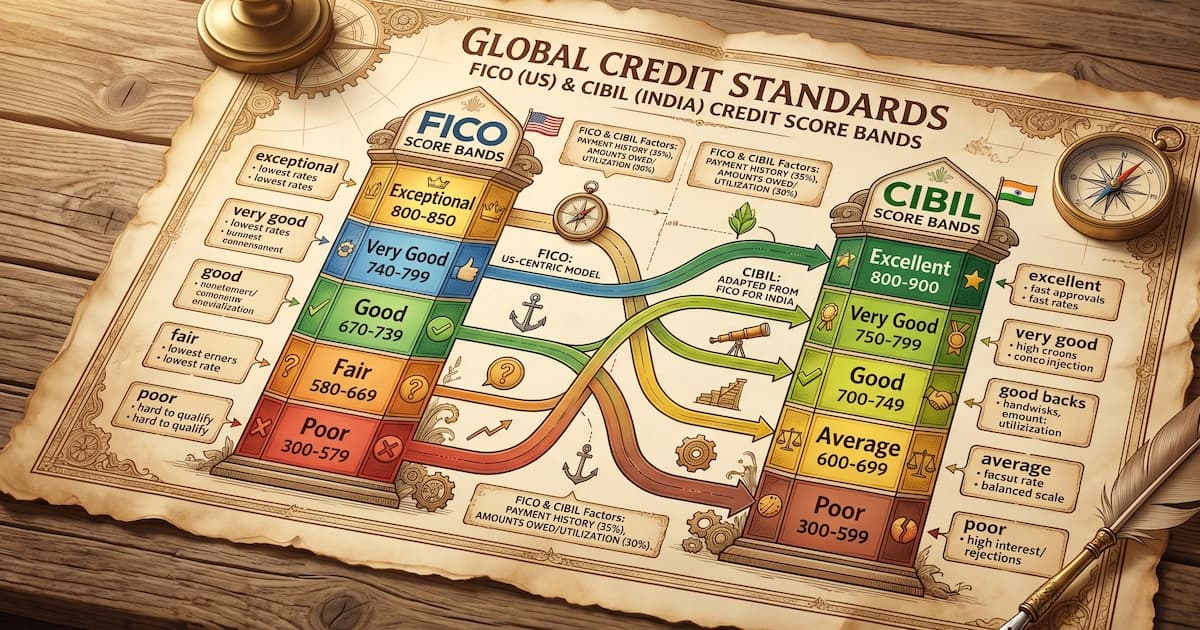
A good credit score is 670+ on FICO (max 850) and 750+ on CIBIL (max 900). See every band, what each one unlocks, and what a good score really saves you.
14 min read
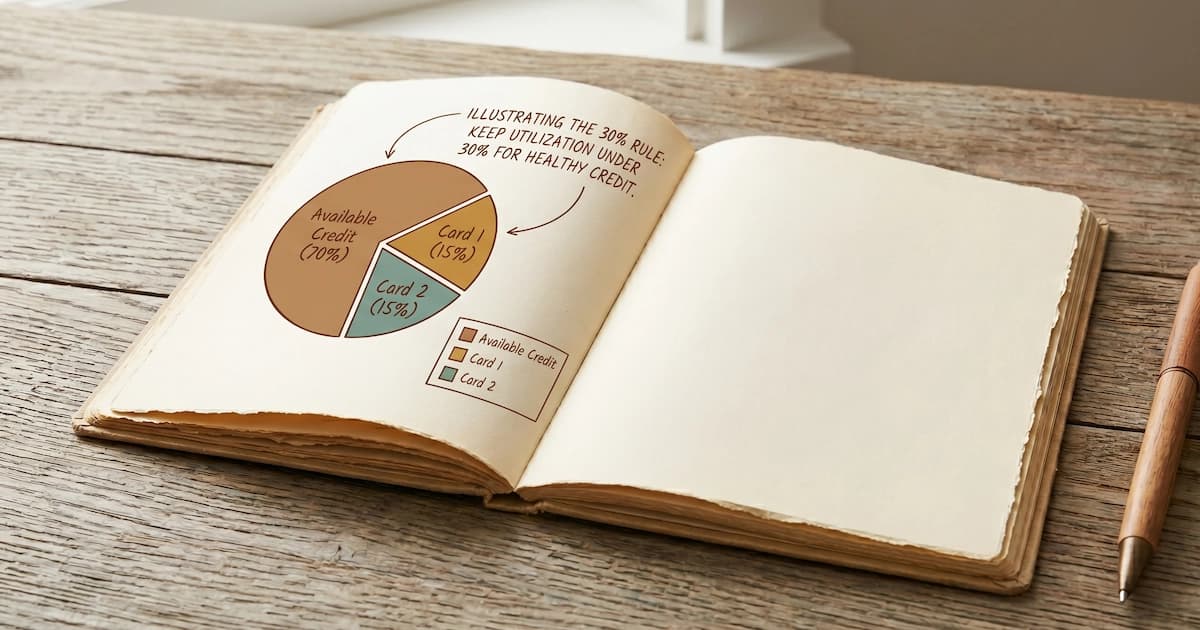
TransUnion CIBIL calls 30% a healthy ratio but sets no official cut-off, and FICO publishes none either. What the data shows, and why top scores sit under 10%.
14 min read