ACH vs Wire Transfer: Speed, Cost, and Safety Compared

By Tapabrata Biswas · Updated September 29, 2026 · 27 min read
Researched with AI assistance, reviewed and edited by Tapabrata Biswas.
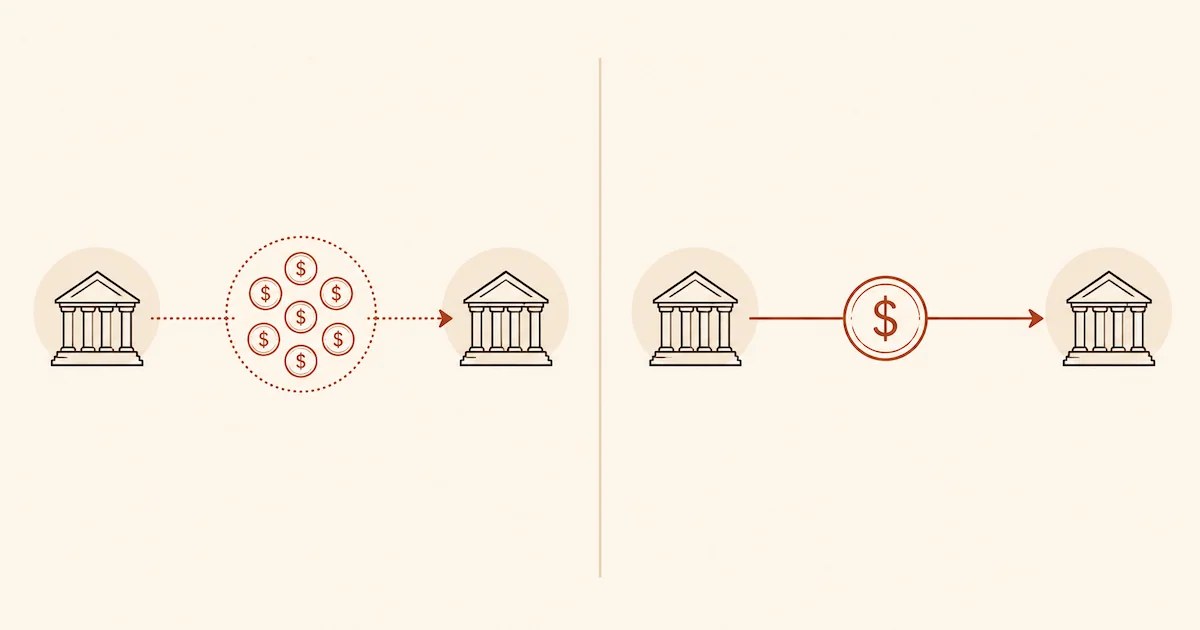
If you only want the verdict: ACH is cheaper and reversible but slow, while a wire is fast and final but costs real money. ACH is the fit for routine US payments like payroll and bills. A wire is the fit for large, urgent, or cross-border transfers where speed matters more than the fee.
That one paragraph beats most of what ranks for this question. It also skips the parts that actually cost people money: the exact fees, the cutoff windows, what happens when money lands in the wrong account, and one legal detail that almost every page online gets wrong. This guide covers all of it, including where the newer instant rails like FedNow, RTP, and UPI fit. It explains how the systems work, and it isn't financial advice.
Should you use ACH or a wire?
Use ACH when the payment is routine and not urgent, and a wire when it's large, time-critical, or crossing a border. That single rule resolves most real decisions, and everything below is the detail behind it.
Pick ACH for direct-deposit payroll, recurring bills, and moving money between your own accounts at different banks. It's cheap, it can be undone if something goes wrong, and you can set it and forget it from a checking account. Pick a wire when a seller demands same-day funds, when a home down payment is due at closing, or when money has to reach a supplier or family member overseas today. You pay for the speed, but on a one-time high-stakes transfer the fee is usually a rounding error against the amount being sent.
For a small, quick payment to a person, an instant rail often beats both. In the US that means Zelle or FedNow; in India, UPI. More on those further down.
ACH vs wire transfer, side by side
This is the full comparison most pages leave half-finished. Every row is a difference that shows up the moment you actually send money.
| ACH transfer | Wire transfer | |
|---|---|---|
| Network | Automated Clearing House (Nacha) | Fedwire (domestic), SWIFT (international) |
| Direction | Push or pull (a biller can debit you) | Push only (you send it out) |
| Speed | 1 to 3 business days; same-day ACH in hours | Same day, often minutes to hours |
| Processing | Batched several times a day | Individual, real time |
| Cost (US) | Free to a few dollars | $25 to $30 domestic, $50+ international |
| Reversible? | Yes: error reversal or consumer dispute | No, final once settled |
| Consumer protection | Covered by Regulation E (EFTA) | Not covered by Regulation E; UCC 4A instead |
| Reach | US only | Worldwide via SWIFT |
| Typical limit | $1M per same-day transaction | High or none, set by your bank |
| Routing number | ACH (ABA) routing number | Often a separate wire routing number |
| Best suited to | Recurring, non-urgent US payments | Large, urgent, or cross-border transfers |
The trade-off is right there in the grid. ACH gives up speed to win on cost and safety. A wire gives up cost and reversibility to win on speed and reach. Neither one is better. They're built for different jobs.
Why every page gives you a different wire fee
Because almost nobody sourcing those numbers says where they came from. Reading nineteen ranking pages on this question in August 2026, only four named a source for any dollar figure. The rest print a range with nothing behind it, and the ranges do not agree.
| What a domestic wire costs | Where it says so |
|---|---|
| $25 to $30 | Melio, Bay Federal Credit Union, Wise |
| Up to $35 for the sender, up to $20 for the receiver | Plaid |
| $20 to $50 | Experian |
| $25 to $50 | Rapyd |
| $20 to $75 | myfsbonline.com |
Speed splits the same way, and there the disagreement is not a range but a straight contradiction. Several pages say a domestic wire arrives within minutes. One comparison table puts wire settlement at one to three business days, and another page states flatly that wires take two business days to process and settle. Those cannot all describe the same rail.
Two things cause this. Fees genuinely differ by bank, so any single figure is a rough average at best. And the numbers get copied between pages without being checked, which is why one page in this field cites two competitors' marketing blogs as the source for its per-transaction costs instead of the network operators. Where a figure below comes from an operator or a regulator, it is linked to one. Where it is a market range, it is described as one.
What is an ACH transfer?
An ACH transfer is an electronic bank-to-bank payment that moves through the Automated Clearing House network in scheduled batches, several at a time. When your salary lands as direct deposit, or your electricity bill is auto-debited, that's ACH at work. The network gathers payments and processes them in batches several times a business day, which is why ACH is cheap and why it isn't instant.
ACH is a US system, governed by a body called Nacha. It's the quiet plumbing behind most routine money movement in America, and it does one thing wires can't: it moves in both directions. A wire only ever pushes money out. ACH can push money out or pull it in, which is exactly what happens when a biller you've authorized reaches into your account on the due date. That pull ability is convenient for autopay and central to how ACH disputes work later on.
A standard ACH transfer takes one to three business days, settling the next business day for non-same-day entries, per the Federal Reserve. Same-day ACH is the faster tier, and its cutoffs are the detail that trips people up. Submit by 10:30 a.m. ET and it settles at 1:00 p.m.; by 2:45 p.m. ET it settles at 5:00 p.m.; by 4:45 p.m. ET it settles at 6:00 p.m., all Eastern time, business days only. The current cap is $1 million per same-day transaction, a limit Nacha has approved raising to $10 million effective September 17, 2027. For most consumers ACH is free or close to it.
What is a wire transfer?
A wire transfer is a direct, real-time movement of funds from one bank to another, processed individually and not in a batch. There's no queue and no overnight wait. The sending bank instructs the receiving bank to credit the money, and for a domestic transfer that usually happens the same day, sometimes within minutes.
Domestic wires in the US run over the Federal Reserve's Fedwire system. International wires ride the SWIFT network, hopping through one or more correspondent banks on the way, each of which can take a cut, which is why an international wire commonly takes one to five business days. Speed is the whole point, and the price reflects it: a domestic outgoing wire typically costs $25 to $30, and an international one $50 or more, per Bankrate. Some banks add a smaller charge to receive one.
To send a wire you'll need the recipient's full name and account number, their bank's name and wire routing number, and for an international transfer the SWIFT or BIC code, sometimes an IBAN. The trait that truly defines a wire, though, is finality. Once the money lands, it's effectively gone. That's a feature when you need certainty, and a serious problem when you've been tricked into sending it to the wrong place.
One detail gets left out of almost every comparison, and it decides whether your wire moves today. Fedwire is not a 24-hour service. Its business day opens at 9:00 p.m. Eastern on the previous calendar day and closes at 7:00 p.m. Eastern, Monday to Friday, excluding holidays, and the deadline for a transfer to a bank's customer is 6:45 p.m. Eastern, per the Federal Reserve. Miss that and the money sits until the next business day, however urgent it was. A wire is fast inside banking hours and completely stationary outside them, which is the opposite of how the instant rails behave.
Is ACH a wire transfer, and is either one an EFT?
No, ACH is not a wire transfer, and the answer to the EFT question is genuinely two-sided. These are the confusions that send people to search engines, so it's worth being precise where almost every competing page waves its hands.
ACH and a wire are separate networks. ACH batches payments over the Automated Clearing House and takes days; a wire moves individually over Fedwire or SWIFT and takes minutes. Same money, different rails, different rules.
The EFT question is the one the whole field gets wrong. In everyday language, an electronic funds transfer is any electronic movement of money between accounts, and people happily call both ACH and wires "EFTs." Colloquially, fine. Legally, no. US Regulation E, the rule that gives you the right to dispute an unauthorized electronic charge, defines an EFT and then explicitly carves wires out. The regulation excludes "any transfer of funds through Fedwire or through a similar wire transfer system that is used primarily for transfers between financial institutions or between businesses," at 12 CFR 1005.3(c)(3). Wires answer to a different rulebook, UCC Article 4A, not the Electronic Fund Transfer Act.
Why does a dry definition matter? Because it's the reason a mistaken ACH debit and a mistaken wire have completely different outcomes. Regulation E hands you error-resolution rights on ACH; the wire carve-out means those consumer rights don't attach to a wire at all. A 2024 attempt by the CFPB to extend some of those protections to online-initiated consumer wires was withdrawn in 2025, so the exclusion still stands today. The hierarchy, held in your head, looks like this: EFT is the everyday umbrella, ACH and wires are the two traditional rails under it, RTP and FedNow are the instant rails, and only ACH sits squarely inside Regulation E's legal definition.
Which is safer, and can you reverse either one?
Safety is directional, not absolute: ACH is safer for the sender because it can be unwound, while a wire is safer for the receiver because it's final. That framing clears up the "is ACH safer than a wire" question, which has no single answer.
An ACH payment can come back through two different mechanisms that people constantly conflate. The first is an error reversal: when a payment is a duplicate, sent to the wrong account, or for the wrong amount, the originator can transmit a reversal so long as it reaches the receiving bank within five banking days of the original settlement date, per Nacha's rules (corroborated in this rule summary). The second is a consumer right: under Regulation E you can dispute an unauthorized ACH debit for up to 60 calendar days from the statement date, using return codes like R10, with a signed statement that the charge wasn't authorized. An error reversal is not the same as a consumer dispute right, and a reversal only recovers money if the funds are still sitting in the receiver's account.
A wire has neither safety net. Once the receiving bank credits it, the sending bank can politely request a recall, but the recipient's bank, and ultimately the recipient, can refuse. Nothing forces the money back. You can cancel a wire only in the narrow window before it settles, which for a domestic wire may be minutes.
Why wire fraud is so hard to undo
Wire finality is exactly why criminals prefer wires, and the numbers are not small. In the classic scam, a fraudster intercepts a home-purchase closing, emails the buyer fake wire instructions that look like they came from the title company, and the buyer wires the entire down payment to the thief.
The FBI's Internet Crime Complaint Center logged a record $16.6 billion in reported cybercrime losses in 2024, and business email compromise, the category that covers this closing scam, accounted for roughly $2.8 billion of it, with about $8.5 billion lost to BEC over 2022 through 2024, per the IC3 2024 report. When the FBI's own rapid-response team tried to freeze fraudulent transfers, it succeeded only about 66 percent of the time, and that's the well-resourced best case. Once a wire clears to a criminal's account and gets moved on, recovery is the exception.
The defense is dull and effective: confirm any wire instructions by calling a known phone number before sending, because no amount of double-checking inside the banking app undoes a wire after it leaves. One related point is worth keeping straight, too. Deposit insurance protects you if your bank fails, not if you authorize a transfer to the wrong person. Those are different risks, and only the first is insured.
What happens if you wire more than $10,000?
Nothing is filed with the government simply because a transfer is large, because the $10,000 rule everyone quotes applies to cash and not to money moving between bank accounts. This is the most-asked question about sending money in the US, and it rests on a mix-up between two unrelated rules.
The one people mean is the Currency Transaction Report, set out at 31 CFR 1010.311. It tells a bank to file a report for any payment "which involves a transaction in currency of more than $10,000". The word doing the work is currency. The IRS describes the same duty as a "cash-in or cash-out currency transaction" and names the form, FinCEN Form 112. The regulation does not mention wire transfers anywhere in its text.
So walking into a branch with $11,000 in notes triggers it. Wiring $80,000 out of an account that already holds the money does not, because no cash changes hands.
The rule that does apply to transfers
The Travel Rule covers funds transfers of $3,000 or more, and all it requires is a paper trail. It sits at 31 CFR 1010.410, paragraphs (e) and (f), and applies "with respect to a transmittal of funds in the amount of $3,000 or more".
Two things happen at that figure. Your bank has to obtain and keep records of who sent the money and who received it. It also has to include those details in the order it passes to the next bank in the chain, which is where the name comes from, because the information travels alongside the payment. Nothing goes to a government agency. Your details just stop being anonymous to every institution the money touches.
The rule almost nobody mentions
A suspicious activity report can be filed on a transfer of $5,000 or more in any form, and the bank is forbidden from telling you. 31 CFR 1020.320 covers transactions that involve or aggregate at least $5,000 "in funds or other assets", and that wording draws no line between cash and a wire. The same regulation says no person involved in a reported transaction is notified that it was reported.
This is why "wires are never reported" is as wrong as "every wire over $10,000 is reported". The trigger is not the size of the payment. It is whether the bank finds the payment odd.
| Rule | Threshold | What happens | Covers a wire or ACH? |
|---|---|---|---|
| Currency Transaction Report, 1010.311 | over $10,000 | filed with FinCEN on Form 112 | No, cash only |
| Travel Rule, 1010.410(e) and (f) | $3,000 or more | records kept, details passed to the next bank | Yes |
| Suspicious activity report, 1020.320 | $5,000 or more, if it looks suspicious | filed, and you are not told | Yes |
Of the ten pages ranking for this comparison that were readable in September 2026, none mentioned the IRS, FinCEN, or any reporting threshold at all. There is a structural reason for the silence. Most of those pages belong to companies that sell payment rails, and a page explaining when your transfer gets written down is not a page that sells one.
Do ACH and wires use the same routing number?
It depends on your bank, and the four biggest US banks do not agree with each other. Some publish one number for everything. Others publish a separate wire routing number that differs from the ACH number printed on your cheques. There is no rule that settles it, which is why the answer you find online depends entirely on which page you land on.
The banks publish the answer themselves, on their own routing-number pages.
| Bank | ACH routing number | Wire routing number | Same? |
|---|---|---|---|
| Bank of America | 121000358 (California, varies by state) | 026009593 (all states) | No |
| Chase | 122100024 (Arizona), 322271627 (California) | 021000021 (all states) | No |
| HSBC USA | 022000020 | Published separately | No |
| Wells Fargo | 121000248 | 121000248 | Yes |
Wells Fargo returns the same nine digits whether you ask for a deposit or a wire. Bank of America and Chase hand you two different numbers. HSBC is asked directly on its own FAQ whether its universal number works for wires and answers, in one word, no.
Why one number sometimes works for everything
Because the wire number at some banks happens to equal one region's ACH number, which makes a real difference look like an imaginary one. Chase is the clearest case. Its nationwide wire number, 021000021, is also its ACH number for downstate New York.
So a customer in New York finds a single number that works for direct deposit and for wires, concludes the two are always identical, and says so online. A customer in Arizona sends a wire to 122100024 and watches it bounce. Both are describing the same bank honestly.
The reason the numbers diverged at all is history, not design. Chase absorbed Washington Mutual, Bank One, Bear Stearns and dozens of regional banks, and each acquisition arrived with its own routing numbers already embedded in millions of standing payroll and autopay instructions. Changing them would have broken those payments, so the regional ACH numbers stayed and the wire traffic was consolidated onto one.
How to find your own wire routing number
The Federal Reserve publishes a free directory that answers this, and it runs separate lookups for the two rails. Its E-Payments Routing Directory offers a "Search Fedwire Participants" tool and a "Search FedACH Participant RDFIs" tool as two distinct searches, which is itself the plainest evidence that eligibility for each rail is tracked per number, not per bank. The directory is refreshed daily, generally by 5:00 a.m. Eastern.
Routing numbers are assigned by LexisNexis Risk Solutions, which acts as Official Routing Number Registrar for the American Bankers Association. Neither the ABA nor the Federal Reserve publishes a plain sentence saying a bank's ACH and wire numbers may differ, so the structure of the Fed's own directory is the closest thing to an official acknowledgement that they can.
For a specific account, the number on the cheque is the ACH one. The wire number usually sits on a separate wire-instructions page on the bank's site, not in the routing-number FAQ, and a phone call is faster than hunting for it.
What happens if you use the wrong one
Most of the time the payment simply fails. A wire sent to an ACH-only number generally gets rejected and returned and not landing in a stranger's account, because the receiving system does not recognise the number as valid for that rail. The cost is a lost settlement cycle, not lost money, though some banks charge a returned-wire fee, so it is worth asking yours what that fee is before you find out.
For the full breakdown of which code does what, including the SWIFT and BIC codes an international wire needs, see routing number vs IFSC code. India sidesteps this problem entirely: the IFSC code stays constant across NEFT, RTGS, and IMPS, so there is no second number to look up.
What about FedNow, RTP, and Zelle?
FedNow and RTP are instant payment rails that settle money in seconds, any hour of any day, and they are the third option most ACH-vs-wire comparisons ignore. Of nineteen ranking pages checked for this guide in August 2026, three mentioned FedNow at all, and every page comparing ACH against wires left it out completely.
The Federal Reserve launched FedNow on July 20, 2023, and it runs a 24-hour business day every day of the week including weekends and holidays. RTP, run by The Clearing House, has operated since 2017, and its own description of settlement is blunt: final and irrevocable, with no ability for the sending bank to recall a payment once submitted. In that respect an instant payment behaves like a wire, not like ACH.
Both now carry a $10 million ceiling. RTP's limit sits there today, and FedNow raised its own customer credit transfer cap from $1 million to $10 million effective 12 November 2025, per the Federal Reserve. Individual banks can set lower limits than the network allows, so yours may cap you well below that.
Reach is the part that changed fastest. RTP reported over 1,322 participating institutions as of July 2026, and it says 98 percent of all US instant payments cleared and settled on its network during 2025. FedNow passed 1,500 participating institutions across all fifty states by December 2025, a 44 percent rise in a year. These rails are no longer a pilot, and they are quietly taking the work small wires and same-day ACH used to do.
Zelle is the one people ask about most, and the honest answer is that it's neither ACH nor a wire. Zelle is a bank-owned network that moves money directly between enrolled US bank accounts, usually within minutes, and its own FAQ declines to classify the underlying rail. Treat it as an instant transfer between banks that happens to have a friendly app on top. If you've ever sent a friend money on Zelle and watched it arrive in seconds, you've used this newer layer of plumbing without thinking about which rail carried it.
How this maps to India's rails
India runs the same split under different names: NEFT works like ACH, RTGS works like a domestic wire, and IMPS and UPI are the instant rails. The roles line up almost one for one.
| US rail | India equivalent | What it is |
|---|---|---|
| ACH | NEFT | Batched bank-to-bank transfers, settled in half-hourly cycles, 24x7x365 |
| Wire (Fedwire) | RTGS | Real-time gross settlement, minimum 2 lakh rupees, no upper ceiling |
| FedNow / RTP | IMPS | Instant interbank transfers, running 24/7 |
| Zelle | UPI | Instant app-based payments between accounts |
The mapping holds, and one part of it inverts. NEFT settles in half-hourly batches like ACH, but the RBI states it runs on a 24x7x365 basis, and it has since December 2019. RTGS went the same way in December 2020. So India's wire equivalent never closes, while Fedwire shuts at 7:00 p.m. Eastern and stays shut all weekend. On availability, the older Indian rails beat the American ones outright.
The RBI also sets no ceiling on either. It states plainly that there is no limit on NEFT transfers, and that RTGS has a 2 lakh rupee minimum with no maximum, though individual banks impose their own caps. NEFT and RTGS are operated by the Reserve Bank of India, while UPI and IMPS are run by NPCI. Money crossing India's borders still travels over SWIFT, the same network as an international wire, with comparable fees and timelines. For the deeper India explainers, see IMPS vs NEFT vs RTGS and what UPI is.
What this guide does not cover
This is an explainer of how the transfer rails work, not advice on any specific transfer or a recommendation of any bank. Fees, limits, and cutoff times vary by bank and change over time, so confirm the current numbers with yours before you send anything important. It also leaves aside business ACH file formats, crypto transfers, and card-network payments, which run on different plumbing again. For anything with real money or legal stakes, such as a closing wire, confirm the details directly with your bank.
Frequently asked questions
Is ACH a wire transfer? No. ACH and wire transfers are different networks doing different jobs. ACH moves money in scheduled batches over the Automated Clearing House network governed by Nacha, so it is cheap, takes 1 to 3 business days, and can be returned. A wire moves individually and in real time over Fedwire (domestic) or SWIFT (international), so it is fast, costs $25 or more, and is final once it settles. They are not two names for the same thing.
Is a wire transfer an EFT? It depends on which definition you mean. In everyday usage a wire is one type of electronic funds transfer, alongside ACH and card payments. But under US Regulation E, the law that gives you the right to dispute an unauthorized electronic charge, a wire is specifically excluded from the definition of an EFT (12 CFR 1005.3(c)(3)). Wires are governed by a different rulebook, UCC Article 4A. That legal carve-out is a big part of why a wire is so hard to reverse.
Which is faster, ACH or a wire transfer? A wire is faster. A domestic wire usually settles the same business day, often within minutes once it is released. A standard ACH transfer takes 1 to 3 business days, though same-day ACH can clear within hours if both banks support it and you send inside the day's cutoff window.
Which is cheaper, ACH or a wire transfer? ACH, by a wide margin. ACH is free or costs a few cents to a few dollars, and many banks charge consumers nothing. A domestic outgoing wire typically costs $25 to $30 and an international one $50 or more, per Bankrate, and some banks also charge a smaller fee to receive a wire.
Can a wire transfer be reversed? Generally no. Once a wire is sent and the receiving bank credits it, the money is gone, and the sending bank cannot claw it back without the recipient agreeing. You can sometimes cancel a wire in the short window before it settles. This finality is why wire fraud, especially in home-purchase closings, is so often unrecoverable, and why wire instructions are worth verifying by phone before sending.
Is Zelle an ACH transfer or a wire? Neither, technically. Zelle is a bank-owned network that moves money directly between enrolled US bank accounts, usually within minutes. It is not a classic ACH batch and not a Fedwire wire, and Zelle's own FAQ does not pin it to either rail. Practically it behaves like an instant transfer. India's UPI plays a similar role there, built on the IMPS instant rails, separate from any ACH-style batch.
Do ACH and wire transfers use the same routing number? It depends on the bank, and the largest US banks disagree. Wells Fargo uses 121000248 for both. Bank of America publishes a state-specific ACH number, 121000358 in California, alongside a single wire number, 026009593. Chase does the same, with ACH numbers such as 122100024 in Arizona against one nationwide wire number, 021000021. HSBC USA is asked on its own FAQ whether its universal number works for wires and answers no. Confusion is common because Chase's wire number is also its downstate New York ACH number, so a New York customer sees one number that works everywhere while an Arizona customer sees two. In India the IFSC code stays the same across NEFT, RTGS and IMPS, so the problem does not arise.
Where do I find my wire routing number? Not on your cheque, which carries the ACH number. The wire number normally sits on a separate wire-instructions page on your bank's website rather than in its routing-number FAQ, and calling the bank is usually faster than searching for it. You can also use the Federal Reserve's E-Payments Routing Directory, which runs a Fedwire participant search and a FedACH participant search as two separate tools, updated daily by 5:00 a.m. Eastern. Routing numbers themselves are assigned by LexisNexis Risk Solutions, which acts as Official Routing Number Registrar for the American Bankers Association.
What happens if I use the ACH number for a wire? Usually the payment fails and not reaching the wrong person, because the receiving system does not accept that number for that rail. The real cost is time, a lost settlement cycle, though some banks charge a returned-wire fee, so it is worth knowing yours in advance.
Are wire transfers available 24/7? No. The Federal Reserve states that the Fedwire Funds Service business day begins at 9:00 p.m. Eastern on the preceding calendar day and ends at 7:00 p.m. Eastern, Monday through Friday, excluding designated holidays, with a 6:45 p.m. Eastern deadline for transfers to a bank's customer. Outside those hours a wire waits for the next business day, however urgent it is. India's RTGS works the other way round: the Reserve Bank of India has run it on a 24x7x365 basis since 14 December 2020.
Do banks report wire transfers over $10,000 to the IRS? Not because of the amount alone. The Currency Transaction Report at 31 CFR 1010.311 applies to a transaction in currency of more than $10,000, which means physical cash, and the regulation never mentions wire transfers. A separate rule, 31 CFR 1020.320, lets a bank file a suspicious activity report on any transaction of $5,000 or more that it finds suspicious, whether cash or a transfer, and the bank is not allowed to tell you it did.
What is the $3,000 rule for wire transfers? It is the Travel Rule, at 31 CFR 1010.410(e) and (f), and it applies to a transmittal of funds of $3,000 or more. Your bank has to keep records of who sent and who received the money, and pass those details to the next bank in the chain. Nothing is filed with a government agency, so the rule leaves a trail without creating a report.
Sources
- Federal Reserve, Same Day ACH FAQ and FedNow Service launch frbservices.org · federalreserve.gov
- Nacha, Same Day ACH dollar-limit increase to $10 million nacha.org
- Consumer Financial Protection Bureau, Regulation E, 12 CFR 1005.3 consumerfinance.gov
- Federal Reserve, Fedwire Funds Service (business-day hours, the 6:45 p.m. ET third-party deadline, and finality) federalreserve.gov
- Federal Reserve, FedNow transaction limit increase to $10 million, effective 12 November 2025 frbservices.org
- Federal Reserve, E-Payments Routing Directory (separate Fedwire and FedACH participant lookups, updated daily by 5:00 a.m. ET) frbservices.org
- The Clearing House, RTP network (the $10 million limit, 24/7 operation, irrevocable settlement, and participant count as of July 2026) theclearinghouse.org
- 31 CFR 1010.311, the Currency Transaction Report requirement, quoted here for the phrase "a transaction in currency of more than $10,000" law.cornell.edu
- 31 CFR 1010.410, paragraphs (e) and (f), the Travel Rule recordkeeping and information-passing duties at $3,000 or more law.cornell.edu
- 31 CFR 1020.320, suspicious activity reporting by banks at $5,000 or more in funds or other assets, and the bar on notifying anyone involved law.cornell.edu
- Internal Revenue Service, Money Services Business information center (FinCEN Form 112 and the cash-in or cash-out currency transaction test) irs.gov
- Reserve Bank of India, NEFT FAQ (half-hourly batches, 24x7x365 availability, no RBI-imposed limit) rbi.org.in
- Reserve Bank of India, RTGS FAQ (2 lakh rupee minimum, no maximum, 24x7x365 since 14 December 2020) rbi.org.in
- Bank of America, Chase, HSBC USA and Wells Fargo published routing-number pages, for the ACH and wire numbers compared in this guide
- Bankrate, Wire transfer fees (a market range, not an operator figure) bankrate.com
- FBI Internet Crime Complaint Center, 2024 Internet Crime Report ic3.gov
- Reserve Bank of India, NEFT, RTGS, and IMPS payment systems rbi.org.in



You might also like
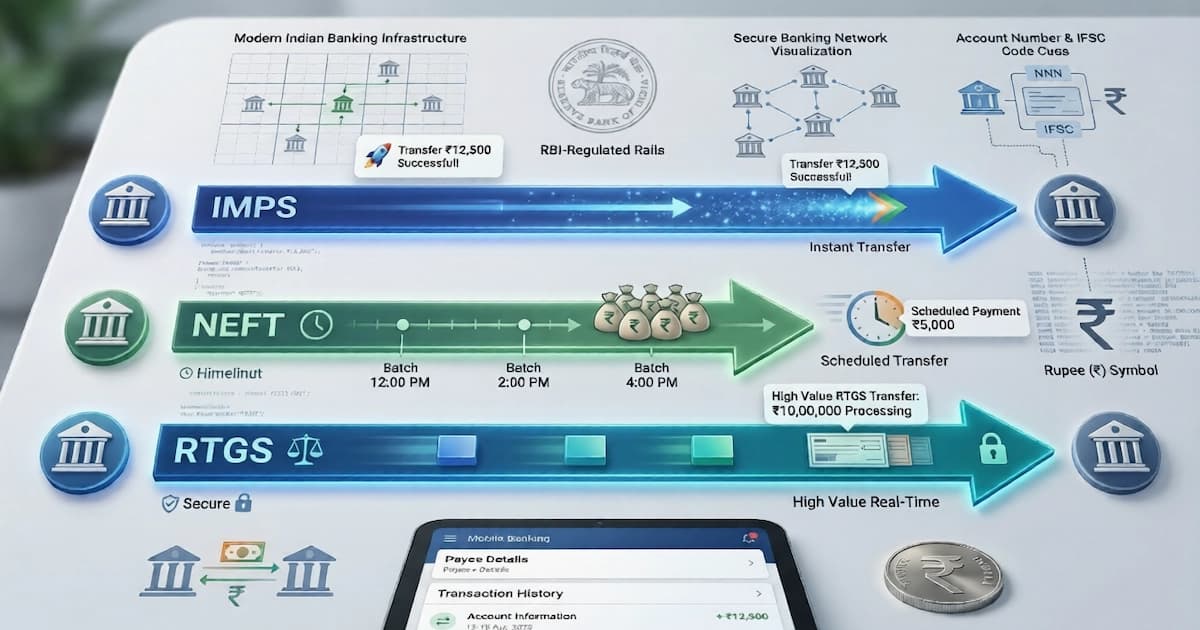
RBI sets no maximum on NEFT and caps RTGS charges at Rs 25 and Rs 50. What each rail costs, how fast it credits, and where bank caps quietly replace RBI rules.
19 min read

What your bank can charge and what it cannot: RBI's Rs 23 ATM cap, the free-transaction rules most pages get wrong, and US averages from Bankrate 2025.
17 min read
India has no routing number. How IFSC, ABA routing numbers and SWIFT differ, how to check a code is valid before you use it, and what happens when it is wrong.
18 min read