Kakeibo: The Japanese Budgeting Method, Free Template

By Tapabrata Biswas · Updated September 20, 2026 · 22 min read
Written and fact-checked by Tapabrata Biswas. How I write
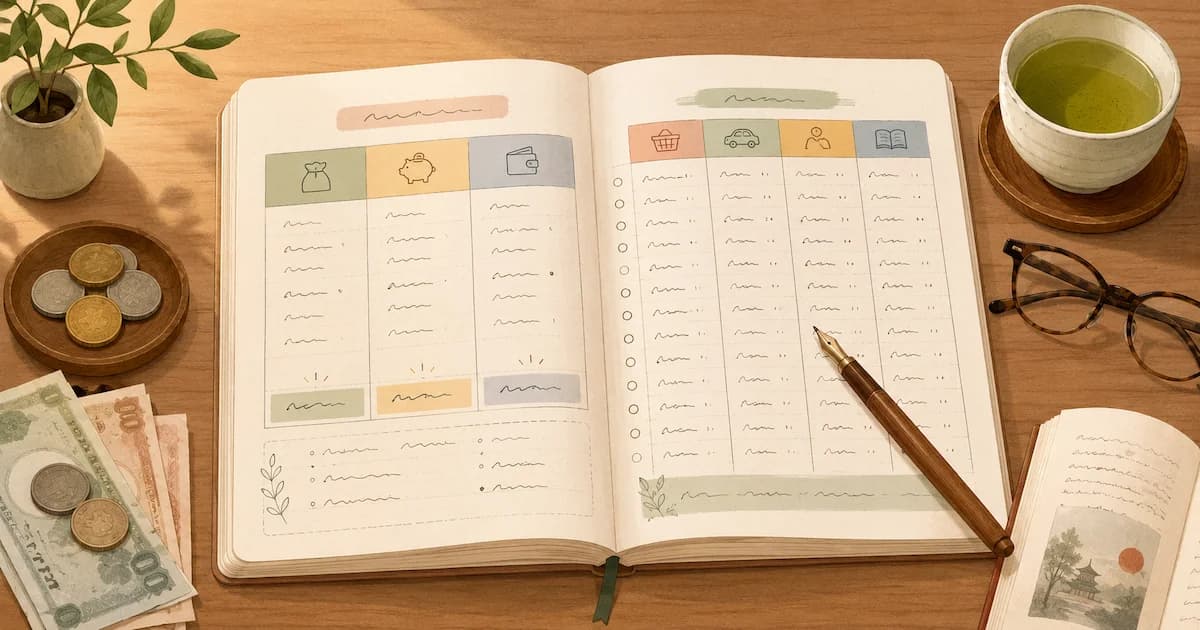
A budgeting method from 1904 has quietly outlasted most of the apps built to replace it. Kakeibo asks you to put your phone down, open a paper notebook, and write every purchase by hand. That sounds like a step backward until you try it and notice how much harder it is to forget a ₹400 impulse buy once your own hand has written it down. The method has no dashboard, no auto-categorization, and no sync. That's the whole idea.
This explains what kakeibo is, where it came from, the four questions and four categories it runs on, how to actually do it step by step, what the ledger looks like, and a full worked month in both rupees and dollars. It's an explainer of the method and who it suits, not financial advice. Kakeibo is one of about ten common approaches, and how it stacks up against the others sits in budgeting methods compared.
What is kakeibo?
Kakeibo is a Japanese pen-and-paper budgeting method that records income and every expense by hand, then reviews the month against four set questions. The word (家計簿, pronounced "kah-keh-boh") means household financial ledger. It's also spelled kakebo, which is just a shorter romanization of the same word, so the two refer to the identical method.
What sets kakeibo apart from a spreadsheet is that the manual part is deliberate. There's no app, no automatic import, no category guessed for you. You write the income at the top, set aside a savings target before you spend a rupee, and then log purchases one line at a time as they happen. The friction is the feature. An app that silently files a transaction lets you stay unaware of it; a notebook that makes you write "₹850, dinner out" in your own handwriting does not. Fumiko Chiba's 2018 book, Kakeibo: The Japanese Art of Saving Money, is what carried the method to Western readers, but the practice itself is more than a century old.
Who invented kakeibo?
Kakeibo was devised by Hani Motoko, and the first edition was published at the end of 1904 as a standalone annual ledger. The publisher she founded still prints it, every year, and the 2026 edition is on sale now.
That sentence differs from almost every English page on this topic, so here is where it comes from. Fujin no Tomo Sha, the company Hani founded, published a 120th-anniversary note about the ledger. Its own words: 『羽仁もと子案家計簿』が初めて発行されたのは、明治37(1904)年末, meaning the Hani Motoko-style kakeibo was first issued at the end of Meiji 37, which is 1904.
Four details the English coverage tends to muddle:
- The name order. In Japanese it is Hani Motoko, family name first. English pages usually flip it to Motoko Hani. A few misspell it "Makoto."
- It was not published inside a magazine. The Japanese sources use 刊行, to issue as a publication, and the publisher describes a separate annual ledger. The "she published it in a women's magazine" framing is an English invention.
- The magazine's name is wrong by four years. Pages that name Fujin no Tomo as the 1904 venue are citing a title that did not exist yet. The magazine launched in 1903 as 家庭之友 (Katei no Tomo) and was renamed 婦人之友 (Fujin no Tomo) only in 1908. The publisher's anniversary note places the ledger in 「『婦人之友』(家庭之友)が創刊された翌年」, the year after that launch.
- The translation. 婦人 means woman, so Fujin no Tomo is "Woman's Friend." "The Housewife's Friend" is a different magazine entirely, 主婦の友 (Shufu no Tomo), and the two get conflated constantly. This post carried that error until September 2026.
The record since is unbroken apart from one gap. 戦中戦後の4年間は紙の統制により発行できませんでした: for four years during and after the war it could not be printed, because paper was rationed. Every other year since 1904, it has appeared.
What travelled to the rest of the world was Fumiko Chiba's 2018 book, after which the method spread through UK, US and Australian finance writing, and more recently Indian personal-finance sites. As the next section shows, a good deal changed in transit.
What does the original Japanese kakeibo actually look like?
The ledger Hani Motoko designed runs on fourteen purpose-based expense items, not four categories, and the four reflective questions are not in the Japanese sources at all. This is the single biggest gap between what "kakeibo" means in English and what it means in Japan, and we could not find it stated on any English page.
The publisher's own guidance is blunt about the count: 14の項目を軸とした費目になっています。一般的な費目に比べると数が多いですが, meaning it is built on fourteen items as its axis, and that is more than a typical household ledger uses. The fourteen:
| Japanese | English |
|---|---|
| 副食物費 | Side dishes |
| 主食費 | Staple foods |
| 調味料費 | Seasonings |
| 光熱費 | Utilities |
| 住居・家具費 | Housing and furniture |
| 衣服費 | Clothing |
| 交際費 | Social |
| 教育費 | Education |
| 教養費 | Culture and learning |
| 娯楽費 | Entertainment |
| 保健・衛生費 | Health and hygiene |
| 職業費 | Work |
| 特別費 | Special |
| 公共費 | Public contributions |
Food alone splits three ways. The book ships with a 50音順費目索引, an index of expense categories in kana order, which tells you plainly that there are more of them than anyone is expected to memorise.
Two more things travel badly:
- The defining feature is the budget, not the mindfulness. The publisher describes the method as 予算のある, having a budget: 生活費を費目わけして年間の予算を立てて、そこから差し引きしながらの記帳, which is dividing living costs by category, setting an annual budget, and recording while subtracting from it. English pages sell kakeibo as a reflection and mindfulness practice. The original is a budget-first system with a year-long horizon.
- The four questions are absent. They appear on every English page and in none of the Japanese sources we could reach: not the publisher's anniversary note, not its own how-to writing, not the Japanese Wikipedia entries for 家計簿 or 羽仁もと子.
Being precise about the limit of that claim: we are saying the four categories and four questions are absent from every Japanese source we could reach, which is not the same as proving who invented them. We did not obtain Chiba's book text or Hani's autobiography. The honest summary is that the four-box kakeibo is an English-language adaptation wearing the name of an older and considerably more demanding system.
None of which makes the four-box version worthless. It is a real, workable budget, and it is what you almost certainly meant if you searched for kakeibo. The rest of this post teaches it, now that you know what it is.
The four questions kakeibo asks
Kakeibo as practised in English runs on four questions you answer around each month: how much money do you have, how much would you like to save, how much are you spending, and how can you improve? The order matters, because the first two are planning questions and the last two are review questions.
- How much money do you have? You total your income for the month.
- How much would you like to save? You set the savings goal before spending, not after.
- How much are you spending? You track every purchase and total it at month end.
- How can you improve? You look back and decide one thing to change next month.
That fourth question is the engine of the method. A budget you write once and never revisit rarely changes anything; kakeibo bakes in a monthly look back so each month informs the next. Some kakeibo journals add a parallel set of weekly questions (what did I spend this week, what could I have skipped), but the four above are the classic, and they're the one element every version agrees on.
The four spending categories
In its English form, kakeibo sorts spending into four categories: needs, wants, culture, and unexpected. You'll also see them labeled survival, optional, culture, and extra, which is the same four buckets under different names. The one constant across every English version is "culture," which most budgets never separate out, and which corresponds loosely to the original's 教養費.
| Category | Also called | What goes in it |
|---|---|---|
| Needs | Survival | Groceries, transport, utilities, medicines, school fees, EMIs |
| Wants | Optional | Dining out, clothes, hobbies, non-essential shopping |
| Culture | Culture | Books, courses, museums, concerts, streaming subscriptions |
| Unexpected | Extra | Repairs, medical bills, gifts, festival and Diwali spending |
The culture bucket is the quietly clever part. By giving books, learning, and the odd concert their own line, kakeibo lets you spend on enrichment without it feeling like a guilty "want," and it makes visible when culture spending has actually become entertainment. For an Indian household, the unexpected bucket earns its keep around festival season, when Diwali gifting and shopping arrive every year yet somehow always feel like a surprise to the budget.
How to do kakeibo, step by step
Doing kakeibo means planning the month on paper, logging every expense by hand as it happens, and reflecting at month end against the four questions. The full cycle is six steps.
- Write down your total income for the month at the top of the page.
- Subtract your fixed expenses (rent, EMIs, base utilities), the costs that don't move.
- Set your savings goal and subtract it too. Whatever's left is your spending money for the month.
- Through the month, log every purchase by hand, tagging each to one of the four categories.
- At the end of each week, total your spending so far; at month end, total each category.
- Reflect: did you hit the savings goal, which category ran hot, and what one thing will you change next month?
The sequence is what makes kakeibo a savings method, more than an expense tracker. Because the savings goal comes out before the spending money is set, saving isn't whatever happens to be left over, it's decided first. The logging in step 4 is the part people underestimate; it takes a minute a day, and that minute is where the awareness comes from.
What a kakeibo ledger looks like
A kakeibo ledger has three parts: a monthly planning block, a daily spending log, and a month-end reflection. Most guides describe the method but never show the book, which is odd given how many people search for a kakeibo ledger or template. The structure, on a single page:
The planning block sits at the top:
| Month plan | Amount |
|---|---|
| Income | ₹60,000 |
| Fixed expenses | minus ₹30,000 |
| Available | ₹30,000 |
| Savings goal | minus ₹12,000 |
| Spending money | ₹18,000 |
Below it runs the daily log, ruled so a week or a fortnight fits at a glance, with a category tag on every line:
| Date | Item | Amount | Category |
|---|---|---|---|
| 3rd | Groceries | ₹1,200 | Needs |
| 5th | Dinner out | ₹850 | Wants |
| 8th | Two books | ₹700 | Culture |
| 12th | Mixer repair | ₹1,500 | Unexpected |
And the month-end reflection closes it: a total for each category, the total spent against your spending money, and a line answering "how can I improve." You can rule this into any notebook. Pre-printed kakeibo journals exist, but a plain diary and a pen do the job. If you'd rather total the month digitally, the kakeibo calculator mirrors this exact layout, and a ready-made Google Sheets template sums each bucket for you, though the pen-and-paper version is the original for a reason.
Free kakeibo template, in Excel and as a printable PDF
We built both, they are free, they need no email address, and neither one is a lead magnet. Search suggestions for kakeibo are dominated by people looking for a template, a budget planner, or a printable PDF, and the pages that explain the method almost never ship the thing itself. The image results are mostly Etsy listings.
| Excel planner | Printable PDF | |
|---|---|---|
| Format | .xlsx, three sheets | A4, three pages, colour |
| Does the maths | Yes, formulas built in | No, you write it |
| Category totals | Fill themselves from the log | You total by hand |
| Currency | Any, one cell sets it | Any, you write it |
| Best for | Anyone who wants the arithmetic done | Anyone who wants the method as intended |
The Excel version carries a planner sheet, a 400-row log, and a read-me:
- Enter income, fixed costs and a savings goal. Spending money computes itself, in that order, because setting the goal before the spending money is the method.
- Log each purchase and pick a category from a dropdown. The cell colours itself by category.
- The Actual column fills from the log with
SUMIF, so category totals are never hand-added. - A checking line tells you whether your four category budgets actually add up to your spending money, or whether you are over, or whether some is still unassigned.
- At month end it answers did you hit the savings goal and which category ran hottest on its own.
The PDF version is three A4 pages: the monthly plan with the four category budgets, a ruled 26-line daily log with category circles, and a month-end reflection page. Print page two as many times as the month needs.
Worth saying plainly, since it argues against our own spreadsheet: kakeibo is a pen-and-paper method, and the PDF is the one that matches it. The whole claim of the method is that writing slows you down enough to notice. A spreadsheet that totals everything for you removes the friction the method depends on. The Excel file exists because plenty of people want the arithmetic handled, and that is a reasonable thing to want. It is just a different thing from kakeibo.
Both files also carry the sourcing from the section above, so the fourteen-item original travels with them.
If you would rather not download anything, the kakeibo calculator runs the same layout in the browser.
A worked example in ₹ and $
Running a real month through kakeibo makes the method concrete, and no other guide seems to bother. Take a household earning ₹60,000 a month, using the plan above: ₹30,000 in fixed costs, a ₹12,000 savings goal set aside first, leaving ₹18,000 of spending money to divide across the four categories.
Over the month, the logged spending totals like this:
| Category | Spent |
|---|---|
| Needs (groceries, transport, phone) | ₹9,000 |
| Wants (dining out, a shirt) | ₹4,200 |
| Culture (two books, a museum, streaming) | ₹1,800 |
| Unexpected (mixer repair) | ₹1,500 |
| Total spent | ₹16,500 |
Spending money was ₹18,000 and only ₹16,500 went out, so ₹1,500 stayed unspent. Added to the ₹12,000 already saved, this household actually put away ₹13,500. The month-end reflection writes itself: the goal was met, and the "how can I improve" answer is that dining out under wants crept toward ₹4,200, the obvious lever for next month. The same logic works in dollars: on $4,000 income with $2,000 fixed and a $600 goal, the $1,400 of spending money might land at $780 needs, $360 wants, $120 culture, and $90 unexpected, a total of $1,350, leaving $50 to add to savings. The numbers change; the four buckets and the reflection don't.
Does writing it by hand actually help?
Kakeibo's core claim, that handwriting makes budgeting work better than an app, rests on the way writing forces attention, since no budgeting trial has tested it. It's worth being honest about the evidence here without overselling it.
The often-cited support is a 2014 study by Pam Mueller and Daniel Oppenheimer, "The Pen Is Mightier Than the Keyboard," which found that students taking notes by hand understood material better than those typing, because handwriting is slower and makes you process the material as you write, where typing lets you transcribe on autopilot. That's a note-taking study, not a budgeting experiment, so it's a reasoned analogy and not proof that kakeibo beats an app on rupees saved. What it does support is the mechanism kakeibo relies on: the slowness of writing "₹850, dinner out" is exactly what makes the spend register, where an app that files it silently lets it slip past unnoticed. Whether that translates into more saving depends entirely on whether you keep it up, which is the honest catch with any manual method.
Is kakeibo difficult to learn?
The method takes about ten minutes to understand and roughly a minute a day to run, so the difficulty is never comprehension, it is the daily logging. There is no formula to learn and nothing to install.
What is genuinely easy:
- The arithmetic. Income, minus fixed costs, minus savings goal, equals spending money. That is the whole calculation.
- The categories. Four buckets, and the edge cases matter far less than people fear. A streaming subscription can sit in culture or wants; what matters is that you pick one and stay consistent.
- Starting. A notebook and a pen. No setup, no account, no subscription.
What is genuinely hard:
- Logging every day. This is the entire difficulty. Miss three days and you are reconstructing from memory, which is exactly the recall the method exists to avoid.
- Writing down the purchases you feel sheepish about. A method that only records the comfortable spending tells you nothing.
- Sticking with it past week two, when the novelty has gone and the habit has not yet formed.
For anyone coming from the original fourteen-item ledger, the answer changes: that version is meaningfully harder, which is why its own publisher warns newcomers about the number of categories and ships an index to look them up.
How kakeibo compares to other budgeting methods
Kakeibo is one of about ten common budgeting methods, and it trades automation for awareness in a way none of the percentage rules do. Where it fits depends on what you want a budget to do.
If kakeibo's freeform categories feel too loose, the 50/30/20 rule gives you fixed percentages in place of a savings goal you set by hand. If you'd rather cap spending with physical cash than with a written log, the envelope budgeting method adds the same friction through cash, where kakeibo uses a written log. And kakeibo's "set the savings goal first" step is really pay yourself first in another form. New to budgeting entirely? Start with how to make a budget, then layer kakeibo's reflection habit on top. The full side-by-side sits in the budgeting methods hub.
What this post does not cover
This is an explainer of what kakeibo is and how to run it, not financial advice or a recommendation to adopt it over any other method. It doesn't sell a template, rank kakeibo journals or apps, or claim a specific savings percentage, since the one widely-quoted "save X% in month one" figure traces back to marketing copy and not to any study. Whether a manual method suits you depends on your own habits and how much upkeep you'll sustain. For a decision tied to your specific finances, a qualified financial professional is the right source.
Frequently asked questions
What is the kakeibo method? Kakeibo is a Japanese budgeting method that records income and every expense by hand in a physical ledger, then reviews the month against four questions. The word means household financial ledger. At the start of the month you note your income, subtract fixed costs, set a savings goal, and divide what remains across four spending categories: needs, wants, culture, and unexpected. Through the month you log each purchase by hand, and at month end you total each category and reflect on where to improve. It uses no app or spreadsheet on purpose, because handwriting is meant to make spending conscious.
What are the four questions in kakeibo? Kakeibo asks four questions each month: how much money do you have, how much would you like to save, how much are you spending, and how can you improve? The first two are answered at the start of the month when you plan; the last two are answered at the end when you total your spending and reflect. The point of the fourth question is that a budget you review is a budget that changes behavior, so each month feeds the next.
What are the four categories in kakeibo? Kakeibo sorts spending into four categories: needs (survival costs like groceries, transport, and utilities), wants (dining out, hobbies, non-essential shopping), culture (books, courses, concerts, streaming), and unexpected (repairs, medical bills, gifts, festival spending). Some versions label them survival, optional, culture, and extra, but the four buckets are the same. Worth knowing: this four-way split is an English-language repackaging. The ledger Hani Motoko actually designed, still published annually in Japan, runs on fourteen purpose-based items with food split three ways into staples, side dishes and seasonings. The unusual one is culture, which most Western budgets fold into wants; kakeibo keeps it separate to make room for enrichment without guilt.
Is kakebo the same as kakeibo? Yes. Kakebo and kakeibo are two romanizations of the same Japanese word, 家計簿, so they refer to the identical budgeting method. Kakeibo is the more common spelling in English; kakebo is the shorter variant you'll see on some templates and journals. There is no difference in the method itself.
Do you need an app or spreadsheet for kakeibo? No. Kakeibo is designed to run on paper, and the handwriting is treated as a feature, not a limitation. The idea is that physically writing down each purchase forces a small pause that an automatic app sync removes, keeping you aware of where money goes. You can keep a kakeibo in any notebook. Some people do adapt it to a spreadsheet or app for the maths, but that trades away the mindfulness the method is built around.
Who is kakeibo best for? Kakeibo tends to suit people who overspend without noticing and who want awareness more than automation. Because it's manual, it works best for those willing to spend a few minutes logging expenses and a longer session reflecting at month end. It's a weaker fit for anyone with high transaction volume or who wants a hands-off, automated system, where a percentage rule like 50/30/20 or an automated pay-yourself-first transfer asks far less upkeep.
Is there a free kakeibo template or printable planner? Yes, and this post carries two, both free and neither gated behind an email address. The Excel planner is a three-sheet workbook: you enter income, fixed costs and a savings goal, the spending money computes itself, and a 400-row log with a category dropdown feeds the category totals through SUMIF, so nothing is hand-added. At month end it works out whether you hit the savings goal and which category ran hottest. The printable PDF is three colour A4 pages: the monthly plan with the four category budgets, a ruled daily log you circle a category on, and a month-end reflection page. Since kakeibo is a pen-and-paper method, the PDF is the one that actually matches it; the spreadsheet exists because plenty of people would rather the arithmetic were handled for them.
Sources
- Fujin no Tomo Sha, 120th anniversary of the Hani Motoko kakeibo (the end-of-1904 first edition, the relationship to Katei no Tomo, the purpose-based expense items, and the four-year wartime gap for paper rationing) (fujinnotomo.co.jp)
- Fujin no Tomo Sha, Kakei Plus (the fourteen items, the kana-order category index, and the annual-budget framing) (note.com/kakei_plus)
- Fujin no Tomo Sha, Hani Motoko kakeibo, 2026 edition (evidence it is still published annually) (fujinnotomo.co.jp)
- Chase UK, Kakeibo: the Japanese art of budgeting and saving money, cited as an example of the English framing, and carrying no sources of its own (chase.co.uk)
- Wikipedia, Kakeibo (origin, method, and 家計簿 etymology) (en.wikipedia.org)
- Fumiko Chiba, Kakeibo: The Japanese Art of Saving Money (2018), the book that popularized the method in the West
- Pam A. Mueller and Daniel M. Oppenheimer, The Pen Is Mightier Than the Keyboard (Psychological Science, 2014), on handwriting and retention (journals.sagepub.com)
- Money Under 30, Kakeibo: the Japanese budget method explained (moneyunder30.com)


You might also like
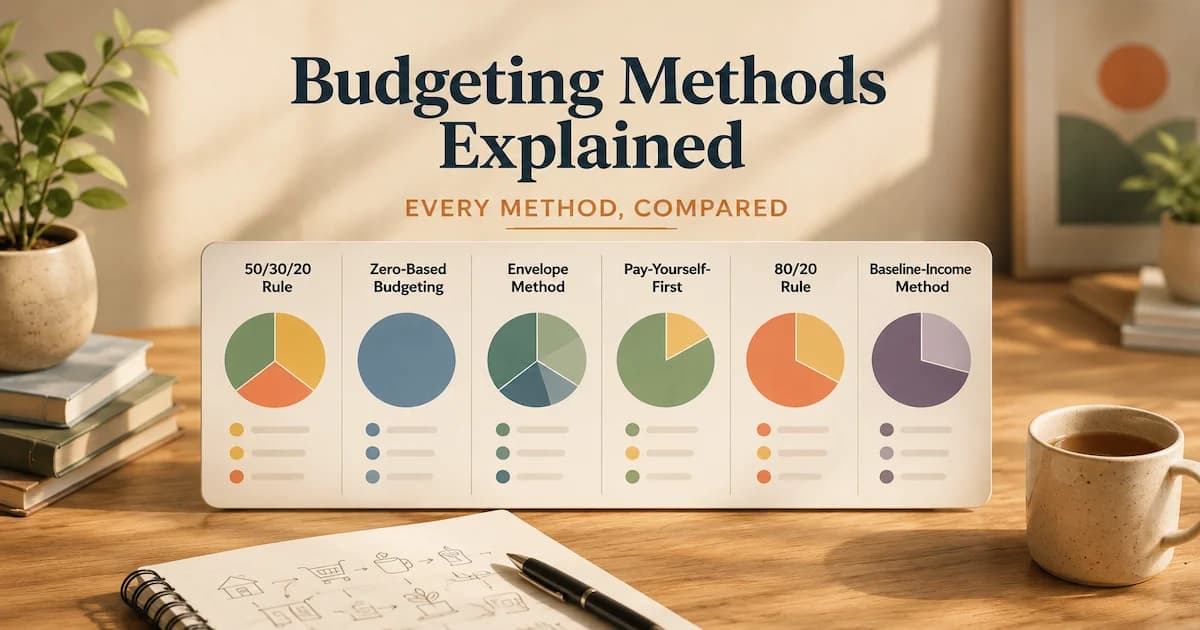
The 10 personal budgeting methods compared, from 50/30/20 and zero-based to kakeibo and cash stuffing, with ₹ and $ examples and a which-fits-you table.
17 min read
The rule everyone can recite leaves three things unresolved: which net income to use, where debt sits, and what to do when needs already eat 70%.
11 min read

What is the envelope budgeting method? The cash-envelope system explained, how to set it up, the digital alternatives, and where it works (and doesn't).
10 min read