Income-tax Act 2025: The Old-to-New Section Map

By Tapabrata Biswas · Published August 28, 2026 · 15 min read
Written and fact-checked by Tapabrata Biswas. How I write

Ask the pages currently ranking for this question what section 80C became, and you will be told 123, or 100, or 150, or "sections 150 to 155". Those are four different answers to a question with one correct answer, and none of the four pages links a document that would settle it.
We read 28 of them on 28 August 2026. Almost none cites a government source at all.
What is the Income-tax Act 2025?
The Income-tax Act 2025 is the statute that replaced the Income-tax Act 1961 as India's income tax law, in force from 1 April 2026. It received presidential assent on 21 August 2025 as Act No. 30 of 2025.
Section 1(3) sets the date: "Save as otherwise provided in this Act, it shall come into force on the 1st April, 2026." Section 536(1) does the other half: "The Income-tax Act, 1961 is hereby repealed."
The change is one of drafting rather than policy. CBDT answers the obvious worry in its own transition FAQ: "No. The income Tax Act, 2025 does not impose any new tax." The Ministry of Finance describes the guiding principles as no major tax policy changes and no modifications of tax rates.
What did change is nearly every number you have memorised. The Act went from 819 sections and 14 schedules to 536 sections and 16 schedules, and from 512,535 words to 259,676.
When does the new Act actually apply to you?
Not to the return you are filing this season. This is the single most practical fact on this page and most of the field gets it wrong or skips it.
The Income Tax Department states it directly: "The ITR for income earned during FY 2025-26 will be filed for Assessment Year 2026-27 under the provisions of the Income Tax Act, 1961."
So the boundary runs like this.
| Income earned | Governed by | Called |
|---|---|---|
| 1 April 2025 to 31 March 2026 | Income-tax Act 1961 | AY 2026-27 |
| 1 April 2026 onward | Income-tax Act 2025 | Tax Year 2026-27 |
Section 536(2)(c) of the new Act preserves the old one expressly, for "any tax year beginning before the 1st April, 2026."
Two numbering systems are therefore live at once, and the old ones are still correct for this year's filing. Several ranking pages tell readers the new Act applies "from Assessment Year 2026-27", which points at a year that ended the day before the Act commenced.
And "assessment year" is gone. Not deprecated, gone. Searching the entire Act for the phrase returns nothing. Section 3(1) defines its replacement: "tax year means the twelve months period of the financial year commencing on the 1st April." One term now does the work of both "previous year" and "assessment year", which the department says were confusing precisely because they referred to two different financial years.
AY 2026-27 is the last assessment year there will be.
The section map
Read from the gazetted Act itself rather than from anyone's table. The rows below are derived, by reading the two Acts against each other, because no official section concordance appears to be public. More on that limitation further down.
| Income-tax Act 1961 | Income-tax Act 2025 |
|---|---|
| 80C, 80CCC, 80CCE | section 123 read with Schedule XV |
| 80CCD(1), the employee's own NPS contribution | Schedule XV, paragraph 1(y) |
| 80CCD(1B), the extra 50,000 | section 124(3) and (4) |
| 80CCD(2), employer contribution | section 124(1) and (2) |
| 80D, health insurance | section 126 |
| 80E, education loan interest | section 129 |
| 80TTA and 80TTB, deposit interest | section 153, the two merged into one |
| 10(13A), house rent allowance | section 11 read with Schedule III, Table serial 11 |
| 24(a) and 24(b), house property | section 22(1)(a) and 22(1)(b), the 2 lakh cap at 22(2)(a) |
| 87A, the rebate | section 156 |
| 115BAC, the new regime | section 202 |
| 139, return of income | section 263 |
| 139(4) belated, 139(5) revised, 139(8A) updated | 263(4), 263(5), 263(6) |
| 234A, 234B, 234C, interest for default | 423, 424, 425 |
| 44AD, 44AE, 44ADA, presumptive | section 58, one table, serials 1, 2 and 3 |
| 192, TDS on salary | section 392(1) |
| the entire 194 series | section 393, one table |
| 206C, TCS | section 394 |
| 197 and 203, certificates | section 395 |
| 285BB, the annual statement | section 510 |
| 285BA, statement of financial transactions | section 508 |
Two of those rows deserve a warning.
Section 80C is a section plus a schedule. Section 123 itself is one sentence. The list people actually care about, life insurance, provident fund, ELSS, tuition fees, home loan principal, is Schedule XV, headed "(See section 123)". This is the characteristic hazard of a rewrite. A provision moved into a schedule looks deleted to anyone comparing section lists. One well-known advisory firm published exactly that error, announcing that the 20% of gross total income NPS deduction had been dropped. It survives at Schedule XV paragraph 1(y)(ii). More on the deduction itself in our guide to Section 80C.
House rent allowance is not section 19. A major tax platform maps it there. Section 19 is the successor to old section 16, which is professional tax and the standard deduction. HRA sits in Schedule III.
Why a flat mapping table misleads
The largest change in the Act is not that section numbers moved. It is that groups of sections were merged, so many old numbers do not have a new number of their own.
TDS is the clearest case. CBDT's own words: "All the TDS sections (Section 192 to 194T) in the Income Tax Act, 1961 are now consolidated under two sections, section 392 and section 393."
Roughly thirty provisions became two. Section 194J, professional fees, is now section 393(1), table serial number 6(iii). Section 194C, contractors, is 393(1) serial 6(i). They are table rows, not sections.
The same pattern repeats. Sections 44AD, 44AE and 44ADA became three serial numbers in one table in section 58. Section 139's five separate limbs became sub-sections of section 263. Sections 197 and 203, which did unrelated jobs, both became section 395.
This is why a neat two-column table, which is what almost every page publishes, quietly misrepresents what happened. It implies that every old number has exactly one new number. Many have a fraction of one, and a few share.
CBDT also states the practical consequence: "Quoting old section numbers such as 194C, 194J, or 194H of the Income Tax Act, 1961 for such transactions may result in system-level validation errors."
What happened to the forms
Here the ground is firmer, because CBDT has published an official form mapping, which it has not done for sections. The form numbers come from the Income-tax Rules 2026, notified as G.S.R. 198(E) on 20 March 2026. The Act itself contains no form numbers at all.
| Rules 1962 | Rules 2026 | What it is |
|---|---|---|
| 16 | 130 | TDS certificate, salary |
| 16A | 131 | TDS certificate, everything else |
| 16B, 16C, 16D, 16E | 132 | TDS certificates |
| 27D | 133 | TCS certificate |
| 24Q | 138 | quarterly statement, salary |
| 26Q | 140 | quarterly statement, non-salary |
| 26QB, 26QC, 26QD, 26QE | 141 | challan-cum-statement |
| 26AS | 168 | Annual Information Statement |
| 15G, 15H | 121 | declaration for no deduction |
| 12BA | 123 | perquisites statement |
| 12BB | 124 | employee deduction claims |
CBDT publishes a short FAQ for each new form, and each one carries a four line block giving the name under the 1962 Rules, the name under the 2026 Rules, the corresponding 1961 section and the corresponding 2025 section. That is a proper concordance, published per form. None of the 28 pages we read cites it.
The Form 130 FAQ opens: "Form No. 130 (Earlier Form No. 16) ... Certificate u/s 395(4)(b) of the Income-tax Act, 2025 for tax deducted at source on salary paid to an employee under section 392(1)". It is due by 15 June of the financial year following the tax year.
Two practical notes. Form 26AS and the Annual Information Statement are now a single document, Form 168, rather than two related ones. And the word "26AS" appears nowhere in either the Act or the Rules.
Form No. 16 still exists, and it is not your Form 16
The number was reused. Rule 31(1)(b) of the Income-tax Rules 2026 requires an institution receiving a donation to "furnish to the donor, a certificate specifying the amount of donation in Form No. 16".
So from 1 April 2026 there are two live documents a person might reasonably call Form 16. The one a salaried employee waits for every June is Form 130. The one actually named Form No. 16 is a receipt a charity gives a donor. They share a number and nothing else.
Which makes "Form 16 has been abolished", a line you will find on plenty of pages, wrong in an unusually confusing way. It was not abolished. It was reassigned. Our Form 16 explainer covers what the certificate itself contains.
What actually changed, beyond the numbering
The reform was framed as substantively neutral, and mostly it is. Parliament's own research service records that the Bill "mainly seeks to simplify the language, and does not aim to bring any substantive changes", while also warning that "there may be changes in implications due to omissions or changes in the language of the provisions."
Reading the Act, several changes are real:
- The TDS correction window was cut from six years to two. Section 397(1)(f) allows a correction statement "within two years from the end of the tax year in which such statement is required to be delivered". The six year window had been introduced only in 2024. This is a narrowing of a compliance right, not a drafting tidy-up.
- Search powers now reach digital space. Section 261 defines "virtual digital space" to include email servers, social media accounts, online trading and banking accounts and cloud servers, and section 247(1)(iii) allows an authorised officer to "override the access code to any computer system".
- Unexplained assets expressly include crypto. Section 104 defines asset to include a "virtual digital asset", where the 1961 provision said only "other valuable article".
- A general power to modify the Act by notification. Section 532(2) lets the central government direct that provisions "shall not apply or shall apply with such exceptions, modifications and adaptations as specified", replacing the older, narrower faceless-scheme powers. Notifications must be laid before Parliament.
- The consolidations are themselves compliance changes, because the reporting systems key on the new citations.
One number worth not quoting yet. The enacted Act gives the revised return window as nine months, at section 263(5). The department's own portal currently says twelve months, attributed to the Finance Act 2026. We could not read the Finance Act as passed, so treat that one as unsettled.
How to check any section yourself, without being misled
If you look up a section on the Income Tax Department's own website, check the year before you read the text.
Section pages sit at addresses of the form /w/section-<number>-<id>, the id is unordered, and there is no year selector on the page. Fetched on 28 August 2026:
| Page | Edition it serves |
|---|---|
/w/section-112-20 | 1997 |
/w/section-54-22 | 1998 |
/w/section-48-45 | 1976 |
/w/section-48-64 | 2025, current |
Three of those four serve law between 27 and 50 years out of date, on the government's own domain, with nothing on the page to say so. Search engines surface the archival editions readily. Each page does carry a Year field, and current editions use a file path containing itact\htmlfiles, so it is checkable once you know to check.
The gazetted Act itself is a more reliable read, and it is public.
What this post deliberately does not cover
Whether any of this changes what you owe. It sets out which provision is which. Your liability depends on your income, your regime choice and your circumstances, and a chartered accountant is the person to ask.
The Act as amended by the Finance Act 2026. The consolidated amended text sits on a host that refuses ordinary requests. Our section numbers are read from the Act as enacted, and were cross-checked against the Finance Bill 2026, which renumbers nothing.
Forms beyond CBDT's published mapping. The Income-tax Rules 2026 run to 976 pages and 190 forms. We reproduce the mapping CBDT published and do not extend it by inference.
An official section concordance, because we could not find one. The department hosts a comparison utility, but it is a client-side application whose underlying data we could not reach. So every section mapping in this post is derived, by reading the two Acts against each other, and confirmed by two independent passes that agree. The form mappings are different. Those are CBDT's own. We think that distinction is worth stating, and we have not seen another page make it.
Frequently asked questions
Which Act applies to the return I am filing now?
The Income-tax Act 1961, for income earned in FY 2025-26. The Income Tax Department states it plainly: the return for income earned during FY 2025-26 is filed for Assessment Year 2026-27 under the provisions of the Income Tax Act, 1961. The 2025 Act commenced on 1 April 2026 and applies to income from that date onward, which is Tax Year 2026-27. Section 536(2)(c) of the new Act expressly preserves the old one for any tax year beginning before 1 April 2026. So the familiar section numbers are still the correct ones for this season's filing, and both numbering systems are live at the same time for one more cycle.
What is section 80C now?
Section 123, read with Schedule XV. The section itself is short; the list of qualifying investments that people actually care about, life insurance premiums, provident fund, ELSS, tuition fees, home loan principal, sits in Schedule XV. That matters because a provision moved into a schedule looks deleted to anyone comparing the two Acts section by section. Ranking pages currently give the answer as 123, as 100, as 150, and as a range of 150 to 155. Only one of those is right. Note also that 80CCD, the NPS deduction, splits: the employee's own contribution goes into Schedule XV, while the extra 50,000 rupees and the employer contribution sit in section 124.
Is Form 16 abolished?
No, and the truth is stranger. The salary TDS certificate that used to be Form 16 is now Form 130, issued under section 395(4) read with Rule 215(1), and due by 15 June of the financial year following the tax year. But the number 16 was not retired. Rule 31(1)(b) of the Income-tax Rules 2026 requires a recipient institution to give a donor a certificate of donation in Form No. 16. So from 1 April 2026 there are two live documents someone might call Form 16, and they have nothing to do with each other.
What happened to assessment year?
It is gone from the statute entirely. A search of the whole Income-tax Act 2025 finds the phrase zero times. Section 3(1) defines a single concept. Tax year means the twelve months period of the financial year commencing on the 1st April. It replaces both previous year and assessment year, which the department says were causing confusion because they referred to two different financial years. AY 2026-27 is the last assessment year there will be. Several ranking pages still tell readers that assessment years are unchanged, or that the new Act applies from AY 2026-27, and both statements are wrong.
Did my tax go up under the new Act?
The government says no. CBDT's own transition FAQ answers the question directly: No. The income Tax Act, 2025 does not impose any new tax. The Ministry of Finance describes the guiding principles as no major tax policy changes to ensure continuity and certainty, and no modifications of tax rates. That said, the rewrite is not purely cosmetic. Several provisions did change substantively, including the window for filing a TDS correction statement, which was cut from six years to two.
Where is the official section mapping table?
There does not appear to be a public one, and that is the honest answer. The department hosts a comparison utility, but it is a client-side application whose data we could not reach, and its host returns 403 to ordinary requests. CBDT has published an official mapping for forms, which is where the Form 130 and Form 168 numbers come from. For sections, no government concordance document could be obtained. Every section mapping you will read anywhere, including ours, is derived by reading the two Acts against each other. Ours says so; most do not.
Sources
- The Income-tax Act, 2025, Act No. 30 of 2025, Gazette of India, assented 21 August 2025. Every section number in this post was read from this text.
- Income Tax Department, objective and scope of the new Act for the tax year concept and the section 202 and section 58 consolidations.
- Income Tax Department, income tax returns help for the statement that FY 2025-26 returns are filed under the 1961 Act, and for section 263.
- Income Tax Department, guide to Income-tax Act 2025 forms for the published form mapping.
- Press Information Bureau, Ministry of Finance for the stated principles of no major tax policy change and no modification of rates.
- PRS Legislative Research, Income-tax Bill for the Select Committee's observations on the scope of the exercise.




You might also like

The Form 26AS password is your date of birth as DDMMYYYY, the same for PDF, text and Excel. PAN plus date of birth is a different form entirely.
18 min read
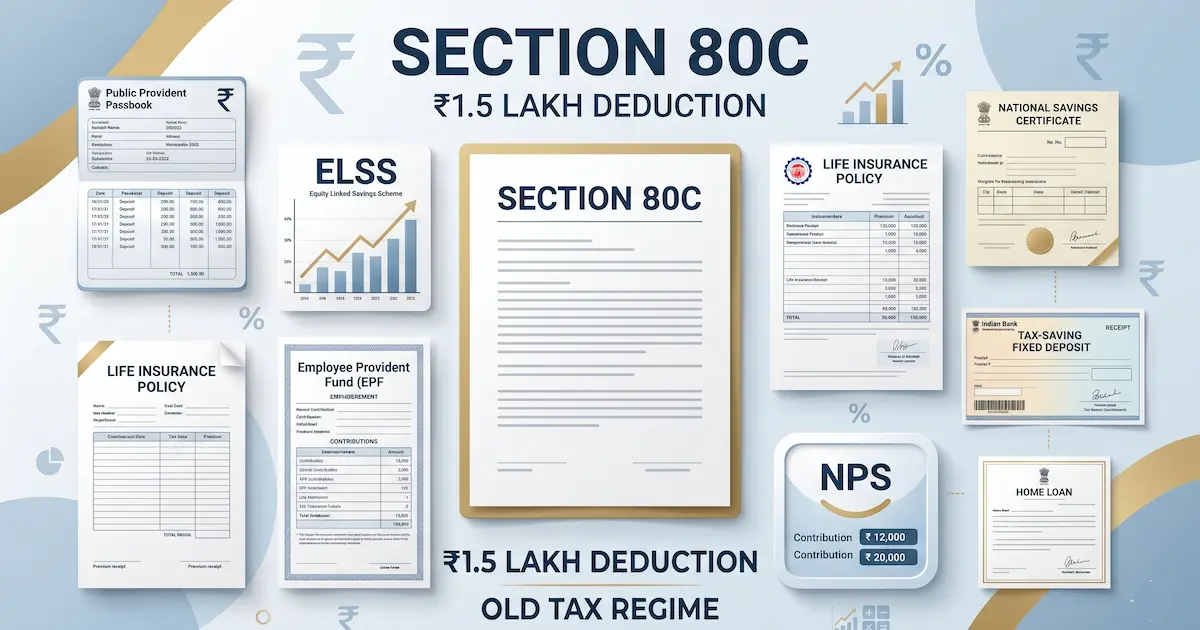
Section 80C cuts up to Rs 1.5 lakh off taxable income under the old regime only. The list, the limit, and where it lands as Section 123.
16 min read
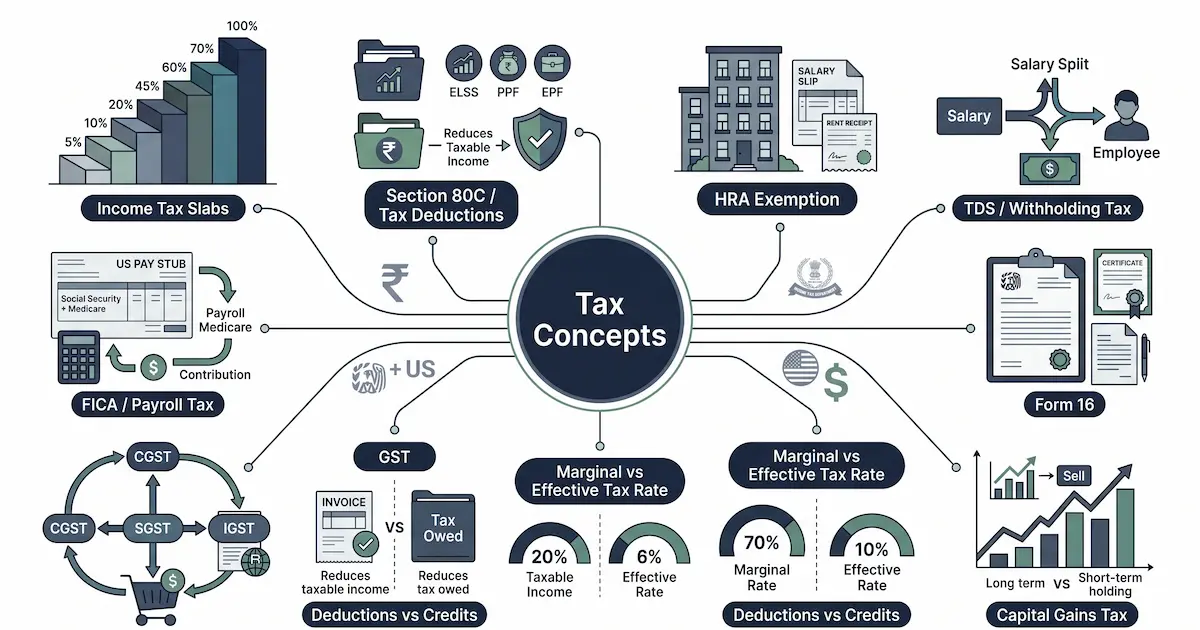
A plain-English guide to the core tax concepts in India and the US: slabs, deductions, TDS, GST, capital gains, FICA, plus what the Income-tax Act 2025 renames.
19 min read