Digital Gold vs Gold ETF vs SGB: The 2026 Tax Position

By Tapabrata Biswas · Published August 30, 2026 · 11 min read
Written and fact-checked by Tapabrata Biswas. How I write
Reviewed by Subir Kumar Debsharma, Tax, GST and ROC professional with 20+ years of experience.

Most comparisons of these three are built around returns, liquidity and convenience. Those matter, but they are not where the three actually diverge, and they are not what changed. What changed is the tax treatment, twice, and the regulatory status of one of them.
This post sets out the current position on all three, with the dates each rule took effect, because the single most useful thing to know here is that a page written eighteen months ago is describing law that no longer applies. This is an explainer and not investment advice. Which route into gold suits you depends on your horizon, your tax position and your wider portfolio, and that is a question for a SEBI-registered adviser.
How are digital gold, gold ETFs and SGBs taxed in 2026?
The three differ on when a gain becomes long-term, not on the rate applied once it is. All three carry 12.5% on long-term gains without indexation. What separates them is how long you have to hold to get there.
| Route | Long-term after | Long-term rate | Short-term |
|---|---|---|---|
| Gold ETF, listed | 12 months | 12.5%, no indexation | slab rate |
| Gold fund-of-funds | 24 months | 12.5%, no indexation | slab rate |
| Physical gold | 24 months | 12.5%, no indexation | slab rate |
| Digital gold | 24 months | 12.5%, no indexation | slab rate |
| SGB sold on the exchange | 12 months | 12.5% | slab rate |
| SGB held to maturity | exempt, but see below |
Two traps sit inside that table.
The first is the gap between a gold ETF and a gold fund-of-funds. People treat them as the same product bought two ways, and for holding-period purposes they are not. The ETF is a listed security and turns long-term at twelve months. The fund-of-funds takes twenty-four, the same as a bar of gold in a locker. Sell a gold FoF at month eighteen expecting 12.5% and the gain is short-term at your slab rate.
The second is that indexation is gone for all of these. Budget 2024 removed it. Any comparison still presenting indexation as a benefit of digital gold or SGBs is describing the position before July 2024.
Why do older pages say gold ETFs are taxed at slab rates?
Because they were, until FY 2025-26, and that is the single most common stale fact in this comparison.
Gold ETFs used to be caught by the specified mutual fund rules in Section 50AA, which taxed the gain at slab rates regardless of how long you held. Finance Act 2024 narrowed the definition of a specified mutual fund to schemes investing more than 65% of their proceeds in debt and money market instruments. A gold ETF holds gold, not debt, so from FY 2025-26 it falls outside that provision and is taxed as a listed non-equity asset: twelve months, 12.5%.
This is why the date on a page matters more here than on most subjects. A comparison written in 2024 was right at the time and is wrong now, and it will not look wrong, because the claim is specific and confidently made.
One page currently ranking near the top of this search states that gold ETFs are "Taxed at income tax slab rate (e.g., 30%) regardless of holding period", that SGBs are "Taxed at 20% after three years", and that indexation is available on digital gold. It carries a last-updated date of 1 October 2025. All three statements describe superseded law, and the same page also tells readers that digital gold returns are tax-free if held under three years, which was never the position at all. Short-term gains on digital gold are taxed at your slab rate.
Can you still buy a Sovereign Gold Bond?
No new ones. The scheme has not been issued since February 2024, so every SGB purchase today is a secondary-market purchase from an existing holder.
That fact does more work than it appears to, because the bond's headline attraction was the tax-free redemption at maturity, and from 1 April 2026 that exemption is narrower. The Finance Act 2026 amendment applies it to an individual who subscribed at the original issue and held the bond continuously until redemption at maturity. Someone who bought on the exchange cannot meet that test no matter how long they hold.
Premature redemption to the RBI on a coupon date after year five is now taxable too, even for an original subscriber, which reverses what a great many pages still say, including the RBI's own FAQ. And the 2.5% coupon has always been taxable at slab rates, with no TDS deducted, which surprises people who assume a government bond arrives net of tax.
The full position, including where the reading of the amended provision is genuinely disputed among tax commentators, is in our post on the Sovereign Gold Bond scheme. If you already hold one from the original issue, your position is materially different from a new buyer's, and it is worth taking to a Chartered Accountant.
What did SEBI say about digital gold?
On 8 November 2025 SEBI issued an advisory stating that digital gold is neither notified as a security nor regulated as a commodity derivative, and therefore falls entirely outside its purview.
The consequence SEBI drew is the part worth carrying: no investor-protection mechanism available in the securities market covers these products. The dispute-resolution routes, the grievance machinery and the compensation arrangements that apply when a regulated intermediary fails simply do not reach digital gold.
Two things followed. Registered Investment Advisers were barred from offering digital gold to clients. And the exchanges barred brokers from selling it, on the straightforward ground that it is not a security and exchange members may only deal in securities. SEBI pointed investors instead towards instruments inside the perimeter: gold ETFs offered by mutual funds, exchange-traded commodity derivative contracts, and Electronic Gold Receipts.
None of that makes digital gold a fraud, and the large platforms offering it are established businesses. It means you are relying on the platform's own standing for protection, and not on a regulator's, which is a different thing from the protection an ETF carries, and it is worth knowing which of the two you are buying.
Which Act governs your gain?
It depends on when you sell, and 1 April 2026 is the dividing line. The Income-tax Act 2025 replaced the 1961 Act on that date, and capital gains follow the date of transfer, so the year you are filing for does not decide it.
So a sale made on or before 31 March 2026 falls under the 1961 Act, with the rates at Sections 111A, 112 and 112A. A sale made after it falls under the 2025 Act, where those became Sections 196, 197 and 198. The rates and the holding periods carried across unchanged, so the arithmetic in the table above does not move either way. Only the section numbers you would quote to a CA do. The full concordance is in our Income-tax Act 2025 section mapping, and the wider capital-gains position is in capital gains tax, short-term versus long-term.
What this post deliberately does not cover
It does not tell you which of the three to buy, or whether to hold gold at all. It does not name platforms, funds or brokers, or rank them. It does not carry today's gold price, expense ratios or platform spreads, all of which move and all of which you should read from the provider on the day. It does not cover gold jewellery as a purchase, where making charges and purity dominate the arithmetic in a way that has nothing to do with tax, and it does not cover borrowing against gold, which runs on its own rulebook and is covered in the RBI gold loan rules.
It also does not resolve the disputed reading of the SGB amendment for redemptions completed before 1 April 2026. Tax commentators disagree, we say so and do not pick a side, and that is a question for a professional looking at your actual holding.
Frequently asked questions
Which is better, digital gold, a gold ETF or an SGB? They are not interchangeable, and two of the three are effectively closed questions now. Sovereign Gold Bonds have not been issued since February 2024, so a new buyer can only get one on the exchange, and from 1 April 2026 an exchange buyer no longer receives the tax-free redemption that made the bond distinctive. Digital gold sits outside SEBI's regulatory perimeter, which SEBI stated in an advisory on 8 November 2025, so no securities-market investor protection applies to it. A gold ETF is a SEBI-regulated instrument, listed, and turns long-term at 12 months rather than 24. Which of them suits a particular person still depends on their holding horizon, their tax position and what they are trying to achieve, which is a conversation for a professional rather than a comparison table.
How are gold ETFs taxed in India in 2026? A listed gold ETF held for more than 12 months is a long-term capital asset, taxed at 12.5% without indexation. Held for 12 months or less, the gain is short-term and taxed at your slab rate. This is a change worth knowing about because it is recent. Gold ETFs used to fall inside the specified mutual fund rules in Section 50AA, which taxed the gain at slab rates whatever the holding period. Finance Act 2024 narrowed that definition to funds investing more than 65% in debt and money market instruments, and from FY 2025-26 gold ETFs are outside it. Pages written before that change still describe the old position, and several ranking ones do.
How is digital gold taxed? Like physical gold, on a 24-month holding period. A gain on digital gold held for more than 24 months is long-term and taxed at 12.5% without indexation. Held for 24 months or less, it is short-term and taxed at your slab rate, which means it is taxed rather than tax-free. Indexation is not available. Some widely-read comparisons still state that short-term digital gold returns are tax-free and that indexation applies, and both statements describe law that has been superseded. Digital gold purchases also usually attract GST at the point of buying, which is a cost rather than a tax on the gain.
Is SGB still available to buy? Not as a new issue. The Sovereign Gold Bond scheme has not been issued since February 2024, so every purchase now is from another holder on the stock exchange. That matters more than it sounds, because the exemption on redemption at maturity was narrowed from 1 April 2026 to an individual who subscribed at the original issue and held the bond continuously until maturity. A secondary-market buyer cannot satisfy that test however long they hold. Premature redemption to the RBI after year five is also now taxable, even for an original subscriber. The 2.5% coupon has always been taxable at slab rates with no TDS deducted.
Why did SEBI warn about digital gold? Because it is not inside the regulatory perimeter people assume it is. In an advisory on 8 November 2025, SEBI noted that online platforms were offering digital gold or e-gold to the public and stated that these products are neither notified as securities nor regulated as commodity derivatives, and so fall entirely outside SEBI's purview. The practical consequence SEBI drew out is that no investor-protection mechanism available in the securities market covers them. Registered Investment Advisers were barred from offering digital gold, and the exchanges barred brokers from selling it on the grounds that it is not a security. SEBI pointed investors instead towards gold ETFs, exchange-traded commodity derivatives and Electronic Gold Receipts.
In summary
The comparison people expect is about returns and convenience. The comparison that has actually changed is about holding periods, dates and regulatory perimeter.
Twelve months for a listed gold ETF, twenty-four for physical gold, digital gold and a gold fund-of-funds. Twelve and a half per cent on long-term gains across all of them, with indexation gone since Budget 2024. Sovereign Gold Bonds closed to new subscription in February 2024, with the tax-free redemption narrowed from April 2026 to original subscribers holding to maturity. And digital gold sitting outside SEBI's perimeter with no securities-market investor protection, which SEBI put in writing in November 2025.
If a page you are reading disagrees with any of that, check its date before you check ours.
Sources
- Securities and Exchange Board of India, investor advisory of 8 November 2025 on digital gold and e-gold products, for the statement that such products are neither notified as securities nor regulated as commodity derivatives, fall outside SEBI's purview, and carry no securities-market investor protection, and for the bar on Registered Investment Advisers offering them: sebi.gov.in
- Income Tax Department of India, capital gains provisions as amended by the Finance (No. 2) Act 2024 and carried into the Income-tax Act 2025, for the 12 and 24 month holding periods, the 12.5% long-term rate and the removal of indexation: incometax.gov.in
- Finance Act 2024, amendment to the definition of a specified mutual fund in Section 50AA, restricting it to schemes investing more than 65% of proceeds in debt and money market instruments, which removes gold ETFs from that treatment from FY 2025-26
- Reserve Bank of India, Sovereign Gold Bond scheme, for the discontinuation of fresh issuance after February 2024 and the redemption mechanics: rbi.org.in
- Tickertape, Digital Gold vs Gold ETF vs SGB, last updated 1 October 2025, read 30 August 2026, quoted above as the source of the superseded tax statements: tickertape.in



You might also like
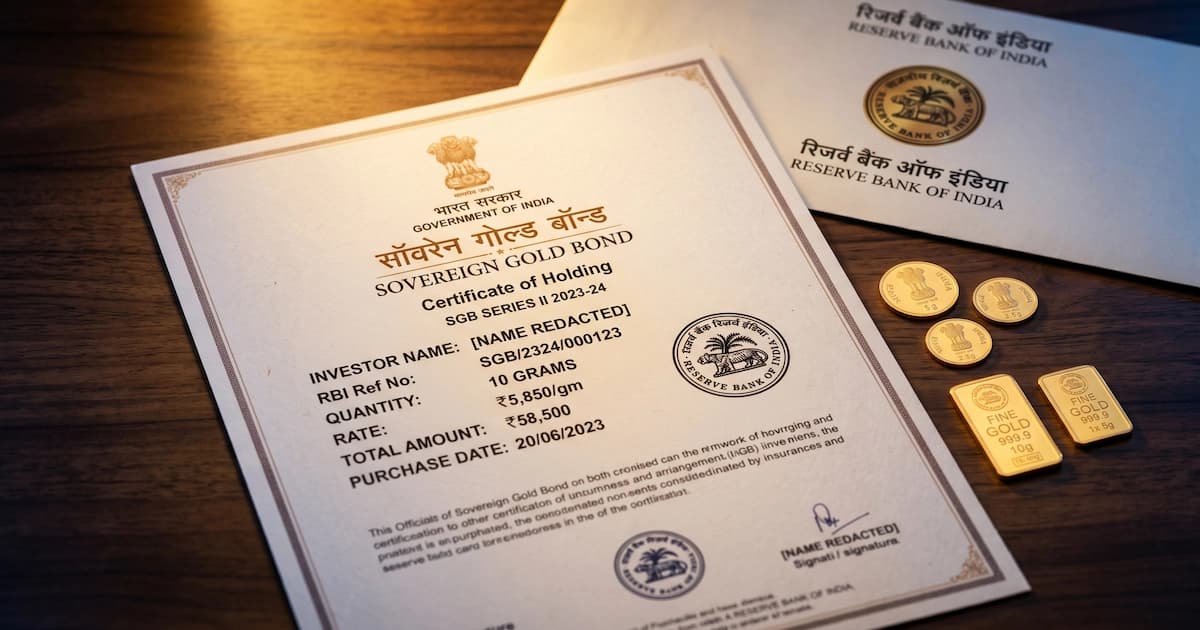
The Sovereign Gold Bond scheme closed to new subscription in February 2024, and from April 2026 only original subscribers holding to maturity stay tax-exempt.
17 min read
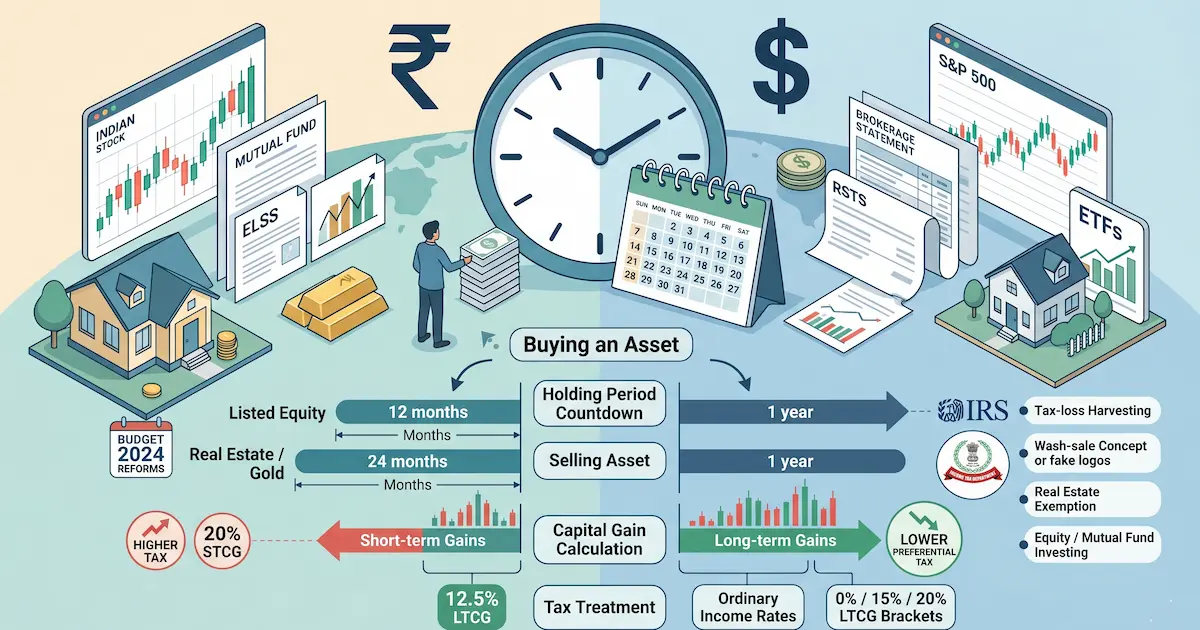
Short versus long-term rates in India and the US: the 12.5% LTCG and Rs 1.25 lakh exemption, the US 0/15/20% brackets, and the new sections.
20 min read

RBI's gold loan rules from 1 April 2026: tiered LTV of 85, 80 and 75 percent, a 12-month cap on bullet loans, and Rs 5,000 a day for late return.
12 min read