PMJJBY vs PMSBY: Rs 436 vs Rs 20, Claims and Exit

By Tapabrata Biswas · Updated September 30, 2026 · 20 min read
Researched with AI assistance, reviewed and edited by Tapabrata Biswas.
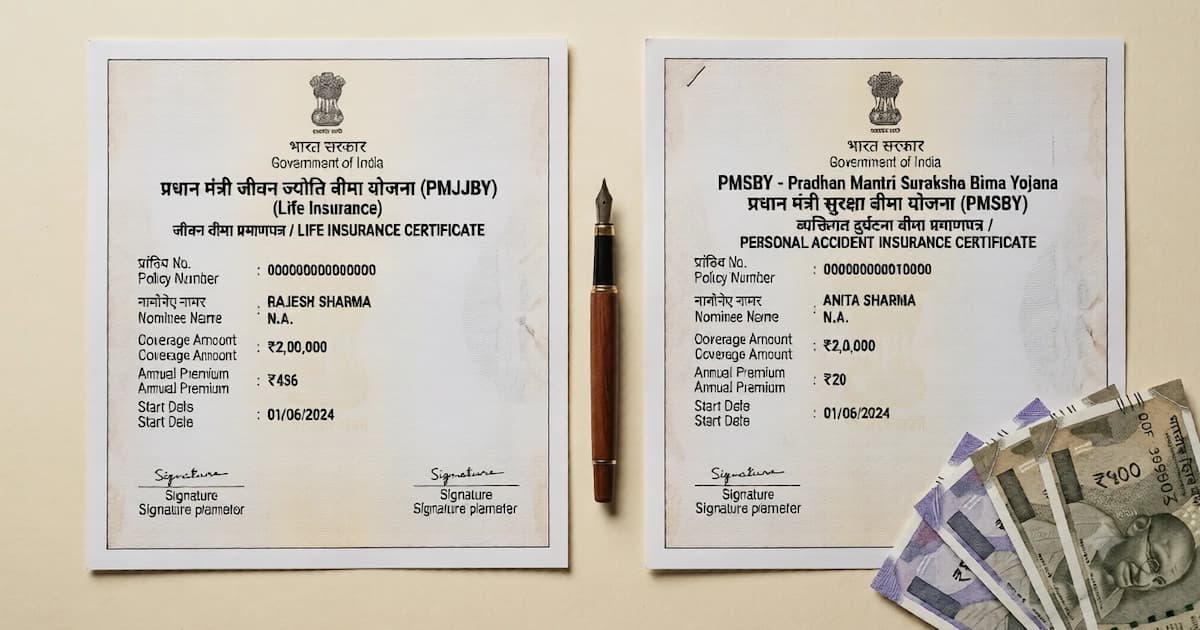
PMJJBY and PMSBY are the two cheapest insurance products in India. Rs 436 a year buys Rs 2 lakh of life cover, Rs 20 a year buys Rs 2 lakh of accident cover, and holding both costs Rs 456. The government launched them together on 9 May 2015 under the Pradhan Mantri Jan Suraksha Yojana.
Most guides stop at that comparison. This one carries on into the questions people actually type, which are about getting money back and getting out. Those answers exist, in the scheme rules and in two official FAQ documents that the Jan Suraksha portal does not even link from its own FAQ page, and they say things no insurance company has a reason to tell you.
This is educational, not insurance advice. For cover matched to your own family and finances, an IRDAI-registered adviser is the right person to ask.
What is the difference between PMJJBY and PMSBY?
PMJJBY is life insurance that pays on death from any cause, while PMSBY is accident insurance that pays only when death or disability is caused by an accident. That single split explains everything else, including why one costs Rs 436 and the other Rs 20.
| PMJJBY | PMSBY | |
|---|---|---|
| Full name | Pradhan Mantri Jeevan Jyoti Bima Yojana | Pradhan Mantri Suraksha Bima Yojana |
| What it covers | Death from any cause | Accidental death and accidental disability |
| Main payout | Rs 2 lakh | Rs 2 lakh |
| Partial disability | not covered | Rs 1 lakh |
| Annual premium | Rs 436 | Rs 20 |
| Entry age | 18 to 50 | 18 to 70 |
| Cover ends at | 55 | 70 |
| Waiting period | 30 days, accidental death excepted | none |
| Suicide | covered | not covered |
| Murder | covered | covered |
PMSBY is cheaper because accidental death is far rarer than death from all causes, so the expected payout per member is tiny. PMJJBY pays whether you die in a crash or of a heart attack at 54, and prices that risk at Rs 436.
Both premiums were revised upward with effect from 1 June 2022. If a page you are reading says Rs 330 or Rs 12, it is four years out of date, and a surprising number still do. When we checked the pages ranking for this comparison in September 2026, four of six were quoting the superseded figures, one of them under an "updated May 2025" stamp and another still referring to service tax, a levy replaced by GST in 2017. Part of the blame sits with the government, because the Jan Suraksha portal is still serving enrolment form PDFs carrying the old Rs 330 and Rs 12.
What is PMJJBY?
PMJJBY is a one-year renewable term life scheme that pays a nominee Rs 2 lakh on the member's death due to any reason, for Rs 436 a year. The rules describe it in exactly those terms, as a one-year cover renewable from year to year.
"Any reason" is broader than most readers expect. The official FAQ is asked whether natural calamities, suicide and murder are covered, and answers that all these events are covered as PMJJBY covers death due to any reason. There is no exclusion list to study.
Where the Rs 436 goes: Rs 395 is the insurer's premium, Rs 30 is a commission to the business correspondent on new enrolments, and Rs 11 is the bank's administrative fee. Enrol yourself online and the rules direct that the saved commission is passed back to you.
The 30-day lien is the rule new joiners miss most. For anyone enrolling for the first time, death from any cause other than an accident is not payable in the first 30 days. Accidental death is covered from day one. The lien exists to stop somebody enrolling immediately after a diagnosis, and it applies again to anyone who exits and rejoins.
A worked case makes it concrete. A 35-year-old enrols on 15 March 2026, so the lien runs to 14 April. Die in a road accident on 10 April and the Rs 2 lakh is paid. Die of a heart attack the same day and no claim is admissible. From 15 April both causes are covered.
What is PMSBY?
PMSBY is a one-year accident scheme paying Rs 2 lakh for accidental death, Rs 2 lakh for total and irrecoverable loss of both eyes, both hands or feet, or one eye plus one limb, and Rs 1 lakh for the loss of one eye, one hand or one foot, for Rs 20 a year. Those three rows are the whole benefit table.
That matters more than it sounds, because of what sits outside them. Asked what is payable for a partial disability that does not involve irrecoverable loss of sight in one eye or use of one hand or foot, the official FAQ answers in four words: no benefit will be payable. The scheme also reimburses no hospital costs at all. A broken leg that heals, however expensive and however long off work, produces nothing from PMSBY.
PMSBY has no waiting period. Cover starts from the date the premium is auto-debited. Do not carry PMJJBY's 30-day lien across to it, an error that appears on several large sites.
Is the PMJJBY premium refundable?
No, and the government explains why in its own FAQ. The official PMJJBY FAQ poses the question directly, noting that unlike other life insurance products the benefit goes only to a nominee on death, and asks why there is no maturity benefit or surrender value.
Its answer is that PMJJBY is a pure term insurance policy which covers only mortality with no investment component, that the pricing is accordingly low compared with policies offering maturity benefits, and that the scheme was designed for weaker sections of society with the premium kept low by eliminating the investment component.
So three things are settled. There is no maturity benefit. There is no surrender value. Nothing is returned if you survive the year. That is not a defect in the scheme. It is why Rs 2 lakh of cover costs Rs 436 when a policy carrying a maturity benefit costs several thousand.
One case in the rules does involve premium money moving, and it runs the opposite way to a refund. Enrol from several bank accounts and cover is still capped at one Rs 2 lakh sum, with the premium paid for the duplicate insurance liable to be forfeited. Both schemes say so. An earlier version of this guide described those duplicate premiums as refunded, which was wrong, and the correction matters because it is the difference between losing Rs 436 and getting it back.
How do I cancel PMJJBY or PMSBY?
The rules let you leave at any point and say nothing whatsoever about how. This is the most-asked question on the topic and the honest answer is that the scheme documents do not answer it.
What the documents do establish:
- Leaving is permitted and reversible. The rules state that individuals who exit the scheme at any point may rejoin in future years by paying the appropriate premium.
- The mandate is revocable by its own wording. The Consent-cum-Declaration form authorises the bank to deduct the premium every year "until further instructions". That phrase is the exit hook.
- The bank holds the paperwork. The rules require the enrolment form, auto-debit authorisation and consent form to be obtained and retained by the participating bank or post office, which is therefore where any instruction would land.
What no government document we read provides: a cancellation form, a procedure, a notice period, or a named place to submit the request. We read both scheme rule books, both official FAQ sets, both consent forms and every page of the Jan Suraksha portal.
That gap is worth naming plainly, because searching harder will not close it. If a page tells you to submit a specific form to cancel, it is describing its own bank's practice, and no scheme rule requires it.
Why did my bank activate PMJJBY without asking me?
Because consent is given once and never asked for again. The Consent-cum-Declaration form authorises the bank to deduct, after 25 May and not later than 1 June every year until further instructions, an amount of Rs 436 or any amount decided from time to time. The Press Information Bureau calls it a one-time mandate.
Neither scheme has annual re-consent by design. A signature given at account opening, during a branch enrolment drive, or inside a net-banking flow keeps renewing the cover every year until somebody actively stops it. The premium then appears each May as a line on a statement that most people do not read.
This is the mirror image of how the same mechanism is praised elsewhere. Automatic enrolment is the most effective tool in consumer finance precisely because people do not override defaults, which is why it works for retirement saving. Here the identical lever quietly renews an insurance policy.
Worth saying clearly: this is a real cover, not a mis-sale. For Rs 436 the member genuinely holds Rs 2 lakh of life insurance. The complaint people arrive with is about not knowing, and the answer is that the consent structure was never built to remind them.
What happens if I stop paying the premium?
Cover terminates, and simply not having enough balance on the debit date is enough to end it. Both schemes list insufficiency of balance among the events on which cover terminates, and PMJJBY's rules add that on termination no benefit becomes payable.
Restarting is allowed, and the two schemes differ in a way worth knowing:
| PMJJBY | PMSBY | |
|---|---|---|
| Can cover be reinstated? | Yes, on the appropriate premium | Yes, on the full annual premium |
| Treated as | fresh cover | reinstated cover |
| Waiting period on return | 30-day lien applies again | none |
| Whose decision | on payment | sole discretion of the insurer |
The PMJJBY condition is the one that costs people. Come back after a lapse and you serve a new 30-day lien, during which only accidental death is paid. The rules say this applies to subscribers who exit during or after the first year and rejoin later.
PMSBY's version is blunter still. Its rules suspend risk cover during the gap and place reinstatement at the sole discretion of the insurance company, so returning is not guaranteed at all.
What happens to PMJJBY cover at 55?
It ends, and nothing comes back. The rules terminate the assurance on attaining age 55 at nearer birthday, subject to annual renewal up to that date, and the clause governing every termination event states that no benefit becomes payable.
There is no payout at 55, no return of the premiums paid across up to 37 years of membership, and no conversion into another policy. A member who joined at 30, paid every year and reached 55 in good health receives nothing, which is exactly how term insurance is supposed to work and exactly what people do not expect from a government scheme.
Entry is capped earlier, at 50 at nearer birthday. That age convention catches people out, because "nearer birthday" rounds to whichever birthday is closer, so it can round upward. Somebody aged 50 years and 7 months counts as 51 and cannot join at all.
PMSBY works differently and more simply. Entry runs 18 to 70 and cover terminates on attaining 70, a single number at both ends.
What does each scheme refuse to pay?
The two schemes treat the same death differently, and the clearest case is suicide. PMJJBY covers it, because it covers death due to any reason. PMSBY does not, and its FAQ says so while confirming that death from murder is covered.
| Cause of death | PMJJBY pays | PMSBY pays |
|---|---|---|
| Illness or natural causes | Yes | No |
| Accident | Yes | Yes |
| Murder | Yes | Yes |
| Suicide | Yes | No |
| Natural calamity | Yes | Yes, treated as an accident |
Two further PMSBY limits deserve more attention than they get. It pays nothing for a permanent partial disability outside its three listed injuries, and it reimburses no hospitalisation expenses following an accident. Its FAQ answers both questions with a flat no.
And only one claim is ever payable per person under PMSBY, however many accounts the premium was debited from.
How do claims work, and is there a deadline?
Each scheme has a claim-cum-discharge form asking for submission preferably within 30 days, and "preferably" is the operative word. The PMJJBY form says preferably within 30 days of the death, the PMSBY form preferably within 30 days of the accident. Neither is written as a bar.
This matters more than a wording quibble. No government document we read sets a hard limitation period or states any consequence of filing late, so a family that missed the first month because they were burying somebody should still file. Pages that state a flat 30-day deadline risk talking a valid claimant out of a valid claim. An earlier version of this guide described a 30-day filing window followed by 30 days at the bank and 30 days at the insurer, and no part of that settlement timeline appears in any scheme document.
The nominee starts at the bank holding the account, which completes its own section of the form from enrolment data and certifies it. PMSBY disability claims are filed by the member instead, and are paid into the member's own account.
Proof of death is more flexible than most write-ups suggest. The PMJJBY form accepts any of four routes:
- A death certificate from the registrar.
- A hospital discharge summary or certificate naming the deceased and stating the date, time and cause of death.
- A certificate from the last attending registered medical practitioner, countersigned and sealed by a gazetted officer or a bank officer.
- A certificate from the District Magistrate, Collector, Deputy Commissioner or an authorised Executive Magistrate.
For accidental death the form normally wants an FIR or panchnama plus a post-mortem report. It carries a sensible exception for deaths such as snake bite or a fall from a tree, where hospital records naming the deceased and stating the cause will do instead.
How do I enrol, and what does it cost mid-year?
You enrol through a bank or post office where you hold a savings account, by giving one consent form and authorising the auto-debit. No medical test is required. Cover runs 1 June to 31 May, with the PMJJBY premium debited between 25 May and 1 June, and the PMSBY premium on or before 1 June.
Joining part-way through the year costs less on PMJJBY, on a pro-rata scale most pages omit:
| First enrolment falls in | PMJJBY premium |
|---|---|
| June, July, August | Rs 436 |
| September, October, November | Rs 342 |
| December, January, February | Rs 228 |
| March, April, May | Rs 114 |
The full Rs 436 is payable at the next renewal whatever you paid to join. PMSBY has no pro-rata scale at all, so joining in April costs the same Rs 20 as joining in June.
One thing we could not establish: there is no documented way to check whether you are enrolled. The Jan Suraksha portal has no login, no enquiry form and no status lookup. The only artefact the rules describe is an acknowledgement slip that may double as a certificate of insurance, held by your bank.
Are PMJJBY and PMSBY premiums tax-deductible?
The PMJJBY premium is a life insurance premium, so it can generally be claimed under Section 80C in the old tax regime, and the death benefit is exempt under Section 10(10D). PMSBY's Rs 20 is too small to matter and its treatment is less settled.
For most subscribers this is beside the point, since their income sits below the taxable threshold. It matters even less than it used to, because the new regime is now the default and does not allow 80C at all. A Chartered Accountant is the right person to confirm your own position before you rely on it.
How many people use these schemes?
PMJJBY had 26.88 crore gross enrolments and 10,45,450 claims disbursed as of February 2026, while PMSBY had 57.11 crore enrolments and 1.76 lakh claims. Both figures come from the Press Information Bureau.
The asymmetry is the interesting part. PMSBY carries more than twice PMJJBY's enrolments and has paid under a sixth as many claims, which is what you would expect when one scheme pays on any death and the other only on accidents. It is also a reminder of what the Rs 20 actually buys, which is protection against a narrow and uncommon event.
On money paid, the most recent rupee figures are ten months older than the claim counts and should not be mixed with them. As on 23 April 2025, PMJJBY had paid Rs 18,397.92 crore and PMSBY Rs 3,121.02 crore across 1,57,155 claims.
One caution on all four numbers. These are gross cumulative enrolments since 2015, including lapsed and duplicate enrolments, so they are not a count of people currently covered. The government publishes no active-cover figure, and no claim rejection rate either.
What this post does not cover
This explains the two schemes. It does not tell you whether Rs 2 lakh is enough cover for your family, which is a personal-planning question for an IRDAI-registered adviser. It leaves the third Jan Suraksha scheme, the guaranteed-pension Atal Pension Yojana, to its own guide. It does not give bank-by-bank enrolment or cancellation steps, because those differ by bank and no scheme rule governs them. And it states no claim settlement turnaround, because the government publishes none.
Frequently asked questions
Is the PMJJBY premium refundable? There is no maturity benefit and no surrender value. The official PMJJBY FAQ asks this question itself and answers that the scheme is a pure term insurance policy covering only mortality, with no investment component, which is why the premium is kept low. If you live through the cover year, the money is spent. The one case where the rules discuss premium money moving is duplicate enrolment, and there the premium paid for the duplicate cover is forfeited rather than returned.
How do I cancel PMJJBY or PMSBY? The scheme rules permit leaving at any point and allow rejoining in later years, and the auto-debit mandate you signed runs until further instructions. But no government document we could find sets out a cancellation procedure, a form, a notice period or where to submit the request. The mandate sits with the bank or post office that holds your account and retains your consent form, so that is where such an instruction would go. Treat any specific step you read elsewhere as unofficial, because the scheme documents do not describe one.
Why did my bank activate PMJJBY without asking me? Because consent is given once, not every year. The Consent-cum-Declaration form authorises the bank to deduct the premium after 25 May and not later than 1 June every year until further instructions. The Press Information Bureau describes it as a one-time mandate. There is no annual re-consent built into either scheme, so a signature given at account opening or during an enrolment drive keeps renewing the cover silently until somebody stops it.
What happens to PMJJBY cover at 55? It ends and nothing is paid. The rules terminate the assurance on attaining age 55 at nearer birthday, subject to annual renewal up to that date, and state that no benefit becomes payable on termination. There is no payout, no refund of past premiums and no conversion into another policy. Entry is capped earlier still, at 50 at nearer birthday, so somebody aged 50 years and 7 months already counts as 51 and cannot join.
What happens if I stop paying the premium? Cover terminates, including when the balance is simply too low on the debit date. PMJJBY can be reinstated on payment of the appropriate premium, but the rules treat the cover as fresh and the 30-day lien applies again, so a period of no protection follows. PMSBY reinstatement needs the full annual premium and its rules state that risk cover stays suspended meanwhile and that reinstatement is at the sole discretion of the insurance company.
What is the difference between PMJJBY and PMSBY? PMJJBY is life insurance that pays Rs 2 lakh on death from any cause for Rs 436 a year. PMSBY is accident insurance that pays Rs 2 lakh for accidental death or total disability and Rs 1 lakh for partial disability, for Rs 20 a year. PMJJBY carries a 30-day lien for new joiners during which only accidental death is paid, while PMSBY has no lien and starts from the date the premium is debited. Held together they cost Rs 456 a year.
The bottom line
Held together for Rs 456 a year, the two schemes pay up to Rs 4 lakh on an accidental death, Rs 2 lakh from each. That is roughly a tenth of what an equivalent private bundle costs, and the reason is that both are pure protection with nothing returned at the end.
Three things are worth carrying away, because the pages ranking above this one mostly get them wrong. The premiums are Rs 436 and Rs 20, not Rs 330 and Rs 12. The claim forms say preferably within 30 days, not compulsorily. And enrolling from five bank accounts gets you one payout while the duplicate premiums are forfeited, so pick one account per scheme and keep it funded before 31 May.
For the third Jan Suraksha scheme see Atal Pension Yojana. For how these sit among India's other schemes, see Employee Provident Fund, Public Provident Fund, and our Indian government savings schemes overview. If a claim of yours has been turned down, why health insurance claims get rejected covers the grounds insurers actually use.
Sources
- Pradhan Mantri Jan Suraksha Yojana, Revised rules for PMJJBY (w.e.f. 1.6.2022), for the Rs 436 premium, the 30-day lien, termination at 55, reinstatement, and duplicate-premium forfeiture, jansuraksha.gov.in/Files/PMJJBY/English/Rules.pdf
- Pradhan Mantri Jan Suraksha Yojana, Rules for PMSBY (w.e.f. 1.6.2022), for the Rs 20 premium, the benefits table, termination at 70, and insurer discretion on reinstatement, jansuraksha.gov.in/Files/PMSBY/English/Rules.pdf
- Pradhan Mantri Jan Suraksha Yojana, Official FAQs on PMJJBY, for the no-maturity-benefit answer, the any-reason scope including suicide and murder, and the pro-rata scale, jansuraksha.gov.in/Files/PMJJBY/English/FAQ.pdf
- Pradhan Mantri Jan Suraksha Yojana, Official FAQs on PMSBY, for the suicide exclusion, the no-benefit answer on unlisted partial disability, and the absence of hospitalisation cover, jansuraksha.gov.in/Files/PMSBY/English/FAQ.pdf
- Pradhan Mantri Jan Suraksha Yojana, PMJJBY claim-cum-discharge form and claimant notes, for the "preferably within 30 days" wording and the accepted proofs of death, jansuraksha.gov.in/Files/PMJJBY/PMJJBY_Claim_Form_Rules.pdf
- Press Information Bureau, Insurance for All (23 April 2026), for the current premiums and the February 2026 enrolment and claim counts, pib.gov.in
- Press Information Bureau, Jan Suraksha schemes complete 10 years (April 2025), for the rupee amounts paid as on 23 April 2025 and the one-time mandate description, pib.gov.in
- Department of Financial Services, Ministry of Finance, PMJJBY scheme page, financialservices.gov.in
- Income Tax Department of India, Section 80C and Section 10(10D), incometax.gov.in



You might also like
Income tax payers cannot join APY since 1 October 2022, and having filed once counts. The contribution chart, the guarantee, and what the nominee gets.
14 min read
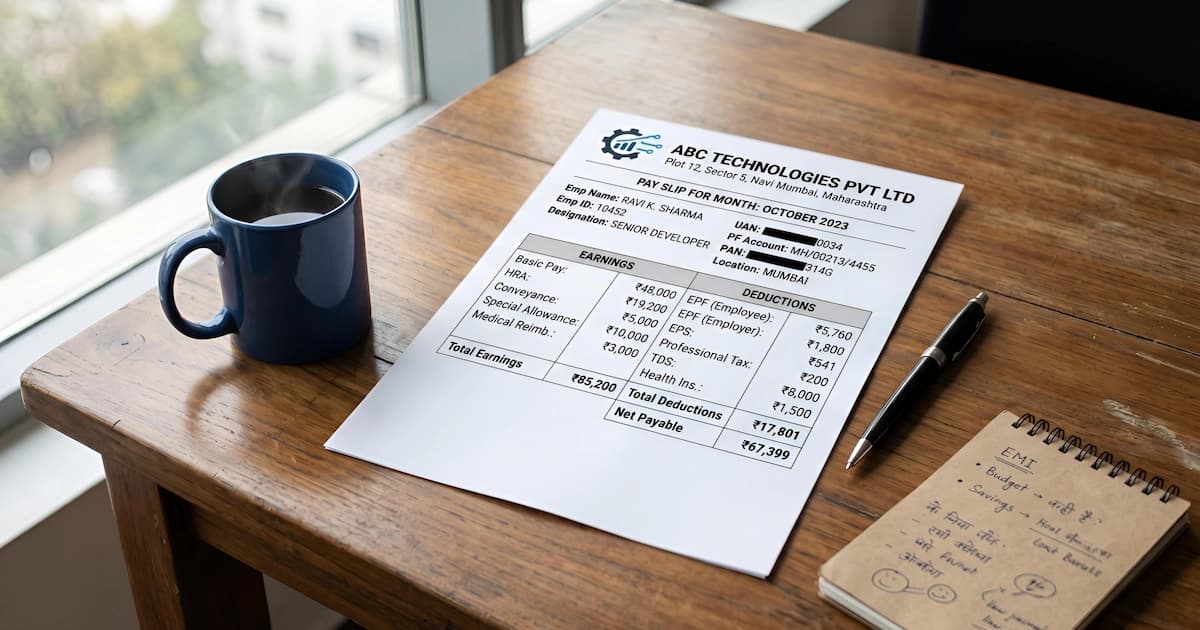
What is EPF? The 8.25% FY 2025-26 interest rate, the 12% + 12% contribution split, the new EPF Scheme 2026 withdrawal rules, and the tax treatment explained.
19 min read
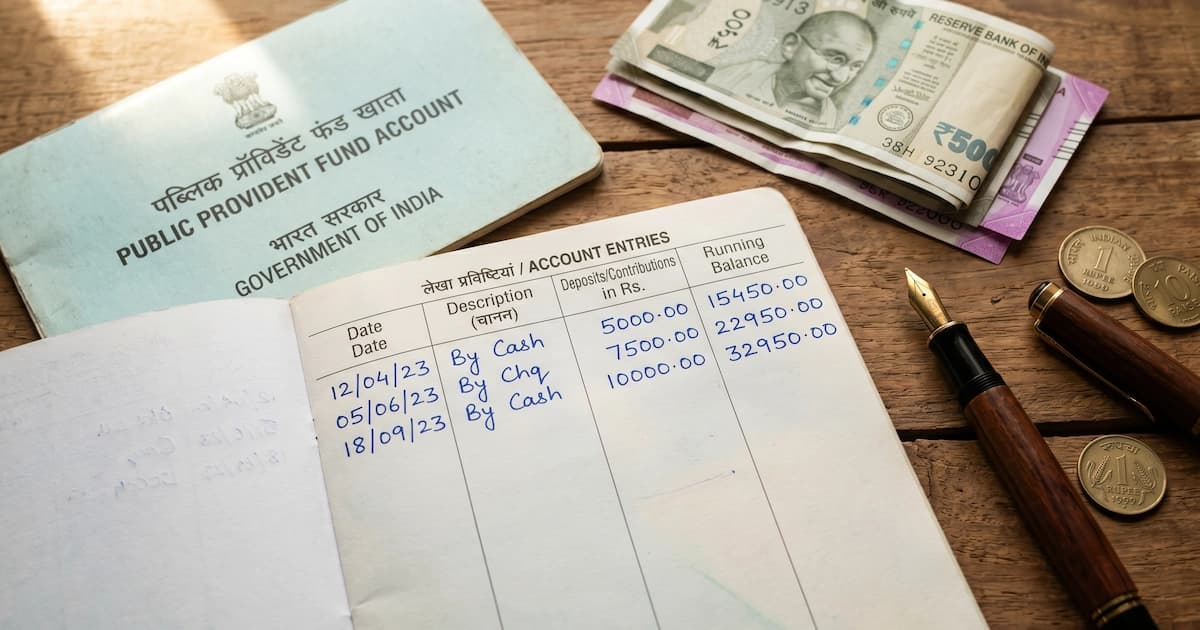
PPF pays 7.1% for Oct-Dec 2026, unchanged since 2020. See the Rs 500 to Rs 1.5 lakh limits, EEE tax, 15-year lock-in, withdrawal rules and a maturity example.
16 min read