Form 121: The New 15G and 15H, and What Age Still Decides

By Tapabrata Biswas · Published August 28, 2026 · 17 min read
Written and fact-checked by Tapabrata Biswas. How I write

Almost every page currently explaining Form 121 tells you the same reassuring thing: age no longer matters, because the two old forms became one.
The Act disagrees, in a Note that most of that coverage appears never to have reached.
What is Form 121?
Form 121 is the declaration you give a bank or other payer so that tax is not deducted at source from certain income, when your tax for the year will be nil. Its official title is "Declaration under section 393(6) for receipt of certain incomes without deduction of tax".
It arrived on 1 April 2026 with the Income-tax Act 2025, and it merged Forms 15G and 15H into one. Section 393(6) of the Act creates it, and Rule 211 of the Income-tax Rules 2026 prescribes the form.
The form itself is published by the Central Board of Direct Taxes at incometaxindia.gov.in. Download it from there. A copy hosted by a bank or a blog may not be the version the department is currently serving.
Section 393(6) sets the core test in a single clause. You declare that "the tax on such person's estimated total income of the tax year in which such income or sum is to be included in computing his total income shall be nil."
Does age still matter?
Yes. The form merged, the test did not.
Section 393(6) carries a Table, and under the Table sits a Note. The operative part of it reads:
"The provisions of this sub-section shall not apply in case of a person referred to in column B of the Table, other than an individual being a resident who is of the age of sixty years or more at any time during the tax year, if the aggregate of amounts of any income or sum ... exceeds the maximum amount not chargeable to tax."
Read that carve-out carefully, because it is doing all the work. It says a second condition applies to everyone except a resident individual aged 60 or more.
So there are still two tests, exactly as there were two forms:
| You are | What you must satisfy |
|---|---|
| A resident individual aged 60 or over | Tax on estimated total income will be nil. That is all. |
| Anyone else eligible | Tax will be nil, and the covered income does not exceed the maximum amount not chargeable to tax |
The old Form 15H carried the relaxed test and Form 15G carried the stricter one. Both survive. What changed is that two forms with two tests became one form with a carve-out.
The form itself makes this obvious once you look. Field 5(a) asks: "If resident individual, whether age is 60 years or more at any time during the tax year. Yes/no". Declaration clause (iv) carries the income ceiling and then adds, in brackets, "not to be applicable in case of resident individual of age of sixty years or more at any time during the tax year".
And the duty to enforce it sits with the payer. Form 121 Note 11 tells the bank, in terms, that for anyone other than a 60-plus resident individual it "shall not accept the declaration" where the income exceeds that ceiling.
Against that, here is what is currently published. One public sector bank writes that "taxpayers no longer need to determine which form applies to them based on age". A national broadcaster's site says of the age distinction: "This has now been completely eliminated." A business daily describes "a unified declaration system for all individuals, regardless of age."
The paperwork was unified. The eligibility rule was not.
Who cannot use Form 121?
Companies and firms, outright. The Table in section 393(6) has two rows. Row 1 is a resident individual, row 2 is "any person not being a company or a firm or an individual covered in Sl. No. (1)". That wording excludes both.
There is also a narrower exclusion that is easy to miss and that we have not seen stated anywhere. Row 1 covers seven kinds of income, at clauses (a) to (g). Row 2 covers only clauses (a) to (f).
Clause (g) is dividends.
So an HUF, an association of persons or a trust can use the declaration against interest, rent, mutual fund income, insurance commission and provident fund balance, but not against dividend TDS. A resident individual can. The difference is one letter in a Table and it is worth knowing before you send a form that will be rejected.
This is not a hypothetical distinction. Google's own AI Overview for "Form 121", captured on 28 August 2026, describes the form as allowing "resident individuals and Hindu Undivided Families (HUFs) to declare that their estimated total tax liability for the financial year is nil, preventing unnecessary TDS on interest, dividends, rent, or mutual fund incomes." Read as written, that offers HUFs a dividend exemption the Table does not give them. The same sentence says "financial year" where the Act says tax year.
What income does it cover?
For a resident individual, seven categories:
- Accumulated balance due to an employee from a recognised provident fund
- Insurance commission
- Rent
- Income in respect of units, meaning mutual funds and specified undertakings
- Interest on securities
- Interest other than on securities, which is the bank, co-operative bank and post office case most people are here for
- Payments under a life insurance policy, and dividends
Does it work for a PF withdrawal?
Yes, and it is the first thing the Table covers. Clause (a) of both rows is "payment of accumulated balance due to an employee referred to in section 392(7)", which is the recognised provident fund case. CBDT's own table names the payer as "Trustees of EPF Scheme or any person authorised under such scheme".
So an employee withdrawing a provident fund balance, where tax for the year will be nil, gives Form 121 to the trustees in the same way a depositor gives it to a bank. The eligibility test is the same one, including the age carve-out, and the same PAN requirement applies.
What the Act and the Rules do not address is the five-year service question that governed whether provident fund withdrawals were taxable at all. That sits elsewhere and is worth asking a chartered accountant about before assuming the declaration is the only step.
How is "nil tax" actually worked out?
This is where one widely read page goes wrong, and the answer is in the form's own notes rather than the Act.
Form 121 Note 10: "Estimated total income shall be calculated after allowing for deduction(s) under Chapter VIII of the Act, if any, or set off of loss, if any, under the head Income from house property and rebate allowable under section 156."
Section 156 is the successor to the old section 87A rebate. So the rebate does count towards making your tax nil.
The trap is that a rebate does not reach every kind of income. A professional tax blog currently publishes a worked example concluding Form 121 applies to someone whose income includes online gaming winnings, while conceding in the same sentence that those winnings are "taxable at special rate". Special-rate income sits outside the rebate, so the tax on that estimated total income is not nil, and the example fails the page's own stated condition three sections earlier.
On rupee thresholds, a warning. Neither the Act, nor Rule 211, nor CBDT's own Form 121 FAQ publishes a single rupee figure for eligibility. Every threshold you will read is supplied by the publisher. They do not agree with each other. One page states the new-regime basic exemption as 3,00,000 where the rest of the field says 4,00,000, and then runs all three of its worked examples against the old regime's 2,50,000 without naming a regime at all. Another heads a column "Basic Exemption Limit" and puts 12,00,000 in it, which is the rebate threshold, a different mechanism entirely.
What the form asks, and what the bank must do
Form 121 has two parts, which is itself a change. Part A is your declaration. Part B is verification by the payer. CBDT describes the effect as ensuring "accountability on both sides, the taxpayer declares, and the payer validates and reports."
Some practical points, all from Rule 211 and the form:
- File it separately with every payer. Part A goes to each person responsible for paying. Three banks means three declarations.
- File it early. CBDT says ideally before the income is credited or paid, and preferably at the start of the tax year, since the point is to stop deduction happening in the first place.
- Electronic or paper. Rule 211(2) allows both, with electronic verification the preferred route.
- You get a UIN per declaration, not per year. Rule 211(3) has the payer allot a unique identification number to each declaration received in a quarter. One page's comparison table claims a "single UIN per PAN per year", which the rule disposes of.
The obligations on the bank are heavier than the coverage suggests. Section 393(7) requires the payer to deliver a copy of your declaration to the Commissioner by the seventh day of the following month. Missing that carries a penalty of 500 rupees for every day the failure continues, under section 465(2)(f), capped at the tax that was deductible. Rule 211(4) requires the payer to report the declaration in its quarterly TDS statement "regardless of the fact that no tax has been deducted", which is how it reaches the annual statement you can check against your own records. And Rule 211(5) lets a tax officer demand the declaration back from the payer for up to seven years after the end of the tax year.
Two things that will invalidate it
No valid PAN. Section 397(2)(f)(i) is blunt: where a person does not furnish a valid Permanent Account Number in a declaration under section 393(6), "then such declaration becomes invalid". Section 397(2)(g) then sends the payer to the higher no-PAN deduction rate. An incomplete form is therefore worse than no form, because you end up with tax deducted at a penal rate and a refund to chase.
A false declaration is a prosecution matter. Section 482 punishes a false statement in any verification under the Act with rigorous imprisonment and a fine: six months to seven years where the tax that would have been evaded exceeds twenty-five lakh rupees, and three months to two years otherwise. Form 121 Note 12 names the section, and the declaration you sign acknowledges it.
How long does a declaration last?
Neither the Act nor the Rules say. Section 393 runs to eleven sub-sections and contains no expiry, lapse or validity wording. Rule 211 has none either.
What exists instead is a tax year field on the form, field 8, and declaration clauses that read "for tax year.....". So it is tax-year specific by design rather than by an express rule.
We are stating that as a gap and leaving it there, because the honest answer to "does my declaration carry over" is that the statute does not address it. The seven-year rule in Rule 211(5) is sometimes read as a validity period. It is not. It is how long the payer may be asked to produce the paper.
A note on what you will find elsewhere
We read 29 pages ranking for this topic and its predecessors on 28 August 2026. Ten of them still teach Forms 15G and 15H as current, with no mention of Form 121 anywhere. They include two banks, three insurers and a large tax platform's own guide to TDS on fixed deposits.
One comparison site's page is stamped "Updated On - 28 Aug 2026", the day we read it, and still instructs readers to file 15G and 15H at the start of the year.
Two other pages quote deduction thresholds of 40,000 and 50,000 rupees that were superseded in April 2025.
None of that makes those pages malicious. It makes them stale, which for a form that changed on a fixed date is the same thing from the reader's side.
What this post deliberately does not cover
Whether you personally qualify. That turns on your total income, your regime, your deductions and your age, and the arithmetic is yours. A chartered accountant is the person to check it with before you sign something that carries a prosecution clause.
Rupee thresholds for eligibility. No primary source publishes them for this form. The relevant figure is the maximum amount not chargeable to tax, which comes from the slab provisions and depends on your regime, so quoting a single number here would be inventing precision the law does not offer.
The deductor's filing mechanics. The department publishes a separate user manual for payers, covering TAN login, quarterly upload and the UIN format. It is a different audience from this page.
What happens to declarations already filed under the old forms. The transition is not addressed in section 393 or Rule 211, and we found no primary source on it.
Frequently asked questions
What is Form 121?
Form 121 is the declaration you give a bank or other payer so that tax is not deducted at source from certain income, when your tax for the year will be nil. It is made under section 393(6) of the Income-tax Act 2025 and prescribed by Rule 211 of the Income-tax Rules 2026. Its official title is Declaration under section 393(6) for receipt of certain incomes without deduction of tax. From 1 April 2026 it replaced Forms 15G and 15H, which were merged into this single form. It covers seven kinds of income for a resident individual, including interest from a bank or post office, rent, dividends, income from mutual fund units, insurance commission, provident fund balance and payments under a life insurance policy.
Has age stopped mattering now that 15G and 15H are one form?
No, and this is the most common error in current coverage. The form merged; the eligibility test did not. The Note to the Table in section 393(6) disapplies the second condition only for a resident individual who is sixty or more at any time in the tax year. So someone aged 60 or over needs to satisfy one test, that tax on estimated total income will be nil. Everyone else must satisfy that same test and also keep the covered income at or below the maximum amount not chargeable to tax. Form 121 itself asks the question at field 5(a), and Note 11 tells the payer not to accept a declaration that fails the ceiling.
Who cannot use Form 121?
Companies and firms, outright. The Table in section 393(6) has two rows. One is a resident individual, the other is any person not being a company or a firm. That wording excludes both. There is also a narrower exclusion that is easy to miss. Row 1 covers seven kinds of income at clauses (a) to (g), but row 2 covers only clauses (a) to (f). Clause (g) is dividends. So a non-individual such as an HUF, an association of persons or a trust can use the declaration against interest or rent, but not against dividend TDS, while a resident individual can.
What happens if I do not give a PAN?
The declaration becomes invalid. Section 397(2)(f)(i) says that where a person does not furnish a valid Permanent Account Number in any declaration under section 393(6), the declaration becomes invalid. Section 397(2)(g) then requires the payer to deduct tax at the higher no-PAN rate. So an incomplete form is worse than useless. It leaves you with tax deducted at a penal rate and a refund to claim later, which is the outcome the declaration exists to avoid.
How long is a Form 121 declaration valid?
Neither the Act nor the Rules say. Section 393 runs to eleven sub-sections and contains no expiry, lapse or validity language, and Rule 211 has none either. The only route to invalidity in the statute is the missing-PAN rule. What the form does contain is a tax year field and declaration clauses that read for tax year, so it is tax-year specific by design. There is a separate seven-year rule, but it is not an expiry: Rule 211(5) lets a tax authority ask the payer to produce the declaration up to seven years after the end of the tax year in which it was received.
Can I use Form 121 for a PF or EPF withdrawal?
Yes. Clause (a) of the section 393(6) Table is 'payment of accumulated balance due to an employee', the recognised provident fund case, and CBDT names the payer as the trustees of the EPF scheme. So an employee withdrawing a provident fund balance, whose tax for the year will be nil, gives Form 121 to the trustees exactly as a depositor gives it to a bank. The same eligibility test applies, including the age carve-out, and the same PAN rule. What the Act and Rule 211 do not address is the separate question of whether the withdrawal is taxable at all, which turns on length of service and is worth checking with a chartered accountant.
What is the difference between Form 121 and Forms 15G and 15H?
The declaration is the same idea; the packaging and the paperwork changed. Forms 15G and 15H were two forms under section 197A of the 1961 Act, prescribed by Rule 29C, with 15H carrying the relaxed test for those aged 60 and over. Form 121 is one form under section 393(6) of the 2025 Act, prescribed by Rule 211, and the relaxed test survives inside it as a carve-out in the Note to the Table. Three things are genuinely new. The form now has a Part B that the payer completes, so the bank now verifies as well as files. The payer allots a unique identification number to each declaration under Rule 211(3). And the payer must report the declaration in its quarterly statement even where no tax was deducted.
What happens if I do not submit Form 121?
Tax gets deducted, and you claim it back later. Nothing is charged for not filing the declaration, because filing it is optional relief and not a duty. The consequence is simply that the payer follows the ordinary deduction rules, so tax comes out of your interest or rent, and you recover it by claiming credit when you file your return. That is the round trip the declaration exists to avoid. Filing it late has the same effect for any income already paid or credited, which is why CBDT says it should ideally reach the payer before the income is credited and preferably at the start of the tax year.
What is the maximum income limit for filing Form 121?
No rupee limit is published anywhere in the primary sources. The Act, Rule 211 and CBDT's Form 121 FAQ all state the ceiling in words. The covered income must not exceed "the maximum amount not chargeable to tax". That amount comes from the slab provisions and depends on which regime applies to you, so a single number would be wrong for many readers. It also does not apply at all to a resident individual aged 60 or more, for whom the Note to the Table disapplies it. Any specific figure you see quoted for Form 121 eligibility has been supplied by the publisher, and the ones currently in circulation disagree with each other.
Is a false declaration a serious matter?
It is a prosecution offence, not a penalty. Section 482 punishes a false statement in any verification under the Act with rigorous imprisonment and a fine. Where the tax that would have been evaded exceeds twenty-five lakh rupees the term is six months to seven years. In any other case it is three months to two years. Form 121 Note 12 names section 482 directly, and the declaration you sign at clause (v) acknowledges liability to prosecution.
Sources
- The Income-tax Act, 2025, Act No. 30 of 2025, Gazette of India. Sections 393(6), 393(7), 397(2), 465(2) and 482 were read from this text.
- The Income-tax Rules, 2026, G.S.R. 198(E), Gazette of India. Rule 211 and Form No. 121, including its notes and declaration clauses, were read from this text.
- Income Tax Department, Form 121 user manual for deductors for the payer-side process and the UIN format.
- Income Tax Department, guide to Income-tax Act 2025 forms for the official mapping of Forms 15G and 15H to Form 121.



You might also like
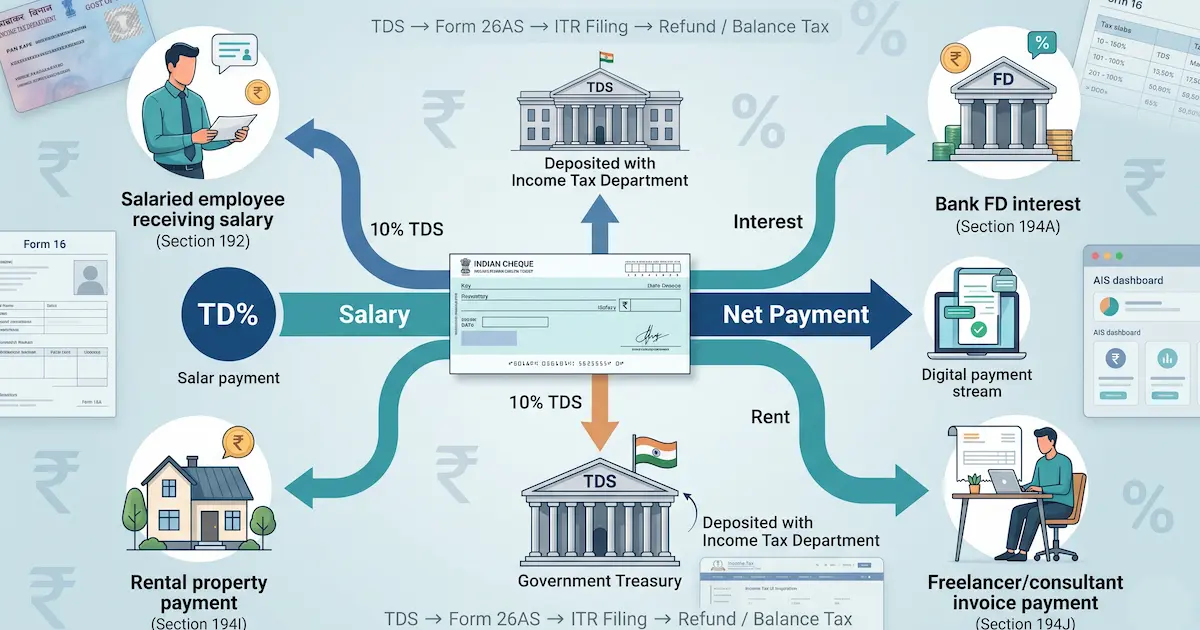
TDS is tax withheld from your salary, interest, and rent. The FY 2025-26 section rates and thresholds, what Budget 2025 changed, and how TDS differs from TCS.
15 min read

Ask the ranking pages what 80C became and you get 123, 100, 150 and 150-155. This is the map, read from the gazetted Act itself.
15 min read
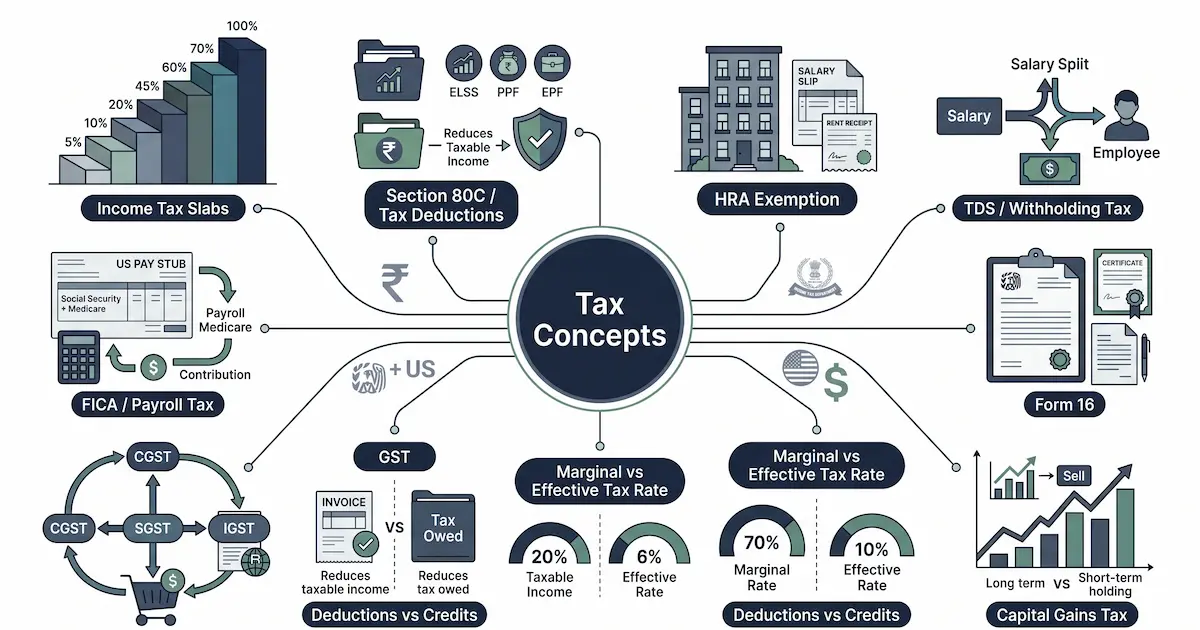
A plain-English guide to the core tax concepts in India and the US: slabs, deductions, TDS, GST, capital gains, FICA, plus what the Income-tax Act 2025 renames.
19 min read