Mint Alternatives: What Replaced It, and the India Gap

By Tapabrata Biswas · Updated July 20, 2026 · 12 min read
Researched with AI assistance, reviewed and edited by Tapabrata Biswas.
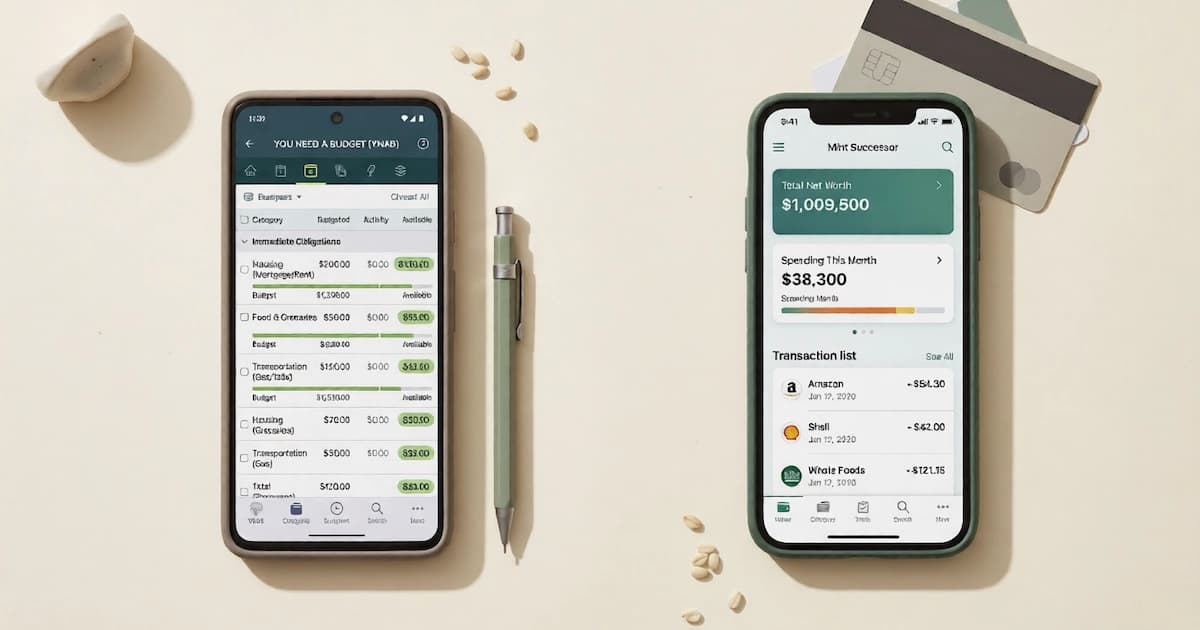
Read Intuit's announcement about moving Mint users to Credit Karma and one word is missing. It promised "some of Mint's most popular features" and listed them: cash flow, spending tracking, net worth, transactions.
The word "budget" never appears.
That single omission reframes two years of complaints. Credit Karma didn't fail to deliver a promised budgeting tool. Intuit never promised one. Of sixteen pages we read on this topic, not one noticed.
There's a second thing none of them noticed, and it matters more to half our readers. Every app on every "best Mint alternative" list is unusable in India. Not because they're bad, but because they cannot connect to an Indian bank, and the reason is structural and not commercial.
So this page covers what actually happened, what shipped and what didn't, what the US successors cost, and then the part nobody writes: why none of them works in India, and what India built instead.
What actually happened to Mint?
Intuit shut Mint down in March 2024 and directed users to Credit Karma, which it also owns.
The announcement of 31 October 2023 is worth reading closely because it's more precise than its coverage. It offered Mint users access to Credit Karma's suite of features "including some of Mint's most popular features," and named cash flow, spending tracking, net worth and transactions. Nothing about budgets, goals or envelopes.
mint.intuit.com still resolves today. It still says Mint has been reimagined on Credit Karma. Its footer reads "©2007-2024 Intuit, Inc.", frozen two years ago, and the old migration help article now redirects to a support case form where documentation used to be. The mobile app path redirects to a Credit Karma 404.
That's not a maintained page. It's a headstone.
What shipped, and what didn't
Credit Karma inherited the net worth dashboard, the transaction feed and month-over-month category comparison. The budgeting layer never arrived.
| Mint feature | In Credit Karma |
|---|---|
| Net worth dashboard | Yes |
| Transaction feed | Yes |
| Month-over-month category comparison | Yes |
| Category budgets | No |
| Savings goals | No |
| Envelope budgeting | No |
| Subscription and recurring tracking | No |
Credit Karma's own wealth page describes "monthly insights into spending habits so you can refine your budget by category." Read that carefully: it's assistance for a budget maintained somewhere else.
User accounts across 2025 and 2026 are consistent on the split. One described the experience as losing the budgeting while keeping the ability to compare categories month to month. Another, writing in September 2025, said they joined because Intuit called it a replacement and took a long time to work out that it wasn't. The one user we found who called Credit Karma the best Mint replacement added, in the same post, that they don't budget in any detailed way.
As of July 2026 even the surviving capability is reported as unreliable, with users finding that category totals no longer match the transactions inside them after re-categorising.
Intuit appears to have left the category entirely. Its flagship consumer platform release of November 2025 contains no occurrence of budget, budgeting, Mint or net worth, and there has been no Intuit statement on Credit Karma budgeting in over two years.
What do the US successors cost?
YNAB currently lists $14.99 a month or $109 a year, with a 34-day free trial requiring no credit card, and a free 365-day trial for college students. It prices in US dollars and states that exchange rates aren't reflected.
That figure is worth stating carefully because the field disagrees with itself. Several pages ranking for Mint alternatives still print $99, and one still prints $84. Every page updated during 2026 except one carries $109, which is what YNAB's own pages say today. We could not verify when the change took effect, so this post gives the current figure without dating the increase.
Across ten ranked alternative lists, four names recur:
| App | Appears on | Usually positioned as |
|---|---|---|
| YNAB | 9 of 10 | The method-driven option |
| Quicken Simplifi | 8 of 10 | The value option |
| PocketGuard | 8 of 10 | Spending tracking |
| Monarch Money | 7 of 10 | The designated Mint successor |
Rocket Money, EveryDollar, Empower and Goodbudget follow. Credit Karma appears on three lists, named as the successor that didn't work.
One caution on the numbers circulating about these companies. Rocket Money's paying subscribers are in SEC filings and are real: 4,926,000 at Q1 2026, up 9.7% year on year. But its fastest growth, up 36.4%, coincided with the Mint shutdown year and then decelerated to 11.3%, with an outright sequential decline between the first and second quarters of 2025. And Rocket Money has never mentioned Mint in any filing. The tidy story of a Mint diaspora flowing neatly into successors is not what the audited numbers show.
Monarch raised a $75 million Series B at an $850 million post-money valuation and reports 20-fold subscriber growth in the year after the shutdown announcement, though that multiple is against an undisclosed base. YNAB publishes nothing at all: no subscriber count, no revenue, no mention of Mint on its press page.
Why can't you use any of these in India?
Because none of them connects to an Indian bank, and each vendor says so in its own documentation.
| App | What the vendor publishes |
|---|---|
| YNAB | Does not support institutions outside the US, Canada, the UK and select European countries |
| Credit Karma | "Meant for a U.S. audience only", requires a valid US Social Security number |
| Monarch | "Currently only available in the US and Canada" |
| Quicken Simplifi | "Not designed to function outside the U.S. and Canada" |
| Empower | "Only support U.S based financial institutions" |
| Copilot | "Only support US financial institutions" |
| Rocket Money | "Does not support international banks" |
| Goodbudget | Bank sync via Plaid, United States only |
| EveryDollar | "We only currently support EveryDollar in the U.S." |
None of them says "we do not support India." They publish closed lists that exclude it, which is a different thing and worth stating accurately.
The plumbing settles it. Plaid supplies bank connections to eight of the ten most-recommended apps, and its API accepts exactly twenty country codes: US, GB, ES, NL, FR, IE, CA, DE, IT, PL, DK, NO, SE, EE, LT, LV, PT, BE, AT, FI. IN is not among them. An Indian bank cannot be passed to the API at all.
A detail that misleads people: Plaid's documentation lists Hindi as an available interface language. That's localisation for diaspora users of US accounts, and it says nothing about Indian bank coverage.
Zero of the sixteen ranking pages we read mention India, quote any of these restrictions, or note the limitation in any form.
What does India use instead?
India built a regulated consent layer where the US relied on screen scraping. Under RBI's Account Aggregator framework, a licensed aggregator moves financial data between institutions when the customer consents, and two provisions define the model.
The first is that no financial information accessed by an aggregator may reside with it. The data passes through; it doesn't accumulate. The second is that an aggregator cannot support transactions, which makes it read-only by design: it can show you your accounts and can never move money out of them.
Becoming one requires an RBI-registered non-banking financial company with net owned funds of at least ₹2 crore, which is the structural reason a foreign aggregator cannot simply add India to a country list.
The scale is substantial. Seventeen aggregators are licensed, and as of June 2026 the ecosystem recorded 314.5 crore accounts linked and 493.5 crore consents fulfilled. Personal finance management is a recognised use case within the framework.
Adoption among consumer apps is uneven, and worth describing accurately and without optimism. Fold states plainly that it connects to banks through the framework. INDmoney takes a different route, accessing SMS and email data with the user's consent to reconstruct transactions. Axio and FinArt also parse transaction SMS for tracking. So the regulated pipe exists and is heavily used across lending and account-opening, while consumer expense tracking still leans substantially on the older method.
Two corrections for anyone working from older lists: Walnut no longer exists as a separate app, having become Walnut 369, then Capital Float, then Axio. Kuvera now trades as Kuvera by CRED.
For the payment rails underneath all of this, our UPI explainer covers how money actually moves in India.
What this post deliberately does not cover
This describes what happened to a product and what exists now. It doesn't recommend an app to anyone, and the pricing and adoption figures are here to describe the market, never to steer a choice.
App selection depends on which accounts you hold, which country they're in, and whether you want tracking or a method. Our budgeting apps guide covers the selection question by budgeting method, and expense tracking apps covers the trackers specifically, including the Indian SMS-parsing category. The method most associated with YNAB is explained in zero-based budgeting.
Four limits on what's stated here. No search-volume figure for Mint appears anywhere in this post, because no fetchable source states one and the numbers circulating in search summaries were absent from the pages they claimed to cite. The YNAB price increase is given as a current figure without a date, because the effective date could not be verified. Monarch's revenue and subscriber counts are not published by Monarch, so the circulating ARR figures are excluded. And several Indian apps could not be verified at all, so this post names only those whose own documentation states their method.
Frequently asked questions
What happened to Mint? Intuit shut it down in March 2024 and pointed users at Credit Karma. The detail that gets missed is what Intuit actually promised. Its announcement of 31 October 2023 offered access to Credit Karma's features including some of Mint's most popular ones, and the items it listed were cash flow, spending tracking, net worth and transactions. The word budget never appears. So the widespread sense that Credit Karma failed to deliver a promised budgeting tool is half right: it did not deliver one, but Intuit never said it would. mint.intuit.com is still reachable and still says Mint has been reimagined on Credit Karma, though its footer copyright stops at 2024.
Did Credit Karma replace Mint's budgeting? No. It carried across the net worth dashboard, the transaction feed and month-over-month category comparison. Category budgets, savings goals, envelope budgeting and subscription tracking did not arrive. Credit Karma's own wealth page describes monthly insights into spending habits so you can refine your budget by category, which is help for a budget kept elsewhere and not a budgeting tool. Intuit appears to have left the category: its flagship consumer platform release of November 2025 contains no mention of budgeting, Mint or net worth, and there has been no Intuit statement on Credit Karma budgeting in over two years.
How much does YNAB cost now? $14.99 a month or $109 a year, per YNAB's own pricing page, with a 34-day free trial that requires no credit card and a free 365-day trial for college students through its College Program. YNAB prices in US dollars and states that exchange rates are not reflected in the price. Several pages ranking for Mint alternatives still print $99 a year and one still prints $84, so the figure is worth checking at the source. The step from $99 to $109 is corroborated by every page updated during 2026 except one, though we could not verify the date the change took effect.
Can you use YNAB or Monarch in India? No, and the restriction is in each vendor's own documentation rather than a matter of interpretation. YNAB states it does not support institutions outside the US, Canada, the UK and select European countries. Monarch says it is currently only available in the US and Canada. Credit Karma requires a valid US Social Security number and describes itself as meant for a US audience only. Quicken Simplifi, Empower, Copilot and Rocket Money all publish similar limits. The plumbing confirms it: Plaid, which supplies bank connections to most of these apps, accepts twenty country codes and IN is not one of them.
What do people in India use instead? India built a regulated consent layer rather than relying on screen scraping. Under RBI's Account Aggregator framework, a licensed aggregator moves financial data between institutions on the customer's consent, and two rules define it: the aggregator cannot let that data reside with it, and it cannot support transactions, so it is read-only by design. Seventeen aggregators are licensed, and 314.5 crore accounts had been linked with 493.5 crore consents fulfilled as of June 2026. Personal finance management is a recognised use case. Among consumer apps, Fold states plainly that it connects through the framework, while several others including INDmoney rely on parsing transaction SMS instead.
Sources
-
Intuit Credit Karma, Intuit Credit Karma welcomes all Minters, 31 October 2023 (the features promised on migration, which name cash flow, spending tracking, net worth and transactions, and never mention budgeting) creditkarma.com
-
YNAB, Pricing (the current $14.99 monthly and $109 annual price, the 34-day trial and the free 365-day college trial) ynab.com
-
YNAB, My bank isn't listed (that YNAB does not support institutions outside the US, Canada, the UK and select European countries) support.ynab.com
-
Monarch, FAQs about Monarch (that Monarch is currently only available in the US and Canada) help.monarch.com
-
Plaid, Link API reference (the country_codes enum listing twenty accepted country codes, which does not include IN) plaid.com
-
Reserve Bank of India, Master Direction, Non-Banking Financial Company, Account Aggregator Directions, issued 2 September 2016, last updated 6 September 2024 (that accessed financial information shall not reside with the aggregator, that it shall not support transactions, and the net owned fund requirement) rbi.org.in
-
Sahamati, Account Aggregator dashboard, figures as of June 2026 (accounts linked and consents fulfilled, and the count of operational aggregators) sahamati.org.in
-
Rocket Companies, Form 10-Q for the quarter ended 31 March 2026, filed 12 May 2026 (Rocket Money paying subscribers) sec.gov
-
Fold, homepage (that Fold connects to banks through the government regulated Account Aggregator framework) fold.money



You might also like
The best budgeting apps for beginners in 2026, chosen by budgeting method. Zero-based, envelope, and 50/30/20 picks for India and the US, free and paid.
20 min read
Best expense tracker apps for 2026 in the US and India, free and paid, plus how SMS-based expense tracking works and which apps still do it.
23 min read

Give every rupee a job until income minus spending is zero. The five steps, a worked example in rupees and dollars, and where it breaks down.
14 min read