Pre-EMI vs Full EMI: What the Choice Actually Costs

By Tapabrata Biswas · Published August 17, 2026 · 11 min read
Researched with AI assistance, reviewed and edited by Tapabrata Biswas.
Take a Rs 50 lakh home loan at 8% over 20 years, on a flat that takes three years to build. Choose pre-EMI and you pay Rs 8,333 a month during construction. Choose full EMI and you pay Rs 10,456. The gap is Rs 2,123 a month, which sounds like a reasonable trade for easier years while you are also paying rent.
Over the life of the loan, that Rs 2,123 a month costs you Rs 10,39,678 in extra interest, and the loan runs three years longer.
Twelve Indian pages comparing pre-EMI and full EMI were read for this guide in August 2026. Not one of them published that number, or any total-cost number, for either path. One lender sets up the exact scenario above under a heading reading "Detailed cost comparison" and then fills every cell with words like "Higher" and "Lower".
This explains how the two options work and what they cost. It is not advice about your money, and the tax parts are general information rather than filing guidance.
What is pre-EMI on a home loan?
Pre-EMI is the interest-only payment you make on the part of a home loan that has been disbursed so far, while the property is still being built. No principal is repaid during this phase at all.
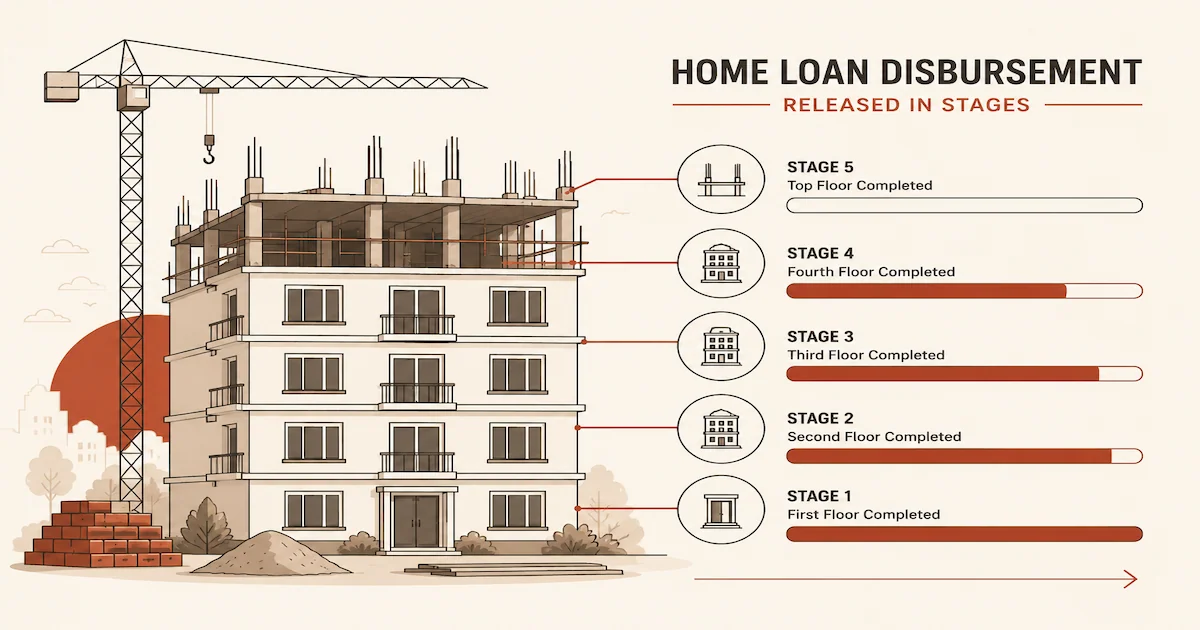
The mechanism follows from how under-construction lending works. A lender does not hand over Rs 50 lakh on day one for a flat that does not exist yet. It releases money in stages as the building goes up, and charges interest only on what it has released. Early on that is a small slice of the loan, so the payment is small. As more is released, the payment climbs.
Once the last stage is disbursed, the regular EMI starts and the principal finally begins to fall.
How does tranche disbursement actually work?
Tranche disbursement is the release of a home loan in instalments tied to construction milestones, paid to the builder and not to you. Published stage breakdowns cluster around 10% to 15% at booking and agreement registration, then again at foundation, at plinth level, on each floor slab, and at final finishing.
The operational chain matters more than the percentages, because it is where delays come from. The builder raises a demand letter when a milestone is hit. You pass it to the lender. The lender may send someone to verify the work has actually been done. Then the money moves, directly to the builder.
Watch what that does to the monthly payment on our Rs 50 lakh loan, released in four equal stages of Rs 12,50,000 a year apart.
| Stage | Disbursed so far | Pre-EMI a month |
|---|---|---|
| First release | Rs 12,50,000 | Rs 8,333 |
| After 12 months | Rs 25,00,000 | Rs 16,667 |
| After 24 months | Rs 37,50,000 | Rs 25,000 |
| After 36 months, fully disbursed | Rs 50,00,000 | Full EMI of Rs 41,822 begins |
The number people budget for is the first row. The number they live with by year three is triple that, and then it jumps again.
Does the loan tenure start during pre-EMI?
No. The tenure starts counting down only when the full sanctioned amount has been disbursed, because until then no principal is being repaid. Your twenty year loan becomes a twenty three year commitment on a three year build.
This is the part the field handles worst. Of the twelve pages surveyed, one states it plainly, three gesture at it by saying the pre-EMI period sits outside the loan tenure, and one states the reverse outright. The clearest version found belonged to a small finance bank, not to any of the large lenders.
There is a sharper edge to it. If the project slips from three years to five, the interest-only phase simply continues. Two extra years of payments, none of which reduce the loan by a rupee. Only one page of the twelve gives construction delay its own section.
What does the choice actually cost?
On a Rs 50 lakh loan at 8% over 20 years with a three year build, pre-EMI produces Rs 56,37,281 of interest against Rs 45,97,603 on full EMI, a difference of Rs 10,39,678. Same flat, same rate, same builder.
| Full EMI | Pre-EMI | |
|---|---|---|
| Monthly outflow, year one | Rs 10,456 | Rs 8,333 |
| Total interest | Rs 45,97,603 | Rs 56,37,281 |
| Loan runs for | 240 months | 276 months |
Two things explain the gap. Under full EMI the principal starts falling from the first disbursement, so every month of the build is a month of progress. Under pre-EMI the balance sits still for three years while interest accrues on it. And the twenty year clock only starts after that, adding thirty six months of interest at the end.
Worth being fair to pre-EMI here, because the cash-flow case is real. Somebody paying rent on one home while financing another has a genuine constraint, and Rs 2,123 a month is Rs 2,123 they do not have. The point is not that pre-EMI is a mistake. It is that the price of that flexibility is Rs 10.4 lakh, and nobody publishes it.
Can you claim tax on interest paid during construction?
Not in the year you pay it. The Income Tax Department allows interest from the pre-construction period to be deducted in five equal annual instalments, starting from the year construction completes, under section 24(b).
The statute itself never uses the word five. It grants the deduction "in equal instalments for the said previous year and for each of the four immediately succeeding previous years", which comes to five. The pre-construction period runs from the date of borrowing to 31 March preceding the year the property is acquired or completed, or the loan is repaid, whichever falls first.
The caps are worth knowing before you plan around them. A self-occupied home carries a Rs 2,00,000 annual ceiling, and only if construction finishes within five years of borrowing. Miss that window and it drops to Rs 30,000. A let-out property has no ceiling on the interest deduction, though the loss you can set against other income is capped at Rs 2,00,000.
The part that undoes most of it
Under the default tax regime, the section 24(b) deduction on a self-occupied home is not allowed at all. The Income Tax Department states this directly, and its own AY 2026-27 guidance for salaried taxpayers lists exactly one property type as eligible under the new regime: let out.
So the five instalment rule is real, correctly described by half the pages that mention it, and worth nothing to a buyer who lives in the flat and files under the default regime. That regime has been the default since assessment year 2024-25.
Two of the twelve pages surveyed mention the regime at all. The rest present the Rs 2,00,000 deduction with no qualifier, several on pages stamped 2026. Since tax turns on your own circumstances, a Chartered Accountant is the right person to confirm where you actually stand.
What this post deliberately does not cover
It does not tell you which option to take. The choice depends on your cash flow, your rent, how much you trust the builder's timeline, and things a page cannot see.
GST on under-construction property is left out, and that omission is deliberate, not accidental. It is a real cost that a ready-to-move flat does not carry, none of the twelve pages surveyed mentions it, and the rate and abatement rules deserve their own verification rather than a passing line here.
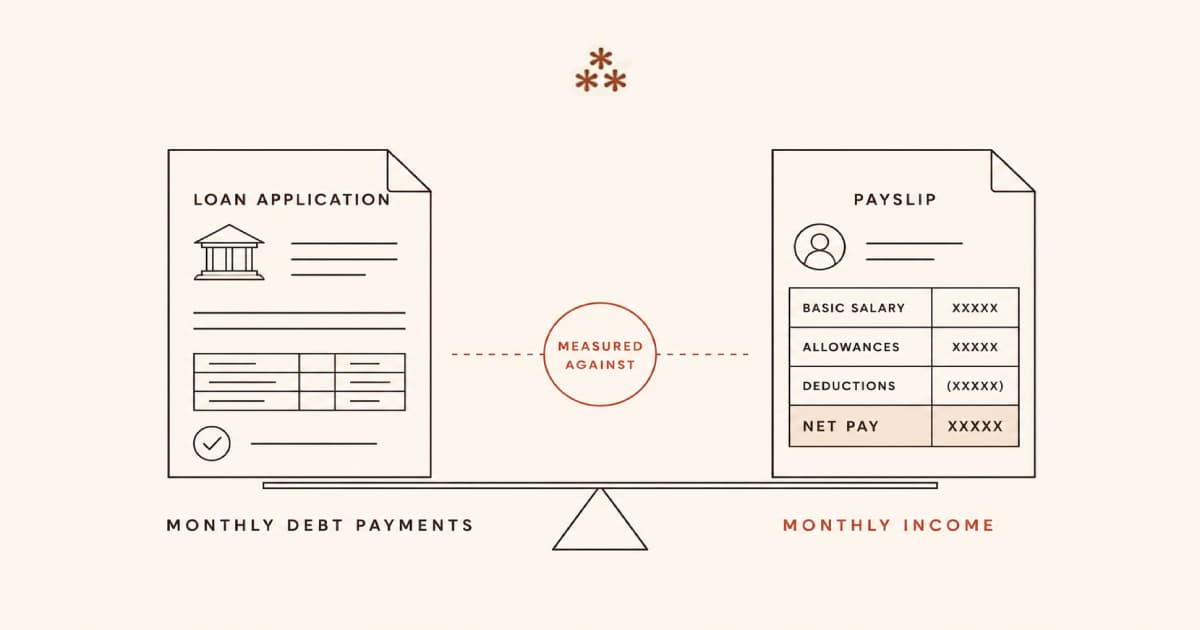
It also does not cover whether to buy under construction at all, the RERA protections that apply if a project stalls, or how lenders assess you. For that last one, the debt-to-income ratio and FOIR covers what lenders actually measure, and how interest rates are assembled explains why your rate is what it is. To run these numbers on your own flat, the home loan EMI calculator starts from the property price and applies the borrowing ceiling.
Frequently asked questions
What is pre-EMI on a home loan? Pre-EMI is the interest-only payment you make on the portion of a home loan that has been disbursed so far, during the construction of the property. Lenders release money for an under-construction flat in stages tied to building milestones, and until the last stage is released you pay interest on the released amount and nothing towards the principal. On a Rs 50 lakh loan at 8% where Rs 12,50,000 has been disbursed, the pre-EMI is about Rs 8,333 a month. Once the full amount is released, the regular EMI begins and the principal starts reducing.
How much more does pre-EMI cost than full EMI? On a Rs 50 lakh loan at 8% over 20 years with a three year construction period and money released in four equal stages, pre-EMI produces total interest of about Rs 56,37,281 against Rs 45,97,603 on full EMI. The difference is Rs 10,39,678, and the loan runs 276 months against 240. What buys that extra cost is a first-year monthly outflow of Rs 8,333 instead of Rs 10,456, a saving of Rs 2,123 a month. Of twelve India pages surveyed in August 2026 that compare the two, none published a total-cost figure for either path.
Does the loan tenure start during the pre-EMI period? No. The tenure starts counting down only once the full sanctioned amount has been disbursed, because until then there is no principal being repaid. That has a consequence worth understanding before signing: if the builder takes five years and not three, the interest-only phase simply continues, and every rupee paid during those extra two years reduces the loan by nothing. Only one page of the twelve surveyed states this plainly, and one states the opposite.
Can I claim tax on interest paid during construction? Not in the year you pay it. The Income Tax Department's own guidance is that interest for the period before construction completes is deductible in five annual instalments starting from the year of completion, under section 24(b). The pre-construction period ends on 31 March preceding the year the property is acquired or completed, or the loan is repaid, whichever comes first. The cap is Rs 2,00,000 a year on a self-occupied home if construction finishes within five years of borrowing, and Rs 30,000 if it does not.
Is the pre-construction interest deduction available under the new tax regime? Not for a home you live in. The Income Tax Department states that under the default regime of section 115BAC, the section 24(b) interest deduction on a self-occupied house property is not allowed, which makes the five instalment benefit worth nothing on the property type most buyers are purchasing. A let-out property keeps an uncapped interest deduction under the default regime, but the resulting loss cannot be set off against other income or carried forward. Of twelve India pages surveyed, two mentioned the regime at all.
How does tranche disbursement work? The lender releases the loan in stages against construction milestones, paying the builder directly. Published breakdowns run roughly 10% to 15% at booking and agreement registration, and similar shares at foundation, plinth, each floor slab and final finishing. The builder raises a demand letter, you submit it, the lender may verify progress on site, then the money moves. Interest is charged only on what has been released.
Where to go from here
The number to carry away is Rs 2,123 against Rs 10,39,678. That is the trade, stated in the only two units that matter, and it is the trade the entire published field describes without ever pricing.
One practical thing follows from it. If cash flow is the reason for choosing pre-EMI, the cost of that choice falls sharply the earlier you switch out of it, because the damage compounds with every month the principal sits untouched. Several lenders allow the switch to full EMI during construction, and one of the twelve pages surveyed contradicts its own sibling page on whether that is possible. Ask your own lender, in writing, before the first disbursement rather than after.
Sources
- Income Tax Department, House Property, for the five annual instalments starting from the year of completion, the definition of the pre-construction period, the Rs 2,00,000 and Rs 30,000 caps, and the statement that the section 24(b) interest deduction on a self-occupied property is not allowed under the default section 115BAC regime: incometaxindia.gov.in
- Income Tax Department, Salaried Individuals for AY 2026-27, whose new-regime deduction table lists let-out property as the only eligible category under section 24(b): incometax.gov.in
- Income Tax Department, Section 24, for the Explanation granting the deduction in equal instalments across the year of completion and the four succeeding years. Note that this page serves an archival snapshot whose provisos still show the pre-2016 three year and Rs 1,50,000 figures, so the Explanation is quoted here and the current caps are taken from the department's House Property guidance above: incometaxindia.gov.in
- Cost comparisons, stage percentages and the observation that no surveyed page publishes a total-cost figure come from a live review of twelve India pre-EMI and disbursement pages on 17 August 2026. The interest totals below are our own calculation on a Rs 50 lakh loan at 8% over 240 months with four equal disbursements a year apart.



You might also like

Indian floating-rate bank loans must reset at least once every three months under an RBI rule. What sets your rate, and which benchmark it is tied to.
13 min read
The 43% mortgage rule was removed in 2020 and India's regulator sets no income ratio at all. What the primary rules say, and what lenders decide themselves.
15 min read

RBI barred pre-payment charges on loans sanctioned from 1 January 2026, but only on floating-rate loans. Most personal loans are fixed, so check which you hold.
11 min read