Debt-to-Income Ratio and FOIR: What Lenders Actually Use

By Tapabrata Biswas · Published August 12, 2026 · 15 min read
Researched with AI assistance, reviewed and edited by Tapabrata Biswas.
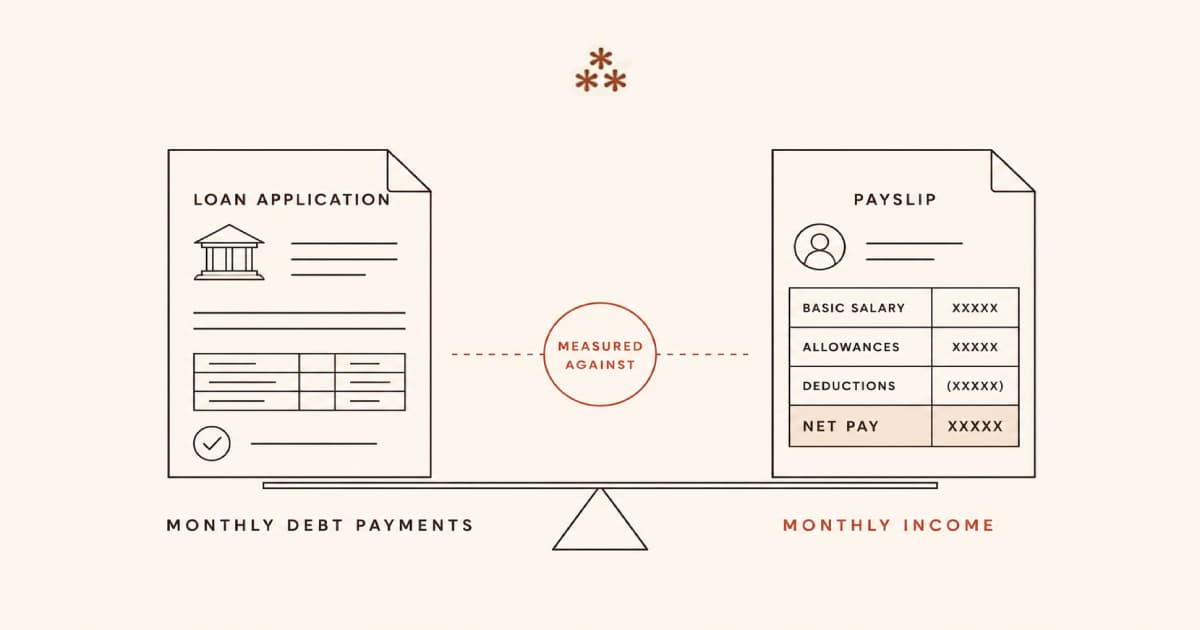
Search the Reserve Bank of India's own website for FOIR and it returns zero records. No thin page, no buried circular. Nothing at all.
That matters, because roughly two dozen Indian bank and lender pages explain FOIR as though it were a rule, quoting ceilings of 40%, 50%, 55%, even 75%, and not one of them cites a circular number or links a regulatory document. The ceiling everyone repeats is lender practice written up as though it came from somewhere official.
The American half of this topic has the mirror-image problem. The 43% debt-to-income limit that Chase, Bank of America and Rocket Mortgage all still quote was removed from the Qualified Mortgage rule by the CFPB in December 2020.
What is a debt-to-income ratio?
A debt-to-income ratio is your total monthly debt payments divided by your gross monthly income, written as a percentage. The CFPB's own worked example: $1,500 for a mortgage, $100 for an auto loan and $400 for everything else is $2,000 of monthly debt, and against $6,000 of gross monthly income that comes to 33%.
Gross means before tax and other deductions come out.
The thing the ratio measures is easy to misread. It is not how much you owe. It is how much of each month's income is already committed before you decide anything. A Rs 40 lakh home loan over 25 years can produce a lower ratio than a Rs 5 lakh personal loan over two years, because the ratio only sees the monthly payment.
That also makes it a different measurement from credit utilisation, which compares your card balances against your credit limits and never looks at income at all. One is about your income. The other is about your limits. They move independently, and a person can look comfortable on one and stretched on the other.
What does India use instead, and is it the same thing?
FOIR is the fixed obligation to income ratio, the term Indian lenders use for the same calculation. Fixed monthly obligations divided by monthly income, times 100.
The arithmetic matches. What goes into it does not.
Start with the denominator, where Indian pages split cleanly down the middle. IndusInd Bank, Bank of Baroda, Ujjivan Small Finance Bank and Godrej Capital all use gross income, and IndusInd defines it properly as salary before deductions like tax and provident fund. IIFL, Oolka and Fincover use net take-home pay. Two pages contradict themselves inside a single article, one of them flipping between gross and net four times across five sentences.
The gap that creates is not small. Provident fund at 12% of basic plus income tax can put twenty percentage points between the two figures. An obligation that reads as 40% of gross can be comfortably more than half of the money that actually lands in the bank. Our post on gross versus net income works through the whole CTC to take-home chain, and the take-home salary calculator does the arithmetic on a real CTC.
Then there's a straightforward error worth knowing about. Two Indian bank pages use gross income as the denominator while listing provident fund and taxes among the obligations in the numerator. Those deductions are already inside the gross figure. Counting them again on the other side of the fraction charges the borrower twice for the same money, and neither page notices.
How much does the gross or net choice actually change?
Enough to move a borrower from comfortable to borderline without a single number about them changing. Since no page in either market shows the same person calculated both ways, here is one.
Take a salaried employee on Rs 1,50,000 a month gross, with basic pay at half of that under the Labour Code floor. Provident fund at 12% of basic takes Rs 9,000. Professional tax takes Rs 200 where the state levies it. Say income tax withholding runs Rs 18,000 a month. Take-home lands at Rs 1,22,800.
Now give them Rs 60,000 of monthly obligations: a car loan, a personal loan and a credit card minimum.
| The same borrower, two methods | Gross basis | Take-home basis |
|---|---|---|
| Income used | Rs 1,50,000 | Rs 1,22,800 |
| Monthly obligations | Rs 60,000 | Rs 60,000 |
| Ratio | 40.0% | 48.9% |
Nothing about this person changed. The obligations are identical, the salary is identical, and the answer moved almost nine percentage points. On a gross basis they sit at the middle of the band Indian lenders describe as acceptable. On a take-home basis they are close to the ceiling several of those same lenders describe as a decline.
Our debt-to-income calculator runs both denominators side by side on your own figures, which no other tool in either market does.
Both numbers are honest. They answer different questions. The gross figure describes how much of what the employer pays is committed, and the take-home figure describes how much of what arrives in the account is committed. A borrower servicing an EMI does it from the second number.
Does any regulator actually set a limit?
In the United States the famous 43% limit was removed nearly six years ago, and in India no such limit was ever set. Both facts are checkable in the primary text, and almost nothing on either search result page reflects either one.
Take the American rule first. The CFPB issued a final rule on 10 December 2020 whose summary states that it removes the General Qualified Mortgage loan definition's 43 percent DTI limit and replaces it with price-based thresholds. What replaced it is a test on price: a loan qualifies when its annual percentage rate sits less than 2.25 percentage points above the average prime offer rate for a comparable transaction, with wider allowances for smaller loans. The rule took effect on 1 March 2021 and mandatory compliance began on 1 October 2022.
Lenders still have to look at the number. The regulation requires a creditor to consider the borrower's monthly debt-to-income ratio or residual income. What no longer exists is the 43% ceiling.
The CFPB's own consumer page is consistent with that. It gives the formula and the worked example, then says only that different loan products and lenders will have different limits. It publishes no threshold at all. On a page whose entire job is explaining the ratio, that silence looks deliberate.
On the Indian side the absence is more complete. RBI's site search returns nothing for FOIR. The housing finance rules deal with loan-to-value ratios and risk weights, with no income test in them anywhere. And RBI says plainly whose job it is, directing that banks frame comprehensive prudential norms covering margins, security and repayment schedules, approved by the bank's own board.
One exception exists and it is worth stating precisely, because a half-remembered version of it circulates. RBI's 2025 credit facilities directions do cap monthly loan repayments at 50% of monthly household income. That rule sits in the microfinance chapter, and microfinance is defined there as collateral-free lending to a household earning up to Rs 3,00,000 a year. It is not a home loan rule.
A second figure gets misread the same way. The National Housing Bank publishes a maximum instalment-to-gross-income ratio of 45%, which reads like a mandate until you notice it sits under eligibility criteria for home loans to qualify for securitisation, next to an 85% loan-to-value criterion, followed by a note that NHB may change the pool selection criteria at its discretion. It is a standard for buying loan pools, not a rule for granting loans.
What do the actual lender rules say?
The real ceilings live in lender and guarantor rulebooks, and they are higher and more conditional than the round numbers in circulation.
Fannie Mae's selling guide is specific. Its maximum total ratio is 36% of stable monthly income for manually underwritten loans, it can be exceeded up to 45% where the borrower meets the credit score and reserve requirements, and for files underwritten through Desktop Underwriter the maximum allowable ratio is 50%.
Read that scoping carefully, because "Fannie Mae's limit is 36%" is how it usually gets quoted and it is wrong. The 36% binds manual underwriting only. Most volume runs through the automated system at 50%.
FHA works differently again. HUD's handbook sets ratios through a compensating factors matrix, and every part of it is scoped to manually underwritten mortgages.
| Credit score | Max housing / total ratios | What is required |
|---|---|---|
| 500 to 579 or none | 31 / 43 | No compensating factors permitted |
| 580 and above | 31 / 43 | None required |
| 580 and above | 37 / 47 | One factor: reserves, a minimal payment increase, or residual income |
| 580 and above | 40 / 40 | No discretionary debt |
| 580 and above | 40 / 50 | Two of the qualifying factors |
For loans scored through FHA's automated system, the handbook sets no maximum ratio at all. The matrix binds only when a file is downgraded to manual underwriting. That is close to the opposite of how the number is usually reported.
What counts as debt, and what does not?
Debt payments count, living costs do not, and the awkward case is rent. Rocket Mortgage explains the reason for the line: lenders exclude groceries, utilities and insurance because those can fluctuate or be cancelled under hardship, while a loan payment cannot.
So minimum credit card payments, car loans, student loans, personal loans, alimony and child support are in. Groceries, petrol, utilities and phone bills are out.
Rent is where the field openly contradicts itself. Wells Fargo, NerdWallet and Rocket Mortgage put it in the numerator. Bank of America says not to include a rental payment. One mortgage lender gives the reasoning everyone else omits: on a home loan application the new mortgage replaces the rent, so counting both charges the borrower twice for one roof. For any other borrowing, rent is a fixed obligation like any other.
Credit cards carry a second trap, and it is the difference between a manageable ratio and a hopeless one. The figure that belongs in the numerator is the minimum payment, not the balance. Zillow states it cleanly: on a $5,000 balance with a $100 minimum, the number used is $100. Bankrate's page says outstanding balances, and one Indian FOIR calculator asks for outstanding credit card debt outright, which would inflate the ratio by the whole ratio of balance to minimum.
What does RBI regulate instead?
RBI regulates the collateral instead of the income, capping how much of a property's value a bank may lend against. The current rules sit in the Reserve Bank of India (Commercial Banks, Credit Facilities) Directions, 2025.
| Loan size | Maximum loan to value | Risk weight |
|---|---|---|
| Up to Rs 30 lakh | 80% | 35% |
| Up to Rs 30 lakh | Above 80% and up to 90% | 50% |
| Above Rs 30 lakh to Rs 75 lakh | 80% | 35% |
| Above Rs 75 lakh | 75% | 50% |
The 90% figure that gets quoted as the general rule applies only to loans up to Rs 30 lakh, and it costs the bank a heavier capital charge. Above Rs 75 lakh the ceiling is 75%.
One detail in those directions catches buyers out: banks may not include stamp duty, registration and other documentation charges in the property cost they lend against, except where the house costs Rs 10 lakh or less. Those charges come out of the buyer's own funds on top of the down payment.
So the Indian picture is coherent once you see the split. The regulator sets the collateral rules. Each bank's board sets the income rules. FOIR is real, it decides applications every day, and it is commercial policy dressed up as regulation by the pages explaining it.
What this post deliberately does not cover
This explains what the ratio is, what the primary rules say, and where the published numbers come from. It gives no view on how much anyone should borrow, which is a question about a specific income, a specific property and a specific lender's policy.
It does not predict whether a particular application will be approved. Lenders weigh credit history, employment stability, the property itself and their own portfolio position alongside any ratio, and two banks can decide the same file differently on the same day.
Loan agreements and foreclosure rules are legal questions for a lawyer. The tax treatment of home loan interest and principal is a question for a chartered accountant in India or a CPA in the United States, since it turns on individual circumstances. For the mechanics of clearing existing debt, as opposed to qualifying for more, our debt and credit guide is the hub.
One limit worth stating plainly. RBI's rules are consolidated and reissued regularly, and a set of capital rules already published will change housing risk weights from 1 April 2027. The figures here are current as of August 2026.
Frequently asked questions
What is a debt-to-income ratio? A debt-to-income ratio is your total monthly debt payments divided by your gross monthly income, expressed as a percentage. The US Consumer Financial Protection Bureau gives the worked example: a mortgage of $1,500, an auto loan of $100 and $400 for other debts comes to $2,000 of monthly debt, and against $6,000 of gross monthly income that is a ratio of 33%. Gross means income before tax and other deductions are taken out. The ratio measures committed income rather than accumulated debt, so a large loan with a long tenure can produce a lower ratio than a small loan repaid quickly.
Is the 43% debt-to-income rule still real? No, not as a rule. The CFPB issued a final rule on 10 December 2020 that, in its own words, removes the General Qualified Mortgage loan definition's 43 percent DTI limit and replaces it with price-based thresholds, tied to how far the annual percentage rate sits above the average prime offer rate. Mandatory compliance began on 1 October 2022. Lenders must still consider a borrower's debt-to-income ratio or residual income, but the 43% cap is no longer in the regulation, and the CFPB's own consumer page on debt-to-income ratios publishes no threshold figure at all.
What is FOIR and how is it different from DTI? FOIR is the fixed obligation to income ratio, the term Indian lenders use for the same idea: fixed monthly obligations divided by monthly income. The difference is not in the arithmetic but in what goes into it. Indian lender pages disagree on whether the denominator is gross salary or take-home pay, and they disagree on whether rent, insurance premiums and living expenses belong in the numerator. Two Indian bank pages use gross income as the denominator while also listing provident fund and taxes as obligations in the numerator, which counts the same deduction twice.
Does RBI set a maximum FOIR for home loans? No. A search of the Reserve Bank of India's own site returns zero records for FOIR, and the housing finance rules address only loan-to-value ratios and risk weights, with no income test anywhere in them. RBI explicitly delegates the judgement, directing that banks frame their own board-approved norms covering repayment schedules and lending policy. The one income-percentage ceiling in the RBI directions caps monthly loan repayments at 50% of household income, and it applies only to microfinance, meaning collateral-free lending to households earning up to Rs 3,00,000 a year.
Should FOIR be calculated on gross salary or take-home pay? Indian lender pages give both answers, which is why the same borrower gets different numbers on different sites. IndusInd Bank, Bank of Baroda, Ujjivan and Godrej Capital all use gross income, defined as salary before deductions. IIFL, Oolka and Fincover use net or take-home income. At least two pages contradict themselves within a single article. The practical consequence is large, because provident fund at 12% plus income tax can put a 20 percentage point gap between the two figures, and an obligation that looks like 40% of gross can be well over half of what actually reaches the bank.
Does rent count in a debt-to-income ratio? It depends on whether a mortgage is about to replace it, and the ranking pages contradict each other flatly. Wells Fargo, NerdWallet and Rocket Mortgage all include rent in the numerator. Bank of America says not to include a rental payment. One mortgage lender explains the logic that the others leave out: for a home loan application the new mortgage payment replaces the rent, so counting both would double up a cost the borrower will only pay once. For any other kind of borrowing, rent is a fixed monthly obligation like any other.
Sources
- Consumer Financial Protection Bureau, Qualified Mortgage Definition Under the Truth in Lending Act (Regulation Z): General QM Loan Definition, Final Rule (removing the 43 percent DTI limit and replacing it with price-based thresholds, issued 10 December 2020, effective 1 March 2021) consumerfinance.gov
- US Government Publishing Office, Federal Register, 85 FR 86308, 29 December 2020 (the rule text as published) govinfo.gov
- US Government Publishing Office, Federal Register, 30 April 2021 (delaying mandatory compliance to 1 October 2022) govinfo.gov
- Consumer Financial Protection Bureau, What is a debt-to-income ratio? (the formula, the worked example, and no threshold figure, last reviewed 28 August 2023) consumerfinance.gov
- Fannie Mae, Selling Guide B3-6-02, Debt-to-Income Ratios (36% manually underwritten, up to 45% with credit score and reserves, 50% through Desktop Underwriter) fanniemae.com
- Reserve Bank of India, Reserve Bank of India (Commercial Banks, Credit Facilities) Directions, 2025, RBI/DOR/2025-26/154 of 28 November 2025 (loan-to-value ceilings, risk weights, the exclusion of stamp duty from property cost, and the microfinance 50% household repayment cap) rbi.org.in
- Reserve Bank of India, site search for FOIR (zero records, checked 12 August 2026) rbi.org.in
- National Housing Bank, eligibility criteria for home loans to qualify for securitisation (the 45% instalment-to-gross-income figure, in its actual context as a pool selection criterion) nhb.org.in



You might also like

How debt and credit work in India and the US, in one guide: CIBIL and FICO, EMIs and revolving cards, and the RBI and Fed rules current as of July 2026.
13 min read

TransUnion CIBIL calls 30% a healthy ratio but sets no official cut-off, and FICO publishes none either. What the data shows, and why top scores sit under 10%.
14 min read

India quotes CTC. The US quotes gross. Neither is what lands in your account, and the US employer's 7.65% is the part nobody puts in the offer letter.
13 min read