Passive Income Ideas for Beginners: What Counts

By Tapabrata Biswas · Published May 18, 2026 · 12 min read
Researched with AI assistance, reviewed and edited by Tapabrata Biswas.

True passive income, money that arrives without ongoing work, exists in only two forms: returns on invested capital, and royalties from past creative work. Everything else marketed as "passive income" is either initially-passive-but-requires-maintenance (affiliate sites, courses, YouTube ad revenue) or actively-active-but-with-passive-marketing (dropshipping, forex trading, "automated" funnels). The 2026 personal-finance content ecosystem is full of the second category, where the word "passive" is doing more work than the income.
This post separates the categories honestly, covers what's realistic for a beginner with limited capital, and explains why the most popular "passive income" pitches aren't what they're marketed as.
What "passive income" actually means
The Internal Revenue Service in the US classifies passive income narrowly: rental income and earnings from a business in which the taxpayer doesn't materially participate. Everything else is either active income (wages, self-employment) or portfolio income (interest, dividends, capital gains): both of which are taxed differently from "passive" in the legal sense.
In common usage, the term has broadened to include any income that doesn't require continuous active work. That broader definition makes more practical sense but introduces confusion when "passive" gets applied to things that require substantial ongoing effort.
A useful three-tier framework:
Truly passive (zero ongoing work after setup):
- Interest from savings accounts and fixed deposits
- Bond coupon payments
- Dividend income from stocks and mutual funds
- Rental income from real estate (if professionally managed)
- Royalties from books, music, courses, or stock content (after creation)
Semi-passive (light maintenance required):
- Affiliate marketing on an established website
- YouTube ad revenue on a content library
- Course sales on Udemy/Skillshare/Teachable
- Pinterest pin design business with established traffic
- Self-managed rental property
Marketed as passive but actually active:
- Dropshipping (requires constant supplier management)
- "Print-on-demand" stores (requires design work and ad spend)
- Cryptocurrency trading or "yield farming"
- Forex "expert advisor" trading systems
- Most "automated" e-commerce funnels sold in courses
Most "passive income" guru content focuses on the third tier because it sells better. The first two tiers produce real income but require honest framing about either upfront capital or upfront work.
Truly passive income: the only two categories
Returns on invested capital
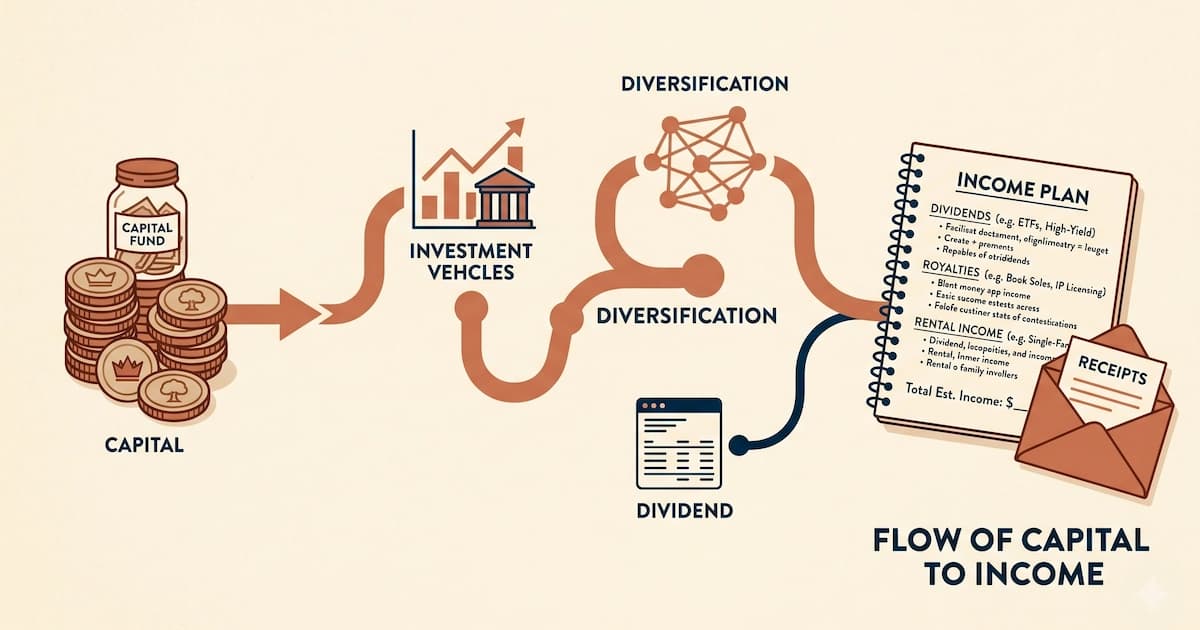
This is the cleanest category. Money sits in an account, earns a return, generates income without any work from you. Three options matter for beginners:
High-yield savings accounts. In the US in 2026, leading high-yield savings accounts pay around 4% APY. In India, leading bank FDs pay 6.5-7.5% for 1-3 year terms. The math is straightforward: a ₹50,000 / $1,000 balance generates ₹3,000-3,750 or $40 per year in pure passive income. A ₹5,00,000 / $10,000 balance generates ₹30,000-37,500 or $400 per year.
For Indian readers, our piece on what is a high-yield savings account covers the mechanics. For US readers, the same principles apply with different account types (HYSAs, CDs, Treasury bonds).
Mutual funds and index funds (especially dividend or debt-fund types). Dividend-focused equity funds and debt mutual funds generate periodic income. Indian large-cap dividend yields average 1-3%; US S&P 500 dividend yield runs 1-2%. Returns are higher when combined with capital appreciation, but the "passive income" portion specifically refers to dividend or coupon payouts.
Real estate (rented through professional management). Self-managed rental property is decidedly NOT passive. It involves tenant communication, maintenance, repairs, and emergencies. Property managed through professional property managers (taking 8-12% of rent) is genuinely passive but reduces effective return.
Royalties from past creative work
This is the category that gets less attention but is more accessible to beginners with skills rather than capital.
Book royalties. Self-published books on Amazon Kindle Direct Publishing or Indian platforms continue earning royalties for years after the initial writing. Realistic numbers: most self-published books earn $200-2,000 / ₹15,000-1.5 lakh in lifetime royalties, but the few that gain traction in a niche can earn 10-100x that.
Course royalties. Courses on Udemy, Skillshare, Teachable, or Hotmart earn royalties indefinitely. Typical course revenue: $50-500/month after initial 30-day launch for most courses. Successful courses earn $1,000-10,000+/month for years.
Stock content royalties. Stock photos (Shutterstock, Adobe Stock), stock music (PremiumBeat, Pond5), or stock video (Storyblocks, Pond5) generate small ongoing royalties. Each individual asset earns small amounts ($0.20-5 per download), but a library of hundreds of assets compounds.
Music streaming royalties. Spotify, Apple Music, and YouTube Music pay per stream (roughly $0.003-0.005 per stream). Indie artists with established catalogues earn meaningful royalties; new artists typically don't reach material amounts.
The "after creation" framing is important. These all require substantial upfront active work (writing the book, recording the course, photographing the stock images). Once that work is done, the income mechanism is genuinely passive.
The capital math for living off passive income
The Trinity Study (William Bengen 1998, follow-up Trinity University research) established that a 4% annual withdrawal rate from a diversified portfolio has high historical survivability over 30+ years. This is the canonical reference for FIRE (financial independence) planning.
Working the math backward: to generate target monthly income at the 4% safe withdrawal rate:
| Target monthly passive income | Required capital (4% withdrawal) |
|---|---|
| ₹10,000 / $200 | ₹30 lakh / $60,000 |
| ₹25,000 / $500 | ₹75 lakh / $150,000 |
| ₹50,000 / $1,000 | ₹1.5 crore / $300,000 |
| ₹1 lakh / $2,000 | ₹3 crore / $600,000 |
| ₹2 lakh / $4,000 | ₹6 crore / $1.2 million |
These numbers are sobering and intentionally so. "Living off passive income" sounds aspirational until the capital requirement comes into view. For a beginner working with limited capital, the realistic goal isn't replacing primary income. It's adding ₹1,000-10,000 / $20-200 in monthly supplementary income to existing earnings, which compounds materially over a decade.
For the math of how that compounding actually works, see our piece on what is compound interest. For the broader explainer on the underlying concept of passive income, see what is passive income.
Semi-passive options for beginners
These require capital OR upfront work AND light ongoing maintenance, not truly passive but realistic for beginners.
Affiliate marketing on a niche website. Build a content site in a specific niche (personal finance, fitness, cooking, hobby), drive traffic through SEO + Pinterest, monetise through affiliate links to relevant products. Income ramp: 6-18 months to first material monthly revenue ($100+ or ₹8,000+). Ongoing maintenance: 5-10 hours/week for content updates and SEO.
YouTube ad revenue. Build a channel in a specific niche, reach the 1,000 subscribers + 4,000 watch hours threshold, monetise through AdSense. Income varies wildly by niche: finance content pays $5-20 CPM (cost per thousand views); gaming pays $1-5 CPM. Once a channel has 50+ videos and 10,000+ subscribers, the back-catalogue produces semi-passive income.
Pinterest pin design business. Design pins for clients, charge per pin or monthly retainer. Income is more active than truly passive but the work is project-based and async-friendly. See side hustles for introverts for the full async-work context.
Course creation. Build a course on Udemy/Skillshare/Teachable. Upfront work: 40-100 hours per course. Ongoing maintenance: occasional updates as the topic evolves, marketing if you want to grow. Realistic income: $100-2,000/month per course after launch, with successful courses earning $1,000-10,000+/month.
What to avoid as "passive income"
Three patterns deserve specific warning.
Cryptocurrency staking, yield farming, and "passive crypto income." The returns marketed (8-25% APY) are real in headline terms but the underlying risks aren't disclosed. Many DeFi protocols offering high yields have collapsed since 2021, taking participant capital with them. Some yield-farming protocols are functionally Ponzi schemes: early participants are paid with new participant deposits. Treat crypto allocations as speculative risk capital, not passive income.
Forex trading "expert advisors" and "automated systems." Forex is one of the most aggressively marketed "passive income" categories targeting retail consumers. The marketing claims automated systems can generate consistent monthly returns; the reality is that more than 70% of retail forex traders lose money according to ESMA disclosure requirements. Indian and US securities regulators have repeatedly warned about misleading forex passive-income marketing.
Real estate crowdfunding promising guaranteed double-digit returns. Real estate crowdfunding (Fundrise, RealtyMogul in the US; similar platforms in India) can be legitimate, but specific offerings promising "guaranteed" 12-18% returns deserve scrutiny. Returns aren't actually guaranteed; the projects often involve construction risk, occupancy risk, or speculative property development.
MLM products marketed as "residual income" or "passive income builder." Multi-level marketing schemes redefine passive income to include downline commissions on recruits. The 99% participant-loss rate per Federal Trade Commission research applies whether the company calls its compensation "passive," "residual," or any other reframing.
A realistic 3-year plan for beginner passive income
Most successful beginner passive-income strategies layer multiple small streams over years rather than chasing a single "passive income system."
Year 1: Foundation through invested capital. Open a high-yield savings account (US) or 1-year FD (India). Invest excess savings beyond emergency fund into a broad-market index fund. Build the capital base that future passive income will scale from. Target year-1 passive income: ₹500-3,000/month or $10-60/month.
Year 2: Add semi-passive content asset. Start a niche affiliate website, YouTube channel, or course in a topic you have expertise in. Year 2 income from this asset is typically near zero, but the foundation is built. Capital base continues compounding.
Year 3: Compounding begins. The invested capital base has grown 15-25% from contributions plus returns. The content asset starts producing modest monthly income. Combined year-3 passive income: typically ₹3,000-15,000/month or $60-300/month for someone with consistent execution.
The 3-year horizon is what most "make $5,000/month passive income in 90 days" marketing hides, the timeline is real but it's measured in years, not weeks.
What experts say
The Reserve Bank of India's Financial Education materials cover Indian savings and investment products that produce truly passive income.
The Securities and Exchange Board of India (SEBI) investor education portal covers mutual fund, equity, and bond investing in the Indian context.
The US Securities and Exchange Commission's investor.gov resources cover US investment income concepts including dividends, bond income, and the underlying mechanics of capital-based passive income.
For the explainer of what passive income actually means as a concept, see what is passive income. For the broader earning context beyond passive, see best side hustles for beginners.
Frequently asked questions
What is truly passive income for a beginner with little capital? Genuinely passive income exists in two forms only: returns on invested capital (high-yield savings interest, dividends, bond coupons, rental income) and royalties from past creative work (books, courses, music, stock photos). For beginners with limited capital, high-yield savings interest is the closest thing to true passive income: even a ₹50,000 / $1,000 balance at 4-7% generates ₹2,000-3,500 or $40-70 per year with zero ongoing work. Other commonly-marketed 'passive' options (affiliate marketing, ad revenue, dropshipping) require substantial ongoing maintenance and aren't truly passive.
How much capital do I need to live off passive income? The Trinity Study (Bengen 1998 and follow-up Trinity research) established that a 4% annual withdrawal rate from a diversified portfolio has high historical survivability over 30+ years. Working backward: to generate ₹50,000/month (₹6 lakh/year) in passive income at 4% requires ₹1.5 crore in invested capital. To generate $4,000/month ($48,000/year) in the US requires roughly $1.2 million. These are FIRE-movement targets, not beginner targets. For supplementary passive income of ₹5,000-20,000/month or $100-400/month, capital requirements scale linearly: roughly ₹15-60 lakh or $30,000-120,000 invested.
Are dividend stocks a good passive income for beginners? Dividend investing is a legitimate passive income approach but typically not the highest-return one for beginners. Indian large-cap dividend yields average 1-3% (vs 1-2% for US S&P 500). To generate ₹10,000/month from dividends at 2% yield requires roughly ₹60 lakh invested. Most personal-finance research suggests beginners focus on total-return index fund investing (which includes both price appreciation and dividends) rather than specifically dividend-focused stocks, because total-return investing produces higher long-term wealth in most historical periods. This is general educational information, not investment advice: consult a qualified advisor before investing.
What 'passive income' should I avoid as a beginner? Three patterns marketed as passive income reliably produce poor outcomes. First, cryptocurrency staking and yield farming marketed as 'passive crypto income', the returns vary wildly and many high-yield protocols have collapsed, taking participant capital with them. Second, foreign exchange (forex) trading 'passive systems' or 'expert advisors'. These are active trading with marketing copy, not passive income. Third, real estate crowdfunding and REIT alternatives promising guaranteed double-digit returns, the returns aren't guaranteed and the underlying risks aren't disclosed. Any pitch promising returns above 8-10% annually for 'passive' income should be approached as risk capital, not safe income.
In summary
Truly passive income exists in two forms only: returns on invested capital and royalties from past creative work. Most popularly-marketed "passive income" categories, affiliate sites, YouTube revenue, dropshipping, course sales, are semi-passive at best, requiring substantial upfront work plus ongoing maintenance. The Trinity Study 4% rule provides the underlying math: meaningful passive income requires meaningful capital (₹30 lakh or $60,000 for even modest ₹10,000/month or $200/month supplementary income).
For beginners with limited capital, the highest-leverage strategy is layering three streams over 3 years: capital accumulation in invested savings, building a semi-passive content asset (affiliate site, course, YouTube), and patient compounding. The 3-year timeline is what most "passive income in 90 days" marketing hides, and it's the realistic horizon for material results. Treat anything promising faster results as marketing, not as a path.
The next read in this series is on what is passive income, the conceptual explainer that this post's practical recommendations build on. For broader Pillar 5 context, see best side hustles for beginners.
Sources
- William P. Bengen, Determining Withdrawal Rates Using Historical Data (Journal of Financial Planning, 1994): original Trinity Study
- Reserve Bank of India, Financial Education resources: rbi.org.in/FinancialEducation/home.aspx
- Securities and Exchange Board of India, SEBI Investor Education Portal: investor.sebi.gov.in
- US Securities and Exchange Commission, Investor.gov Education Resources: investor.gov
- US Federal Trade Commission, Multi-Level Marketing Business Guidance: ftc.gov multi-level marketing guidance




You might also like
What is passive income? The everyday meaning vs the narrower IRS definition, active vs passive vs portfolio income, and how it's taxed in India and the US.
14 min read

The best beginner side hustles for 2026 with realistic ₹ and $ earnings, startup cost, time to first payment, and how side income is taxed in India and the US.
27 min read

The formula, worked rupee examples, and why compounding daily rather than yearly is worth far less than most people assume.
11 min read