What Is Dropshipping? Real Margins and Why Most Fail

By Tapabrata Biswas · Published June 23, 2026 · 12 min read
Researched with AI assistance, reviewed and edited by Tapabrata Biswas.
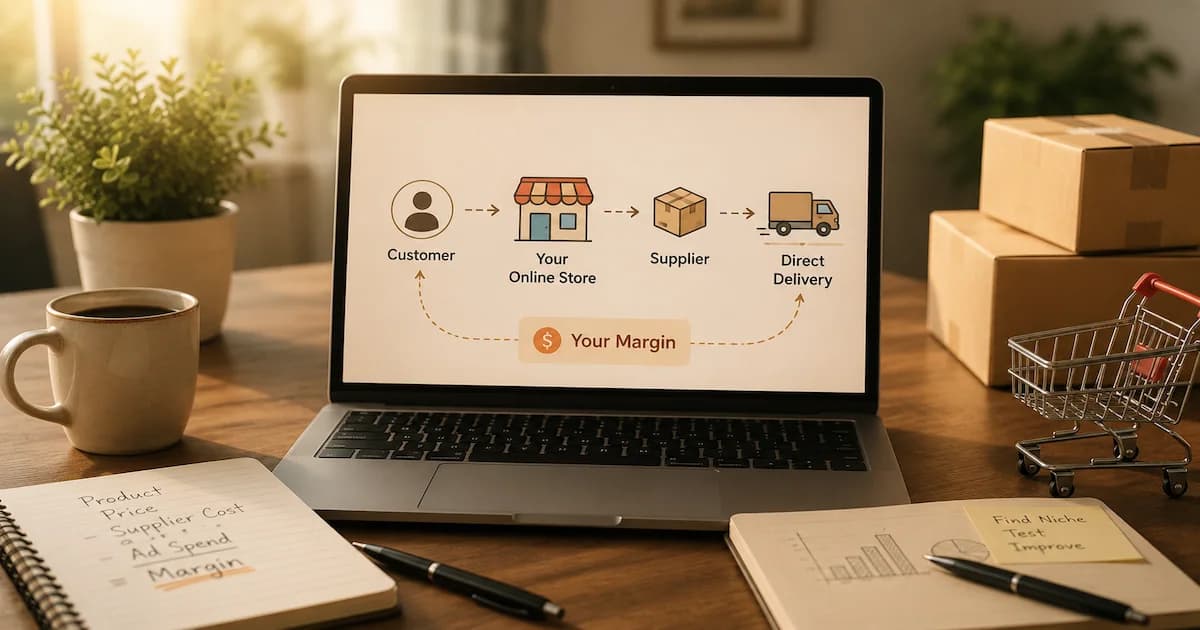
Dropshipping is one of the most searched side hustles on the internet, and most of what's written about it is published by companies that sell the store builders, payment tools, or supplier directories you'd buy to start one. This explainer doesn't. We don't sell a platform, a course, or a supplier list, so this is the version with the numbers those pages tend to bury: how the model actually works, what the real margins are after costs, why most stores fail, and how it plays out differently in India and the US.
It's an explainer of the model and its economics, not a guide to starting a store and not a claim that you'll make money doing it.
What dropshipping is
Dropshipping is a retail fulfilment model in which an online store sells products it does not stock, forwarding each order to a third-party supplier who ships the item directly to the customer. The seller never handles, stores, or sees the product. They run the storefront and the marketing; the supplier holds the inventory and does the shipping.
That's the whole appeal: you can list products for sale without buying them first, so the upfront cost is low compared with traditional retail. It's also the whole risk, because the things that decide success (price, shipping speed, product quality, returns) are largely controlled by a supplier you don't manage. The global dropshipping market is large and growing fast, valued in the hundreds of billions of dollars and projected by market-research firms to pass $1 trillion within the next several years, which is exactly why so much promotional content surrounds it.
How dropshipping works: the order flow
The mechanics are a four-step loop that repeats on every sale:
- A customer orders a product from your online store and pays your retail price.
- You forward that order to your supplier and pay their wholesale price.
- The supplier ships the product directly to your customer, usually in unbranded packaging.
- You keep the difference between the two prices, before your running costs come out of it.
You're never out of pocket for inventory, because the customer pays you before you pay the supplier. What you are responsible for is everything the customer experiences: the storefront, the marketing that brings them in, customer service, and handling returns or complaints when a supplier ships slowly or sends the wrong item.
Where the profit actually comes from: gross versus net
In dropshipping, your profit is the gap between the retail price the customer pays and the wholesale price you pay the supplier, minus advertising, payment processing, shipping, and returns. The first half of that sentence is what promotional content shows you. The second half is what determines whether you actually make money.
The distinction that trips up almost every beginner is gross margin versus net margin. If you sell an item for $40 that costs you $12, that's a 70% gross margin, and that's the number the "start a store" pages lead with. Your net margin is what's left after the costs of making the sale, and it's a different figure entirely. The next section runs the full teardown.
The honest economics: a worked example
The same sale the promotional pages show, with every cost included: Take a $39.99 product sold through paid ads, a typical setup for a new store:
| Line item | Amount |
|---|---|
| Selling price (what the customer pays) | $39.99 |
| Product cost (to the supplier) | -$8.00 |
| Shipping (supplier to customer) | -$4.00 |
| Payment processing (about 2.9% + $0.30) | -$1.46 |
| Advertising (about 30% of revenue) | -$12.00 |
| Returns and chargeback allowance (about 5%) | -$2.00 |
| Platform and app fees (per order) | -$1.50 |
| Net profit per order | about $11.00 (roughly 28%) |
That looks fine, until you notice the advertising line is the swing factor. New stores routinely spend closer to 40% of revenue on cold paid traffic while they're still learning. Push ad cost to $16.00 and the net drops to about $7.00 (roughly 18%). Add one round of refunds or a single ad campaign that doesn't convert, and that same order is suddenly break-even or negative.
A realistic dropshipping net margin is about 15% to 20% of revenue, not the 65% to 70% gross margin beginners often mistake for take-home profit. That gap, between the markup you see and the profit you keep, is the single most important thing to understand before treating dropshipping as income.
The India picture has its own twist. Take a ₹1,499 product sourced from a domestic supplier:
| Line item | Amount |
|---|---|
| Selling price | ₹1,499 |
| Product cost | -₹600 |
| Shipping | -₹120 |
| Payment gateway (about 2%) | -₹30 |
| Advertising (about 30%) | -₹450 |
| COD return-to-origin allowance | -₹150 |
| Net profit per order | about ₹150 (roughly 10%) |
The India-specific margin killer is that last line. A large share of Indian e-commerce orders are cash on delivery, and when a customer refuses a COD parcel, the order returns to the seller (called return-to-origin, or RTO). You pay forward and return shipping on a sale that earned nothing. On thin dropshipping margins, a modest RTO rate can wipe out the profit from the orders that did go through.
Why most dropshipping stores fail
Industry estimates commonly put the dropshipping failure rate around 80% to 90% within the first few months, with only a small share reaching consistent long-term profit. These figures aren't from a single official registry, so treat them as widely repeated estimates rather than precise statistics. The platforms that profit from new stores rarely lead with them, which is reason enough to state them plainly.
The causes are predictable, and most are economic rather than bad luck:
- Thin or negative unit economics. The margin teardown above, run badly, loses money on every sale.
- Rising advertising costs. Paid traffic is the main way new stores get customers, and it keeps getting more expensive, eating the margin.
- Unreliable suppliers and slow shipping. International orders can take 15 to 30 days, which drives refunds and chargebacks.
- No differentiation. When dozens of stores sell the same generic product, price is the only lever, and price wars destroy margins.
- The passive-income mismatch. Dropshipping is sold as passive income, but it's an active marketing business. People expecting the former quit when they meet the latter. If genuine passive income is the goal, passive income ideas for beginners covers approaches that fit that definition better.
Dropshipping versus holding inventory versus print-on-demand
Dropshipping is one of three common ways to sell physical products online, and the right comparison is neutral, not sold by whichever vendor wrote it:
| Dropshipping | Holding inventory | Print-on-demand | |
|---|---|---|---|
| Upfront capital | Lowest | Highest (bulk buy plus storage) | Low |
| Per-unit cost | High (single-unit pricing) | Lowest (bulk pricing) | Highest (made to order) |
| Inventory risk | None | High (unsold stock) | None |
| Shipping speed | Slow, especially international | Fastest (you control it) | Slow (printed per order) |
| Branding and control | Lowest (generic products) | Highest | High (your own designs) |
| Best suited to | Testing products cheaply | Proven sellers wanting margin control | Custom or branded merchandise |
Dropshipping wins on one axis: the lowest cost to start and test. It loses on shipping speed, product control, and per-unit cost. That trade is the honest summary of the model.
Dropshipping in India versus the US
The model is the same in both countries, but the rules and the practical realities differ enough to matter.
In India, the most-promoted supplier (AliExpress) has been unavailable since the 2020 ban on several Chinese apps, so sellers source from IndiaMART, Alibaba, or domestic suppliers and print-on-demand services like Qikink. Domestic sourcing means 3 to 7 day delivery and not 15 to 30, which is a real advantage. On tax, GST registration is mandatory for most dropshippers in India: selling through marketplaces and making inter-state supplies both require it regardless of turnover, and even an independent intra-state seller of goods must register once turnover crosses ₹40 lakh (₹20 lakh in special-category states). GST is charged on the selling price. Cross-border sourcing also brings customs duty and RBI rules on international payments into play. Because classification and registration are situation-specific, a chartered accountant is the right person to confirm your GST position before you start.
In the US, the tax questions are sales-tax nexus (you may owe sales tax in states where you cross economic-nexus thresholds, commonly $100,000 in sales or 200 transactions) and income tax on your net profit, with quarterly estimated payments if you'll owe more than $1,000 for the year. A CPA is the right source for your specific nexus and filing obligations.
Is dropshipping legal, and is it a scam?
Dropshipping is a legal and legitimate retail fulfilment model in both India and the US. Selling products you don't physically stock is ordinary retail practice, used by large established retailers as well as small stores.
The scams sit around the model, not in it. The most common are paid courses from self-styled gurus promising passive riches, supplier directories that charge for information available free, and stores that collect payment and never deliver. None of those is dropshipping itself; they're businesses built on the hype. Treated honestly, with real delivery timelines, working customer service, and proper tax compliance, it's a legitimate way to sell. Treated as a get-rich-quick scheme, it's where a lot of people lose money. For where it sits among realistic options, see the best side hustles for beginners and side hustles you can start with no money.
Frequently asked questions
How do dropshippers make money?
A dropshipper's profit is the gap between the retail price the customer pays and the wholesale price the seller pays the supplier, minus the running costs. The seller never holds the product: the customer orders at retail, the seller forwards the order and pays the supplier wholesale, and the supplier ships directly to the customer. The difference looks like profit, but advertising, payment-processing fees, shipping, app fees, and returns come out of it first, which is why the take-home number is far smaller than the headline markup.
Is dropshipping profitable, and what is a realistic margin?
Dropshipping can be profitable, but the realistic net margin is about 15% to 20% of revenue and not the 65% to 70% gross margin beginners often quote. The gap is everything between gross and net: advertising (commonly 30% to 40% of revenue for cold paid traffic), payment processing (around 2% to 3%), shipping, platform and app fees, and a returns allowance. A product that looks like it earns a 70% markup often nets closer to 15% to 20% once those are paid, and a single bad ad campaign or a wave of refunds can push a month negative.
Why do most dropshipping stores fail?
Industry estimates commonly put the failure rate around 80% to 90% within the first few months, with only a small share reaching consistent long-term profit. The usual causes are thin or negative unit economics once ads and fees are counted, rising advertising costs, unreliable suppliers and long shipping times (15 to 30 days for international orders), no brand differentiation when many stores sell the same generic products, and an expectation that it's passive income when it's an active marketing business. Most failures are economic, not bad luck.
Do I need GST registration for dropshipping in India?
In most cases, yes. GST registration is mandatory for most dropshippers in India, because selling through marketplaces and making inter-state supplies both require it regardless of turnover. Even an independent intra-state seller of goods must register once turnover crosses ₹40 lakh (₹20 lakh in special-category states). GST is charged on the selling price, and input tax credit may be available on eligible costs. Because rate classification and registration depend on your specific products and structure, confirm your obligations with a chartered accountant before you start selling.
Is dropshipping legal, and is it a scam?
Dropshipping itself is a legal and legitimate retail fulfilment model in both India and the US. The scams attached to it are separate: paid "guru" courses promising passive riches, supplier directories that resell free information, and stores that take payment then never deliver. The model is legal; the risk is the hype around it and the operators who misrepresent the economics. Legitimate dropshipping still requires tax compliance (GST in India, sales and income tax in the US) and honest delivery timelines.
What this post does not cover
This is a neutral explainer of how dropshipping works and what its economics really are. It isn't a step-by-step guide to launching a store, a recommendation to start one, or a claim about how much you can earn. It doesn't endorse any platform, supplier, course, or tool, and the margin figures here are illustrative examples and not a forecast of any store's results. The tax sections are general: GST classification in India and sales-tax nexus in the US both depend on your specific products and structure, so a chartered accountant (India) or CPA (US) is the right source before you sell anything.
Sources
- U.S. Federal Trade Commission, Business guidance on selling online and business opportunities (ftc.gov)
- Shopify, What is dropshipping and how does it work (platform mechanics reference) (shopify.com)
- Central Board of Indirect Taxes and Customs (GST), India (cbic-gst.gov.in)
- U.S. Small Business Administration, Marketing, sales, and tax basics for small businesses (sba.gov)
You might also like

The best beginner side hustles for 2026 with realistic ₹ and $ earnings, startup cost, time to first payment, and how side income is taxed in India and the US.
26 min read

Truly passive income needs capital or royalties. Content and courses are semi-passive, and most influencer pitches are not passive at all.
12 min read

Side hustles needing no upfront capital: writing, virtual assistance, tutoring and content. Honest timelines and earnings for India and the US.
10 min read