What Is Passive Income? Meaning, Types, and Tax

By Tapabrata Biswas · Updated July 14, 2026 · 14 min read
Researched with AI assistance, reviewed and edited by Tapabrata Biswas.
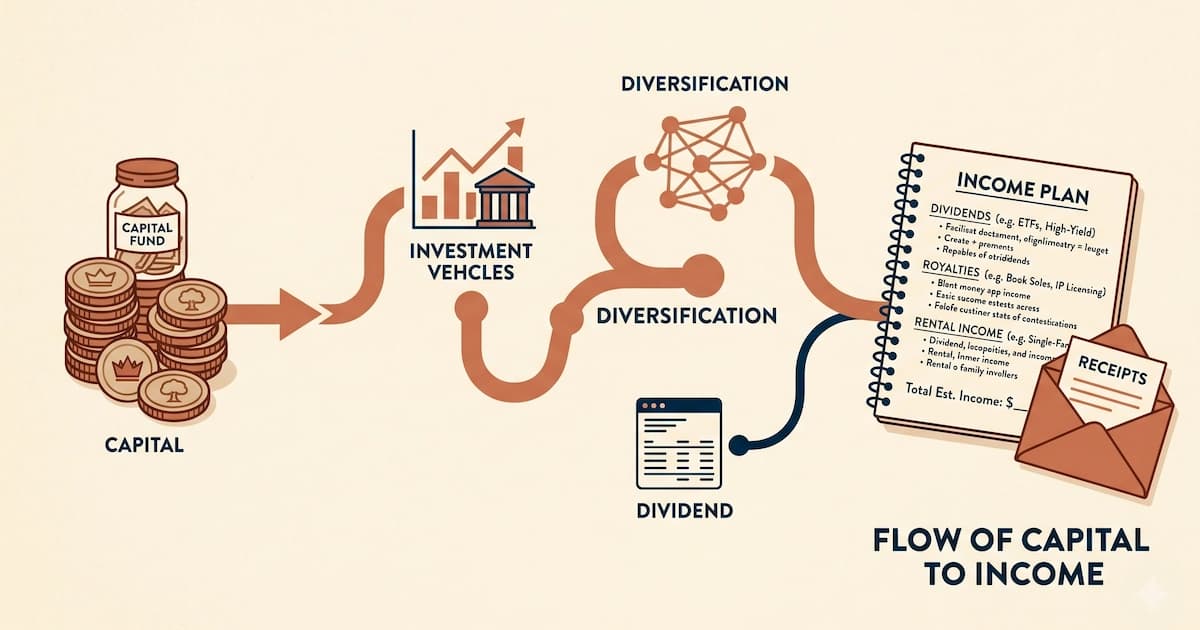
Ask ten people what passive income is and you'll get two different answers without anyone realizing it. Most will say money that arrives while you sleep: dividends, rent, royalties. The US tax code says something narrower and more specific, and under its rules your dividends and interest aren't even "passive" at all. That gap between the everyday meaning and the technical one is where most of the confusion (and most of the misleading marketing) lives.
This covers what passive income actually means in both senses, how it differs from active and portfolio income, whether rental income really counts, and how it's taxed in India and the US. It's an explainer of the concept, not tax advice or a recommendation to pursue any specific income source. For which streams to actually build, the companion piece is passive income ideas for beginners.
What is passive income?
Passive income is money that keeps arriving after the work or investment that created it is mostly finished, without needing your continuous active effort to maintain it. Interest on savings, dividends from shares, rent from a property, royalties from a book you already wrote: the common thread is that the income continues while you do something else.
There's a catch the marketing tends to hide. Passive describes the income, not the setup. Every genuinely passive stream costs one of two things upfront: capital, or labor. A dividend needs the money invested to buy the shares. A royalty needs the book written first. A rental needs a property bought and let. So "passive" is better read as a spectrum than a switch. On one end sits money that truly runs itself once funded; on the other sits income that quietly demands ongoing work and only wears a passive label for the marketing. It is not, in any version, free money.
Passive income vs the IRS definition: two different answers
In everyday use, passive income means any income that doesn't require active daily work; in US tax law, it means only two specific things. The IRS, in Publication 925, recognizes exactly two kinds of passive activity: a trade or business in which you don't materially participate, and rental activity.
The surprise is what's left out. Interest, dividends, annuities, and capital gains are not passive income to the IRS. They're a separate category called portfolio income. That isn't a technicality with no consequences. Passive losses can offset passive income but not portfolio income, so a loss on a rental can't be used to reduce the tax on your stock dividends or bond interest. Everyday writing collapses portfolio and passive into one word, which is fine for casual conversation and misleading at tax time. Most of the finance-blog SERP blurs it; the two sources that state it cleanly are the IRS itself and Wikipedia. So when someone lists "dividend stocks" as passive income, they're using the everyday meaning, and a tax preparer using the strict meaning would file them differently.
Active vs passive vs portfolio income
US tax law sorts income into three buckets, not two: active, passive, and portfolio. Everyday personal finance usually stops at active versus passive and folds portfolio into passive, which is where the confusion starts. The three-way split is the one that matters at tax time.
| Active income | Passive income (IRS) | Portfolio income | |
|---|---|---|---|
| What it is | Work you do now | Rental activity; a business you don't run | Investments |
| Examples | Salary, wages, freelancing | Managed rentals, silent-partner business income | Interest, dividends, capital gains |
| Stops when you stop working? | Yes | No | No |
| US tax rate | Ordinary income rates | Ordinary income rates | Ordinary or preferential (long-term gains, qualified dividends) |
| Can passive losses offset it? | No | Yes | No |
The old Rich Dad framing (earned, portfolio, passive) uses the same three-bucket skeleton, with the thesis that building wealth means converting earned income into the other two. Whatever the labels, the useful takeaway is that "not from a job" isn't one thing. It's two very different tax animals.
What counts as passive income?
In the everyday sense, passive income comes from three sources: returns on invested capital, royalties from past work, and rental income you don't actively run. These are the categories where the money genuinely keeps flowing with minimal upkeep once the capital or the creative work is in place.
- Returns on invested capital: interest from a high-yield savings account or fixed deposit, dividends from shares or funds, bond coupons, and REIT distributions. To the IRS these are portfolio income, but in daily use people call them passive.
- Royalties from past creative work: a book, a recorded course, a licensed photo, a streamed song. Some royalties decay (a book usually peaks in its first year), others compound (an evergreen course). The 100 hours of writing weren't passive; the royalties that follow are.
- Managed rental income: a property let through a professional manager who takes roughly 8% to 12% of rent and handles tenants, repairs, and emergencies. This is the textbook case of passive income in both the everyday and the tax sense.
Then there's the semi-passive pile that marketing relabels as passive: affiliate sites and YouTube channels (income continues, but traffic needs constant feeding), dropshipping and print-on-demand (constant supplier and ad management), forex "expert advisor" bots (more than 70% of retail forex traders lose money, per ESMA disclosures), and multi-level-marketing "residual income" (about 99% of participants lose money, per FTC research). The honest label for most of these is semi-passive at best. The detailed breakdown of what's worth building lives in passive income ideas for beginners.
Is rental income passive income?
For US tax, rental income is generally passive even when you manage the property yourself, unless you qualify as a real estate professional. This trips up a lot of landlords, because self-managing a rental feels active, yet the IRS still treats the income as passive.
The precise rule from Publication 925 matters here. The 500-hour material-participation test decides whether a trade or business is passive. Rentals are a different case: they're passive by default regardless of your hours, unless you meet the real estate professional standard (broadly, more than 750 hours a year in real estate and over half your working time in it). There's also a short-term-rental exception. If the average guest stay is 7 days or fewer, as with many Airbnb-style lets, the activity can be treated as active for tax. So the same building can produce passive income as a yearly rental and active income as a nightly one. None of this changes how it feels: managing tenants, coordinating repairs, and chasing rent is real work, which is why so many landlords say their rental income turned out "less passive than expected."
Is passive income the same as residual income?
In everyday finance, passive income and residual income are used almost interchangeably, but residual income has a second meaning that has nothing to do with earnings. In the recurring-income sense, residual income means money that keeps coming after the upfront work is done, which is the same idea as passive income.
The other meaning shows up in lending. There, residual income is the cash a borrower has left each month after paying major bills and debts, and mortgage underwriters check it to judge whether a loan is affordable. Two completely different concepts share one label. All residual income in the recurring sense can be passive, but "residual income" on a loan application is just leftover monthly cash. Multi-level-marketing pitches love the word "residual" precisely because it sounds like the passive kind while describing commissions that need constant recruiting to sustain.
How is passive income taxed in the US?
US passive income is generally taxed at ordinary income rates, with special loss rules and a possible extra surtax. This is a YMYL area, so treat the following as general education and confirm your own situation with a CPA or enrolled agent.
Three features stand out. First, passive income is usually taxed like wages, at ordinary rates, though long-term capital gains and qualified dividends (portfolio income) can get preferential rates. Second, the passive activity loss rule: passive losses can only offset passive income, with disallowed losses carried forward until you dispose of the activity, plus a limited allowance of up to $25,000 of rental losses against other income for active participants who meet the income limits. Third, a 3.8% Net Investment Income Tax can apply on investment income above $200,000 for single filers and $250,000 for married filing jointly, per IRS Topic 559. That surtax reaches both portfolio income and passive activity income, which is a rare place the two buckets get treated the same.
How is passive income taxed in India?
India has no separate passive-income tax category; the same earnings are taxed under whichever standard head they fall into. The Income Tax Act has five heads of income, and there is simply no "passive" one. So-called passive income slots into three of them.
Rent from property is taxed under Income from House Property, with deductions available under Section 24. Interest and dividends fall under Income from Other Sources, the residuary head, and are added to your total income and taxed at your slab rate. Profits on selling shares, property, or other assets are taxed under Capital Gains, where equity long-term gains are taxed at 12.5% above ₹1.25 lakh after the Budget 2024 changes covered in capital gains tax explained. One shift worth knowing: since the Finance Act 2020 abolished the Dividend Distribution Tax, dividends are taxed directly in the investor's hands at slab rates, no longer at the company level. The Hindi term for passive income is निष्क्रिय आय (nishkriy aay). Because India lacks the US passive-activity-loss machinery, the rules are simpler in structure but still turn on your slab and the asset, so a chartered accountant is the right check for anything material.
How much capital does passive income actually take?
Meaningful passive income scales roughly linearly with invested capital, and the 4% rule gives a usable benchmark. William Bengen's 1994 study in the Journal of Financial Planning found that withdrawing about 4% of a diversified portfolio a year had strong historical survivability over 30-plus years. Run that backward and the capital needed for a target income becomes concrete.
| Target monthly passive income | Invested capital needed (4% rule) |
|---|---|
| ₹5,000 / $100 | ₹15 lakh / $30,000 |
| ₹10,000 / $200 | ₹30 lakh / $60,000 |
| ₹25,000 / $500 | ₹75 lakh / $150,000 |
| ₹50,000 / $1,000 | ₹1.5 crore / $300,000 |
| ₹1 lakh / $2,000 | ₹3 crore / $600,000 |
These sit on a continuum, with no threshold that suddenly unlocks. Every ₹10 lakh / $20,000 of capital adds roughly ₹3,300 / $67 of monthly income at 4%. That's the unglamorous truth the "quit your job with passive income" content skips: for capital-based passive income, the number that matters is the size of the capital base, which is why the FIRE approach in what is the FIRE movement is really about accumulation. For tracking the wealth that produces it, see what is net worth, and for how the capital compounds, compound interest.
Common misconceptions
Most myths about passive income come from treating the income as the whole story and ignoring the capital or work behind it. A quick reality check on the four that recur most:
| The belief | The reality |
|---|---|
| Passive income means never working again | Only if the capital base is large enough to replace a salary, typically ₹3 crore+ / $600,000+ |
| Passive income is easy | The income is passive; earning the capital or doing the upfront creative work rarely is |
| Higher yield is simply better | Higher yield carries higher risk; a "guaranteed" 12% product is riskier or fraudulent |
| Passive income avoids tax | It's taxable in both India and the US; tax-advantaged accounts defer or reduce, not erase |
Securities regulators in both countries, SEBI in India and the SEC in the US, have repeatedly warned about high-yield products aimed at passive-income seekers. When a return looks too clean, the risk is usually hidden, not absent.
What this post does not cover
This is an explainer of what passive income means and how it's classified and taxed, not tax advice or investment advice. It doesn't recommend specific income streams, rank platforms, or tell you what to invest in. The detailed menu of what to actually build, with realistic per-stream numbers and what to avoid, is in passive income ideas for beginners. Tax treatment turns on individual facts, so a chartered accountant in India or a CPA in the US is the right source before you act on anything here.
Frequently asked questions
What is passive income in simple words? Passive income is money you keep earning without actively working for it on an ongoing basis, after the upfront effort or investment that created it is done. Examples in everyday usage include interest from savings, dividends from shares, rent from property you don't manage day to day, and royalties from a book or course you already made. The catch is that "passive" describes the ongoing income, not the start: almost every passive income stream needs either meaningful capital or substantial upfront work before the money arrives. It is not free money.
What is the difference between active, passive, and portfolio income? Active income is money from work you do now, like salary, wages, or freelancing; it stops when you stop. Portfolio income is money from investments, meaning interest, dividends, and capital gains. Passive income, in the strict US tax sense, is money from rental activity or a business you don't materially participate in. In everyday language people lump portfolio and passive together, but US tax law keeps them separate, which matters because passive losses can offset passive income but not portfolio income.
Is rental income passive income? For US tax, yes, rental income is generally passive even if you actively manage the property, unless you qualify as a real estate professional (broadly, 750+ hours a year in real estate). One exception: a short-term rental where the average guest stay is 7 days or fewer can be treated as active for tax. So a landlord who self-manages a normal long-term rental still reports passive income for tax, even though the day-to-day work of tenants, repairs, and rent collection feels anything but passive.
Is passive income the same as residual income? In everyday personal-finance usage the two are used almost interchangeably to mean recurring income that keeps arriving after the upfront work is done. But residual income has a second, unrelated meaning in lending: it is the money a borrower has left over each month after paying major expenses, which mortgage lenders check to gauge affordability. So all residual income in the first sense can be passive, but "residual income" can also mean something that has nothing to do with passive earnings.
How is passive income taxed in India? India has no separate passive-income tax category. The same earnings are taxed under whichever of the standard heads they fall into: rent under Income from House Property, interest and dividends under Income from Other Sources, and profits on selling assets under Capital Gains. Most of it is added to your total income and taxed at your slab rate, though some capital gains carry special rates. Since the Finance Act 2020 abolished the Dividend Distribution Tax, dividends are taxed in the investor's hands at slab rates. A chartered accountant can confirm treatment for your situation.
How much capital does passive income need? It scales roughly linearly with capital, with no magic threshold. Using the 4% rule from William Bengen's 1994 research, about ₹30 lakh / $60,000 invested in a diversified portfolio can support roughly ₹10,000 / $200 per month, and about ₹3 crore / $600,000 supports around ₹1 lakh / $2,000 per month. Even ₹50,000 / $1,000 in a high-yield savings account earns a few thousand rupees or tens of dollars a year. The practical point is that meaningful passive income comes from steady capital accumulation over years, not from one high-yield trick.
Sources
- US Internal Revenue Service, Publication 925, Passive Activity and At-Risk Rules (irs.gov)
- US Internal Revenue Service, Topic 559, Net Investment Income Tax (irs.gov)
- Wikipedia, Passive income (on the portfolio-vs-passive distinction) (wikipedia.org)
- ClearTax, Passive income and its taxation in India (cleartax.in)
- William P. Bengen, Determining Withdrawal Rates Using Historical Data (Journal of Financial Planning, 1994), the origin of the 4% rule
- Securities and Exchange Board of India, SEBI Investor Education Portal (investor.sebi.gov.in)




You might also like

Truly passive income needs capital or royalties. Content and courses are semi-passive, and most influencer pitches are not passive at all.
12 min read
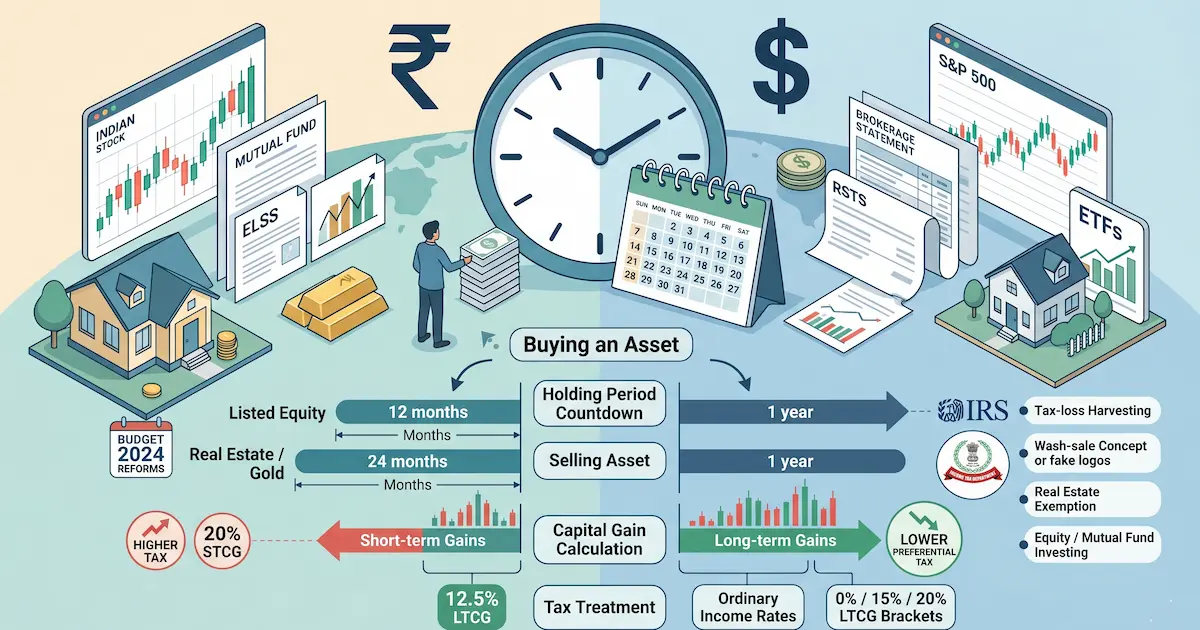
Short versus long-term rates in India and the US: the 12.5% LTCG and Rs 1.25 lakh exemption, the US 0/15/20% brackets, and the new sections.
20 min read

The formula, worked rupee examples, and why compounding daily rather than yearly is worth far less than most people assume.
11 min read