What Is a Payday Loan? How They Work and What They Cost

By Tapabrata Biswas · Updated September 19, 2026 · 14 min read
Written and fact-checked by Tapabrata Biswas. How I write
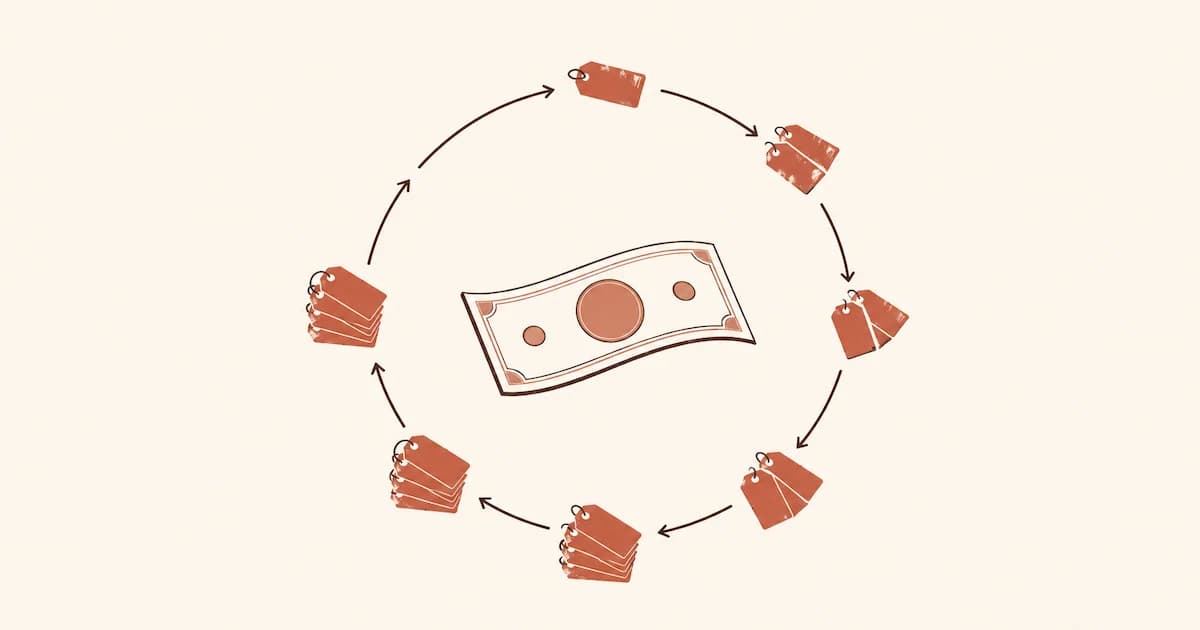
If you only want the short version: a payday loan is a small, very expensive loan you repay in one lump sum on your next payday, and its headline number is the one that shocks people, an APR of roughly 391%. The bigger danger is not the single fee but the rollover cycle, where a borrower who cannot repay pays the fee again and again while the original balance never moves.
This guide explains how payday loans work, what they actually cost, what happens when someone cannot repay, and how the US model compares with India, where there is no regulated "payday loan" at all and the closest thing is the instant-loan-app market. It explains the mechanics and the risks. It is not advice on whether to take one, and it is not debt counselling.
What is a payday loan?
A payday loan is a short-term, high-cost loan of generally $500 or less that is due on the borrower's next payday, usually two to four weeks later, per the Consumer Financial Protection Bureau. It goes by other names too: cash advance, payday advance, deferred deposit. The defining features are always the same. The amount is small, the term is a matter of weeks, the cost is high, and repayment is a single payment rather than installments.
A payday loan is not really unsecured in the way a credit card is. To get one, you hand the lender a post-dated check for the loan plus the fee, or you authorise the lender to pull the money electronically from your bank account on the due date. That access to your account is the lender's security, and it shapes everything that happens if you cannot pay.
How does a payday loan work?
A payday loan is designed to be fast and to require almost no underwriting. The trade-off for that speed is the price.
The process is short. You show ID, proof of income, and an active bank account. There is usually no credit check. You sign the agreement and either leave a post-dated check or authorise an electronic debit for the full amount plus the fee. The money comes to you in cash, by check, as a deposit, or on a prepaid card, often within an hour. Then, on your next payday, the whole amount plus the fee is due at once. The lender either cashes your check or pulls the funds from your account.
That single-payment structure is the crux of the problem. A borrower who was short enough to need $300 two weeks ago is often still short when the full $345 comes due, which is where the cycle begins.
What does a payday loan cost?
Payday lenders charge a flat fee rather than a stated interest rate, commonly $10 to $30 for every $100 borrowed. That framing is what hides the true cost. A fee sounds small; the annual percentage rate it works out to does not.
Take the CFPB's own example, annualised. A $100 loan with a $15 fee for 14 days costs $15 to borrow $100 for two weeks. Stretch that across a year and it is about 391% APR ($15/$100 multiplied by 365/14). At $30 per $100 the rate runs past 600%. For comparison, the CFPB notes credit cards typically charge 12% to 30%, and a personal loan runs 6% to 36%.
Put in dollars on a real loan:
| Amount borrowed | Fee at $15 / $100 | Due on payday | Roughly the APR |
|---|---|---|---|
| $100 | $15 | $115 | 391% |
| $300 | $45 | $345 | 391% |
| $500 | $75 | $575 | 391% |
The number does not change with the loan size, because the fee is a flat percentage of the amount. What changes is the dollar hit, and the odds you can cover it two weeks later.
Why the rollover cycle is the real cost
The single fee is not what makes payday loans dangerous. The rollover is. When a borrower cannot repay on the due date, most states let them "roll over" the loan, meaning they pay the fee again to push the due date out another two weeks, while the original balance stays exactly where it was.
The CFPB has found that about 80% of payday loans are rolled over or re-borrowed rather than repaid on time, and that many borrowers take out a new loan the same day they repay an old one. Research by the Pew Charitable Trusts found the average borrower stays in payday debt for five months of the year and pays $520 in fees to repeatedly borrow $375.
Watch what that does to a $300 loan at a $15-per-$100 fee:
| Week | What happens | Fee this cycle | Total fees paid | Still owed |
|---|---|---|---|---|
| 0 | Borrow $300 | none | $0 | $300 |
| 2 | Can't repay $345, pay the fee to roll over | $45 | $45 | $300 |
| 4 | Roll over again | $45 | $90 | $300 |
| 6 | Roll over again | $45 | $135 | $300 |
| 8 | Roll over again | $45 | $180 | $300 |
| 10 | Roll over again | $45 | $225 | $300 |
After about ten weeks and five rollovers, near Pew's five-month average, you have paid $225 in fees and you still owe the full $300. Not one dollar has come off the principal. That is the trap in a single table: the fees approach the size of the loan while the loan itself never shrinks.
What happens if you can't repay?
Because the lender holds your check or your bank-account authorisation, a missed payday loan sets off a chain of automatic attempts and fees. The mechanics matter more than any warning.
First, the lender tries to collect. It cashes the post-dated check or submits the electronic debit. If your balance is short, that failed attempt can trigger an overdraft or non-sufficient-funds fee from your own bank, up to about $35 at the banks that charge most, and the lender may retry, stacking more fees. If it still goes unpaid, the debt can be sold to a collections agency, and the lender can sue you in civil court and, if it wins, seek wage garnishment.
One point is widely misunderstood: an unpaid payday loan is a civil debt, not a crime. You cannot be jailed simply for failing to repay it, whatever a threatening collections call implies. Our explainer on how credit card interest works covers the related mechanics of revolving high-interest debt.
Payday loan vs personal loan
A payday loan and a personal loan are both ways to borrow money, but on almost every dimension that matters they are opposites. A personal loan is a larger, longer, far cheaper installment loan; a payday loan is a small, two-week, extremely expensive one.
| Payday loan | Personal loan | |
|---|---|---|
| Typical amount | $100 to $500 | $1,000 to $100,000 |
| Term | 2 to 4 weeks | 1 to 7 years |
| Typical APR | 391% to 600% | 6% to 36% |
| Repayment | One lump sum on payday | Fixed monthly installments |
| Credit check | Usually none | Yes |
| Builds credit? | No, unless it defaults to collections | Yes, payments are reported |
| Backed by | A post-dated check or bank-account access | Your credit (unsecured) |
| Funding speed | Often under an hour | A few days |
The credit-reporting row is the one people miss. A payday loan repaid perfectly usually does nothing for your credit score, because most payday lenders do not report to the bureaus, so it is a cost with no credit-building upside.
What are payday alternative loans and cash advance apps?
Two products come up so often next to payday loans that they are worth defining, mostly because they are regulated very differently.
A payday alternative loan (PAL) is a small-dollar loan offered by a federal credit union and capped at 28% APR, under rules set by the National Credit Union Administration. A PAL runs from $200 to $1,000, a second type (PAL II) goes up to $2,000, with a term of one to six months and an application fee capped at about $20. The condition is that you have to be a member of the credit union to get one.
A cash advance app, such as Earnin, Dave, or Brigit, advances a portion of your earned wages before payday. These are marketed as interest-free, but they usually make money through optional "tips," a monthly subscription, or a fee to transfer the money instantly, and once those charges are annualised the effective cost can climb. The CFPB has moved to treat some of these earned-wage-access products as loans under lending law. Neither product is a recommendation here; they are simply the two things borrowers most often weigh a payday loan against.
Do payday loans exist in India?
India has no RBI-regulated product called a payday loan. The Reserve Bank of India does not recognise it as a category, so the demand it would serve flows instead into the short-term personal-loan and instant-loan-app market, which splits sharply into a legal side and a dangerous unregulated one.
On the legal side, lending is allowed only by a regulated entity, a bank or an RBI-registered NBFC, or by a lending-app partner acting as its agent. Under the RBI Digital Lending Directions, such a lender must give you a Key Fact Statement (KFS) before the loan, disclosing the all-inclusive Annual Percentage Rate and every fee, so the true cost cannot hide behind a flat charge the way a US payday fee does. The money must flow directly between your bank account and the lender's, not through the app. There is a cooling-off period, limits on data the app can access, and a ban on coercive recovery. A regulated loan is also reported to CIBIL, so unlike a US payday loan it does affect your credit score either way.
The unregulated side is where the horror stories come from. A large market of apps operates with no RBI registration and no NBFC partner, scraping borrowers' contacts and photos and using harassment as a recovery tool. Indian authorities have banned dozens of such lending apps, and Google Play now requires personal-loan apps in India to appear on the RBI's published list and name a valid licensed lender. The practical test for a borrower is simple: a legitimate lender names its RBI-registered entity and hands you a KFS with the APR; an app that cannot do either is the one to walk away from.
| US payday loan | India regulated short-term loan | |
|---|---|---|
| Regulated category? | Yes, under state law plus CFPB oversight | No payday category; short-term personal loans only |
| Cost disclosure | A flat fee; APR often about 391% | All-in APR shown upfront in a Key Fact Statement |
| Money flow | Lender-controlled | Directly between your account and the lender's |
| Reported to credit bureau? | Usually not | Yes, to CIBIL |
| Regulator | State regulators plus CFPB | Reserve Bank of India |
For the India side, this sits next to the newer buy now, pay later products, another form of short-term credit the RBI has been bringing under the same disclosure rules.
Where payday loans are banned or capped
Payday lending is not legal everywhere in the US. 18 states and Washington, D.C. either ban it outright or cap the rate at around 36%, which effectively ends the payday model there, while the remaining states allow it under their own fee limits, per Pew's tracking. On top of that, the federal Military Lending Act caps the rate at 36% APR for active-duty servicemembers and their dependents, which is why storefront lenders often cannot serve them.
The Center for Responsible Lending put the figure at more than $2.4 billion in fees in a single year across the 30 states that allow payday lending, in a report published on 6 February 2025. That number gives a sense of how much the rollover cycle, and not the single loan, drives the business.
Frequently asked questions
How much does a payday loan cost? Lenders charge a flat fee, commonly $10 to $30 for every $100 borrowed. A $15 fee per $100 on a two-week loan works out to about 391% APR, per the CFPB. On a $500 loan, a $75 fee is due in full on your next payday, on top of repaying the $500.
What is the APR on a payday loan? Usually around 391% to 400%, and it can exceed 600% in states with looser rules. The rate looks shocking because a flat fee is charged over a two-week term, then annualised: a $15-per-$100 fee is about 391% APR, against 6% to 36% on a typical personal loan.
What happens if you can't repay a payday loan? The lender will try to withdraw the amount from your bank account, which can trigger overdraft or non-sufficient-funds fees, up to about $35 at the banks that charge most, though several large issuers now charge nothing. If it still isn't paid, the debt can go to collections, and the lender can sue and seek wage garnishment. Not repaying is a civil matter and not a criminal one, so you cannot be jailed for the debt itself.
Are payday loans legal everywhere? No. In the US, 18 states and Washington, D.C. either ban payday lending or cap rates at around 36%, while the rest allow it under their own rules. A federal law also caps the rate at 36% APR for active-duty servicemembers and their families.
Do payday loans exist in India? Not as a regulated category. The Reserve Bank of India does not recognise 'payday loan' as a product. The legal equivalent is a short-term personal loan from an RBI-registered bank, NBFC, or their lending-app partner, which must give you a Key Fact Statement showing the all-in APR and must report the loan to CIBIL. Many instant-loan apps operate without RBI registration and carry serious risks.
Does a payday loan affect your credit score? Usually not directly in the US. Most payday lenders do not report to the credit bureaus, so on-time repayment does not build credit, though a default that reaches collections can hurt your score. In India, a regulated lender reports the loan to CIBIL either way, so it does affect your credit there.
Do payday loans require a credit check? Usually not. Most payday lenders skip the traditional credit check and rely instead on your proof of income and access to your bank account, which is why they are marketed as 'no credit check' loans and why people with low credit scores can still get one. The trade-off is that the loan is not reported to the credit bureaus, so repaying it on time does not build your credit.
What this guide does not cover
This is an explainer of what payday loans are and how they work, not advice on whether to take one, and not a plan for getting out of payday debt. It does not compare specific lenders or apps, and it leaves aside employer advances, the state-by-state fee tables, and car-title loans, which follow a similar high-cost structure. Rules, fees, and state limits change, so confirm the current terms before relying on any figure here. If you are already caught in a rollover cycle, that is a situation for a qualified nonprofit credit counsellor and not a blog post.
Sources
- Consumer Financial Protection Bureau, What is a payday loan? and payday debt-trap findings consumerfinance.gov
- Federal Trade Commission, What to know about payday and car title loans consumer.ftc.gov
- Pew Charitable Trusts, Payday Lending in America research series pewtrusts.org
- Center for Responsible Lending, Down the Drain: Payday Lenders Take $2.4 Billion in Fees from Borrowers in One Year, 6 February 2025 responsiblelending.org
- National Credit Union Administration, Payday Alternative Loans (PALs) ncua.gov
- Reserve Bank of India, Guidelines on Digital Lending (Key Fact Statement) rbi.org.in

You might also like
RBI barred pre-payment charges on loans sanctioned from 1 January 2026, but only on floating-rate loans. Most personal loans are fixed, so check which you hold.
11 min read
Credit card interest is charged daily on your average daily balance once you carry a balance. The real math, grace periods, and the minimum trap, in ₹ and $.
13 min read
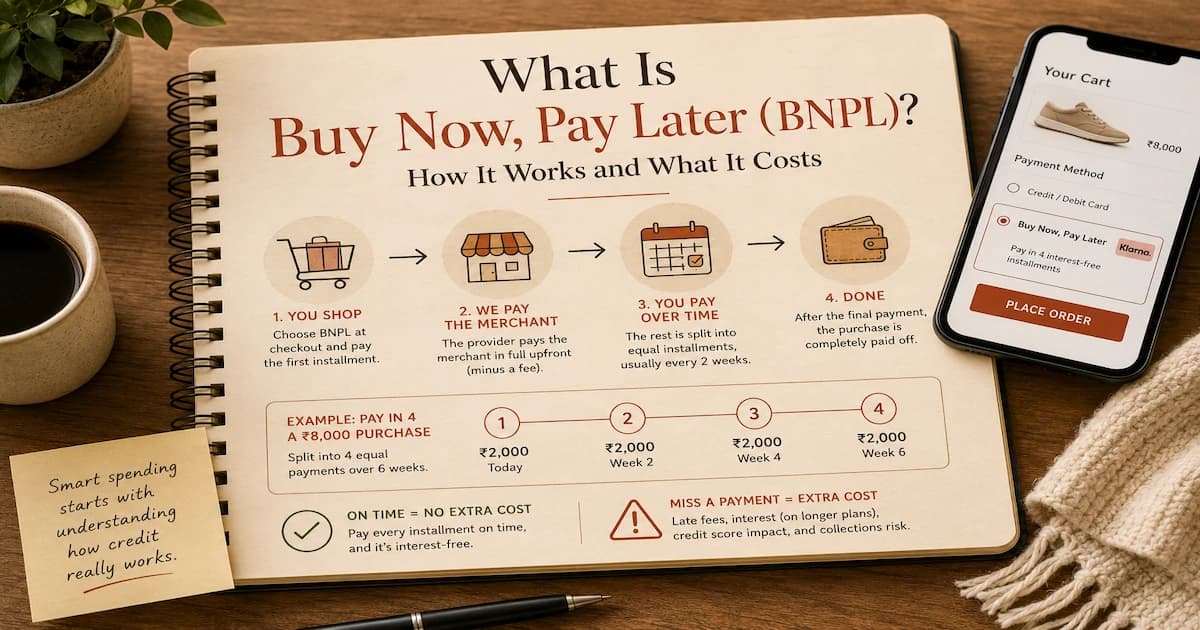
How the pay-in-4 model works, what BNPL really costs when you miss a payment, and how it compares with a credit card in India and the US.
8 min read