Current Account vs Savings Account in India: Difference

By Tapabrata Biswas · Updated August 9, 2026 · 14 min read
Researched with AI assistance, reviewed and edited by Tapabrata Biswas.
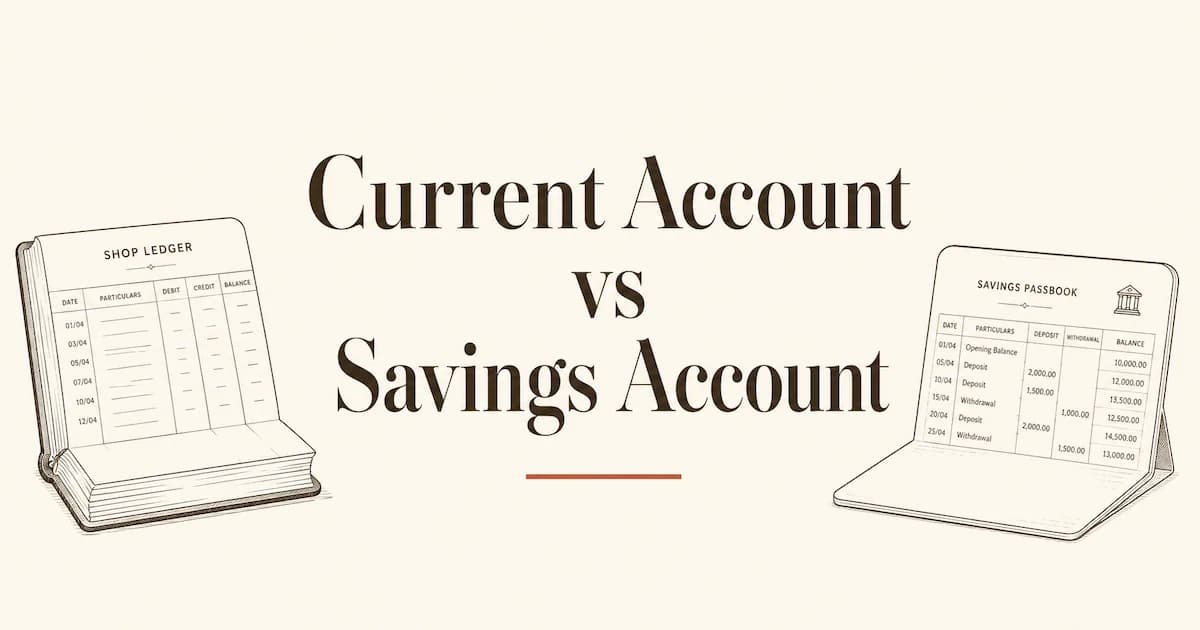
Indian banks sort deposit accounts into two main families, and people open the wrong one more often than you'd expect. A freelancer opens a current account because it sounds professional, then loses interest on every rupee that sits there. A small shop runs its takings through a personal savings account, then gets charged once the cash deposits cross the free limit. The two accounts look similar at the counter, but they're built for different users and behave differently on the things that matter: interest, transaction limits, and minimum balance.
This explains how the two account types differ in India, not which one to open. The right account depends on who you are and how the money moves. If you're comparing the US split between a checking and a savings account instead, that's a different structure, covered in savings vs checking account.
What is a current account?
A current account is a non-interest-bearing bank account designed for businesses and high-volume transactions, with no cap on the number of transactions but typically a higher minimum balance. In Hindi it's called a चालू खाता (chaalu khaata) and in Tamil a நடப்புக் கணக்கு (natappu kanakku). The name comes from the idea of money that is "current," constantly moving in and out, the opposite of money parked to grow.
One quick disambiguation, because the phrase is overloaded. The "current account" in economics, as in a country's current account deficit, is a balance-of-payments term about trade and cross-border flows. It has nothing to do with the bank account this page is about. Different concept, same two words.
The bank product is shaped around business needs. There's no meaningful limit on how many deposits, withdrawals, or transfers you make in a month, so a trader settling dozens of payments a day doesn't run into per-transaction charges the way a personal account holder would. Current accounts usually come with a cheque book by default, an overdraft facility (a pre-approved short-term borrowing line for when payments exceed the balance), and higher cash-handling allowances. In exchange, the bank pays no interest on the balance and asks the holder to keep a larger minimum amount in the account. Businesses, firms, companies, and high-volume professionals are the typical holders. The account is the operational hub for a business: receipts come in, supplier payments and salaries go out, and the balance swings with the cash cycle and doesn't just accumulate.
What is a savings account?
A savings account is an interest-bearing deposit account for individuals, paying interest on the balance but limiting the volume of certain transactions. It's the default account most Indians open, often as a salary account, and it doubles as both a place to keep money and a way to spend it through a debit card, UPI, and NEFT or IMPS.
Two features define it. The first is interest: the bank pays a small annual rate on the daily closing balance, credited every quarter, in return for holding your deposits. The second is a set of soft limits aimed at keeping the account in personal territory, clear of commercial volume. Banks cap the number of free cash deposits and withdrawals, the number of free cheque leaves, and free ATM use, then levy charges once you cross those thresholds. None of this gets in the way of ordinary personal use, but it makes the savings account a poor fit for genuine business volume. The full mechanics of how interest is calculated and credited sit in what is a savings account.
Current account vs savings account: the differences
The cleanest way to hold the two accounts apart is to remember who each is for: a current account is a tool for a business, a savings account is a tool for a person. Almost every other difference follows from that one distinction.
| Feature | Current account | Savings account |
|---|---|---|
| Built for | Businesses, firms, high-volume use | Individuals, personal money |
| Interest paid | None (0%, by RBI rule) | Roughly 2.7% to 7% a year (Q1 2026, varies by bank and slab) |
| Transaction volume | Effectively unlimited | Free up to bank limits, then charged |
| Minimum balance | Higher (often ₹10,000 to ₹25,000+) | Lower or nil (₹0 to ₹10,000) |
| Overdraft facility | Usually available | Rare for standard accounts |
| Cheque book | Standard, larger books | Available, smaller free quota |
| Deposit insurance | DICGC ₹5 lakh | DICGC ₹5 lakh |
| Typical holder | Trader, company, professional | Salaried individual, saver |
The interest row and the minimum-balance row pull in opposite directions, and that's the whole trade. A current account asks you to keep more money in the account and pays you nothing for it, because the value you get is transaction capacity. A savings account asks for less and pays interest, because it expects the balance to mostly sit still.
How do interest, transaction limits, and minimum balance differ?
Interest is the starkest difference and the only one fixed by regulation: a current account pays zero because the RBI defines it as non-interest-bearing, while savings accounts paid between 2.70% and about 7% as of Q1 2026, and neither the transaction limits nor the minimum balance is set by the RBI at all. These are also the three rows people misread most often.
Interest is the starkest gap, because one side is simply zero, and it's a regulation, not a bank's choice. The Reserve Bank of India defines a current account as a non-interest-bearing demand deposit, and its Master Direction on Interest Rate on Deposits states plainly that no interest is paid on current account balances (per the RBI). A savings account pays interest that varies widely by bank: the State Bank of India, the country's largest bank by deposits, paid 2.70% on most savings balances as of Q1 2026, while IDFC FIRST Bank and several small finance banks advertised rates up to about 7% on specific balance slabs over the same period. On a ₹5 lakh balance left untouched for a year, that's the difference between earning nothing in a current account and earning ₹13,500 or more in a savings account.
Transaction limits run the other way. India doesn't cap the number of savings-account transactions, but individual banks set free-usage limits and charge beyond them: a fixed number of free cash withdrawals or deposits per month, a free cheque-leaf quota, and free ATM transactions capped at metro branches. A current account is built to avoid exactly these frictions, with much higher or unlimited free allowances suited to a business processing many payments. For a saver these caps never bind; for a shopkeeper running daily takings through the account, they add up fast.
Minimum balance is the cost of entry, and here a common myth needs correcting: the RBI does not set the figure. Each bank decides its own minimum-balance requirement and the penalty for missing it. Current accounts generally require a higher monthly average balance, commonly ₹10,000 to ₹25,000 or more, because the bank earns nothing on the float. Savings accounts ask for less, from zero on basic savings (BSBDA) accounts to around ₹10,000 at metro private banks. Missing the required balance triggers a penalty, often a few hundred rupees per quarter plus GST, the kind of avoidable fee detailed in what are bank fees explained. One protection worth knowing: RBI rules say a savings account can't be pushed into a negative balance purely by non-maintenance penalties, a safeguard that doesn't apply the same way to current accounts, which carry overdraft mechanics.
What is CASA?
CASA stands for Current Account and Savings Account, and a bank's CASA ratio is the share of its total deposits held in those two accounts. You'll see the term in bank results and analyst notes far more than at the branch counter, but it explains a lot about why banks behave the way they do.
The logic is simple once the interest picture is clear. A current account pays 0% and a savings account pays only 2.7% to 4% or so, which makes both of them cheap money for the bank to lend out, unlike a fixed deposit that might cost the bank 7%. So a high CASA ratio, commonly 40% to 60% at Indian banks, means a bank is funded largely by low-cost deposits and can earn a wider margin. The spread across banks is real: Yes Bank's CASA ratio sat near 26% in 2020, while Kotak Mahindra and ICICI touched around 51% in 2018 to 2019 (Wikipedia). None of this changes what your account does for you, but it's the reason every bank pushes you to open and fund both.
Is a salary account a current or savings account?
A salary account is a savings account, specifically a zero-balance variant of one, and never a current account. This confuses a lot of people, because a salary account has its own name and is opened by the employer for the individual.
The substance is pure savings account. Your employer sets it up under an arrangement with the bank to credit your monthly salary, it earns the same interest a savings account does, and it carries no minimum-balance requirement while salary keeps flowing in. The current account, remember, pays no interest at all, so a salary account can't be one. If salary stops landing for a few consecutive months, most banks quietly convert the salary account into an ordinary savings account, at which point the usual minimum-balance rules kick in.
Types of current account
Indian banks offer several current-account variants, differing mainly in minimum balance and the transaction and cash-handling limits included. The names vary by bank, but the standard set covers the same ground.
- Standard or regular: the basic type, a mandatory minimum balance, no interest.
- Premium: for high-transaction-volume users, with a higher balance requirement and richer free limits.
- Startup: low or zero minimum balance and lighter charges, aimed at new businesses.
- Merchant: built for online sellers, bundling payment-gateway support and cheaper cash handling.
- Foreign currency: for businesses handling inward or outward foreign-currency remittances.
- Packaged: a mid-tier tier that adds extras like insurance or travel benefits.
One eligibility rule surprises borrowers: since an RBI circular first issued in August 2020, a bank generally won't open a current account for a customer who already has a cash-credit or overdraft facility from the banking system, because those transactions are meant to route through the CC or OD account instead. The exact thresholds have been revised since, so a business with borrowings should confirm the current position with its bank.
Which account fits which user
Matching the account to the user is mostly a question of transaction volume and whether the balance is meant to grow. The account you need follows from how the money behaves, not from which one sounds more serious.
A savings account fits an individual whose money is personal: salary in, rent and bills out, some balance left to earn interest. It also fits a sole proprietor or freelancer with modest, mostly-digital transaction volume, where the free limits are generous enough and the interest is worth having. The account doubles as a transactional account through UPI and a debit card, so it covers daily spending without a second account.
A current account fits a business whose transaction volume is high enough that a savings account's free limits would turn into running charges, or that needs an overdraft line, large cash-handling capacity, or a business identity on the account. A registered firm or company generally needs a current account regardless of volume, because banks expect business money to run through a business account and stay out of a personal one. Plenty of people sit in between, and the honest answer there is that it depends on the numbers: how many transactions cross the account, whether the balance is idle enough that lost interest matters, and whether the business needs facilities, such as overdraft, that savings accounts don't carry.
Current account in India vs the UK and US
The phrase "current account" means different things in different countries, which is a real source of confusion for Indian readers reading foreign finance content. In India a current account is a business account. Elsewhere the same words point at an ordinary personal account.
In the UK, a "current account" is the everyday personal account most people use for salary and spending, closer in function to an Indian savings account than to an Indian current account. In the US, that everyday personal account is called a checking account, and "current account" isn't used for personal banking at all. So an American article about a "checking account" or a British one about a "current account" is usually describing the account an Indian would call a savings account. Both accounts, wherever they sit, are protected by deposit insurance: in India the DICGC covers up to ₹5 lakh per depositor per bank, and the US FDIC covers $250,000. For the US side of this terminology, the checking account explainer lays it out.
What this post does not cover
This is a plain-English comparison of the two account types in India. It isn't a recommendation of any bank or account variant and isn't tax or investment guidance. It doesn't cover the documentation needed to open a business account, corporate account structures, or how either account is taxed. Rates, minimum-balance figures, and free-transaction limits change and differ across banks and variants, so the numbers here reflect the illustrative Q1 2026 range, so confirm current figures with the bank, and RBI rules such as the DICGC cover and the current-account eligibility circular can be revised. For a decision tied to a specific business or tax situation, a chartered accountant or the bank directly is the right source.
Frequently asked questions
What is the difference between a current account and a savings account? A current account is a non-interest-bearing bank account built for businesses and high-volume transactions, while a savings account is an interest-bearing account for individuals. The current account allows unlimited transactions and offers overdraft but pays no interest and demands a higher minimum balance; the savings account pays interest (roughly 2.7% to 7% a year in India as of Q1 2026), limits free transactions, and asks for a lower or nil minimum balance. In short, a current account is a tool for a business and a savings account is a tool for a person.
Does a current account earn interest? No. A current account in India pays zero interest by RBI rule, which defines it as a non-interest-bearing demand deposit. A savings account pays interest credited quarterly, roughly 2.7% at SBI and up to about 7% at some private and small finance banks on specific slabs as of Q1 2026. Idle money earns nothing in a current account and something in a savings account, which is the single biggest practical difference between them.
Is a salary account a current or savings account? A salary account is a savings account, specifically a zero-balance variant of one. Your employer opens it under an arrangement with the bank to credit your monthly salary, and it earns savings-account interest with no minimum-balance requirement. It is never a current account, which pays no interest. If no salary is credited for a few consecutive months, most banks convert a salary account into a regular savings account with its usual minimum-balance rules.
What is CASA in banking? CASA stands for Current Account and Savings Account. It is a banking metric: a bank's CASA ratio is the share of its total deposits held in these two accounts. Banks prize a high CASA ratio, commonly 40% to 60% at Indian banks, because current accounts pay no interest and savings accounts pay very little, so these are the cheapest funds a bank can lend out. That is why banks market both account types so heavily.
What is the minimum balance for a current vs savings account? It varies by bank, and the RBI leaves the figure to each bank and sets none itself. Current accounts almost always require more: many private-bank current accounts ask for a monthly average balance of ₹10,000 to ₹25,000 or higher, while regular savings accounts ask for ₹2,500 to ₹10,000 depending on branch location, and basic savings (BSBDA) accounts carry no requirement. Falling short of the required balance triggers a penalty charged per quarter.
Are current and savings accounts insured in India? Yes, both are insured by the Deposit Insurance and Credit Guarantee Corporation (DICGC), an RBI subsidiary, up to ₹5 lakh per depositor per bank, covering principal and interest together. This cover applies to savings, current, fixed, and recurring deposits alike. The ₹5 lakh figure was raised from ₹1 lakh in February 2020, so any page still quoting ₹1 lakh is out of date.
Sources
- Reserve Bank of India, Master Direction, Interest Rate on Deposits, and FAQ (current accounts are non-interest-bearing) (rbi.org.in)
- Deposit Insurance and Credit Guarantee Corporation, deposit insurance of ₹5 lakh covering all account types (dicgc.org.in)
- Reserve Bank of India, Basic Savings Bank Deposit Account (BSBDA) guidelines (rbi.org.in)
- CASA ratio, definition and Indian bank ranges (en.wikipedia.org)
- State Bank of India and IDFC FIRST Bank, published savings-account interest rates, Q1 2026 (respective bank websites)



You might also like
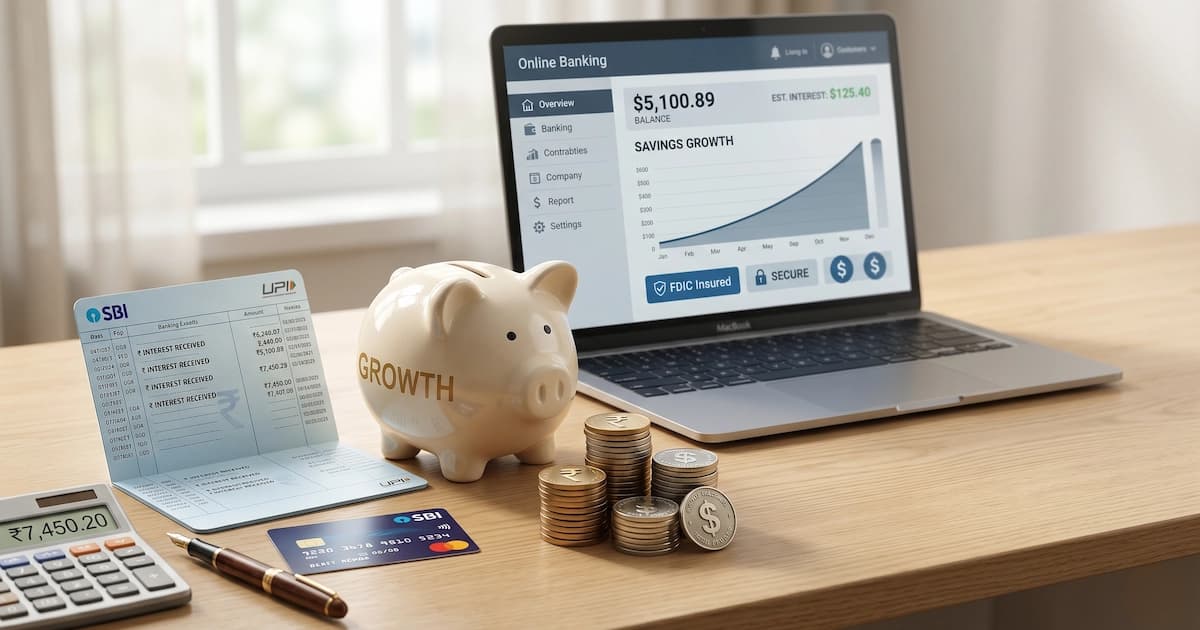
Why RBI makes every Indian bank pay the same rate below Rs 1 lakh, how savings interest is actually calculated, and what DICGC and FDIC really cover.
15 min read

DICGC insures ₹5 lakh per Indian bank; FDIC insures $250,000 per US bank. The rules, what is and isn't covered, the 90-day payout, and FDIC vs NCUA vs SIPC.
16 min read
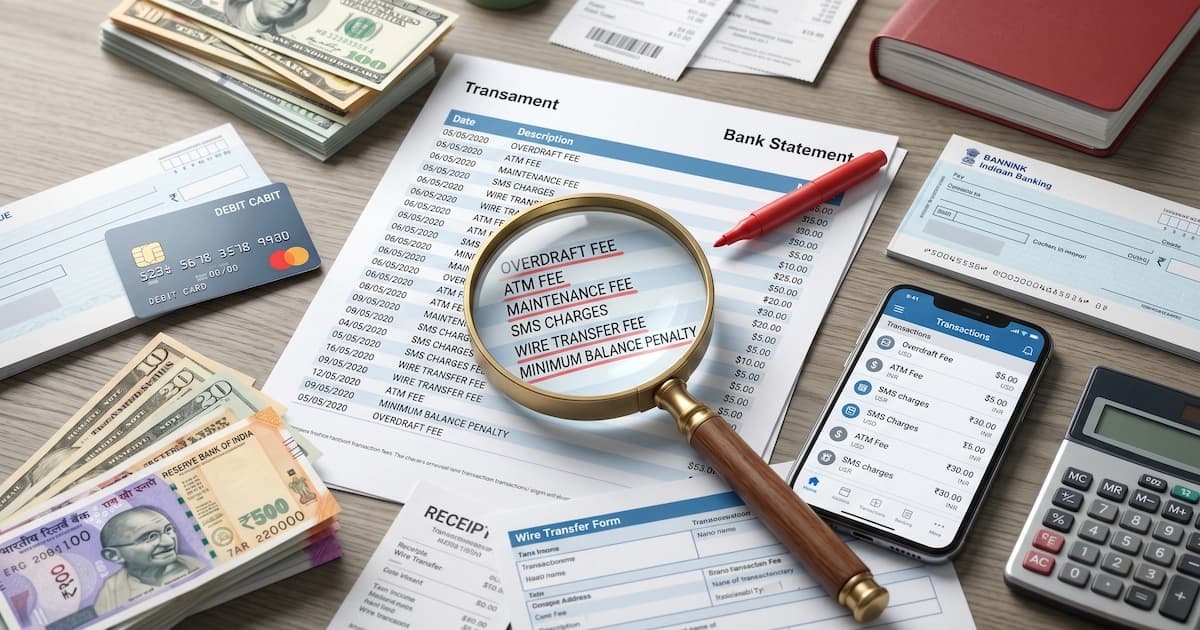
What your bank can charge and what it cannot: RBI's Rs 23 ATM cap, the free-transaction rules most pages get wrong, and US averages from Bankrate 2025.
15 min read