The 5 Cs of Credit: What Lenders Check Beyond Your Score

By Tapabrata Biswas · Published September 15, 2026 · 16 min read
Researched with AI assistance, reviewed and edited by Tapabrata Biswas.

Nearly every page explaining the 5 Cs of credit is published by somebody who wants to lend you money. Wells Fargo, Chase, Bajaj Finserv, Tata Capital. Each one ends with a button.
None of them cites the document where the framework is actually written down.
It sits in the Comptroller's Handbook, the manual US bank examiners work from when they inspect a lender's files. We pulled the current booklet, 171 pages of it, and the definition is on page 13.
What are the 5 Cs of credit?
The 5 Cs of credit are character, capacity, capital, collateral and conditions, and they are the criteria a lender weighs when deciding whether to approve a loan. The Office of the Comptroller of the Currency puts it this way in the Installment Lending booklet of its Comptroller's Handbook, version 1.3, page 13: "Prudent underwriting is of paramount importance to effective lending. Over the years, the basic components of effective lending decisions have come to be known as the 'five Cs' of credit."
The handbook then defines each one, in language plainer than most bank marketing manages.
| C | The OCC's own definition |
|---|---|
| Character | "refers to a borrower's reputation" |
| Capacity | "measures a borrower's ability to repay a loan by comparing income against recurring debts" |
| Capital | "is the net worth the borrower puts toward a potential investment" |
| Collateral | "such as property or large assets, helps secure the loan" |
| Conditions | "are outside circumstances that may affect the borrower's financial situation and ability to repay" |
Notice what Conditions covers, because it is the one every consumer page treats as filler. The handbook spells it out: "what is happening in the borrower's industry, the local market, and competition." Conditions are the C you cannot fix.
Is your credit score one of the 5 Cs?
No. Your credit score is evidence for one of them. It feeds Character, your reputation and repayment record, and that is one C out of five.
This is the part the lender pages leave out, and it explains a rejection that otherwise makes no sense. A 780 CIBIL score is a statement about how you have repaid in the past. It says nothing about whether your existing EMIs already consume half your salary, which is Capacity, or whether you have a rupee of your own to put in, which is Capital.
The OCC's glossary sharpens this further. It defines the five Cs as "the evaluation criteria typically used in a judgmental credit decision."
That word is doing real work. A judgmental decision is one a person makes. Most routine consumer lending in 2026 runs the other way, through automated scorecards that approve or decline without a human reading anything. The 5 Cs describe what happens when the score does not settle the file on its own: a borderline application, a large loan, a first-time borrower with no history, a self-employed applicant whose income is hard to read.
So the framework matters most precisely when your score is least able to speak for you. For how the score itself is built, and what each bureau does and does not publish, see how credit scores are calculated.
Who actually defines the 5 Cs?
A US banking regulator does, and almost nobody says so. The OCC's Comptroller's Handbook is not guidance for consumers or a bank's content marketing. It is the manual examiners use to supervise lenders, which makes it a considerably better source than the pages currently ranking for this term.
What we found elsewhere is more interesting than a single tidy answer.
The Federal Reserve's education arm teaches three. Federal Reserve Education publishes a lesson under its Making Personal Finance Decisions Curriculum titled "The Three C's of Credit (Lesson 9A)". The lesson has students "play the role of credit providers and assess the credit worthiness of an individual with a loan request". The three are named in the title and not in the page text, so we can tell you a central bank's teaching materials standardise on three, where the banks settle on five, and we cannot tell you from that page which three.
The Small Business Administration uses five different words. Its page is called "Five Factors that Impact Your Business Credit" and the five are creditworthiness, credit capacity, capital invested, collateral and company conditions. It is also a contributor blog post from May 2018, carrying a named author byline and no policy status, which is worth knowing before anyone cites it as government policy.
RBI does not appear to use the mnemonic at all. We searched its Master Directions and its credit risk guidance and did not find the five Cs. RBI's language is principles-based, built around due diligence and credit appraisal obligations placed on the lender, without an acronym attached. Indian banks and NBFCs use the term freely in their own blogs. Their regulator does not hand it to them.
Capacity, and the ratio Indian pages skip
Capacity is the test most applications actually fail, and India measures it with FOIR. FOIR is the fixed obligation to income ratio, the share of your monthly income already promised to somebody else before this new loan exists.
Bank of Baroda's own page, dated February 2024, states the formula: "FOIR = (Total Monthly Loan Obligations / Gross Monthly Income) x 100". It counts existing loan EMIs, credit card payments, taxes, provident fund and rent.
That last item catches people out. Rent counts as a fixed obligation in India, even though it builds you nothing and can be stopped with a month's notice.
Run it on a real salary. Take gross monthly income of ₹80,000, a car loan EMI of ₹12,000, a credit card payment of ₹3,000 and rent of ₹20,000.
| Amount | |
|---|---|
| Gross monthly income | ₹80,000 |
| Car loan EMI | ₹12,000 |
| Credit card payment | ₹3,000 |
| Rent | ₹20,000 |
| Total fixed obligations | ₹35,000 |
| FOIR | 43.75% |
Now apply for a personal loan with an EMI of ₹10,000. Obligations rise to ₹45,000 and FOIR reaches 56.25%, which is past the band Bank of Baroda describes as recommended.
Nothing about your repayment history changed. Your score is identical. The application is now harder, because a different C moved.
On thresholds, Bank of Baroda's page gives two slightly different bars in the same article: a FOIR "below 40% is considered healthy", while "a FOIR falling within the range of 40% to 55% is recommended". Lenders set their own limits, so read both as a guide, since neither is a rule.
The US runs the same test under a different name. Chase's page works it through: "If you have a mortgage that requires you to spend $2,000 in monthly installments and you make $5,000 a month, your DTI ratio would be 40%. Generally, lenders favor a DTI ratio of 36% or lower."
Character, capital, collateral and conditions, briefly
Character is the C your credit report answers. In India that is your CIBIL, Experian, Equifax or CRIF record; in the US, the report behind your FICO score. What sits in it, and what does not, is covered in what a credit report contains. Worth knowing that lenders read the report, not only the number on top of it, so a settled account or a long-closed default can speak even when the score has recovered.
Capital is what you put in yourself. On a home loan that is the down payment; on a business loan it is the promoter's own money. The OCC calls it "the net worth the borrower puts toward a potential investment", and the logic is simple enough: a borrower with their own money in the deal behaves differently from one with nothing at stake.
Collateral secures the loan. It is the difference between a secured and an unsecured product, and it is why a loan against property carries a lower rate than a personal loan. A lender with recourse to an asset prices the risk differently from one without.
Conditions are the C nobody can influence. Interest-rate cycles, your employer's industry, the local property market. An application that would clear in one quarter can fail in the next with your own numbers unchanged, and no amount of preparation on your side alters it.
Why does everyone quote a different number of Cs?
Because there is no agreed number, and the extra Cs come from places worth knowing about. Google's own People Also Ask box for this term asks about the 3 Cs, 4 Cs, 5 Cs, 6 Cs, 7 Cs, the five Ps, the seven Ps, the 3 Rs, the four Rs, the five pillars of credit and the five principles of lending. Almost none of that is explained anywhere on the results page.
| Version | Where it comes from | Traceable? |
|---|---|---|
| 5 Cs | OCC Comptroller's Handbook, Installment Lending v1.3 | Yes, a regulator's examiner manual |
| 3 Cs | Federal Reserve Education, "The Three C's of Credit (Lesson 9A)" | Yes, a central bank's teaching curriculum |
| 6 Cs | Emagia, adding "cash flow" | A credit-risk software vendor, citing no source |
| 7 Cs | Dennis West, Northern Initiatives, adding "courage" and "compassion" | A named executive's own essay, presented as his addition |
| "Five factors of credit" | FICO's published score weights | Real, but a scoring framework and not a lending one |
| 3 Rs, 7 Ps | Indian agricultural finance curriculum | A real teaching tradition, sources unreachable |
| 4 Cs, 5 Ps, 4 Rs, five pillars, five principles | No source found | Unverifiable |
Two entries deserve a closer look.
The sixth C is a product feature. Emagia sells order-to-cash and credit-risk software. Its page adds cash flow as a sixth C and cites nothing for the framework. That is not a scandal, it is content marketing, and it is a reasonable thing to add on the merits. It is simply not a tradition anyone inherited.
The seventh C is one person's argument, and he says so. Dennis West, a past president of the community development lender Northern Initiatives, published an essay adding courage and compassion to the five. He frames them openly as his own proposal. That is more honest than most of what circulates, and it becomes misleading only when a later page repeats "the 7 Cs of credit" as if it were standard practice.
And the "five factors of credit" is a different thing entirely. Those are FICO's published weights for building a credit score, which is why the phrase sits next to the 5 Cs in search results and confuses people. One framework describes how a number gets built. The other describes how a lending decision gets made. They are not versions of each other.
Does India have its own version?
Yes, and it lives in agricultural finance, a long way from retail banking. The Indian mnemonic tradition runs on the 3 Rs of credit, covering returns from the proposed investment, repaying capacity and risk-bearing ability, alongside the 7 Ps of farm credit. Both are taught in the agricultural economics curriculum at Indian agricultural universities under the ICAR system.
We are naming that tradition without quoting it, deliberately. Both government hosts carrying the source lecture were unreachable when we checked, one with an expired security certificate and one that failed to resolve at all, so we have the framework names from search listings and not from the curriculum itself.
There is also a reading of the 5 Cs in that same Indian agricultural literature that drops collateral and adds "common sense". We could not open the source for that either, so treat it as reported and not confirmed.
What this post deliberately does not cover
This explains what lenders assess. It does not tell you how to get approved, which loan to take, or what to do about a rejection, because those depend on your income, your existing obligations and the specific lender's policy, none of which an article can see.
No approval thresholds here are rules. The FOIR bands come from one bank's published page and the DTI figure from another's, and every lender sets its own limits. For anything specific to your application, the lender's own eligibility criteria and, where the amount is significant, a qualified financial adviser are the right places to go.
Business and commercial lending sit outside this page. Much of what ranks for this term is actually about business loans or B2B trade credit, where debt service coverage ratios and company financials carry weight that does not apply to a salaried borrower at all.
Three gaps are worth naming. We could not open Investopedia's page on this subject across three separate attempts, so its treatment is unassessed. Our view of the Indian search results is partial, because the tools available to us read the US results page. And the Indian agricultural sources above stayed unreachable.
Frequently asked questions
What are the 5 Cs of credit? The 5 Cs of credit are character, capacity, capital, collateral and conditions, and they are the criteria a lender weighs when deciding whether to approve a loan. The definitions come from the OCC's Comptroller's Handbook, the manual US bank examiners work from. Character refers to a borrower's reputation. Capacity measures the ability to repay by comparing income against recurring debts. Capital is the net worth the borrower puts toward the purchase. Collateral, such as property or large assets, helps secure the loan. Conditions are outside circumstances that may affect repayment, such as what is happening in the borrower's industry or local market.
Is my credit score one of the 5 Cs of credit? No. Your credit score is evidence for one of them, Character, which covers your reputation and repayment record. The other four are separate. Capacity is about your income against your existing EMIs, capital is what you put in yourself, collateral is what secures the loan, and conditions are circumstances outside your control. This is why a strong score can still meet a rejection: a 780 CIBIL score says nothing about whether your existing obligations already eat half your salary. The OCC's glossary describes the 5 Cs as the criteria for a judgmental credit decision, meaning the assessment a person makes when an automated score does not settle the application on its own.
Who actually defines the 5 Cs of credit? The clearest definition sits in the Office of the Comptroller of the Currency's Comptroller's Handbook, in the Installment Lending booklet at page 13, which states that the basic components of effective lending decisions have come to be known as the five Cs of credit. That is a live regulatory document US bank examiners work from. Almost every page that ranks for this term attributes the framework to nobody. Two other points are worth knowing: the Federal Reserve's education arm publishes a lesson titled The Three C's of Credit, so a central bank's teaching materials use three, and we could not find the five Cs anywhere in RBI's Master Directions or its credit risk guidance, because RBI's language is principles-based, with no acronym attached.
What is FOIR and what is a good FOIR for a personal loan? FOIR is the fixed obligation to income ratio, India's version of the Capacity test, and it is the share of your monthly income already committed to fixed payments. Bank of Baroda states the formula as total monthly loan obligations divided by gross monthly income, multiplied by 100, and counts existing EMIs, credit card payments, taxes, provident fund and rent as obligations. On thresholds its own page gives two slightly different bars: a FOIR below 40% is described as healthy, while a range of 40% to 55% is described as recommended. Lenders set their own limits, so treat those as a guide. The detail that catches people out is rent, because it counts as a fixed obligation in India even though you own nothing at the end of it.
Why do some sources say 3 Cs, 6 Cs or 7 Cs of credit? Because there is no agreed number and the extra Cs come from very different places. The Federal Reserve's education curriculum publishes a lesson titled The Three C's of Credit. A sixth C, cash flow, is promoted by Emagia, a company that sells credit-risk software, on a page that cites no source for the framework. A seventh and eighth, courage and compassion, come from a named essay by Dennis West, a past president of the community lender Northern Initiatives, who presents them openly as his own proposal, never as established practice. Several versions in circulation, including the 4 Cs, the 5 Ps and the five pillars of credit, returned no traceable source at all when we looked.
Do Indian lenders use the 5 Cs of credit? Indian lenders and their marketing pages use the term widely, but we could not find it in RBI's own rulebook. RBI's Master Directions and its credit risk guidance use principles-based language about due diligence and credit appraisal, with no acronym attached. India does have its own lending mnemonics, but they sit in agricultural finance, well away from retail banking: the 3 Rs of credit, covering returns, repaying capacity and risk-bearing ability, and the 7 Ps of farm credit, both taught in the agricultural economics curriculum at Indian agricultural universities. We could not open either government host to verify the component lists, so we name the tradition without quoting it.
In summary
Five criteria, one of which your credit score speaks to. The other four are separate questions a score cannot answer, and Capacity is where most applications actually come apart, which is why a ₹10,000 EMI can move a FOIR from 43.75% to 56.25% while your repayment record sits untouched.
The framework is real and a regulator writes it down. What gets built on top of it, the sixth C from a software company and the seventh from one lender's essay, is worth reading for what it is.
For the number itself and how each bureau builds it, how credit scores are calculated goes through FICO's published weights and CIBIL's silence. For where a given score actually lands you, what counts as a good credit score has the bands for both countries, and the wider picture sits in debt and credit explained.
Sources
All pages below were checked on 15 September 2026.
- Office of the Comptroller of the Currency, Comptroller's Handbook: Installment Lending, version 1.3 (the five Cs at page 13, and the "judgmental credit decision" glossary entry in Appendix H), occ.gov
- Federal Reserve Education, The Three C's of Credit (Lesson 9A), Making Personal Finance Decisions Curriculum, federalreserveeducation.org
- US Small Business Administration, Five Factors that Impact Your Business Credit (contributor blog, May 2018), sba.gov
- Bank of Baroda, What is FOIR and how is it calculated (formula and thresholds, 21 February 2024), bankofbaroda.bank.in
- Chase, The 5 Cs of credit (the worked debt-to-income example), chase.com
- Wells Fargo, 5 Cs of credit, what lenders look for, wellsfargo.com
- Emagia, What are the 6 Cs of credit (the sixth C, from a credit-risk software vendor), emagia.com
- Northern Initiatives, The Case for the 7 Cs of Credit by Dennis West, northerninitiatives.org
- Reserve Bank of India, Guidance Note on Credit Risk Management (searched for the five Cs, not found), rbi.org.in




You might also like
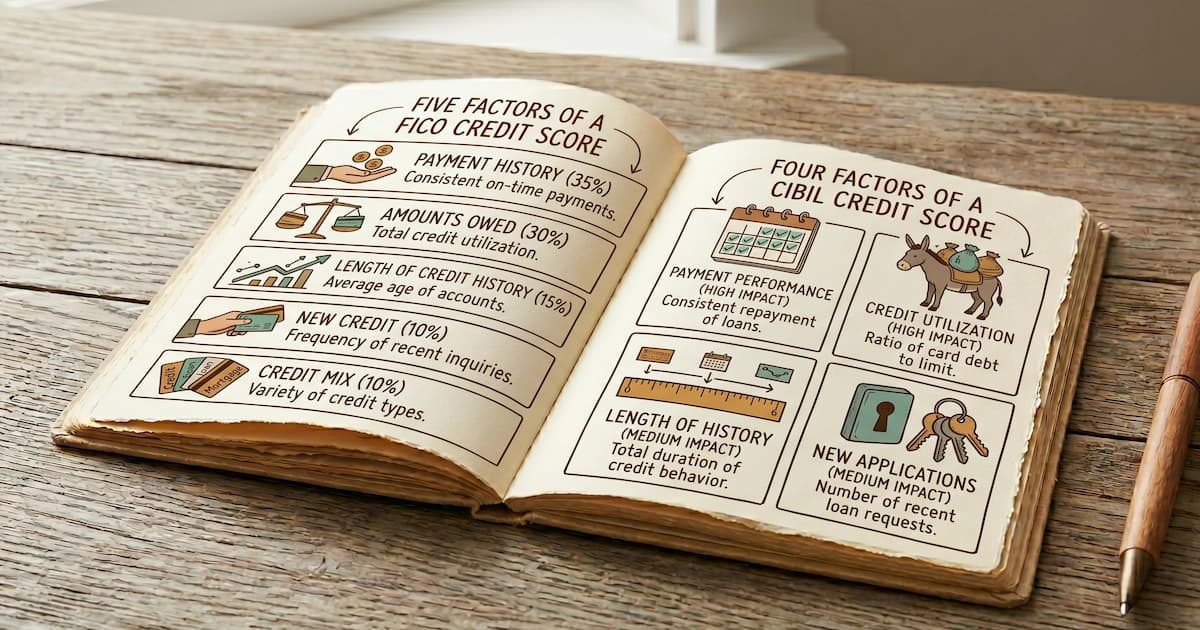
How credit scores are calculated: FICO's five published weights, why CIBIL publishes none, what both models ignore entirely, and what changed in 2026.
15 min read
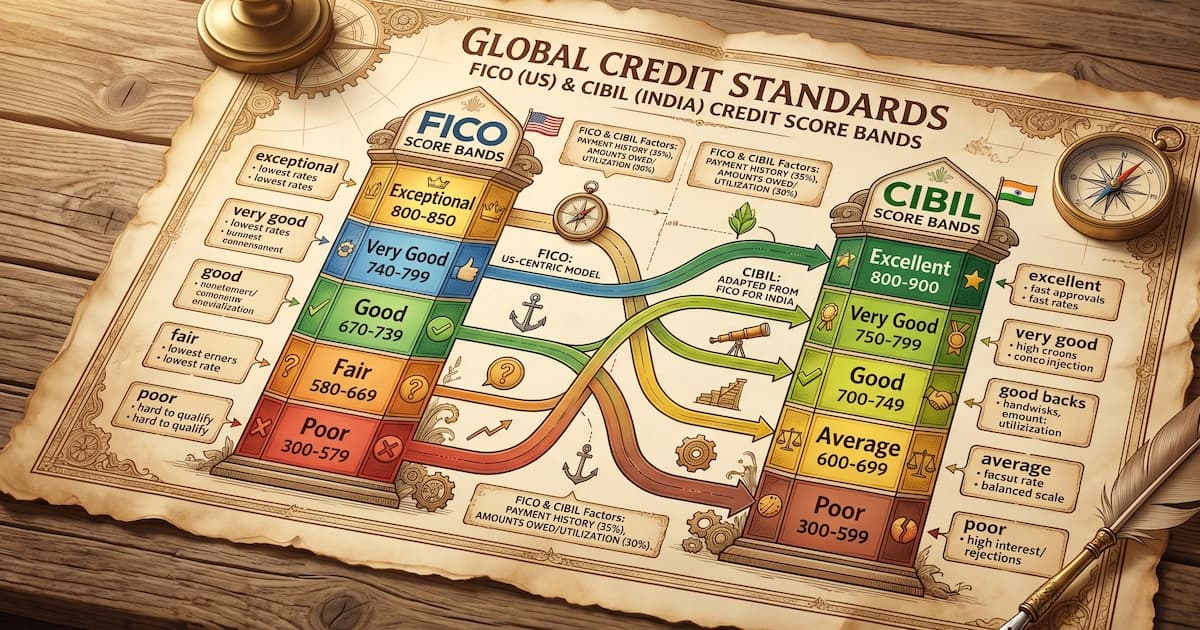
A good credit score is 670+ on FICO (max 850) and 750+ on CIBIL (max 900). See every band, what each one unlocks, and what a good score really saves you.
12 min read

RBI barred pre-payment charges on loans sanctioned from 1 January 2026, but only on floating-rate loans. Most personal loans are fixed, so check which you hold.
14 min read