What Is GDP? Why India's 7.7% and US 2.1% Don't Compare

By Tapabrata Biswas · Updated July 21, 2026 · 11 min read
Written and fact-checked by Tapabrata Biswas. How I write
India's economy grew 7.7%. The US economy grew 2.1%.
Put like that, the comparison writes itself. It is also close to meaningless, because the two figures are built on different clocks.
India's headline is a year-on-year change across an April to March fiscal year. The US headline is a single quarter converted to an annual rate, across a January to December year. One measures twelve months against the twelve before it. The other asks what a year would look like if one quarter's pace continued. They answer different questions, and stacking them side by side compares a distance with a speed.
There is a second thing worth knowing before quoting any Indian GDP number from before 2026. MoSPI replaced the entire series on 27 February 2026, moving the base year from 2011-12 to 2022-23, which changed published values going back to Q1 of FY 2022-23.
So this covers what GDP measures, how it is assembled, why the two countries' headlines differ, and what the number leaves out.
What is GDP?
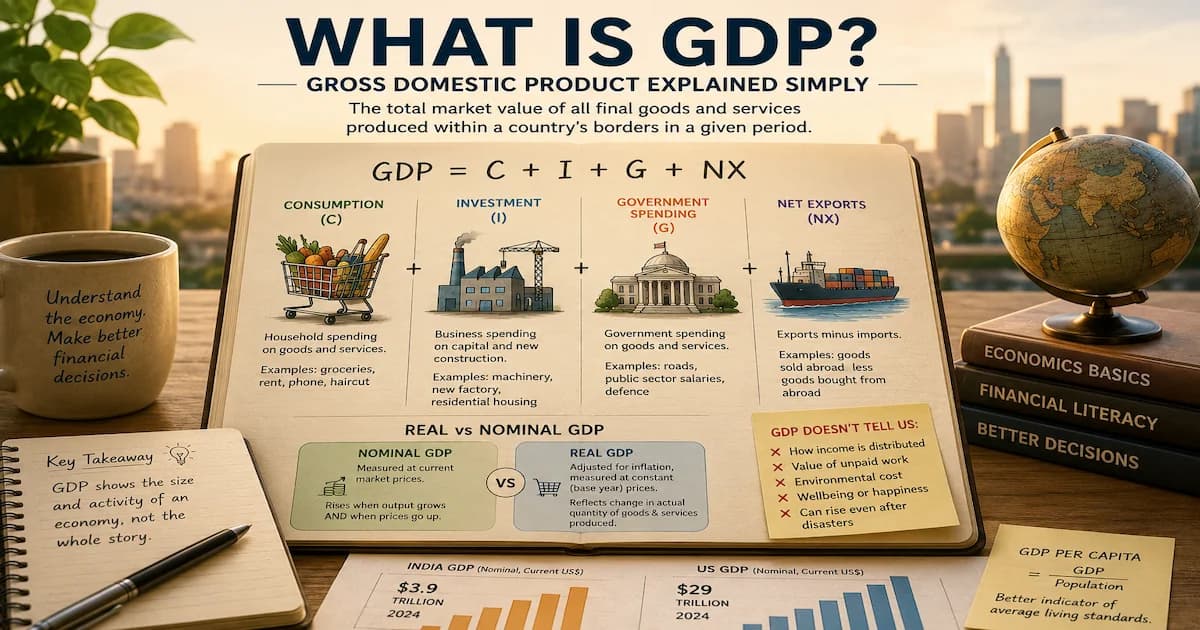
GDP is the total market value of all final goods and services produced within a country's borders during a set period. Two words in that sentence carry most of the weight.
Final means only the finished item counts. The steel inside a car is not added separately to the car, because the steel's value already sits inside the car's price. Counting both would double count the same production.
Within borders means location, not ownership. A foreign company's factory operating in India counts toward India's GDP. An Indian company's factory operating abroad does not. That is the line separating GDP from Gross National Product, which counts by nationality.
The standard expenditure identity adds four buckets:
| Component | What it captures |
|---|---|
| C, consumption | Household spending on goods and services |
| I, investment | Business capital spending and construction |
| G, government | Government spending on goods and services |
| NX, net exports | Exports minus imports |
Household consumption is the largest of the four in both India and the US, which is why consumer spending carries so much weight in reporting on either economy. Several of the terms in that table appear across economic reporting, and our glossary of financial terms covers them individually.
Why don't India's and the US's growth figures compare?
Because one is a year-on-year change and the other is a quarterly rate annualised, over fiscal years that start in different months.
| India, MoSPI | US, BEA | |
|---|---|---|
| Fiscal year | April to March | January to December |
| Headline convention | Year-on-year change | Quarter-on-quarter, seasonally adjusted annual rate |
| The question it answers | How much bigger than the same period last year? | What if this quarter's pace held for a year? |
| Latest headline | 7.7% real growth, FY 2025-26 | 2.1% real growth, Q1 2026 |
| Estimate stage | Provisional Estimates | Third estimate, released 25 June 2026 |
An annualised quarterly rate is volatile by construction, because a single quarter's movement gets multiplied out across a year. US real GDP grew 0.5% in Q4 2025 and 2.1% in Q1 2026 on the same measure, a swing that says as much about the convention as about the economy.
A year-on-year figure smooths that, at the cost of responding more slowly to a turning point. Neither convention is better. They are different instruments, and the error is reading them as though they were the same one.
What is the difference between real and nominal GDP?
Nominal GDP is measured at current prices, so it rises with both output and inflation, while real GDP values output at a fixed base year's prices and isolates the change in quantity.
India's FY 2025-26 figures show the gap in a single pair of numbers:
| Measure | FY 2025-26 level | Growth |
|---|---|---|
| Real GDP, constant prices | ₹323.12 lakh crore | 7.7% |
| Nominal GDP, current prices | ₹345.47 lakh crore | 8.6% |
Roughly a percentage point separates them, and that gap is broadly the effect of rising prices. It is the cleanest available illustration of why inflation has to be removed before output figures mean anything across years, and the same logic that makes inflation erode money's value over time.
When a report says the economy grew by some percentage, it almost always means real GDP.
What changed when India rebased its GDP series?
MoSPI released a new series of annual and quarterly national accounts on 27 February 2026, replacing the base year of 2011-12 with 2022-23.
The stated reason is specific: FY 2022-23 represents a recent normal year after COVID, with comprehensive data available across sectors, which makes it a suitable benchmark.
A base year revision is a different animal from the annual revisions that happen every year. MoSPI draws the line itself. In an annual revision, changes come only from updated data becoming available, with no change to the conceptual framework or data sources, so the series stays strictly comparable across years. In a base year revision, the framework and the sources change too.
Three consequences follow, and none of them appears in the explainers we read.
Published quarterly values changed back to Q1 of FY 2022-23, with consequential changes to growth rates from Q1 of FY 2023-24 onwards. A quarterly figure quoted from the old series is not comparable with the new one.
The deflation method changed. Manufacturing moved to double deflation, where inputs and outputs are deflated separately, while other sectors use single or volume extrapolation with item-level WPI and CPI. Deflation is how nominal converts to real, so this alters the real growth rate itself rather than only the levels.
The back series is a separate release. Recasting years before FY 2022-23 onto the new base is scheduled independently of the main release, which means the long historical run on the new basis arrives later than the new numbers themselves.
Do GDP numbers get revised?
Routinely, and in both countries, because early estimates extrapolate from indicators while later ones incorporate actual returns.
India's own FY 2025-26 figure moved between releases. The Second Advance Estimates of 27 February 2026 put real GDP growth at 7.6%, on a level of ₹322.58 lakh crore. The Provisional Estimates that followed put it at 7.7%, on ₹323.12 lakh crore.
The US builds the revision into its publishing schedule outright, issuing an advance, a second and a third estimate of every quarter as source data arrives. The 2.1% for Q1 2026 is the third of those, released 25 June 2026.
The practical reading is that a GDP headline on release day is a first estimate and never a final measurement. Treating one as final, or reading a tenth of a percentage point as meaningful, asks more of the number than it can carry.
What this post deliberately does not cover
This explains what GDP measures, how the two countries' headline conventions differ, and what a base year revision changes. It offers no forecast of where either economy is headed and draws no conclusion about which economy is performing better, because the headline figures compared here are measured on different bases.
Several things sit outside GDP by construction, and knowing which ones matters as much as the definition. GDP omits unpaid work such as caregiving and housework. It records no measure of how output is distributed, so growth is compatible with widening inequality. It carries no environmental cost. And it can rise after a disaster, because rebuilding counts as production while the destruction itself does not subtract. GDP per capita, which divides output by population, gets closer to an average but still says nothing about distribution.
Two limits on the figures. Every number here carries its release stage and date, because estimates get revised and Indian figures published before 27 February 2026 sit on a different base year. And nothing here should be read as a signal about any investment, since the relationship between GDP prints and asset prices is not the subject of this post.
Frequently asked questions
Can you compare India's GDP growth with US GDP growth directly? Not from the headline numbers alone, because the two are built differently. India's headline growth is a year-on-year comparison, measuring a quarter or a full fiscal year against the same period twelve months earlier, over an April to March year. The US headline is a quarter-on-quarter change converted to a seasonally adjusted annual rate, which answers what growth would be if that single quarter's pace held for a year, over a January to December year. So India's 7.7% for FY 2025-26 and the US 2.1% for Q1 2026 measure different spans on different clocks. The gap between the two economies is real, but the headline figures are not a like-for-like measurement.
What is GDP in simple terms? GDP is the total market value of all final goods and services produced within a country's borders during a set period. Two words in that sentence carry most of the weight. Final means only the finished item counts, so the steel inside a car is not added separately to the car itself, which avoids double counting. Within borders means location and not ownership, so a foreign company's factory operating in India counts toward India's GDP while an Indian company's output abroad does not.
What is the difference between real and nominal GDP? Nominal GDP is measured at current prices, so it rises when output grows and also when prices rise. Real GDP values output at the prices of a fixed base year, which strips the price change out and leaves the change in actual quantity. The gap between the two is roughly the effect of inflation, and India's figures for FY 2025-26 show it plainly: real GDP grew 7.7% while nominal GDP grew 8.6%. When a report says the economy grew by some percentage, it almost always means real GDP.
Why did India change its GDP base year to 2022-23? MoSPI released a new series of annual and quarterly national accounts on 27 February 2026, moving the base year from 2011-12 to 2022-23. Its stated reason is that FY 2022-23 represents a recent normal year after COVID with comprehensive data available across sectors, making it a suitable benchmark. A base year revision differs from a routine annual revision because it changes the conceptual framework and brings in new data sources, where an annual revision only incorporates updated data. The practical effect is that published quarterly values changed back to Q1 of FY 2022-23, so a figure quoted from the old series is not comparable with the new one.
Do GDP figures get revised after publication? Routinely, and in both countries. India's estimate of FY 2025-26 real GDP growth was 7.6% in the Second Advance Estimates of February 2026 and 7.7% in the Provisional Estimates that followed. The US publishes three estimates of each quarter, an advance, a second and a third, as more source data arrives. Early figures are built by extrapolating from indicators and later ones incorporate actual returns, which is why a headline reported on release day is a first reading and not a final measurement.
Does rising GDP mean people are better off? Not on its own, because GDP measures the value of output and says nothing about how that output is shared. It omits unpaid work such as caregiving and housework, ignores the distribution of income, carries no measure of environmental cost, and can rise after a disaster because rebuilding counts as production. Growth usually accompanies more activity, more jobs and more income, which tends to move alongside living standards. GDP per capita, which divides total output by population, gets closer to an average but still reveals nothing about inequality.
Sources
-
Ministry of Statistics and Programme Implementation, New Series of Gross Domestic Product Estimates with Base Year 2022-23, 27 February 2026 (the move from base year 2011-12 to 2022-23 and the reason given, the distinction between base year and annual revisions, the change to published quarterly values back to Q1 FY 2022-23, the revised deflation strategy including double deflation for manufacturing, the separate scheduling of the back series, and the Second Advance Estimates of 7.6% real and 8.6% nominal growth on levels of ₹322.58 lakh crore and ₹345.47 lakh crore) pib.gov.in
-
Ministry of Statistics and Programme Implementation, Press Note on Provisional Estimates of Annual GDP for FY 2025-26 and Q4 2025-26 (real GDP growth of 7.7% for FY 2025-26 against 7.1% in 2024-25, on a level of ₹323.12 lakh crore) mospi.gov.in
-
Bureau of Economic Analysis, Gross Domestic Product (real GDP growth of 2.1% in Q1 2026 in the third estimate released 25 June 2026, growth of 0.5% in Q4 2025, and the advance, second and third estimate publication sequence) bea.gov



You might also like

What is inflation? A plain-English explanation of how prices rise, how it is measured, and what it actually means for everyday savings, wages, and debt.
11 min read

At 4.38% inflation and 2.70% savings interest, Rs 1,00,000 loses Rs 14,978 of buying power over ten years. What inflation does to cash, pay and debt.
10 min read

What is financial literacy? A plain-English explanation of the skill that helps people make informed money decisions. No jargon, no advice, just clear research.
11 min read