Money Saving Challenges 2026: 10 That Build Habits

By Tapabrata Biswas · Published May 10, 2026 · 11 min read
Researched with AI assistance, reviewed and edited by Tapabrata Biswas.

The 52-week money challenge produces $1,378 by year-end. The 100-envelope challenge produces $5,050 in 100 days. A 30-day no-spend challenge frees up $200-$800 in a single month for most beginners who run it. The numbers are predictable because the structures are predictable, and that's what separates a money-saving challenge from a vague "I should save more" intention.
Money saving challenges have become a staple of personal finance content for a reason: they work for many households where open-ended "save more money" advice doesn't. The structural feature that makes them work is straightforward. They convert saving from an indefinite lifestyle change into a discrete project with a clear start, end, and target. Most people can sustain a 30-day commitment when they can't sustain an indefinite one.
The challenge format is also flexible. Different challenges suit different goals (building a habit, hitting a specific savings number, breaking an overspending pattern, gamifying frugality).
Why challenges work when resolutions don't
Behavioural research on goal-setting finds that two structural features predict whether a financial commitment is sustained.
The first is a defined endpoint. Open-ended commitments ("I'll save more this year") have no natural milestone where success or failure is evaluated. Time-bounded commitments ("I'll save $X by date Y") have built-in evaluation points that maintain motivation.
The second is a specific daily or weekly action. Vague commitments ("be better with money") don't translate into specific behaviours. Concrete actions ("transfer $25 to savings every Friday") do.
Money saving challenges combine both: a defined timeframe (one week to one year) and a specific action (a known amount or rule). The combination is why a household that has tried and failed to "save more" repeatedly can succeed at a 52-week challenge or a 30-day no-spend.
Researchers at the Consumer Financial Protection Bureau have documented in their 2022 Financial Well-Being in America report that households who maintain explicit savings goals, which includes most people doing challenges, score higher on financial well-being measures than those who save without a target. The Federal Reserve's 2023 Economic Well-Being of U.S. Households report found 37% of adults could not cover an unexpected $400 expense from cash, a gap that even a 100-day $1,000 challenge fully closes.
Challenge 1: the 52-week money challenge
Save $1 in week one, $2 in week two, $3 in week three, escalating by $1 each week. By week 52, you save $52. Total saved across the year: $1,378.
Best for beginners. The first weeks are nearly frictionless, and the visible weekly progress builds the habit. Watch out for the back half of the year, which requires substantially more saving per week. Many participants drop off in months 9-12 as the weekly amount grows. Variations exist where you reverse the order ($52 in week 1, $1 in week 52) to front-load the difficulty when motivation is highest.
We cover this challenge in detail in the 52-week money challenge explained.
Challenge 2: the no-spend challenge
For a defined period (most often 30 days, sometimes a week or 90 days), spend nothing on a defined category: usually discretionary spending (entertainment, eating out, non-essential shopping). Essentials (rent, utilities, groceries, healthcare) continue normally.
Best for households recovering from a spending burst (post-holiday, post-vacation) or trying to break a specific category habit (eating out, online shopping). Watch out for "essentials", the category needs to be defined clearly in advance, or it expands during the challenge. Strict no-spend challenges often produce a rebound spending spike after the challenge ends; building a habit from the experience matters more than the savings during the month.
Covered in detail in the no-spend challenge explained.
Challenge 3: the round-up challenge
Round every purchase up to the nearest dollar (or $5) and transfer the difference to savings. A $4.27 coffee triggers a $0.73 transfer; a $23.49 grocery bill triggers a $0.51 transfer.
Best for households who do most spending electronically. Many banks and apps automate this: Bank of America's Keep the Change, Acorns, and Chime's Save When You Spend all implement variations. Watch out for the small dollar amounts ($20-$60/month for typical spending): useful for habit-building but not enough on their own to build an emergency fund quickly. Best paired with a larger primary savings strategy.
Challenge 4: the 100-envelope challenge
Number 100 envelopes 1 through 100. Each day for 100 days, randomly draw one envelope and put that dollar amount in it. After 100 days, the envelopes contain $5,050.
Best for households who can sustain the gamification energy and have $5,050 to deploy across 100 days (about $50/day on average). Watch out for the cash flow requirement, roughly $1,500/month in dedicated savings during the challenge isn't feasible for many household budgets. The variation that draws random numbers from a smaller range ($1-$25) produces lower totals but is more accessible.
Challenge 5: the 30-30-30 challenge
For 30 days, do 30 minutes of financial review per week and reduce 30 specific spending decisions by deferring them or skipping them. The "30 reductions" is the structural pattern; the financial review is the awareness layer.
Best for households who want a habit-building challenge that focuses on awareness and small decisions rather than a fixed dollar amount. Watch out for the looser definition. It's less defined than dollar-amount challenges. Works best when paired with tracking spending so the 30 deferred decisions are visible.
Challenge 6: the pantry challenge
For one to four weeks, eat exclusively from food already in your pantry, freezer, and refrigerator. Buy only fresh produce, dairy, and absolute essentials. The goal is to use up the food you already paid for and identify the categories where your grocery shopping was overstocked.
Best for households whose pantries are full of items that aren't being used. The pantry challenge almost always reveals significant existing food value that wasn't being deployed. Watch out for the planning required to ensure you don't end up eating poorly. Best done over 2-3 weeks rather than a month for most households.
Challenge 7: the $1,000 in 100 days challenge
Save $10 per day for 100 days, in cash or by transfer. Total: $1,000. Variations include $5/day for 200 days or $20/day for 50 days, depending on the household's monthly cash flow.
Best for households building a starter emergency fund. The daily framing makes it more concrete than "save $300/month." Watch out for what $10/day really means, roughly the cost of a daily lunch out, making the challenge effectively an "eat lunch at home" challenge for many households. That's not a problem; it's the explicit trade-off the challenge surfaces.
Challenge 8: the spare change jar (analog version)
Every coin and bill under $5 that comes through your possession goes into a designated jar. At the end of the year, the jar gets deposited into savings.
Best for households who use cash regularly. The visible accumulation creates motivation; most participants report saving $300-$800 in a year without ever feeling like they cut spending. Watch out for the limitation: irrelevant for cashless households. The all-electronic version is the round-up challenge (#3 above).
Challenge 9: the bi-weekly $20 challenge
Every payday (every two weeks for most US workers, monthly for most Indian salaried workers), transfer $20 (or ₹500) to savings before any other transactions. Total over a year: $520 in the US case, ₹12,000 in the India case.
Best for households who want the simplest possible challenge to start the saving habit. The amount is small enough to be sustainable for almost any household with employment income. Watch out for the modest scale: $520/year alone won't move the needle on major financial goals. The point is the habit, which can scale up after the first successful year.
Challenge 10: the percentage challenge
For one year, transfer 1% of every paycheck to savings the moment it lands. A $2,000 paycheck triggers a $20 transfer; a $3,500 paycheck triggers a $35 transfer. After 90 days, increase to 2%. After 180 days, 3%. After 270 days, 4%. By year-end, you're saving 5% per paycheck.
Best for households who want to gradually build to a meaningful savings rate without shock. Aligns naturally with the pay yourself first method. Watch out for the gradual increases: many participants stall at 2% and don't continue stepping up.
How to choose a challenge
The ten challenges side-by-side, with totals and the rough monthly cash flow each requires:
| Challenge | Duration | Total saved | Monthly cash flow needed |
|---|---|---|---|
| 52-week | 12 months | $1,378 | $115 average (1¢-$52/week) |
| No-spend (30-day) | 30 days | $200-$800 | $0: cuts existing spend |
| Round-up | Ongoing | $20-$60/month | Whatever you spend |
| 100-envelope | 100 days | $5,050 | ~$1,500/month |
| 30-30-30 | 30 days | varies | $0: awareness focus |
| Pantry | 1-4 weeks | $200-$600 | -$200/wk grocery savings |
| $1,000 in 100 days | 100 days | $1,000 | $300/month |
| Spare-change jar | 12 months | $300-$800 | Cash users only |
| Bi-weekly $20 | 12 months | $520 | $40/month |
| Percentage (1%→5%) | 12 months | 3% of net annual | Scales with income |
Three questions settle the choice for most beginners.
The first: are you trying to build a habit or hit a specific number? Habit-building points to the 52-week challenge, percentage challenge, or bi-weekly $20. Specific number points to the no-spend challenge, $1,000 in 100 days, or 100-envelope challenge.
The second: how much discretionary income do you have for saving? Less than $50/month suits the bi-weekly $20, round-up challenge, or 52-week challenge. $50-$200/month suits the no-spend challenge or $1,000 in 100 days. More than $200/month opens up the 100-envelope or percentage challenge ramping up.
The third: how much friction can you sustain? Low (set it and forget) suits the percentage challenge or round-ups. Medium (weekly action) suits the 52-week or $1,000 in 100 days. High (daily action) suits no-spend or pantry challenge.
Common challenge mistakes
Four patterns trip people up regularly.
The first is starting too aggressively. Picking the most ambitious challenge first produces collapse by week 3 for most beginners. Start small; layer up after success.
The second is not transferring savings to a separate account. If the saved money sits in checking, it gets re-spent. The whole point is to make the savings physically separate from spending money.
The third is stacking multiple challenges simultaneously. Each additional challenge multiplies the discipline cost and one bad week collapses everything.
The fourth is not having a plan for when the challenge ends. Many participants do well during the challenge and then revert immediately afterward. The challenge's value is the habit it builds; if there's no plan to continue some version of the behaviour, the gains are temporary.
What experts say
Investopedia's overview of the 52-week challenge provides background on the most popular specific challenge.
The Consumer Financial Protection Bureau's emergency fund guide covers the structured-savings principle that underlies most challenges, even if the CFPB doesn't promote any specific challenge by name.
For the deep dive on the specific challenges referenced above, see the 52-week money challenge explained and the no-spend challenge explained. For the broader budgeting framework that makes savings persistent rather than challenge-based, see our zero-based budgeting piece.
Frequently asked questions
What is a money saving challenge? A money saving challenge is a structured short-term commitment, usually 1 to 12 months, to save a specific amount, follow a specific saving rule, or change a specific spending behaviour. The structure provides external accountability that pure willpower-based saving often lacks. Most challenges produce $500 to $1,500 in additional savings over the challenge period.
Do money saving challenges actually work? Yes, but for a specific reason: they make saving a discrete project with a defined end date rather than an open-ended lifestyle change. Behavioural research repeatedly finds that time-limited commitments are easier to sustain than indefinite ones, and the savings produced during a challenge often persist as a new baseline after the challenge ends.
Which money saving challenge is best for beginners? The 52-week money challenge or a 30-day no-spend challenge are the most beginner-friendly because both have clear daily/weekly actions and visible progress. The 52-week challenge requires only $1 of saving in week one, which makes starting almost frictionless. A 30-day no-spend challenge produces immediate visible savings within a single month.
Should I do multiple money saving challenges at once? Generally no, particularly for first-time challengers. Stacking challenges multiplies the discipline cost, and one bad week tends to collapse all of them simultaneously. After completing one challenge successfully, layering a second one becomes more sustainable. Sequential challenges produce better long-term outcomes than simultaneous ones.
In summary
Money saving challenges work because they convert open-ended saving advice into discrete time-bounded projects with clear daily or weekly actions. Ten established challenges suit different households and goals: beginners benefit most from the 52-week or no-spend challenges; habit-building works best with percentage challenges and round-ups; specific savings targets pair well with the $1,000 in 100 days or the 100-envelope challenge. The structural insight is the same across all of them: the saving happens because the framework removes the daily decision and not requiring willpower for it.
Pick one challenge, not three, and commit for its full duration. The completion is what builds the habit that persists afterward, and that habit is worth more than the dollars saved during the challenge itself.
Challenges pair well with a regular budget, so it's worth a look at how each budgeting method works to hold the savings you build.
Sources
- Investopedia, 52-Week Money Challenge: investopedia.com/terms/1/52-week-money-challenge.asp
- Consumer Financial Protection Bureau, An Essential Guide to Building an Emergency Fund: consumerfinance.gov/an-essential-guide-to-building-an-emergency-fund
- Consumer Financial Protection Bureau, Financial Well-Being in America: consumerfinance.gov/data-research/research-reports/financial-well-being-america



You might also like

Save a rising amount each week for a year. The correct rupee and dollar totals, the December and Diwali collision nobody flags, and what it adds up to.
9 min read

The rules of a no-spend challenge, what counts as essential, the benefits beyond the savings figure, and the rebound trap that catches most people.
11 min read
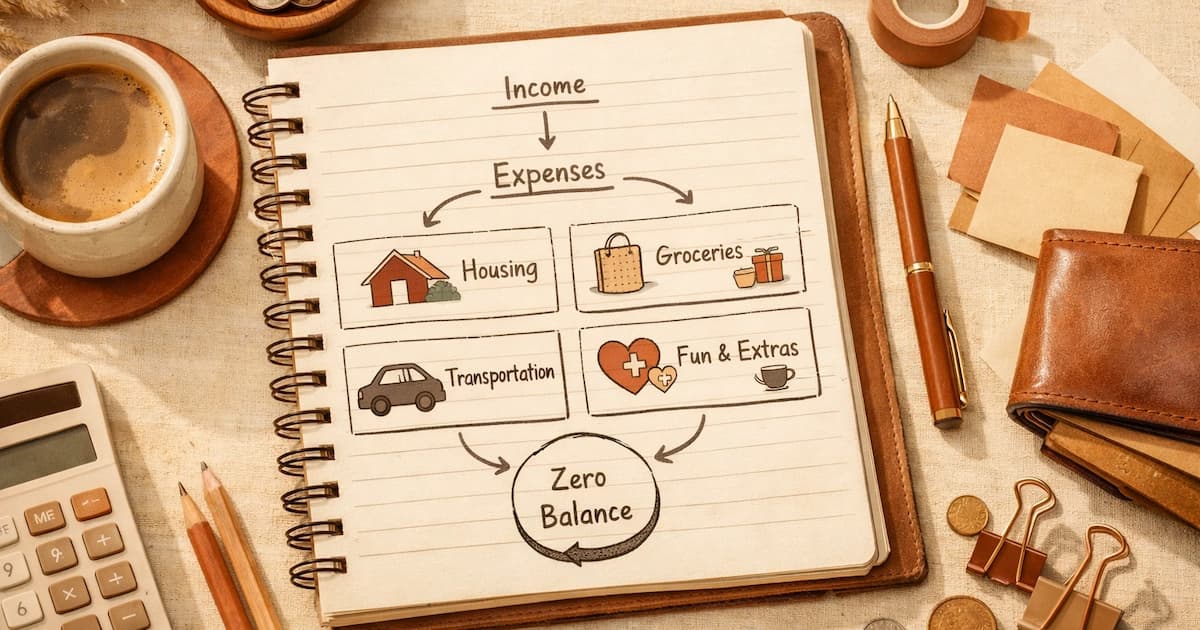
Give every rupee a job until income minus spending is zero. The five steps, a worked example in rupees and dollars, and where it breaks down.
14 min read